
Why Do People Wear Hats to Horse Races?
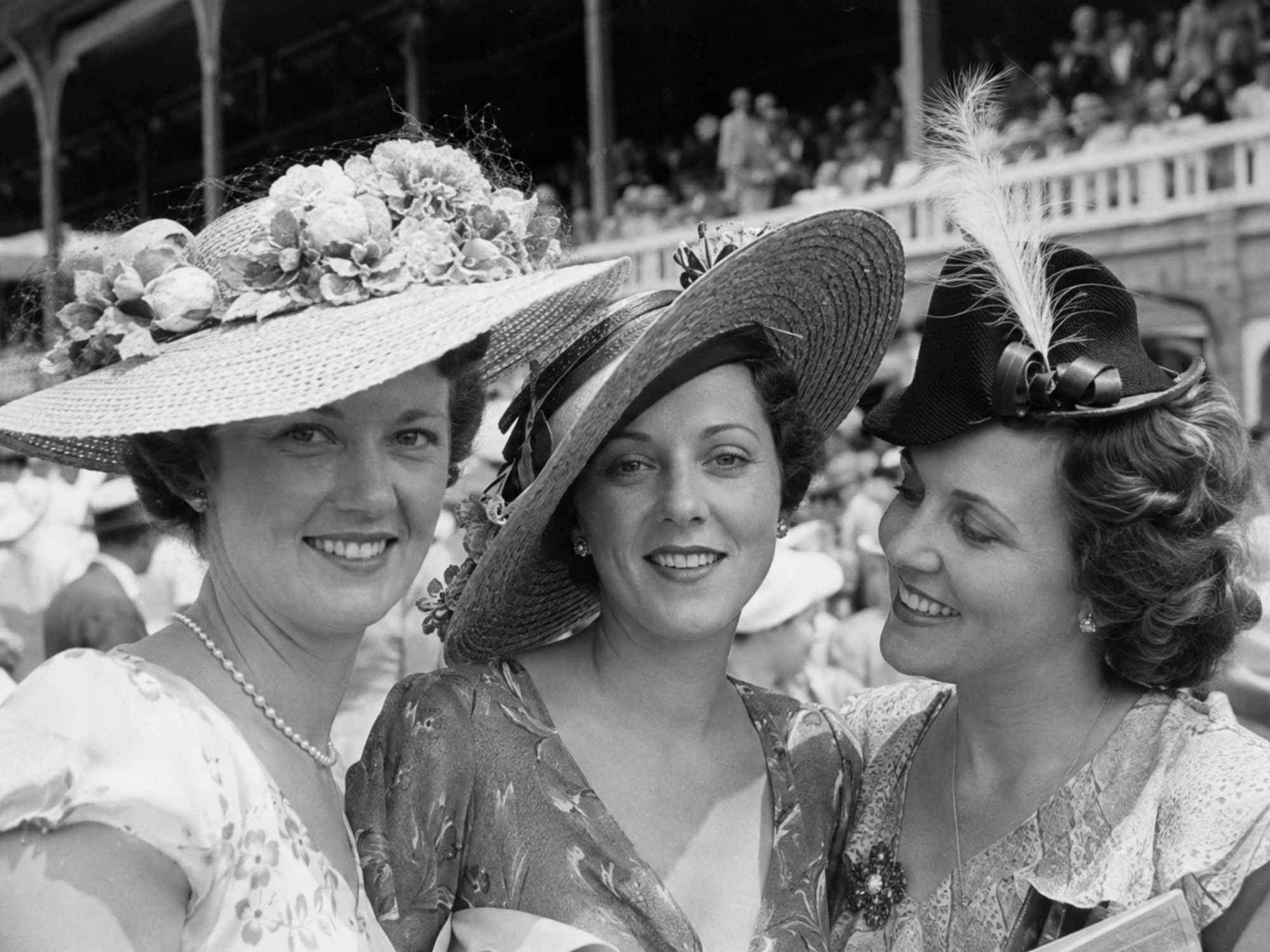
Three racegoers gather beneath the grandstand at Saratoga Race Course. Elaborate hats made race day as much a public spectacle as a sporting event. A Ball Club Register historical reconstruction.
How Saratoga Race Course turned summer fashion into part of the sport
The horses were not the only things being studied at Saratoga.
From the grandstand, spectators examined the field moving toward the starting line. They compared bloodlines, trainers, jockeys and the condition of the track. Between races, however, attention returned to the people around them.
Who had arrived from New York? Who was staying at the Grand Union? Who had been invited into the clubhouse? Who was dining with whom that evening?
And, inevitably, what was everyone wearing?
At Saratoga Race Course, a hat could provide shade from the August sun. It could also identify its wearer as someone who understood the occasion. Brims, ribbons, feathers and flowers appeared beneath the grandstand alongside straw boaters, Panamas and felt hats. Styles changed, but the expectation endured.
Race day was a sporting event and a public performance.
People came to watch the horses. They also came to watch one another.
Before the Race Course
Saratoga Springs was fashionable before it was famous for thoroughbred racing.
Its first attraction came from the ground. Naturally carbonated mineral springs had been visited for centuries, and by the beginning of the nineteenth century, promoters were building hotels and bathhouses around their supposed curative powers.
Visitors drank the water, bathed in it and carried bottles home. Physicians prescribed different springs for different ailments. Hotels advertised rest, restoration and relief from the heat and congestion of growing American cities.
The waters provided a respectable reason to travel. Everything built around them supplied reasons to remain.
Gideon Putnam opened an early boarding house near Congress Spring in 1802 and began constructing Union Hall the following year. As transportation improved, Saratoga developed into a seasonal resort of national importance. Hotels expanded until they contained hundreds of rooms. Dining halls, verandas, gardens and parlors accommodated a summer population far larger than the town ordinarily supported.
By the middle of the nineteenth century, Saratoga offered two experiences at once.
It was a health resort where visitors could follow a regimen of mineral water, bathing, walking and rest. It was also a place of dinners, dancing, gambling and display.
The contradiction became part of its appeal.
A visitor could arrive for the waters and discover nearly every form of diversion that fashionable society permitted. Morning might begin at one of the springs. The afternoon could be spent driving, visiting or listening to music. Dinner was followed by dancing, cards and conversation beneath hotel chandeliers.
The season developed its own social rhythm. Guests returned at approximately the same time each year. Families recognized one another on hotel verandas. Business relationships, political alliances and courtships moved forward in rooms presented as places of leisure.
Saratoga was becoming a stage before anyone built the Race Course.
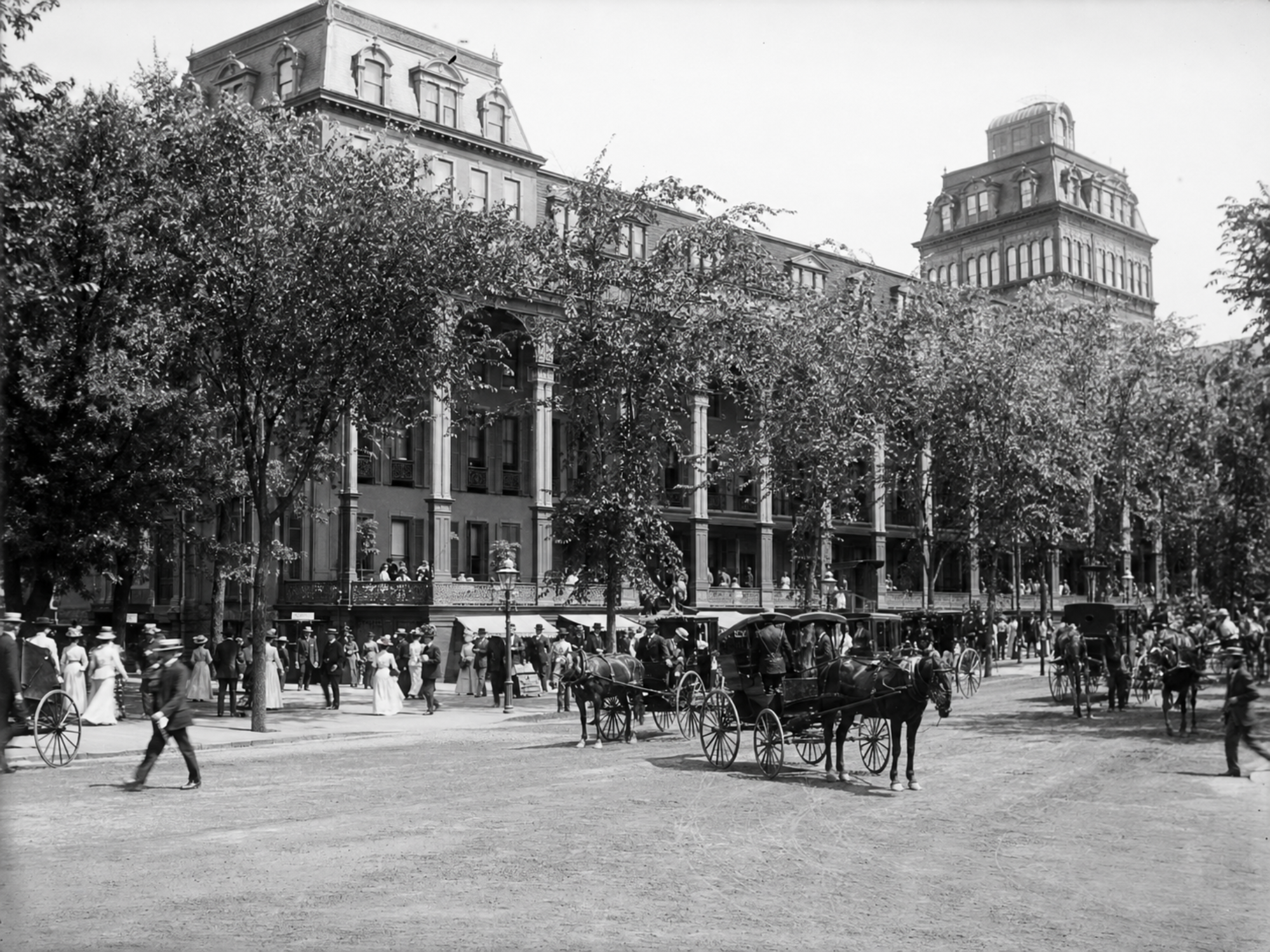
Guests and horse-drawn carriages gather outside the Grand Union Hotel during Saratoga’s summer season, circa 1898. The immense Broadway resort stood at the center of the city’s fashionable social life. A Ball Club Register historical reconstruction.
Four Days in August
John Morrissey understood what the city was missing.
Morrissey had been a bare-knuckle boxing champion, gambling-house proprietor and political operator. He would later serve in Congress and the New York State Senate. In Saratoga, he recognized that a large summer population with money, leisure and an appetite for wagering could support a first-class thoroughbred meeting.
On August 3, 1863, barely a month after the Battle of Gettysburg, Morrissey opened a four-day racing program at the existing trotting grounds on Union Avenue.
The timing was audacious.
The Civil War continued, but many Southern race meetings had been disrupted, leaving owners, horses and racing followers in search of alternatives. Saratoga was sufficiently removed from the front and already equipped to receive visitors. Its hotels, rail connections and reputation for gambling made it a natural gathering place.
The experiment succeeded.
The following year, Morrissey and his associates opened a larger course across Union Avenue. William R. Travers, John Hunter and Leonard Jerome were among the prominent figures involved in the new association. The first Travers Stakes was run there in 1864 and named for Travers, the organization’s first president.
Thoroughbred racing did not create Saratoga’s summer society. It gave that society a common destination every afternoon.
Hotel verandas emptied toward the course. Carriages moved along Union Avenue. Owners, trainers, bookmakers, politicians, businessmen and curious vacationers gathered around the same grounds.
The Race Course concentrated the social season into a few hours.
That concentration changed the importance of what people wore.
The Grandstand as Theater
Nineteenth-century spectators did not invent the idea of dressing for the races. British race meetings had long combined sport, society and fashion, with Royal Ascot providing the most influential example.
American courses adapted those customs to their own cities and climates. Formality varied by location and by enclosure, but the principle remained recognizable: an important racing date was an occasion.
At Saratoga, the setting intensified that expectation.
The city already attracted wealthy and socially ambitious visitors. Racing brought them together in daylight, where clothing could be observed in a way it could not inside a dim ballroom or crowded dining room. The grandstand placed hundreds of people in ascending rows, each visible to those above, below and across the aisle.
The clubhouse and private boxes created additional distinctions. Admission placed a spectator inside the grounds, but one’s location within them could still communicate status, access and connection.
Dress participated in the same system.
A carefully chosen hat showed that the wearer understood the setting. A new hat suggested the season mattered enough to justify the expense. A restrained one could signal confidence just as effectively as an elaborate arrangement of flowers or feathers.
Newspapers reported on notable visitors and summer society. Hotel arrivals became news. So did dinners, dances and appearances at the course. The races supplied the event around which all that observation could organize itself.
The horses carried stable colors.
The crowd carried its own.
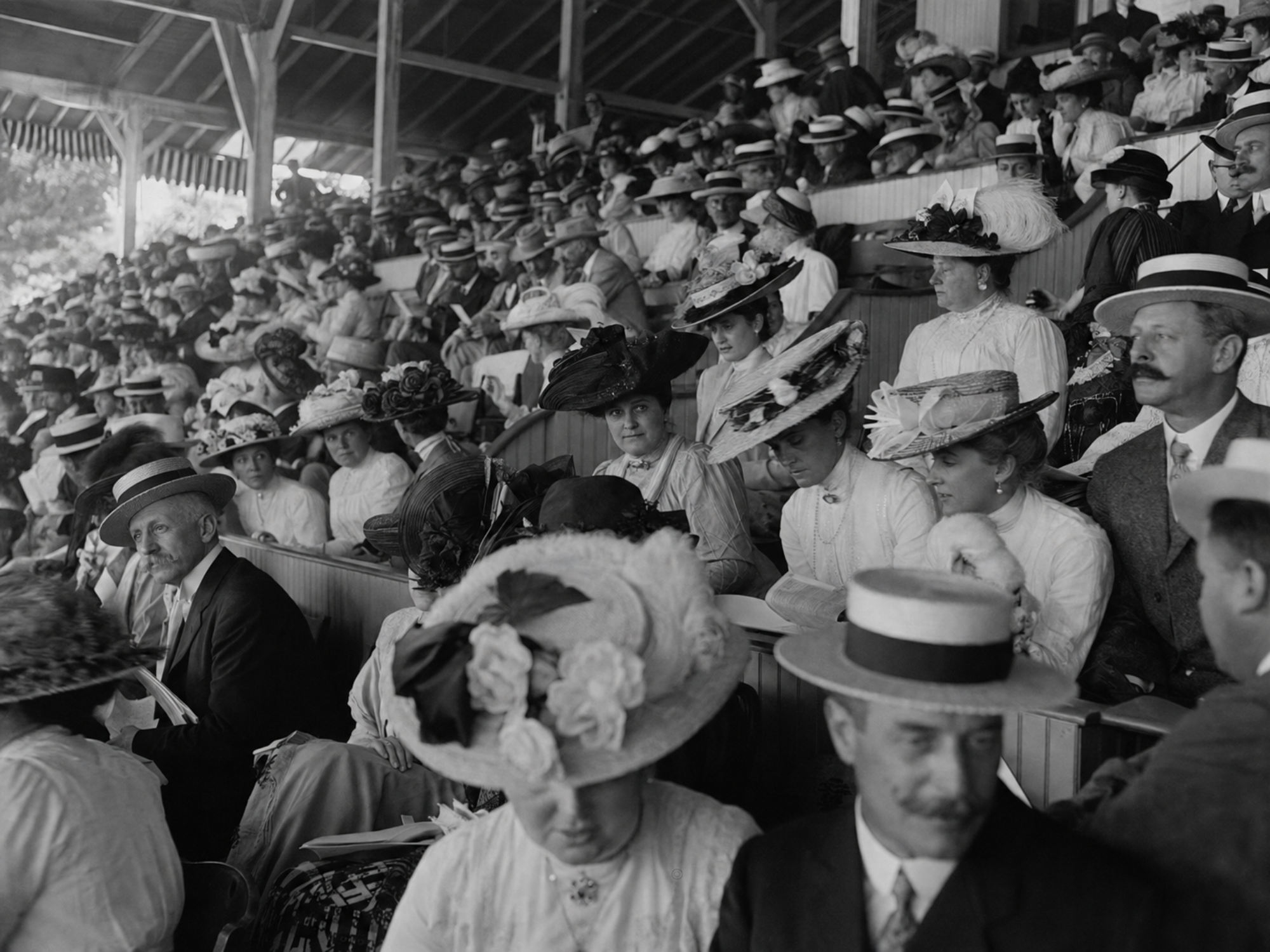
Spectators fill the grandstand at Saratoga Race Course, circa 1910. Picture hats, flowers, feathers, boaters and Panamas turned the crowd itself into part of the afternoon’s spectacle. A Ball Club Register historical reconstruction.
Why Hats Belonged at the Races
The simplest explanation for the horse-racing hat tradition is that people once wore hats almost everywhere in public.
For much of the nineteenth and early twentieth centuries, a properly dressed man or woman ordinarily left home with some form of head covering. A racing crowd naturally reflected the standards of the society from which it came.
The racecourse added several practical and social reasons for making the hat especially important.
First, racing took place outdoors.
Even beneath a covered grandstand, spectators moved through open entrances, lawns, paddocks and betting areas. A brim provided protection from the summer sun. At Saratoga, where the meeting occupied some of the hottest weeks of the year, that function mattered.
Second, the hat completed the silhouette.
Women’s clothing was designed as an ensemble in which the headwear balanced the proportions of the dress, coat or suit. A hat was not necessarily an optional ornament added at the end. It could determine whether the entire appearance felt formal, fashionable or incomplete.
Men followed their own conventions. Straw boaters and Panamas suited summer afternoons. Derbies, homburgs and other felt hats appeared as weather and fashion changed. Removing or replacing a hat could alter the formality of an outfit as clearly as changing a coat.
Third, the racecourse encouraged display.
Racing compressed a city’s most visible visitors into one place. A distinctive hat could be recognized from several rows away. It framed the face, added height and allowed color or movement to enter an outfit without requiring an unconventional dress.
Feathers moved in the breeze. Ribbons could reproduce the colors of a stable. Flowers connected race day to the gardens and floral decorations of the resort.
The hat was useful because everyone could see it.
That visibility helped racing preserve the tradition even after headwear began disappearing from ordinary American life. By the second half of the twentieth century, hats were no longer required for most daily public appearances. At the races, their increasing rarity elsewhere made them feel even more special.
What had once been routine became ceremonial.
From Picture Hats to Cloches
There has never been one standard horse-racing hat.
During Saratoga’s rise in the late nineteenth century, women’s hats could be substantial constructions of straw, felt, velvet or silk decorated with ribbon, flowers, lace and feathers. Styles responded to changing hairstyles and dress silhouettes. Some sat high on the head. Others extended outward with broad brims.
Near the turn of the twentieth century, the large picture hat became especially suited to public occasions. Its broad brim framed the face and created a dramatic profile. Trimming could be restrained or abundant, depending on the wearer, the year and the resources available.
The scale presented occasional difficulties in a grandstand. A fashionable hat was designed to be noticed, not necessarily to improve the view of the person seated behind it.
The First World War and the changing social life that followed altered women’s clothing. Hair became shorter. Skirts rose. Dresses became less structured. Hats moved closer to the head.
The cloche became one of the defining shapes of the 1920s.
Usually made of felt or fabric and pulled low over the forehead, the cloche surrounded the head like a bell. Its close shape complemented bobbed hair and the straighter silhouette associated with the decade. Decoration was incorporated through bands, pleating, embroidery, pins, feathers or asymmetrical details rather than the towering arrangements of an earlier generation.
At Saratoga, the cloche brought modern city fashion into an old resort setting.
By the 1930s, hats began moving upward and sideways again. Brims returned in varying widths. Crowns softened. Toques, turbans and tilted hats allowed the face to become more visible. Small hats could perch at an angle, held in place with hatpins or fitted carefully around the hairstyle. Veils, bows and feathers provided movement without recreating the enormous dimensions of the Edwardian period.
A photograph of the Saratoga grandstand therefore records more than attendance at a race. The shapes above the crowd can often place the scene within a particular decade.
The hats changed because the people wearing them changed.
The ritual survived because Saratoga did not.
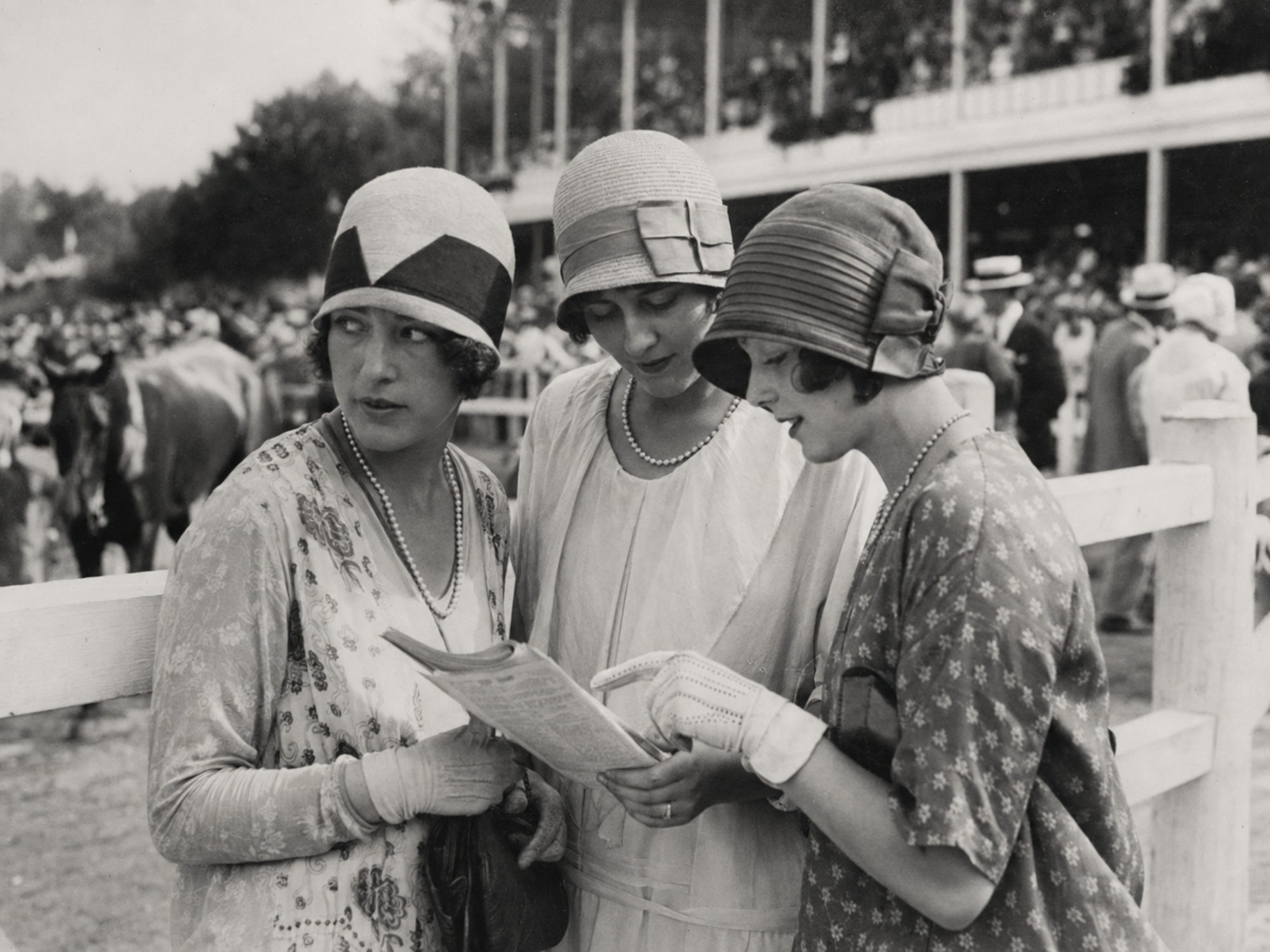
Three racegoers study the day’s program beside the Saratoga paddock, circa 1927. Their close-fitting cloche hats reflected the cleaner, more compact silhouette of the new decade. A Ball Club Register historical reconstruction.
What Was a Fascinator?
The word “fascinator” is older than the headpiece now associated with horse racing.
During the nineteenth century, a fascinator was a lightweight covering worn by women around the head and sometimes the neck. It could be knitted, crocheted or made from delicate lace or net. Some resembled loose hoods. Others were closer to scarves, arranged over the hair and tied or wrapped for warmth and modesty.
The original fascinator had no stiff crown and little resemblance to the decorative pieces worn at modern racing events. It was valued for softness and lightness. A woman might wear one while traveling, attending an evening entertainment or leaving a formal gathering when a heavier bonnet was unnecessary.
That version of the fascinator was fading from fashion by the early twentieth century, although the term remained recognizable.
The modern object came later.
Small cocktail hats and close ornamental headpieces appeared during the middle decades of the twentieth century, but “fascinator” did not become the standard name for a decoration attached to a comb, band or clip until much later. Milliners used feathers, flowers, netting and sculpted materials to create pieces that ornamented the head without covering it.
Because the modern fascinator was designed for occasions when hats remained customary, it found a natural home at weddings, royal events and race meetings. Its association with Royal Ascot, the Kentucky Derby, the Melbourne Cup and Saratoga became so strong that the word now suggests racing fashion almost immediately.
The meaning changed, but the word retained something of its original character.
A fascinator does not disappear into an outfit. It attracts the eye.
The same could be said of certain people who came to Saratoga every summer.
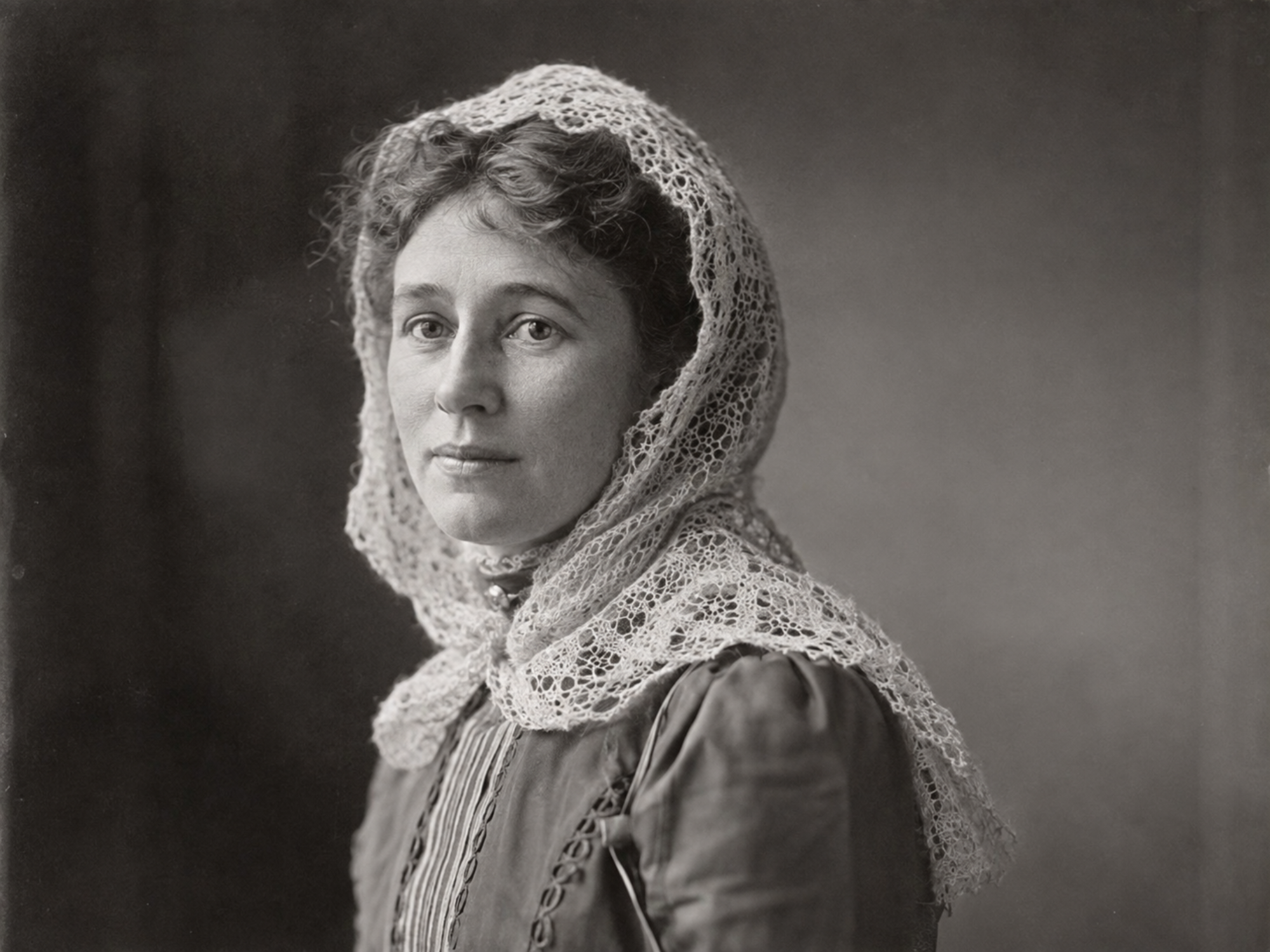
A woman wears a lightweight lace fascinator, circa 1890. Unlike the ornamental headpieces known by that name today, the original fascinator was a soft hood or scarf worn around the head and neck. A Ball Club Register historical reconstruction.
The August Crowd
Saratoga’s racing season drew more than one social class, despite the elegance that came to define its public image.
Owners and wealthy visitors occupied clubhouse tables and private boxes. Professional horsemen moved between the barns, paddock and track. Bookmakers and bettors studied the field. Hotel employees, drivers, stable workers, vendors and railroad crews sustained the seasonal economy surrounding them.
Local residents entered the same grounds as visitors who had traveled hundreds of miles. Some arrived carefully dressed for an annual occasion. Others came often enough to develop routines around particular seats, picnic areas or views of the paddock.
The Race Course belonged to all of them, but it did not present them in the same way.
The fashionable crowd received disproportionate attention because it photographed well and generated stories beyond the result of a race. Wealthy visitors brought clothing from New York, Boston and other cities. Saratoga allowed new styles to be seen while the season was still underway.
That public display did not end when the final horse crossed the finish line.
The crowd returned to Broadway and the hotels. It went to restaurants, verandas, private houses, casinos and lake clubs. Clothing worn at the track continued into the first part of the evening, while dinner and dancing created reasons to change again.
Racing established the schedule for the town.
The final post did not end the day. It released the audience into Saratoga Springs.
After the Final Race
By the late 1920s, Saratoga’s great nineteenth-century resort culture was changing.
The enormous hotels no longer held the same unquestioned position they once had. Automobiles gave visitors greater freedom to move beyond the center of town. Prohibition had officially removed alcohol from public hospitality, although it had not eliminated Saratoga’s appetite for diversion. Lake houses, private rooms and discreet establishments competed for the hours after dinner.
The Race Course remained the fixed point.
Each afternoon still produced a crowd already assembled, already dressed and already looking for somewhere to continue the day. The final race created a daily migration away from Union Avenue.
In the record preserved by The Ball Club Register, one part of that crowd traveled south toward Jefferson Street and Crescent Avenue.
There stood The Hatbox.
The grounds were built for baseball, but they borrowed their habits from the Race Course. First pitch was scheduled fifteen minutes after the final post. Two complete squads played under the same Saratoga name, with players changing sides as the summer required. There was no customary visiting club and no stable opponent.
The grandstand included supper tables. Guests could arrive from the races, take their places and eat while the game moved below them. White uniforms with red pinstripes occupied one side of the field. Red flannel occupied the other.
The arrangement made the game less formal than the Race Course but more considered than an ordinary independent ballpark.
Hats remained on heads as guests entered the grounds. Race programs appeared beside baseball scorecards. A successful wager might pay for supper. An unsuccessful one could be discussed until the first pitch gave everyone something else to study.
The players understood that they were performing for an audience trained to compare form.
At Saratoga, no favorite was safe for long.
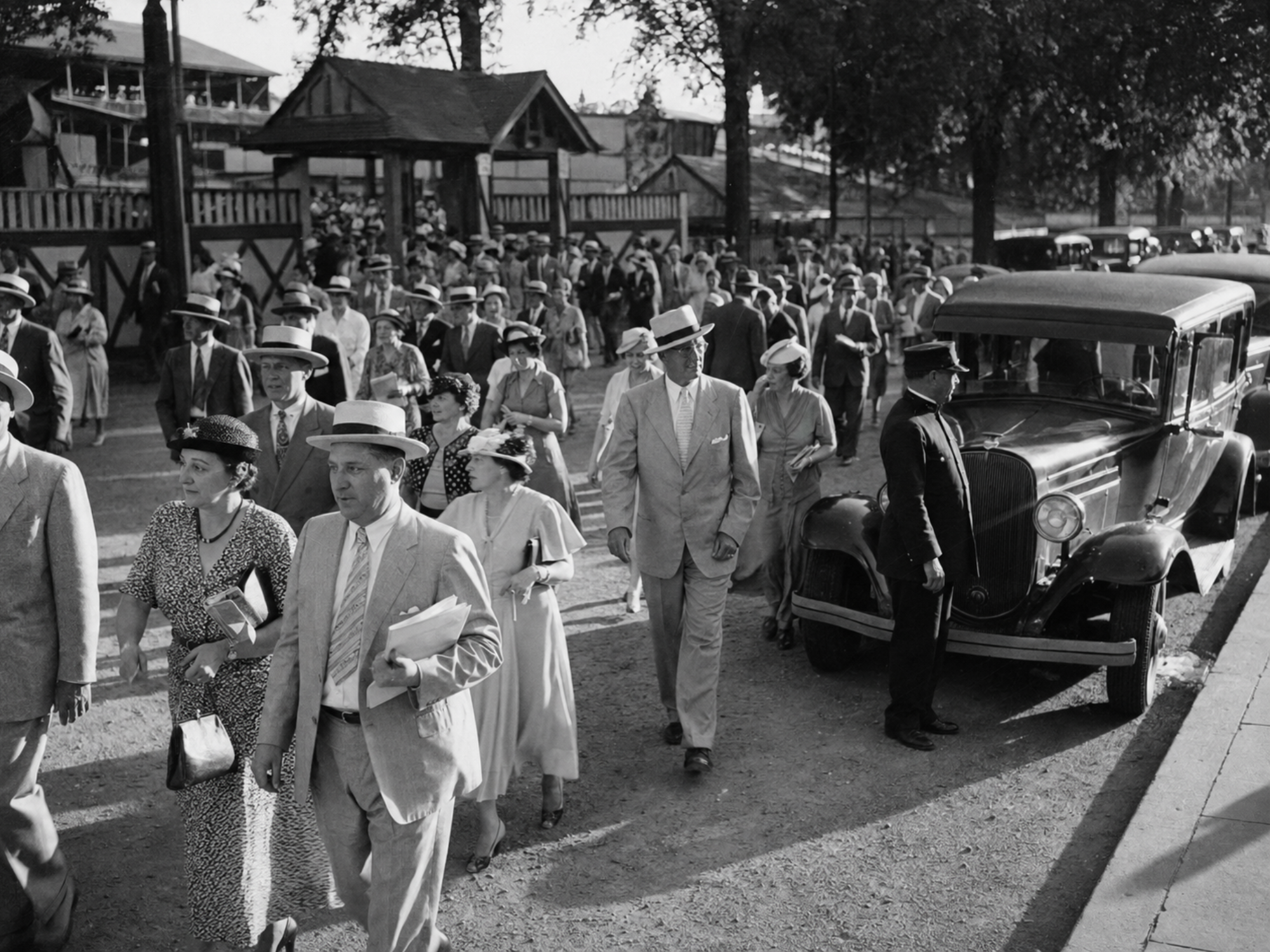
Racegoers leave Saratoga Race Course after the final race, circa 1935. Programs in hand, the crowd moved toward waiting automobiles and the evening’s next destination. A Ball Club Register historical reconstruction.
The Fascinators
The club’s name belonged to that audience.
A fascinator could still describe the delicate head covering remembered from an earlier generation. In its most literal sense, it could also describe something capable of holding attention.
Saratoga offered both meanings.
Its racing crowd had made headwear part of the town’s visual identity long before the modern fascinator appeared. The grandstand was filled with hats that framed faces, announced seasons and distinguished one August from another. The people beneath them could be equally compelling: owners, gamblers, performers, politicians, students, horsemen and summer visitors passing through town.
The Saratoga Springs Fascinators inherited that entire social world.
Their name did not depend on one particular style of hat. It referred to the spectacle surrounding the races, the people who carried that spectacle into the evening and the pleasure of observing a crowd that had gathered partly to observe itself.
The modern racing fascinator adds another layer to the name. Today, elaborate headpieces remain a familiar sight at Saratoga Race Course. NYRA celebrates the tradition through fashion events and hat contests. Milliners work at the track, and many visitors begin planning their race-day clothing from the head down.
The object has changed.
The impulse has not.
For more than a century and a half, Saratoga has invited people to make an occasion of the races. The horses provide the contest. The crowd supplies the theater.
And above the crowd, the hats remain.
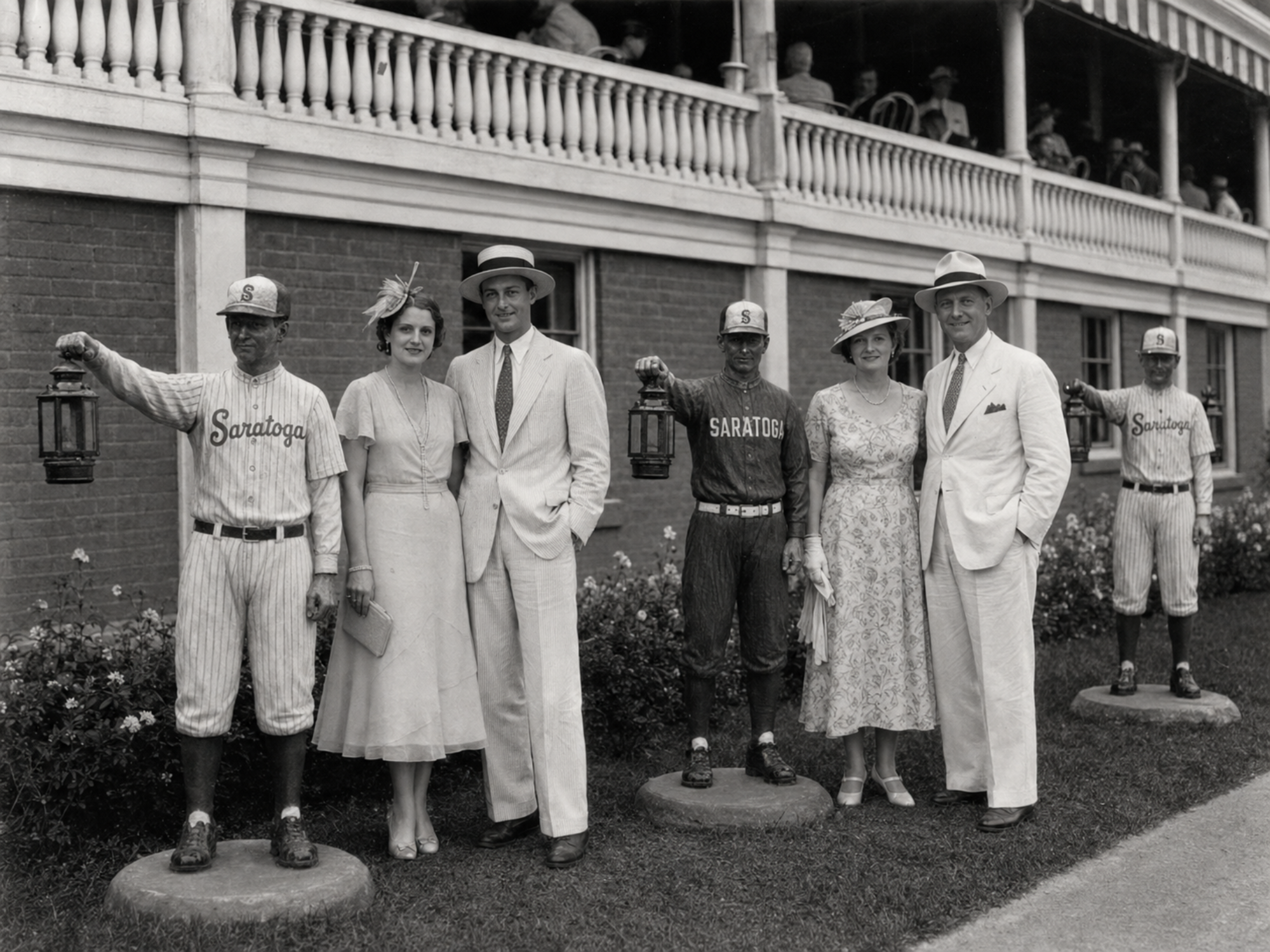
Two couples pose with the Fascinators’ uniformed lawn jockeys outside The Hatbox, circa 1935. The ballpark carried Saratoga’s racing colors and social rituals into the hours after the final post. A Ball Club Register historical reconstruction.
Continue to the Saratoga Springs Fascinators club record.
Sources and Further Reading
The Saratoga Springs Fascinators and The Hatbox are original Ball Club Register creations. The historical setting of this essay was informed by the following resources on Saratoga Springs, thoroughbred racing and the development of women’s headwear.
Saratoga Spa State Park, National Park Service
John Morrissey, National Museum of Racing and Hall of Fame
Saratoga Races, Albany Institute of History & Art
Saratoga Race Course, Keeneland Library
Art Deco Textile and Fashion Designs, The Metropolitan Museum of Art
Cloche, 1925–1930, The Metropolitan Museum of Art
Ahead of Fashion: Hats of the 20th Century, Philadelphia Museum of Art
“Fascinator” definition and word history, Merriam-Webster
What to Wear to Saratoga Race Course, New York Racing Association
