
Why Tyler Is the Rose Capital of America
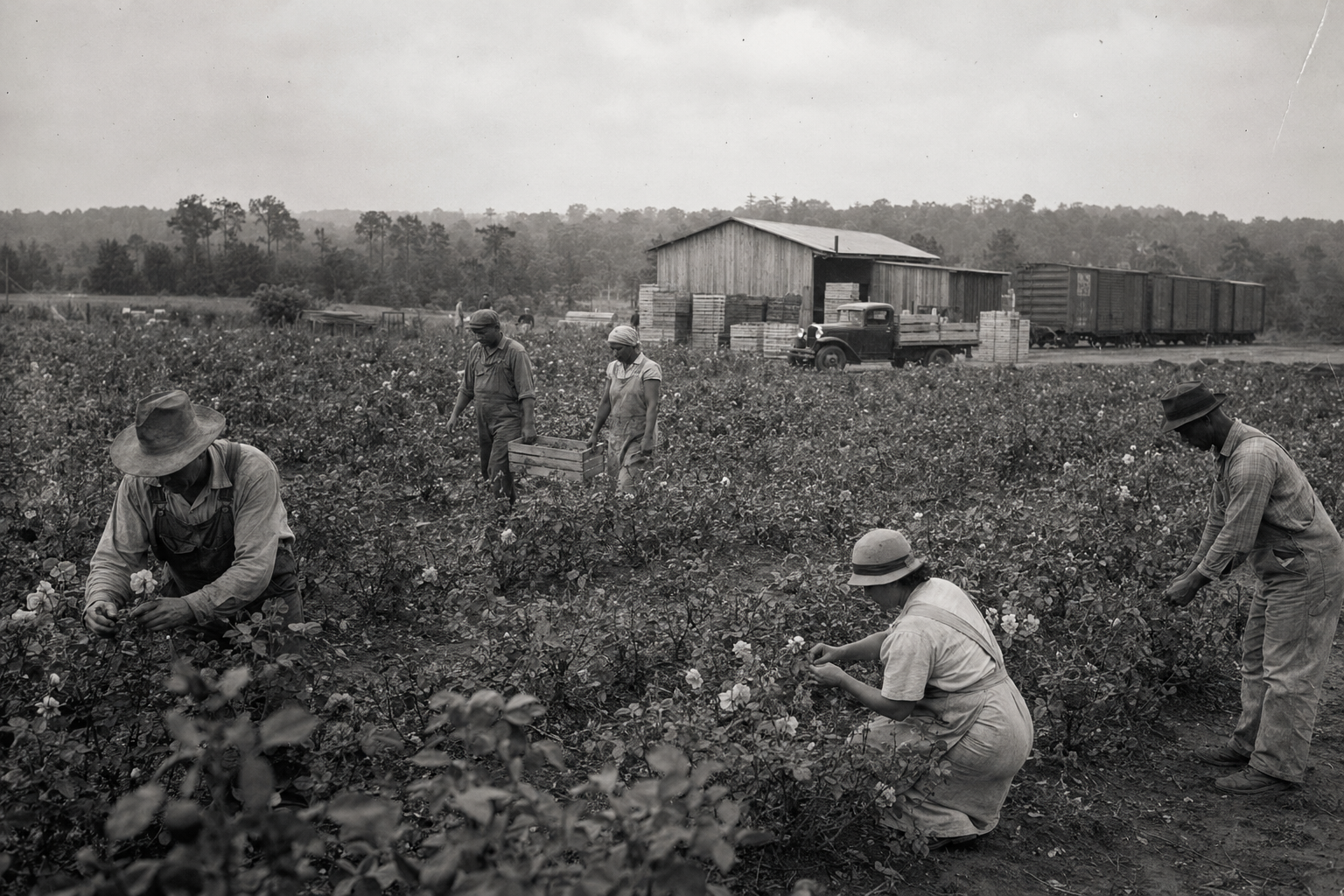
Nursery workers tend commercial rose fields outside Tyler during the early 1930s. Packing sheds and freight cars carried the region’s rosebushes to customers across the country. A Ball Club Register historical reconstruction.
The growers, nurseries and festival traditions that transformed an East Texas city
Tyler did not become the Rose Capital of America because roses had always covered the surrounding countryside.
The identity was cultivated.
It grew from failed peach orchards, enterprising nurserymen, favorable East Texas soil and thousands of workers who learned how to bud, dig, grade, pack and ship rosebushes across the country. What began as an agricultural adjustment became a regional industry. The industry became a festival, and the festival changed how Tyler presented itself to the world.
By the middle of the twentieth century, the rose had entered nearly every part of the city’s public identity. It appeared in parades and shop windows, on promotional literature and civic buildings, in the elaborate gowns of the Rose Queen and across the uniforms of a baseball club on the east side of town.
The Tyler Roses did not borrow an attractive flower for their name.
They wore the crop that made Tyler famous.
Before the Roses
During the late nineteenth century, Smith County was better known for fruit than flowers.
Cotton and corn remained important crops, but the area around Tyler also developed an extensive orchard industry. By 1900, Smith County contained more than one million fruit trees, most of them peach trees. Packing, shipping and nursery work became familiar parts of the local economy.
The orchards appeared to offer farmers a profitable future. Then disease began damaging the peach crop.
As blight and other agricultural problems weakened the fruit industry, growers searched for something better suited to the region’s sandy soil, mild winters and long growing season. Some expanded their general nursery operations. Others experimented with ornamental plants and rosebushes.
Roses were not entirely new to East Texas. Small nurseries had grown them before the turn of the century, usually in limited numbers and often on their own roots. What changed after 1900 was the scale of the work.
Growers began treating roses as a commercial crop.
The land surrounding Tyler proved especially useful for field production. Roses could be propagated in nursery rows, cultivated through the growing season and dug while dormant. The city’s transportation connections then allowed the finished plants to be shipped to customers far beyond Texas.
The same railroad network that moved peaches, timber, cotton and manufactured goods could carry rosebushes north and east.
A new industry took root.
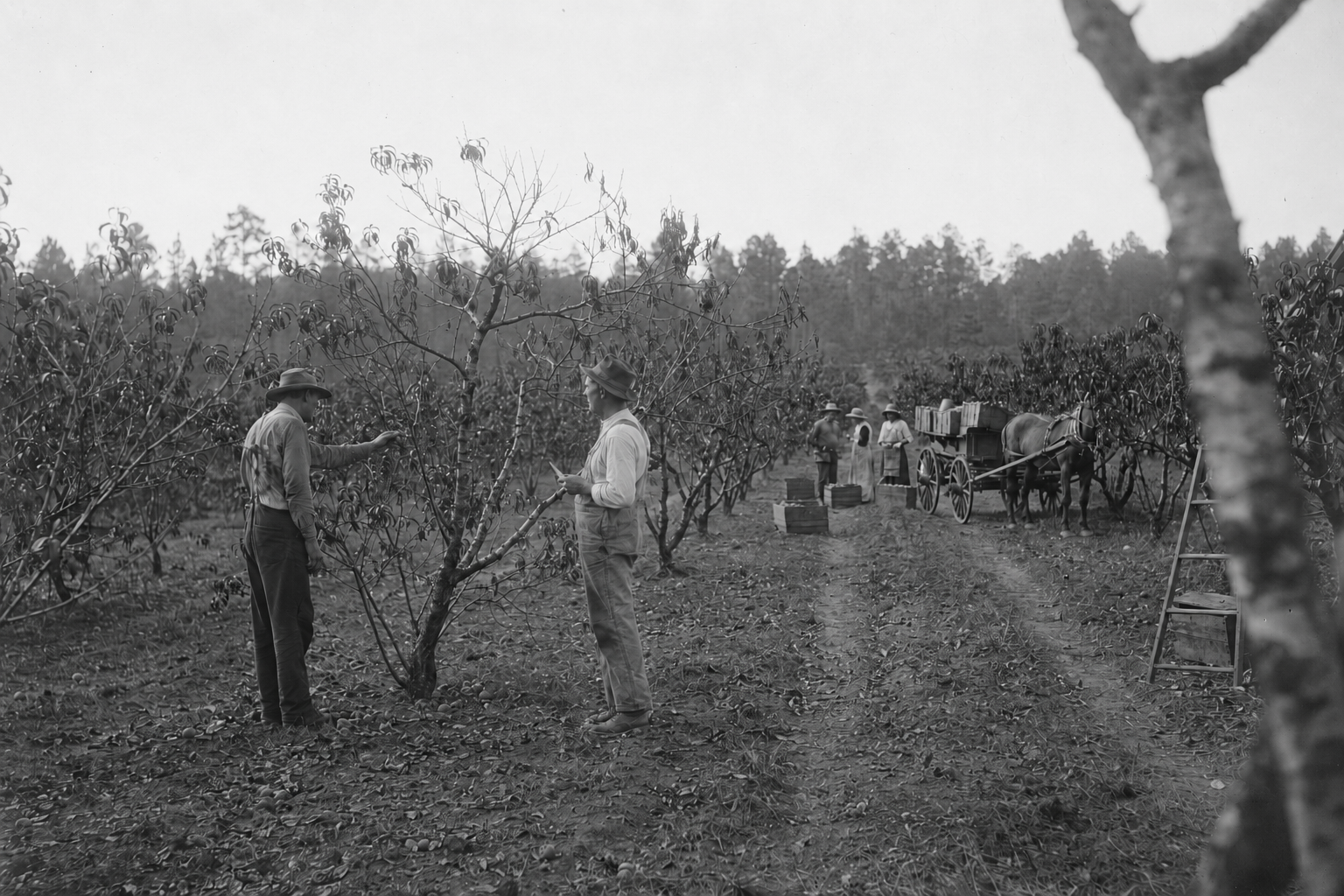
Growers inspect disease damage in a Smith County peach orchard near the beginning of the twentieth century. The decline of the fruit crop encouraged local nurserymen to look toward roses. A Ball Club Register historical reconstruction.
Growing a Rose Industry
Commercial rose growing required patience and specialized labor.
Many Tyler-area growers used budding, a propagation method in which a bud from a desired rose variety was inserted into hardy rootstock. Once the union took hold, the upper growth of the rootstock could be removed, allowing the selected variety to develop on a stronger root system.
The work was repetitive and exact. Each bud had to be cut cleanly, placed correctly and wrapped securely. A successful nursery depended on crews who could move quickly through long field rows without sacrificing the quality of the plants.
Cultivation continued through the year. Workers prepared the soil, controlled weeds, inspected the plants and removed unwanted growth. When the bushes entered dormancy, digging crews lifted them from the ground. Other workers graded the roots, trimmed the canes, identified the varieties and carried the plants into packing sheds.
There, the bushes were bundled and prepared for shipment.
The finished product did not resemble the flowering plant a customer imagined for the garden. A dormant rosebush was largely bare root and clipped cane, wrapped to retain moisture and labeled so that hundreds of varieties would not become confused in transit.
Tyler’s growers learned to perform this work at industrial scale.
By the 1920s, roses had become one of the area’s major businesses. Nurseries expanded around Tyler and throughout Smith County. Packing houses stood close to railroad sidings, allowing bundled plants to move from the field to freight cars with as little delay as possible.
The growing season created a rhythm understood throughout the region. Budding, cultivating, digging and packing each brought different crews into the fields and sheds. Families worked alongside seasonal laborers. Nursery owners developed catalogs and national sales networks. Railroad employees handled shipments addressed to towns many of them would never visit.
By the end of the 1930s, more than nine million rosebushes were being shipped from the area annually. During the following decade, more than half of the commercial rosebushes grown in the United States came from within ten miles of Tyler.
The rose was no longer a promising alternative to peaches.
It was the crop by which Tyler was known.
From Crop to Civic Identity
An industry becomes part of a city’s identity when it leaves the workplace and enters public life.
In Tyler, that transition happened during the 1930s.
Roses began appearing more prominently in local advertising, civic promotions and storefront displays. Businesses embraced rose imagery even when they had no direct connection to the nursery trade. Visitors encountered the flower in hotel decorations, restaurant windows and printed guides to the city.
The language changed as well.
Tyler was increasingly described as the Rose Capital of America, a title that connected the city’s agricultural importance with an image of beauty and refinement. It gave Tyler something that oil, cotton and timber could not provide: a civic symbol that could be worn, carried, planted and celebrated.
The symbol remained grounded in work. Every public bouquet represented fields, budding knives, packing sheds and freight shipments. Yet once the rose entered the center of town, it acquired a second life.
It became pageantry.
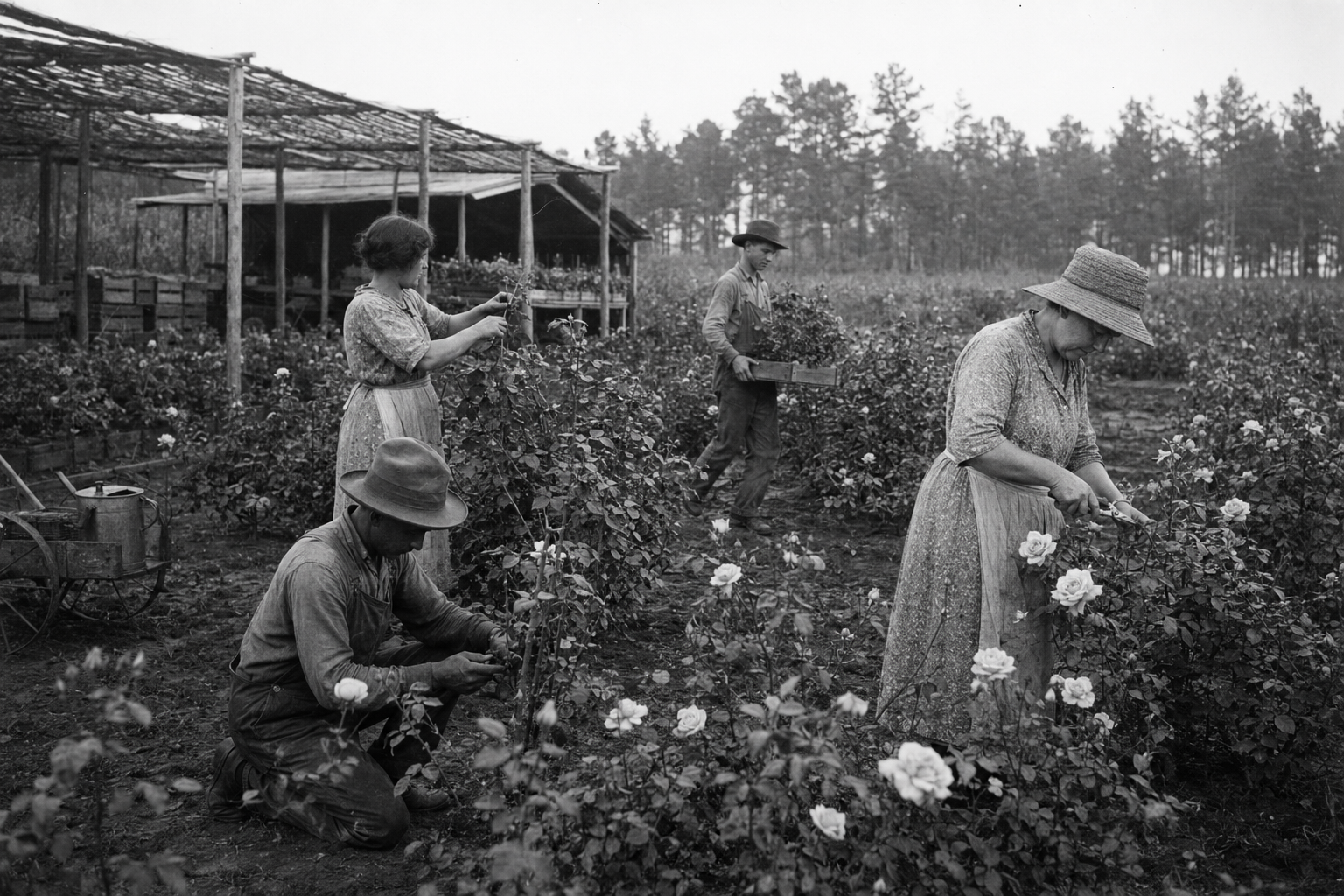
Nursery workers bud, prune and tend living rose stock outside Tyler in the late 1920s. Skilled propagation work allowed the region’s rose industry to expand rapidly. A Ball Club Register historical reconstruction.
The First Rose Festival
The first Tyler Rose Festival was held in October 1933.
The event was organized by members of the Tyler Garden Club, the Chamber of Commerce and local rose growers. Its purpose was straightforward: draw attention to the importance of the rose industry and bring visitors to Tyler.
Volunteers raised $1,500 to stage the inaugural celebration. Several thousand visitors came from fifteen states. The program included a rose show, a parade and the coronation of Margaret Copeland as the first Rose Queen.
The festival allowed Tyler to present an agricultural product as a civic spectacle.
Rose displays demonstrated the range and quality of the local crop. Parade floats carried flowers through the streets. Bands, visiting dignitaries and garden clubs expanded the celebration beyond the nursery industry. The coronation transformed the rose into an emblem of ceremony, with the Queen and her court providing a human center for the festivities.
Originally known as the East Texas Rose Festival, the celebration was renamed the Texas Rose Festival during the Texas Centennial in 1936. Its ambitions had grown along with its audience.
Festival week altered the appearance of Tyler. Rose-pink ribbons and floral decorations appeared throughout the city. Storefronts adopted rose displays. Residents gathered for the parade and coronation. Growers who ordinarily sold dormant bushes now presented the flower at the height of its bloom.
The festival did not invent Tyler’s connection to the rose. It made that connection visible.
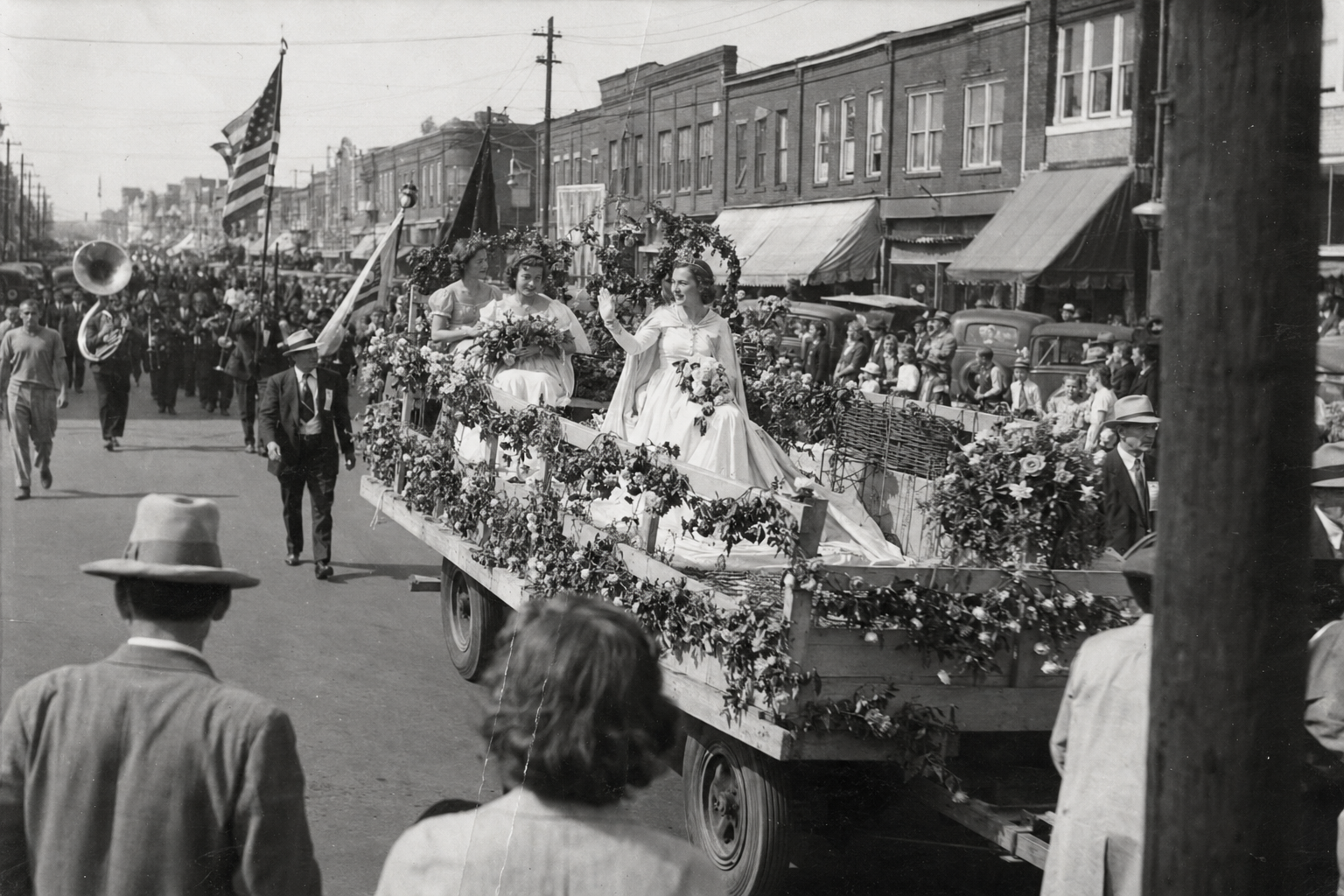
The Rose Queen and her court pass through downtown Tyler during the 1936 Texas Rose Festival. The annual celebration transformed the city’s agricultural industry into a visible civic identity. A Ball Club Register historical reconstruction.
A Ball Club in Bloom
When baseball arrived at Cotton Belt Park in 1912, Tyler’s rose industry was still developing.
The grounds stood on the east side of the city near freight yards, packing houses and warehouses. Trains moved beyond the outfield carrying the products of East Texas to distant markets. During the digging and shipping season, some of those freight cars carried bundled rosebushes packed by the hundreds.
The ball club took the name Tyler Roses.
At first, the name was more direct than decorative. It identified the team with a growing local industry, much as other clubs were named for the workers, products and trades of their towns. The earliest Tyler uniforms remained restrained, and the flower did not immediately dominate the club’s appearance.
That changed as the rose became more central to the city itself.
The first Rose Festival was held in 1933. The following year, the club introduced a cream pinstriped cap with a powder-blue bill and an interlocking TR. The T appeared in rose pink, while the R remained powder blue.
In 1936, the club adopted a more explicit crest: a rose-pink T rising above a deep-red rose.
The timing was not accidental. The Tyler Roses were developing their mature identity at the same moment the city was transforming its leading crop into a complete civic language.
Rose pink appeared across the club’s cream flannel uniforms. Powder-blue pinstripes supplied contrast without overwhelming the color. The flower itself remained carefully drawn and relatively small, more like the mark of a nursery or agricultural association than a decorative bouquet.
At Cotton Belt Park, the rose became part of the crowd as well.
Supporters wore rose-pink ribbons on important dates. Local growers supplied flowers for presentations. The Blue and pink of the club’s insignia could be seen beneath the covered grandstand and along the bleachers. Beyond right field, workers sometimes watched from warehouse windows overlooking the grounds.
The Roses did not need to explain what the flower meant.
In Tyler, everyone already knew.
The Rose Capital at the Ballpark
The club’s relationship to the nursery industry extended beyond its name and uniforms.
Rose growers purchased advertisements in programs and along the outfield fence. Packing-house employees attended games after their shifts. Seasonal workers followed the club during the spring and summer before the dormant digging season returned them to the fields and sheds.
The freight lines connected the two worlds. They carried opposing clubs into Tyler and carried rosebushes out.
Cotton Belt Park absorbed the sounds of that landscape. Switching cars could be heard beyond the outfield. Warehouse doors opened toward the tracks. On certain days, the smell of packing material, soil and industrial smoke traveled across the grounds.
The setting prevented the club’s rose identity from becoming overly refined. The Tyler Roses represented beauty, but theirs was the beauty of a cultivated crop. It came from labor, repetition and commercial discipline.
That quality entered the way the club played.
The Roses became known for making opponents earn every base. The phrase appeared on a board inside Cotton Belt Park and eventually became the team’s most familiar instruction: “Make Them Earn It.”
It was a fitting expression for a club representing a city that had built its reputation one field row, one bud and one shipment at a time.
A Garden for the City
Even as the festival grew, Tyler lacked a municipal rose garden large enough to represent the industry that had made the city famous.
The city had purchased the future garden property in 1912. Construction began in 1938 with assistance from the Works Progress Administration. Plans called for formal beds, walks and public spaces that would display the breadth of Tyler’s rose culture.
Much of the early work was completed before the United States entered the Second World War. The war interrupted both the public project and the annual festival. Nursery production and civic resources shifted toward more immediate needs.
After the war, work on the garden resumed.
The Tyler Municipal Rose Garden officially opened in 1952. Its fourteen acres eventually became one of the largest public collections of roses in the United States, providing a permanent home for the flower that had already defined Tyler for decades.
The opening came one year after the Tyler Roses played their final season.
The timing gives the two institutions an unusual relationship. The ball club belonged to the years when the rose was moving from field crop to civic emblem. The municipal garden belonged to what followed, when that identity had become permanent.
One closed as the other opened.
The rose remained.
The Name Tyler Carried
Tyler’s claim as the Rose Capital of America was not created by a slogan.
It was earned in nursery fields and packing sheds. It was measured in millions of bushes, freight shipments and the hands required to prepare each plant. The festival gave the industry ceremony. The municipal garden gave it a permanent public home.
The Tyler Roses gave it a ball club.
Their name connected Cotton Belt Park to the fields surrounding the city. Their rose-pink lettering reflected the ribbons that appeared during festival week. Their crest transformed an agricultural product into a mark that could be worn on a uniform, painted on a wall and carried into another town.
The club was not named for a generalized idea of beauty.
It was named for Tyler’s work, its economy and the identity the city had cultivated from the soil.
By the time the Roses wore the flower over their hearts, Tyler had already planted it everywhere else.
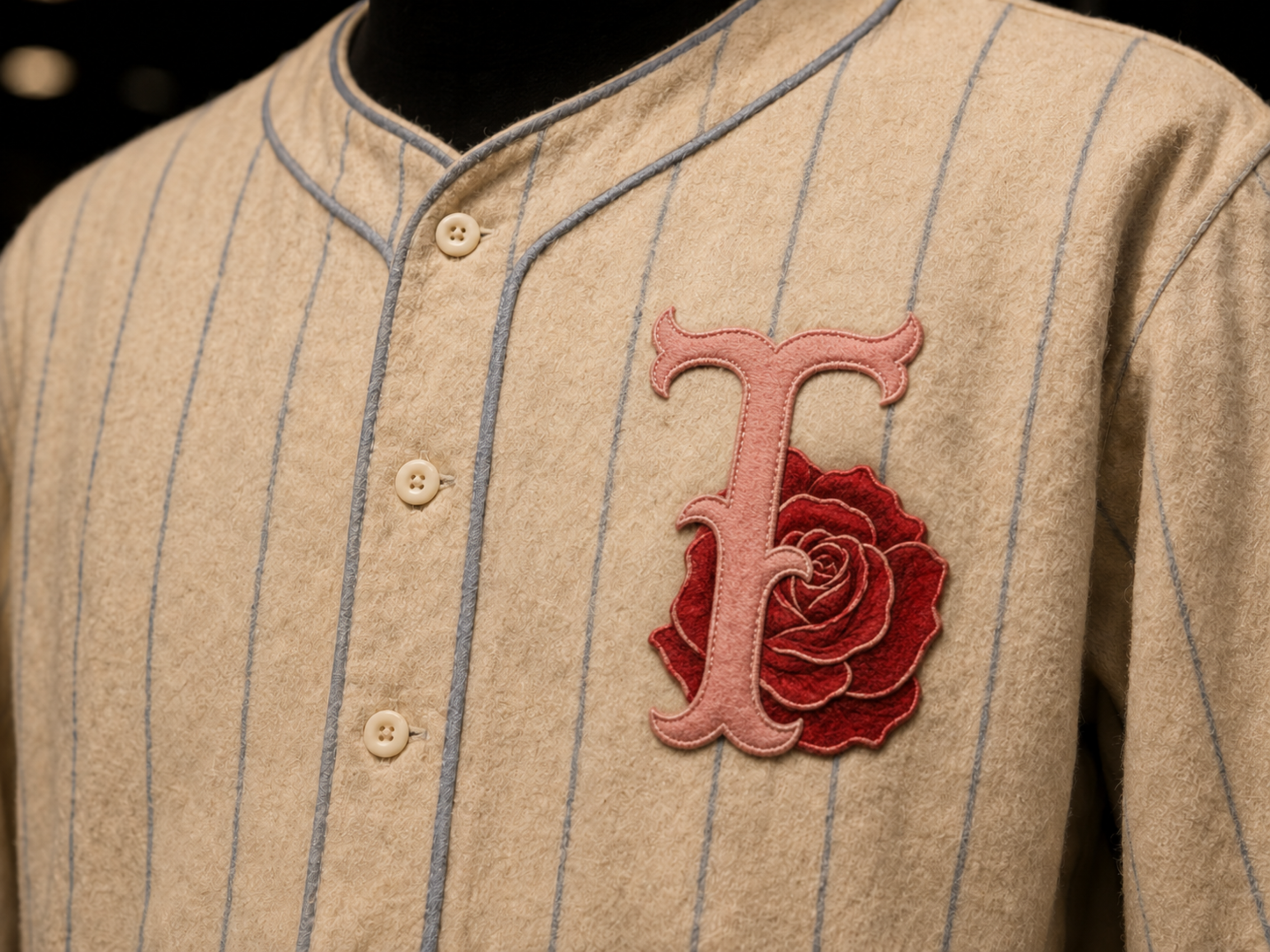
The Tyler Roses home uniform, featuring the T over Rose club mark, circa 1946.
Sources and Further Reading
The Tyler Roses are an original Ball Club Register creation. The historical setting of this essay was informed by the following resources on Tyler’s rose-growing industry, municipal garden, and festival traditions.
“Tyler, Texas”, Handbook of Texas, Texas State Historical Association
“Texas Rose Festival”, Handbook of Texas, Texas State Historical Association
Tyler Municipal Rose Garden, National Park Service
Tyler’s Garden of Roses, Smithsonian Gardens
Tyler Rose Garden, City of Tyler Parks and Recreation
Tyler Rose Museum, Texas Rose Festival Association