
How to Use a Baseball Scorecard
Learn the numbers, symbols and simple routine behind keeping score at a baseball game.
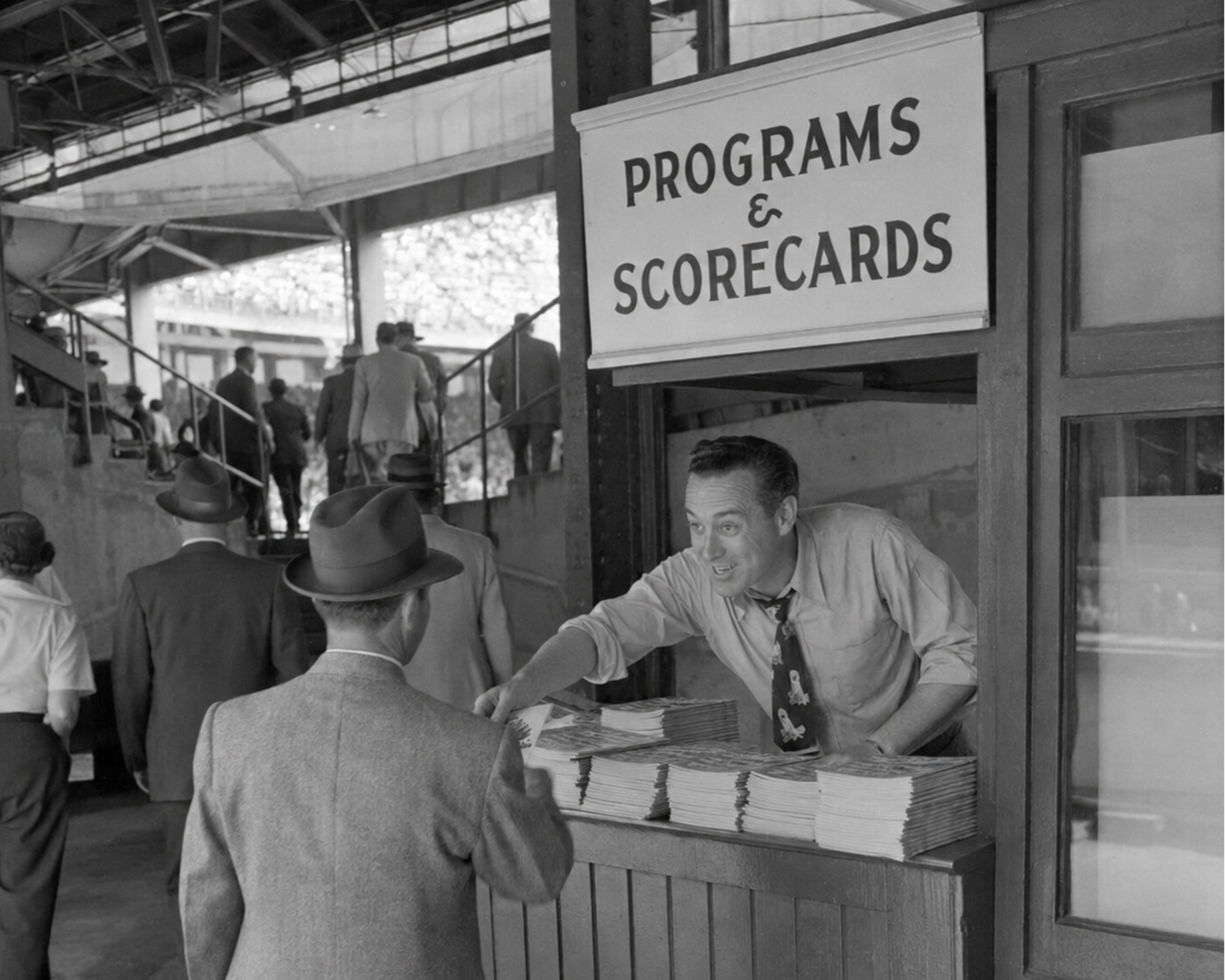
Programs and scorecards were sold along the concourse as spectators made their way to their seats, placing the day’s lineups and a permanent record of the game in their hands.
There is a moment during a ballgame when a baseball scorecard begins to look like a record worth keeping. The lineups have been written in. A few shorthand notes are scribbled in pencil. Outs, hits and walks begin to collect across the innings. By the late innings, the page has acquired a character of its own: part record of the game and part memory for the person who watched it.
For generations, keeping score has been one of baseball’s quietest traditions. It turns watching into a form of participation. The scorer follows each batter, notices which fielder made the play and traces every runner’s progress around the bases. When the final out is made, the card holds more than the score. It preserves the sequence in which the game unfolded.
A completed scorecard can look complicated because it shows all nine innings at once. During the game, however, it is built one plate appearance at a time.
What a baseball scorecard preserves
What makes a scorecard worth keeping is not just the final score, but the route the game took to reach it.
A box score tells you how many runs, hits and errors each team finished with. A baseball scorecard preserves the sequence behind those totals. It shows which batter began an inning, which fielders combined to make an out, how a runner moved from first to third and where a promising rally came to an end.
Every completed card also bears the hand of the person who kept it. Printed designs vary, and experienced scorekeepers often develop their own marks and shorthand. There is no single notation system that every scorer must imitate.
The goal is not to produce a perfect scorecard. It is to create a record that is legible, consistent and complete enough that you can return to it later and watch the game unfold again.
Understand the grid
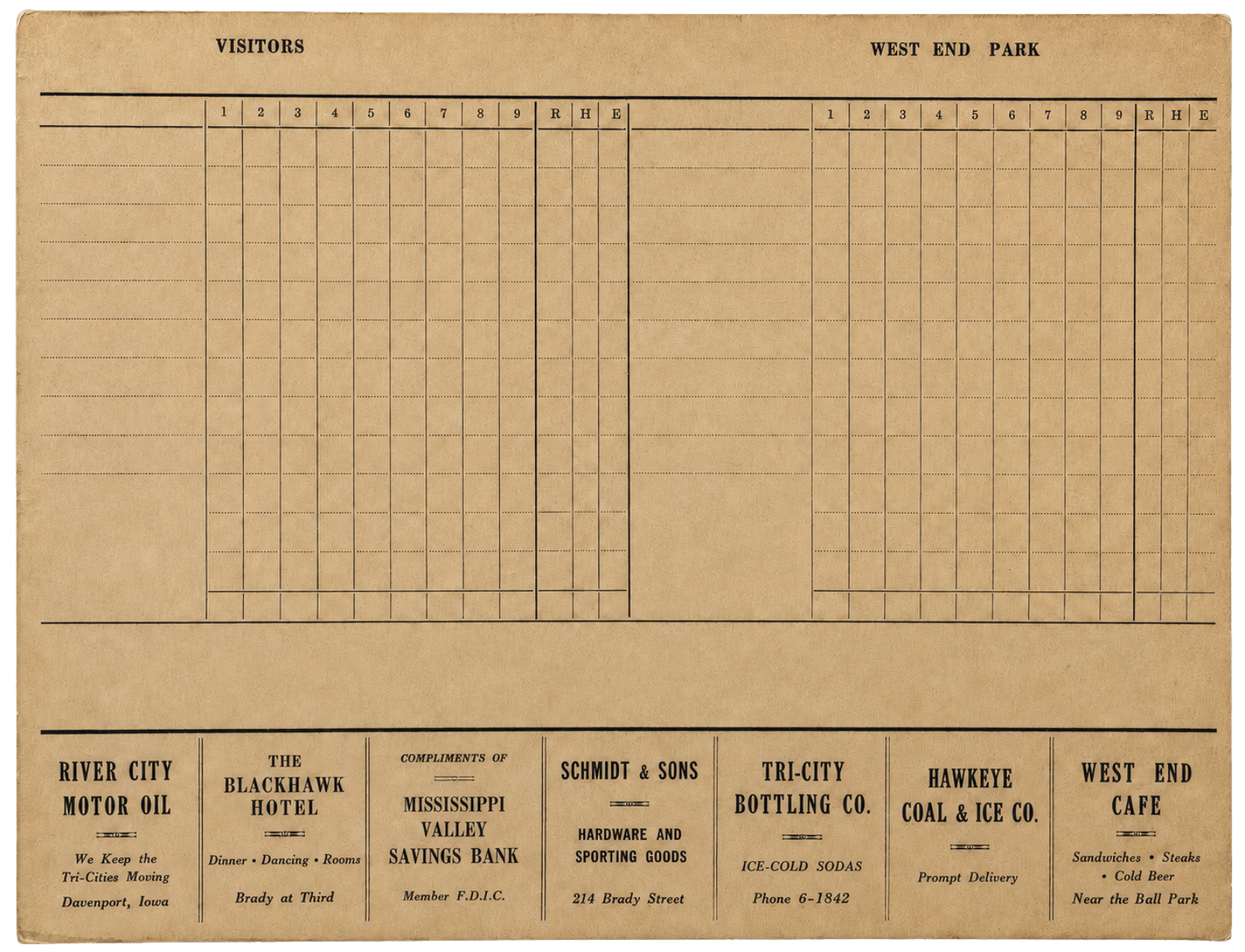
Most scorecards use the same basic arrangement. The batting order runs vertically down the page. The innings run horizontally across the top. Where a player's row meets an inning column, you will find the scoring box for that plate appearance.
The visiting team bats in the top half of each inning, and the home team bats in the bottom half. Most scorecards provide a separate lineup grid for each team.
During an inning, work down the batting order. After the third out, switch to the other team’s scoring grid. When the first team bats again, move to the next inning column and begin with the next batter due. The batting order does not reset at the start of a new inning.
If a team bats around, continue at the top of the batting order in the next unused set of scoring boxes and label that continuation with the same inning number. Many scorecards provide an extra column for this purpose. Do not overwrite the player’s first plate appearance.
What one scoring box represents
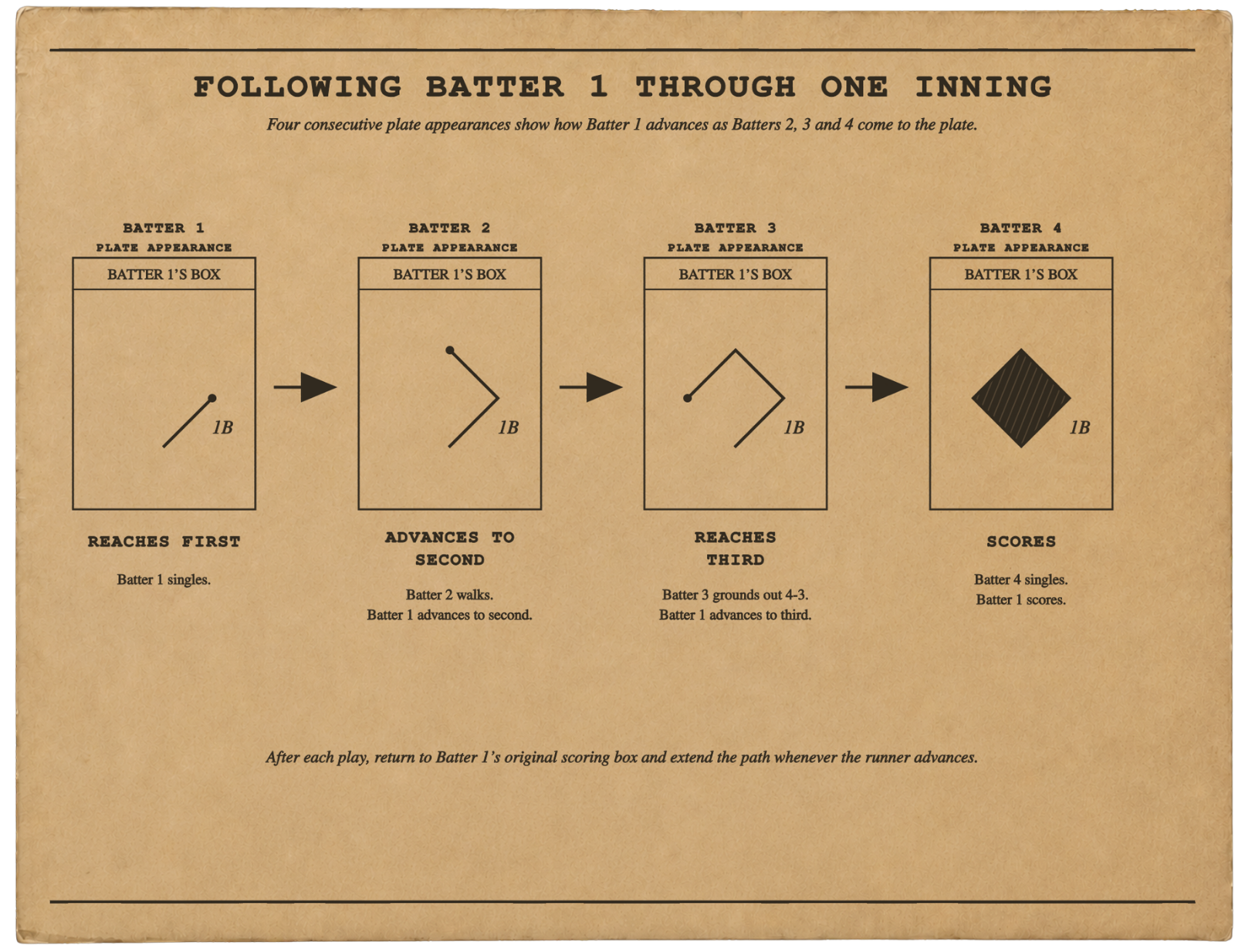
Each scoring box begins as the record of one batter’s plate appearance. If the batter is retired, record how the out was made and the box is complete. If the batter reaches base, that same box follows the player as a runner. Continue updating it until the runner scores, is put out or remains on base when the inning ends. In this way, one scoring box records both how the player reached base and everything that happened afterward.
Some scorecards print a small diamond inside every box. Others, including many older cards, leave the box open. If no diamond is printed, draw a small one yourself. Home plate is at the bottom, first base is at the right, second base is at the top and third base is at the left. Draw the runner’s route one segment at a time as the player advances around the bases.
Learn the nine baseball position numbers
A scorecard uses numbers to identify the defensive positions, allowing an entire play to be recorded in only a few marks. These are position numbers, not uniform numbers, and they remain the same no matter which teams or players are on the field. Once the nine numbers become familiar, a sequence such as 6-3 immediately tells you that the shortstop fielded the ball and threw to first.
| 1 | Pitcher |
|---|---|
| 2 | Catcher |
| 3 | First baseman |
| 4 | Second baseman |
| 5 | Third baseman |
| 6 | Shortstop |
| 7 | Left fielder |
| 8 | Center fielder |
| 9 | Right fielder |
| DH | Designated hitter; a batting role with no defensive position number |
The sequence of numbers tells you how the defense handled the ball. A grounder fielded by the shortstop and thrown to first is 6-3. A bunt fielded by the pitcher and thrown to first is 1-3. A double play from shortstop to second baseman to first baseman is 6-4-3.
Outfield catches use the same system. A fly ball caught by the center fielder can be written F8, or simply 8 if that is the style you choose. A designated hitter is normally written DH because the player is batting without occupying one of the nine fielding positions.
How outs are recorded
Recording an out means noting more than the fact that a batter was retired. The scorecard should also show whether the out came by strikeout, a caught ball or a play involving one or more fielders. These marks allow you to reconstruct the action later, while numbering the first, second and third outs makes the end of each inning easy to find.
| K | Strikeout swinging |
|---|---|
| K | Strikeout looking, or a called third strike |
| F7 | Fly ball caught by the left fielder |
| L6 | Line drive caught by the shortstop |
| P3 | Pop fly caught by the first baseman |
| 6-3 | Ground ball fielded by the shortstop and thrown to first |
| 6-4 | Shortstop throws to the second baseman for a force out at second |
| 6-4-3 DP | Double play from shortstop to second baseman to first baseman |
How a batter reaches base
A batter who reaches base does not always receive credit for a hit, so the scorecard must record how the safe arrival occurred. Singles, doubles, triples and home runs count as hits, while walks, batters hit by a pitch, errors and fielder’s choices do not. After recording the result, begin the runner’s path around the diamond and continue updating that same box until the runner scores, is put out or is left on base.
| 1B | Single; draw the runner’s path from home to first |
|---|---|
| 2B | Double; draw the path from home through first to second |
| 3B | Triple; draw the path from home through first and second to third |
| HR | Home run; complete the diamond and shade it to record the run |
| BB | Base on balls, or walk; the batter reaches first without being credited with a hit |
| HBP | Hit by pitch; the batter is awarded first without being credited with a hit |
| E6 | Reaches on an error by the shortstop; replace 6 with the responsible fielder’s number |
| FC | Fielder’s choice; the batter reaches while the defense attempts to retire another runner |
Essential baseball scorecard abbreviations
The table below gathers the basic baseball scorecard symbols and abbreviations introduced so far and adds several marks used for sacrifices, base running, errors and substitutions. Together, they provide enough vocabulary to record most plays a beginner will encounter. Some scoring decisions require judgment, particularly when distinguishing a hit from an error or a sacrifice from an ordinary out. If an official ruling is announced, use it. Otherwise, make a clear provisional mark and apply your system consistently.
| 1B / 2B / 3B | Single, double or triple |
|---|---|
| HR | Home run |
| BB | Base on balls, or walk |
| HBP | Hit by pitch |
| K | Strikeout swinging |
| K | Strikeout looking |
| FC | Fielder’s choice |
| E + number | Error charged to a fielder, such as E6 for the shortstop |
| SH or SAC | Sacrifice bunt |
| SF | Sacrifice fly |
| SB | Stolen base |
| CS | Caught stealing |
| WP | Wild pitch |
| PB | Passed ball |
| BK | Balk |
| DP | Double play |
| RBI | Run batted in |
| PH | Pinch hitter |
| PR | Pinch runner |
Before the first pitch
Begin with a pencil. Lineups change, substitutes enter and official scoring decisions are sometimes revised. A pencil keeps the scorecard flexible and makes corrections part of the process.
Before play begins:
Write the teams, date and ballpark in the game information area.
Enter each starting lineup in batting order.
Write each player’s defensive position beside the name.
Record the starting pitchers and complete any other game-information fields on the card.
Leave room beneath or beside each lineup spot for substitutes.
Lineups are not always announced early enough to complete every detail before the game begins. Enter the information you have, then return to any unfinished lines between innings. A blank space can be completed later. A missed play cannot.
The routine for every plate appearance
When the batter steps in, follow the same routine every time. Find the correct box, record the batter’s result, update every runner and mark any out.
Step 1: Find the batter's box
Locate the batter's row and the current inning column. Their intersection is the box you will use. If you are unsure who is batting, check the lineup and continue from the last completed plate appearance.
Step 2: Record the batter's result
For scorekeeping purposes, begin by asking one question: was the batter retired, or did the batter reach base? Record that result first. Then update the runners.
If the batter is out
For a strikeout, write K. Many scorekeepers use a backward K when the third strike is called rather than swung at.
For a ball put in play, write the fielding position or sequence that produced the out. A groundout from shortstop to first is 6-3. A flyout to center is F8. A line drive caught by the shortstop may be written L6. An unassisted play by the first baseman can be written 3U.
If two outs are recorded on one continuous play, include the full fielding sequence and mark the play DP for double play. The familiar 6-4-3 DP means the shortstop throws to the second baseman, who throws to the first baseman, recording two outs.
If the batter reaches base
Write how the batter reached and draw the route to the proper base. Use 1B for a single, 2B for a double, 3B for a triple and HR for a home run. Some scorers add the position number of the fielder who handled the ball, such as 1B9 for a single to right field.
A batter can also reach without being credited with a hit. Use BB for a walk, HBP for a hit by pitch, E followed by a fielder's number for an error, and FC for a fielder's choice.
That distinction matters when you total the inning. A walk, error or fielder's choice puts a runner on base, but none of them adds a hit to the team's total.
Step 3: Update every runner
This is the habit that separates a complete scorecard from a collection of isolated batting results. Once the batter's result is recorded, return to the original scoring box of every runner already on base.
Extend each runner's path to the base reached on the play. If a runner moves from first to third, add the segments from first to second and from second to third in that runner's original box. Do not record the entire play only in the new batter's box.
When useful, write beside the base path why the runner advanced. You might write the next batter’s lineup number beside the segment to show which plate appearance moved the runner, or use an abbreviation such as SB, WP, PB or BK. Choose one method and use it consistently.
When a runner scores, complete the route home and shade the finished diamond. When a runner is retired on the bases, record the defensive sequence in that runner's box and mark the out. When the inning ends with a runner still aboard, leave the unfinished path visible. That open diamond shows a runner left on base.
Step 4: Count the outs
Many scorekeepers place a small circled 1, 2 or 3 beside the play that produced each out. Others simply keep the out count in the margin. Either method works as long as the inning's three outs can be found quickly.
After the third out, draw a short diagonal line or another clear inning-ending mark after the final batter. Then note which batter will lead off the next inning. This prevents the common mistake of returning to the top of the lineup when play resumes.
If you are uncertain about a hit, error or fielder’s choice, make a light provisional mark and keep watching. You can confirm or correct the ruling between pitches or innings.
Practice: score one complete half-inning
The easiest way to understand the system is to use it. The six plays below create a practical baseball scorecard example and show how to fill out a baseball scorecard one plate appearance at a time. Each step adds to the same scorecard, exactly as it would during a live game
1. Adams singles
Write 1B in Adams's box and draw the line from home to first. There are no outs and no other runners to update.
2. Baker walks
Write BB in Baker's box and draw Baker's path to first. Because Adams already occupies first base, the walk forces Adams to second. Return to Adams's original box and add the segment from first to second. There are runners on first and second with no outs.
3. Collins doubles to left
Write 2B7 in Collins's box and draw the route from home to first to second. Adams scores from second, so complete and shade Adams' diamond. Baker advances from first to third, so extend Baker's path through second to third.
The inning now has one run and two hits: Adams's single and Collins's double. Baker's walk did not count as a hit.
4. Diaz strikes out
Write K in Diaz's box and mark the first out. Baker remains at third and Collins remains at second, so their base paths do not change.
5. Evans hits a sacrifice fly
Evans lifts a fly ball to center field. The center fielder makes the catch and Baker tags from third and scores. Write SF8 in Evans's box and mark the second out. Complete and shade Baker's diamond. Collins remains at second.
6. Foster grounds out
Foster grounds to shortstop, who throws to first. Write 6-3 in Foster's box and mark the third out. Collins is left on second base, so Collins's diamond remains unfinished.
The completed half-inning contains two runs, two hits, no errors and one runner left on base. The three outs are Diaz’s strikeout, Evans’s sacrifice fly and Foster’s groundout. The walk put Baker on base but did not add a hit. The sacrifice fly produced an out and a run, but it is not charged as an official at-bat.
After the third out, count the completed diamonds in the inning column and record the total number of runs in the space at the bottom. In this example, enter 2.
Notice that the story of the inning is spread across several boxes. Collins’ double is recorded in Collins’ box, but Adams’ run remains in Adams’ box and Baker’s trip from first to third remains in Baker’s. The scorer keeps returning to the runner’s original box until that runner’s trip is finished.
How to finish a baseball scorecard
Recording the final out does not quite finish the scorecard. Close the inning clearly, preserve any substitutions and check the totals before putting the card away.
Close each half-inning
After the third out, make the inning break easy to find. Draw the inning-ending mark after the final batter’s box, identify the next batter due and enter the inning’s run total in the line score. If your card provides spaces for inning hits and errors, enter those as well.
Leave incomplete runner paths visible. They show who was left on base. Then move to the other team’s scoring grid for the next half-inning. When this team bats again, continue with the next batter in the order.
Record substitutions without losing the batting order
A substitute inherits the batting-order position of the player replaced. Write the new player's name beneath or beside the original player in the same lineup spot and note the inning of entry.
Use PH for a pinch hitter and PR for a pinch runner. For a defensive replacement or position change, add the new position and the inning of the change beside the original entry. Card designs handle substitutions differently, but the central rule does not change: substitutions alter the personnel, not the order in which that lineup spot bats.
Check the final totals
When the final out is recorded, take a minute to check the page. A useful final review asks:
Do the inning-by-inning runs add to the final score?
Do the individual hits add to the team's hit total?
Do the charged errors add to the team's error total?
Does every half-inning played to completion contain three outs? A walk-off bottom half may end as soon as the winning run scores.
Can every runner be followed until that runner scored, was put out or was left on base?
If the home team led after the top of the ninth, is the unplayed bottom of the ninth marked with an X rather than a zero?
You can also total at-bats, runs, hits and runs batted in for each player if your card provides those columns. Those totals are useful, but they are the final accounting. The play-by-play record is the heart of the card.
Five common baseball scorekeeping mistakes
Following only the batter. After every play, check every occupied base and update each runner's original box.
Confusing position numbers with uniform numbers. A shortstop is always 6 on the scorecard, no matter what number appears on the jersey.
Counting every safe arrival as a hit. Walks, errors and fielder's choices put batters on base without adding a hit.
Restarting the lineup each inning. Begin the next inning with the batter who follows the final batter from the previous inning.
Trying to perfect the last play while the next pitch is being thrown. Make a provisional pencil mark, stay with the live game and clean up the notation when play pauses.
A completed baseball scorecard
The scorecard developed alongside baseball's early statistical record. In 1859, writer Henry Chadwick formulated an influential early box score that tracked runs, hits, putouts, assists and errors. Printed scorecards and personal notation continued to evolve, which is why finished pages from different eras can look so distinct while preserving the same essential information.
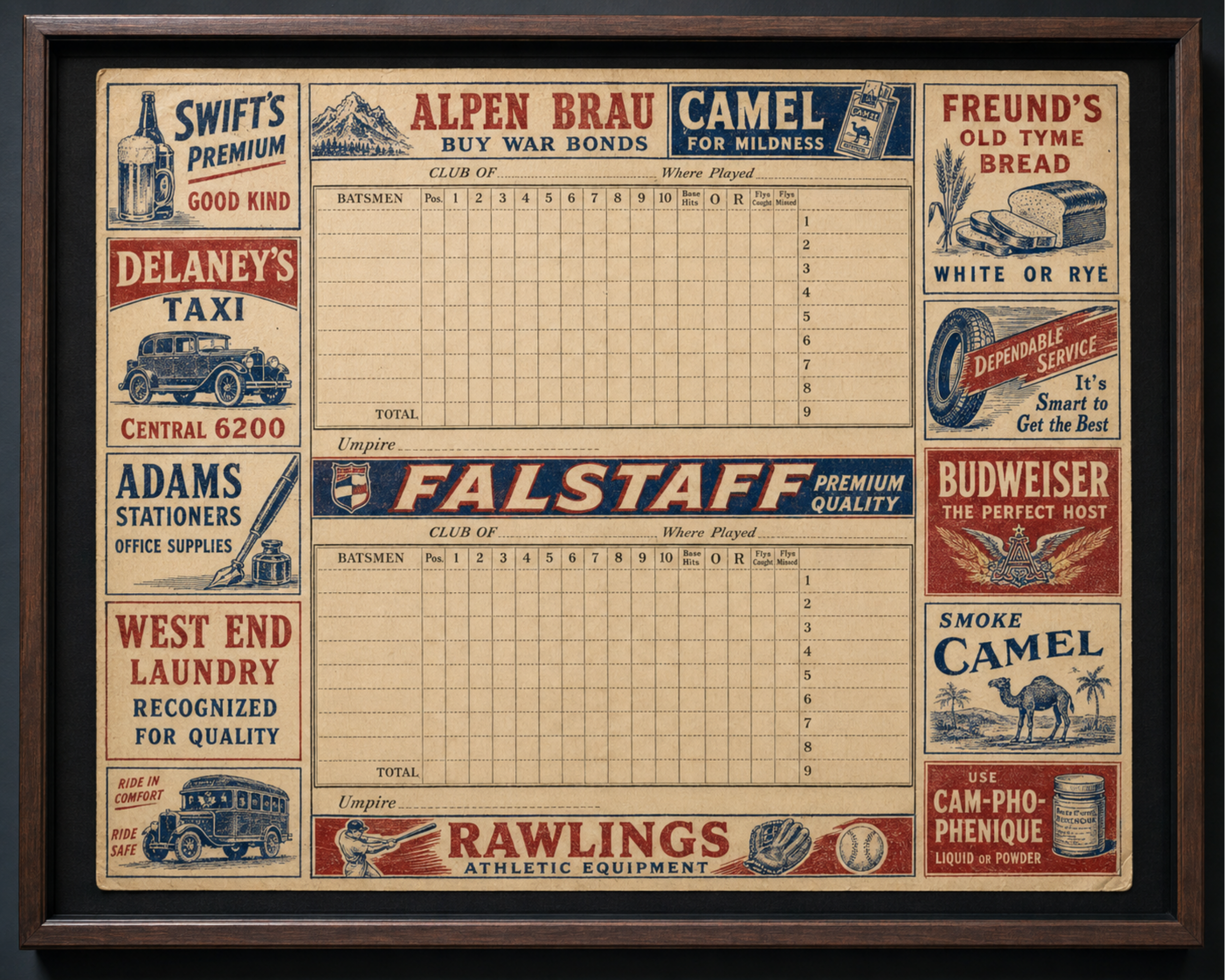
The completed card below records Game Seven of the privately arranged 1946 inter-circuit series between the Tyler Roses and Davenport Deadheaders. Davenport won 3-2, with seven hits and no errors. Tyler finished with two runs, six hits and no errors. Because Davenport still led after the top of the ninth, the unplayed bottom half is marked with an X.
The finished card shows what the same method becomes when it is carried through nine innings. Every mark began with the same short routine: locate the batter, record the result, update the runners and mark the outs.
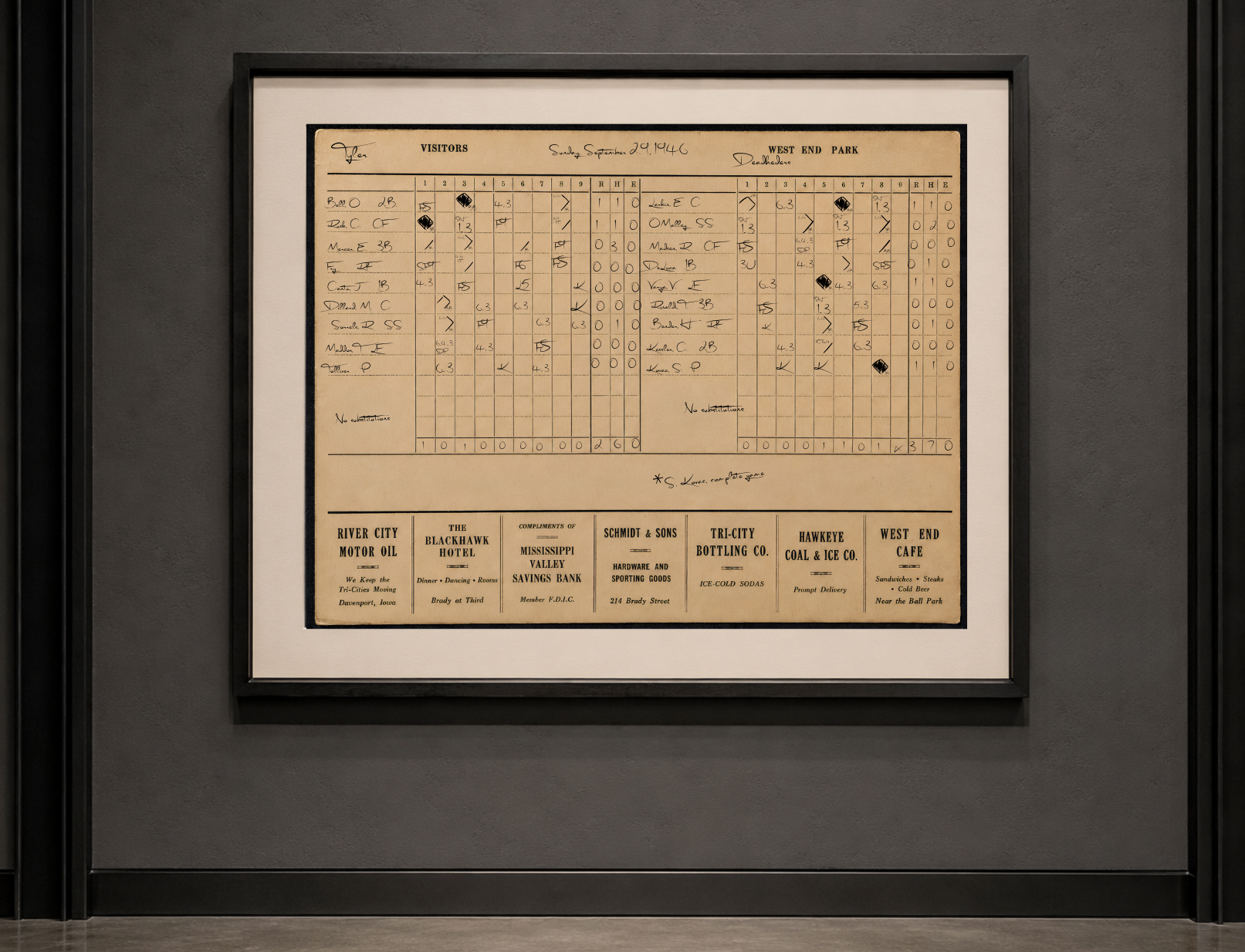
An enlarged reproduction of the completed Game Seven scorecard, framed for display in The Ball Club Register. The original records Davenport’s 3-2 victory over Tyler at West End Park on September 29, 1946.
Keep the game, not a perfect page
A completed baseball scorecard is both a shared record and a personal object. The position numbers and common abbreviations give scorers a language they can recognize, but no two pages look exactly alike. A substitute is squeezed into a margin. A ruling is erased and entered again. The pencil grows darker as the game grows close.
Those imperfections are not failures. They are evidence that the card was made in real time by someone paying attention.
Begin with the batting order. Learn the nine position numbers. Record what happened to the batter, follow every runner and count three outs. With each inning, the marks will come more naturally. When the final out is made, you will have more than the score. You will have the game in sequence, preserved by someone who was there.
Sources and further reading
Major League Baseball, Baseball Basics: How to Keep Score.
Little League University, What's the Score?: The Basics of Scorekeeping.
National Baseball Hall of Fame and Museum, Henry Chadwick.
