Davenport Deadheaders
Davenport, Iowa
Established 1922
1946 Northern Division Champions
Club History
The Davenport Deadheaders were organized in the spring of 1922 by men employed in the commercial greenhouses, municipal planting crews, freight yards, and factories along the city’s west end. The first club played Sunday afternoons against company teams and independent nines from neighboring river towns.
The nickname was not selected at a formal meeting. It first appeared in a local box score during the opening season, apparently borrowed from the work performed by several of the club’s founders. Other papers repeated it, and by the following summer the players themselves had accepted the name.
For its first two seasons, Davenport relied on borrowed grounds and collections taken among players and west-end merchants. The club later settled at West End Park, a rough municipal diamond near the freight yards that local subscribers helped fence and improve. When the Deadheaders entered the Midland Association in 1928, the park became their permanent home.
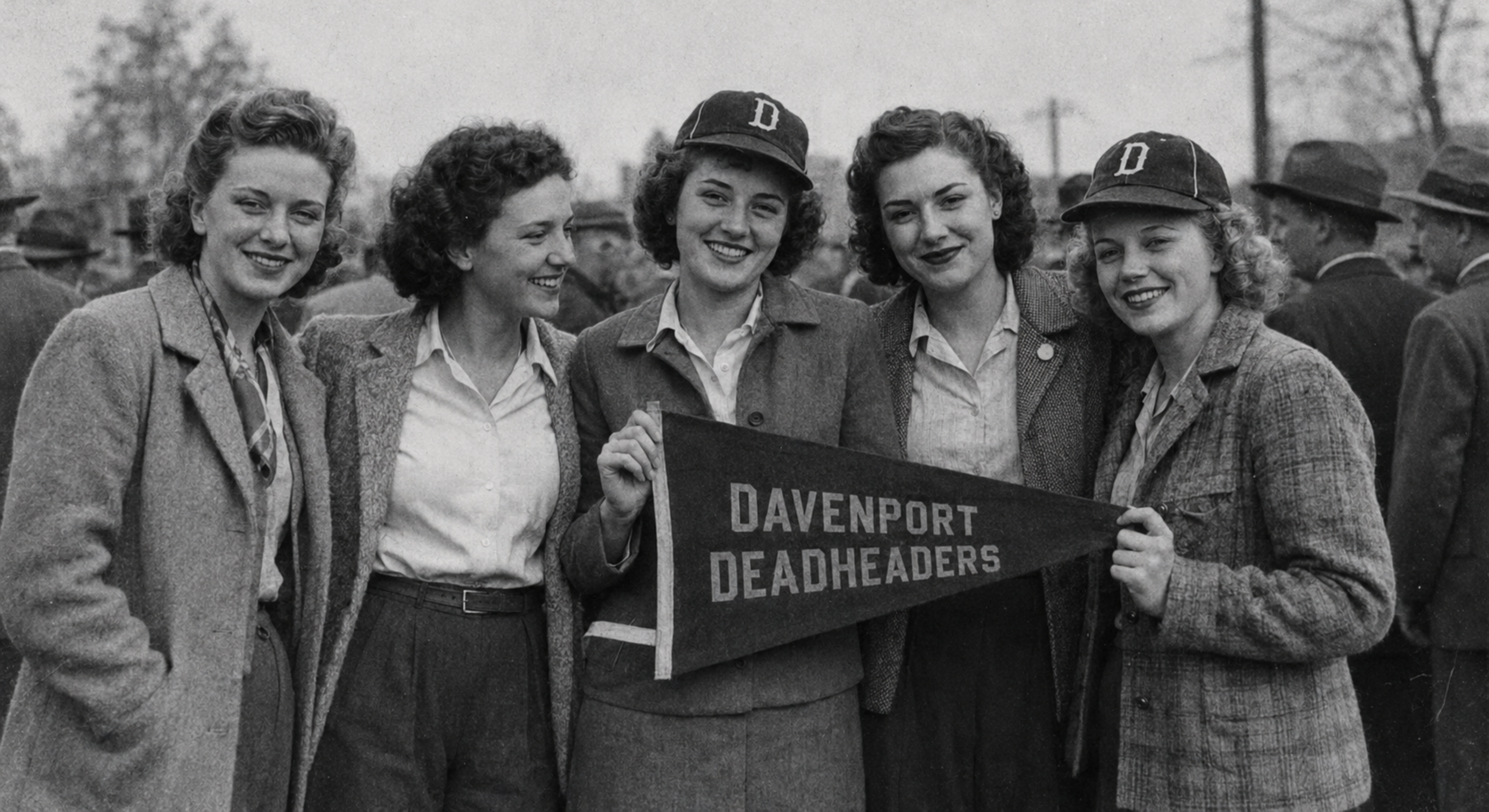
Davenport’s first sustained success came in 1931. The Deadheaders stayed near the top of the Northern Division throughout the summer and secured the pennant during the final week of the schedule. That club also standardized the cream block D worn on its navy caps.
The 1931 team did not begin a dynasty. During the remainder of the decade, Davenport was better known for consistency than dominance. The Deadheaders usually finished in the upper half of the standings, traveled with a modest roster, and proved particularly difficult to beat at West End Park. Sunday doubleheaders regularly drew factory workers, railroad families, and spectators crossing the river from Illinois.
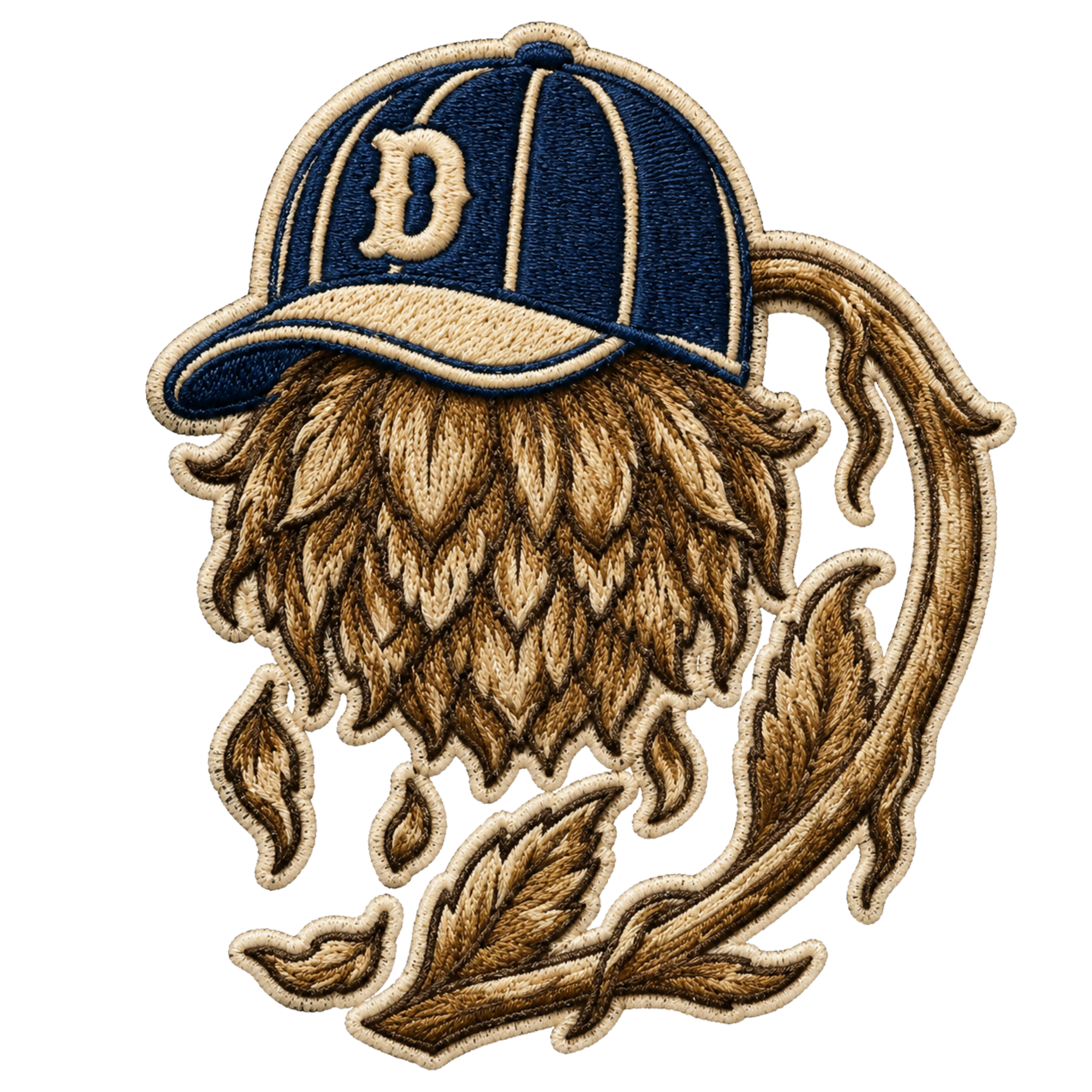
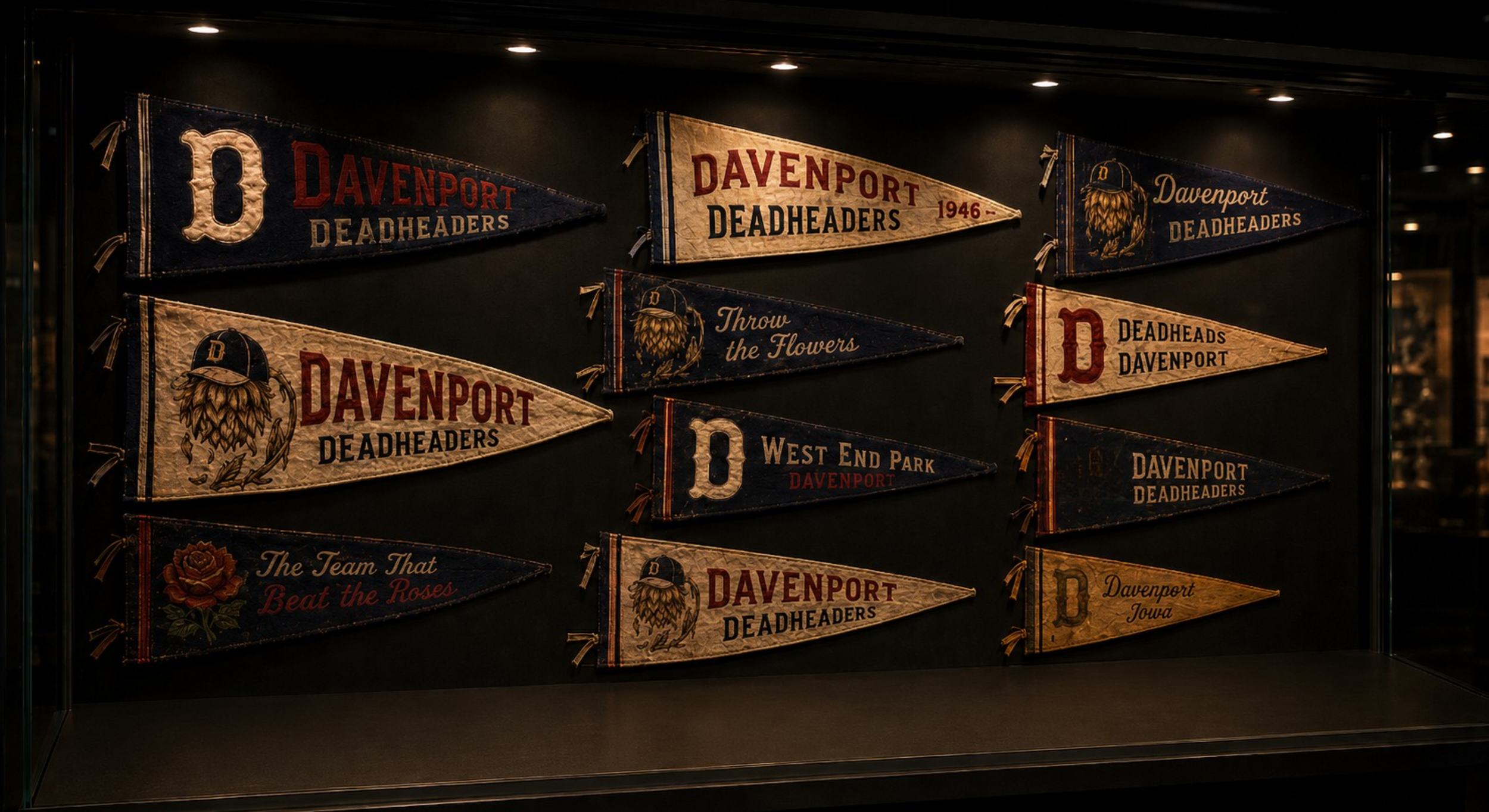
The spent-bloom emblem associated with the club appeared later. It was introduced in a 1938 program and gradually replaced the block D as the Deadheaders’ principal printed mark. The letter remained on the cap, while the Deadhead appeared on advertisements, scorecards, pennants, and club stationery.
The team completed its 1942 schedule but suspended operations before the following season. Several players entered military service, travel became increasingly difficult, and the club’s directors concluded that a proper regional schedule could not be maintained.
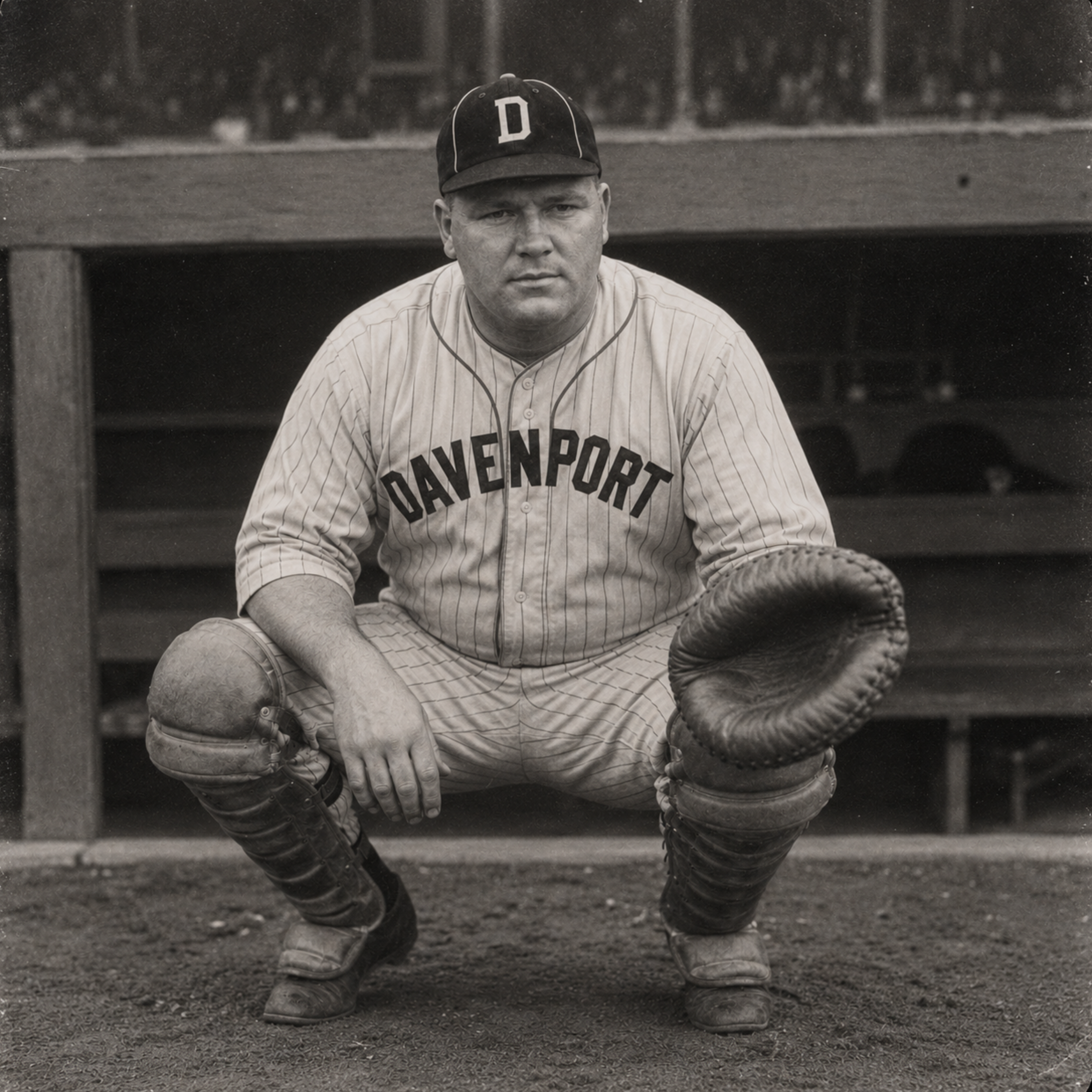
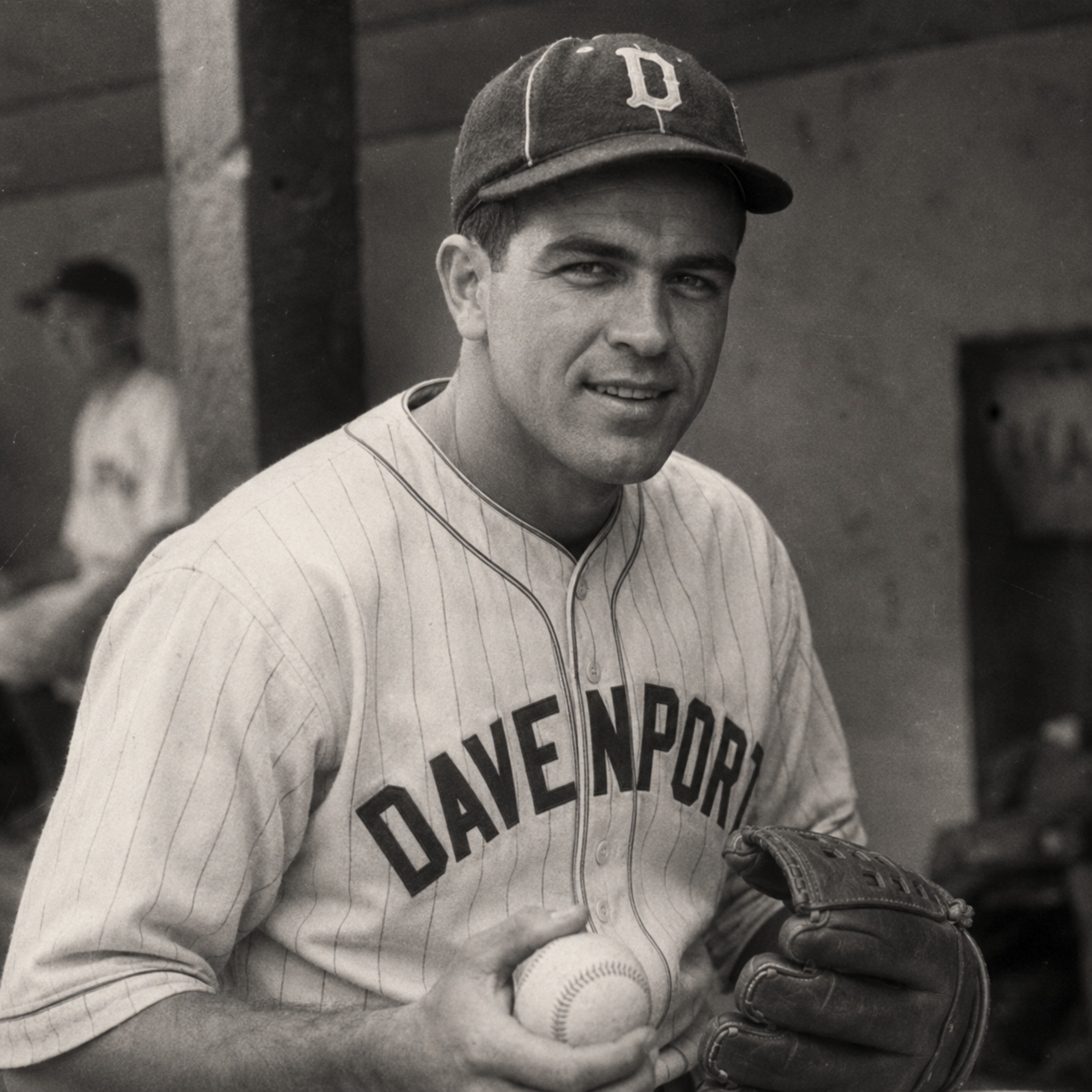
When Davenport reorganized in the spring of 1946, few expected an immediate championship. Manager Walter “Red” Donnelly assembled a roster from returning servicemen, veterans of the prewar club, and several younger players recruited from factory and neighborhood teams. Catcher Eddie Larkin returned as captain, while right-hander Sam Kovac emerged as the staff’s most dependable pitcher.
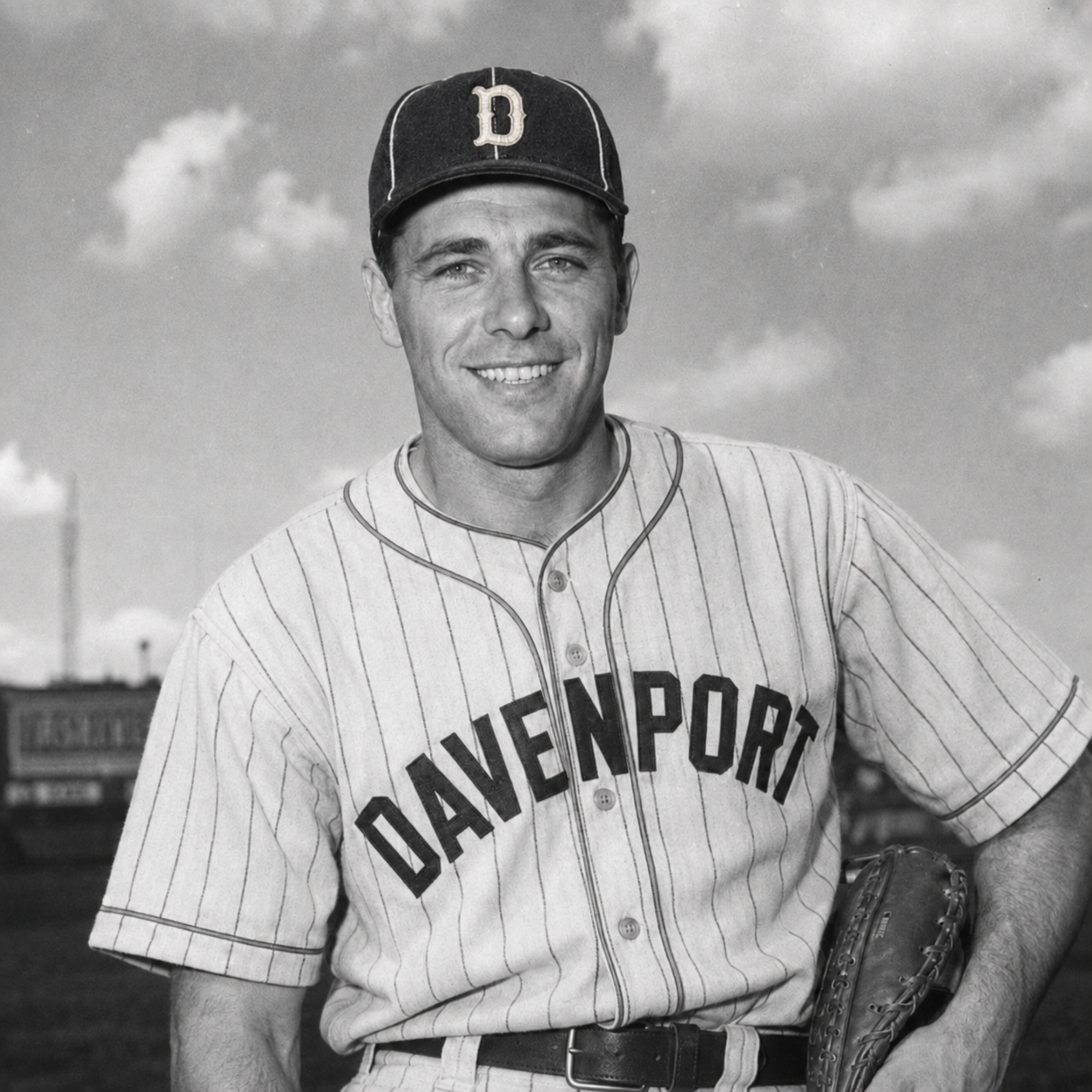
Davenport was not built like a powerhouse. The Deadheaders had neither a rich sponsor nor a deep bench, so Donnelly managed the club for steadiness rather than spectacle: a settled lineup, heavy use of his starting pitchers, and experienced defense at the center of everything. First baseman Frank DeLuca supplied much of the power, while Eddie Larkin caught nearly every important game and served as the club’s steadying voice behind the plate.
Davenport remained in the division race throughout the summer. The Deadheaders finished 68–40 and secured the Northern Division title during the final weekend of the schedule, earning the club’s first pennant since 1931.
At the conclusion of league play, Davenport accepted an invitation to meet the Tyler Roses, champions of the Southern Independent Circuit. The privately arranged seven-game series was intended to settle years of argument between the two regional leagues.
Tyler had finished 76–28 and carried the reputation of a club built to win every season. The Roses won two of the first three games at Cotton Belt Park before the series moved north.
Davenport evened the series with a 2–0 victory in Game Four, but Tyler reclaimed the advantage the following afternoon. Facing elimination in Game Six, the Deadheaders broke open a close game in the middle innings and won 6–3.
Kovac started the deciding game on short rest. Tyler scored twice early, but he allowed nothing after the third inning. Davenport cut the lead to one before DeLuca doubled home the tying run in the sixth. The Deadheaders pushed across the go-ahead run in the eighth, and Kovac finished the complete-game 3–2 victory.
Contemporary accounts placed the final-game crowd at more than 4,000. Spectators filled the wooden grandstand, packed the first-base bleachers, and stood several rows deep behind temporary rope lines running along both foul territories.
The Midland Association recognized Davenport only as its 1946 Northern Division champion. The series against Tyler carried no official sanction, and no governing body awarded a trophy.
In Davenport, that distinction mattered very little. The 1946 Deadheaders were remembered simply as the team that beat the Roses.
Club and Community
-
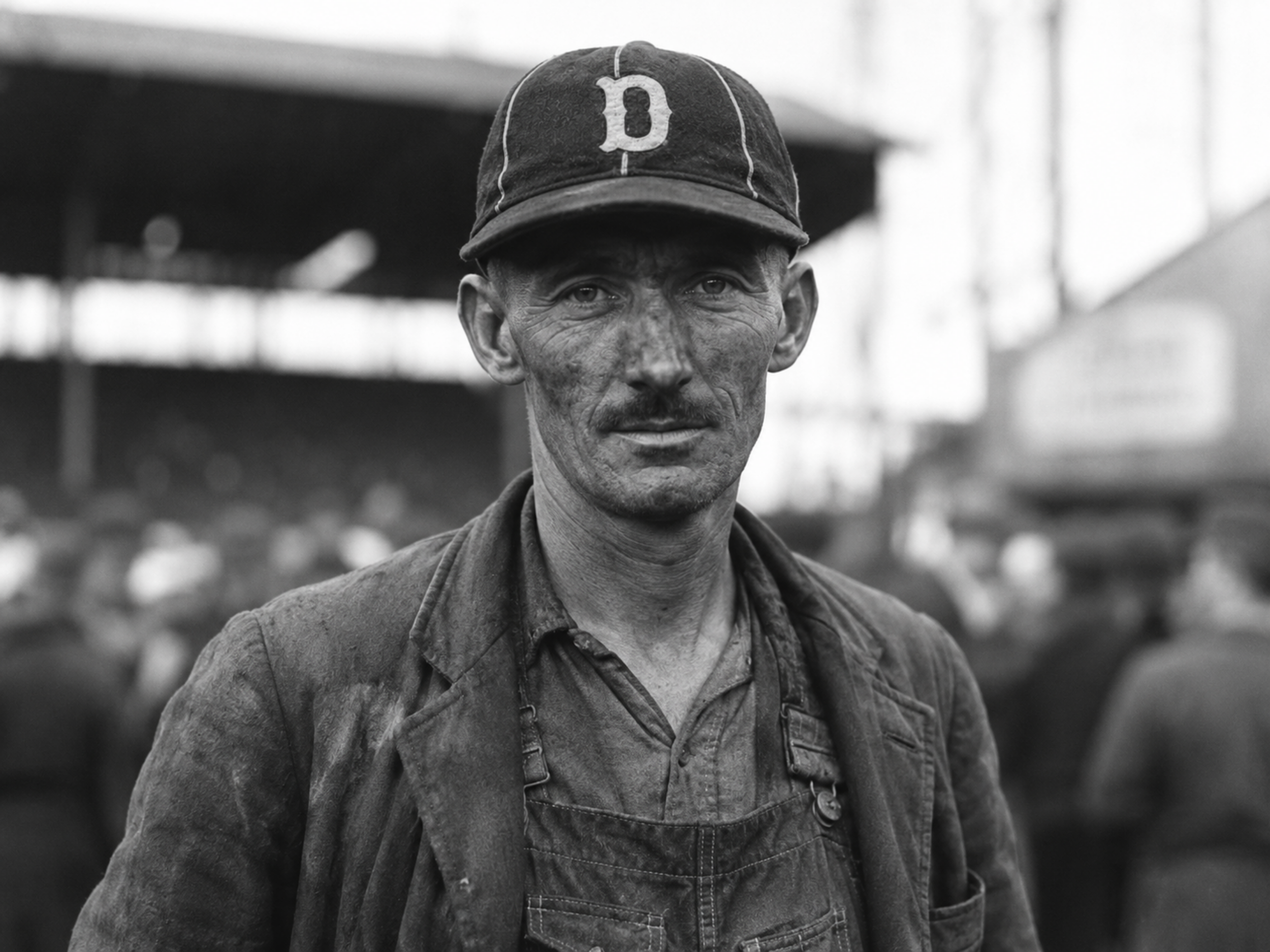
![Black-and-white 1940s portrait of a factory worker wearing a Davenport Deadheaders cap outside West End Park, with the ballpark crowd blurred behind him.]()
After the Shift
Factory Worker at West End Park · Circa 1940s
Still marked by the day’s work, a Davenport factory hand arrives at West End Park in a Deadheaders cap. The portrait captures the club’s core constituency: men and families who came from the yards, shops, foundries, and greenhouses straight to the game, carrying the west end with them through the gate.
-
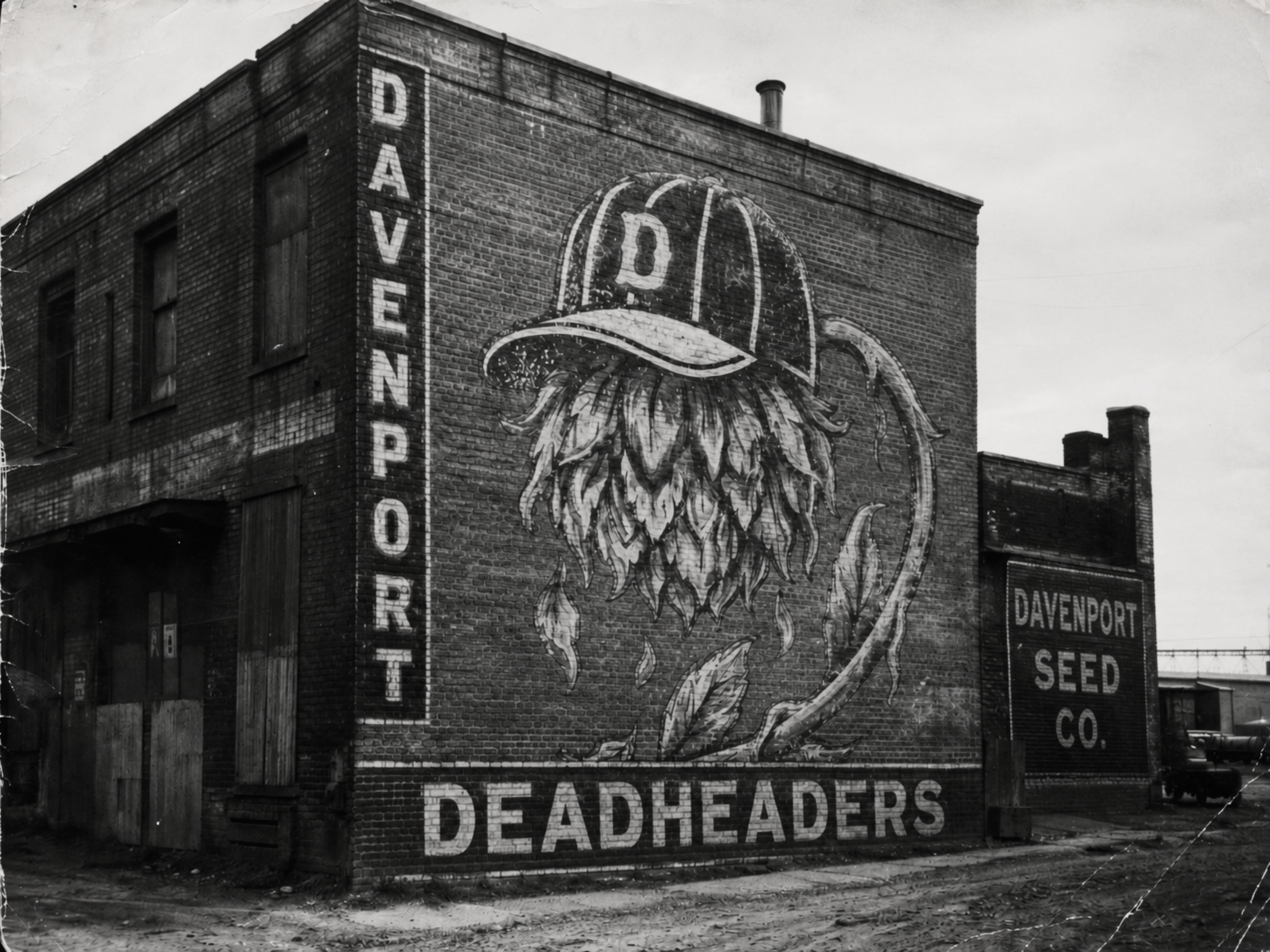
![Black-and-white 1940s photograph of a brick Davenport warehouse with a large faded Davenport Deadheaders mural painted on the wall.]()
The Deadhead on Brick
Warehouse Mural · Davenport’s West End
Painted across a brick warehouse near the seed houses and freight tracks, the fading Deadheaders mural shows how thoroughly the club had entered Davenport’s west-end landscape. The mark reads less like advertising than civic ownership — a ballclub weathered into the same brickwork as the trades that supported it.
-
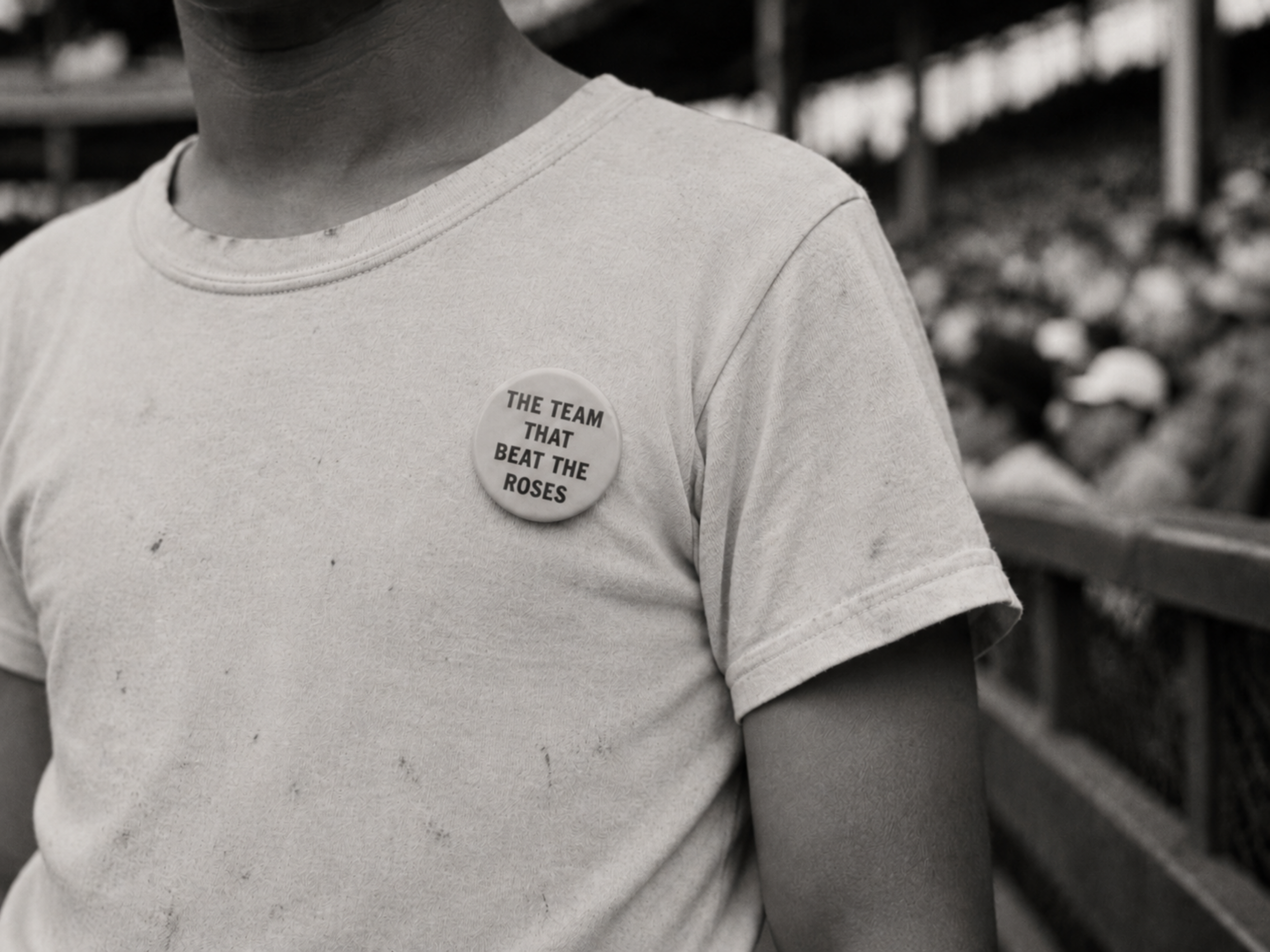
![Close-up black-and-white photograph of a young Davenport fan wearing a button that reads “The Team That Beat the Roses.”]()
The Team That Beat the Roses
Fan Button · After the 1946 Tyler Series
After Davenport’s upset of Tyler, the slogan left the ballpark and followed the club into town. Pinned to a child’s stained summer shirt, the button turns the victory into something local and personal — a piece of neighborhood pride worn by the next generation of Deadheaders supporters.
-
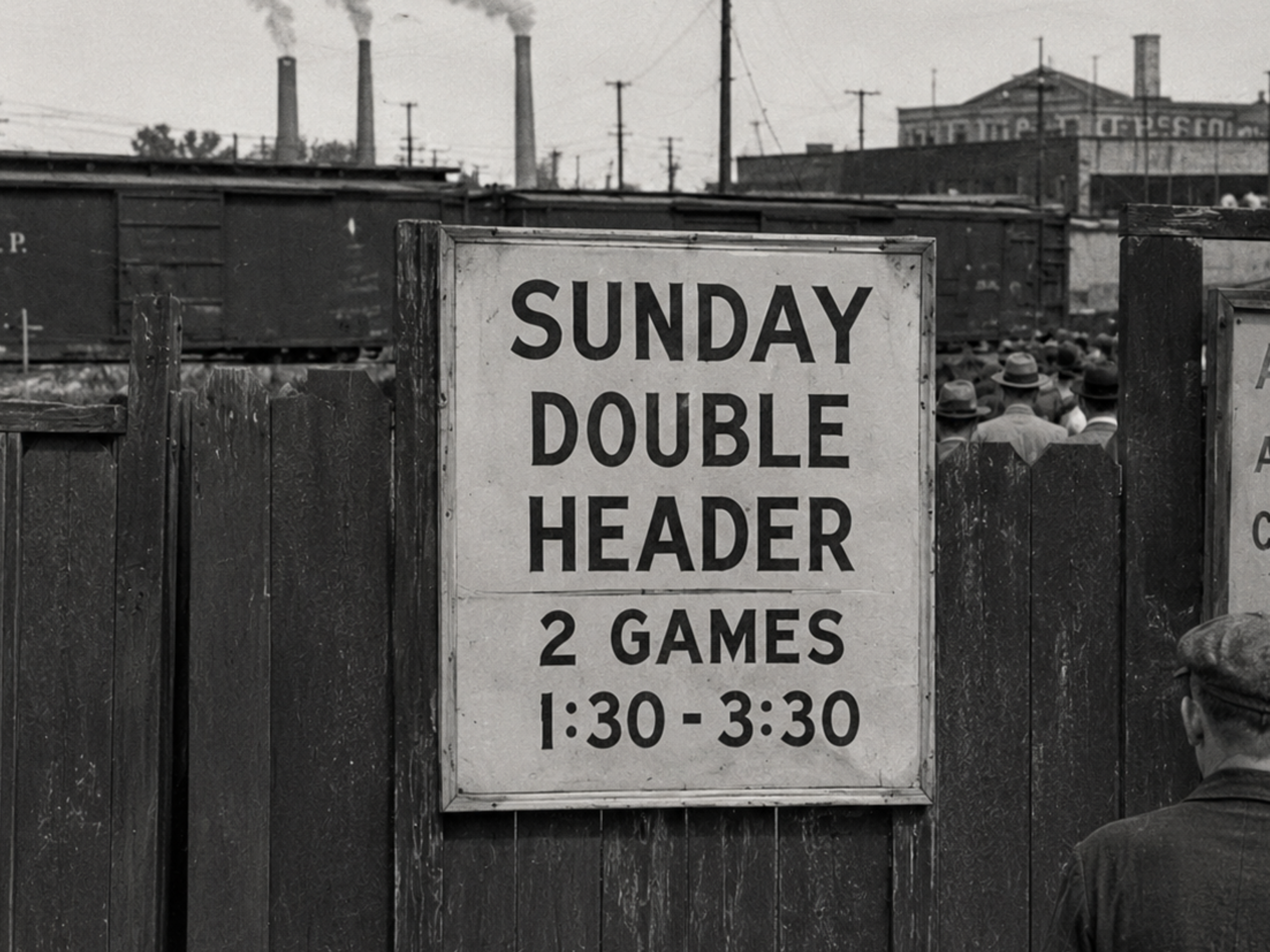
![West End Park fence sign advertising a Sunday doubleheader, with freight cars and smokestacks beyond the ballpark.]()
Sunday Doubleheader
West End Park Signage · Circa 1940s
Tacked to the west-end fence, the handbill advertised the weekly rhythm of Deadheaders baseball: two games, one afternoon, and a crowd arriving from the plants, yards, and riverfront neighborhoods. Beyond the sign, freight cars and smokestacks kept West End Park tied closely to Davenport’s working day.
Club Record
| Club | Davenport Deadheaders Baseball Club |
|---|---|
| Location | Davenport, Iowa |
| Established | 1922 |
| Years Active | 1922–1942; 1946–1951 |
| Operations Suspended | 1943–1945 |
| League | Midland Association |
| Division | Northern Division |
| Status | Independent regional club |
| Home Park | West End Park |
| Ballpark Capacity | Approximately 3,200 seated; more than 4,000 with standing room |
| Club Colors | Navy blue, cream, and red |
| Primary Uniform | Cream flannel with navy pinstripes, red “DAVENPORT” lettering, and navy trim |
| Travel Uniform | Gray flannel with navy “DAVENPORT” lettering and red trim |
| Cap | Navy with cream seam piping and a cream block D |
| Primary Cap Mark | Cream block D |
| Common Shortened Name | The Deadheaders |
| Informal Nickname | The West End Nine |
| Club Motto | See It Through |
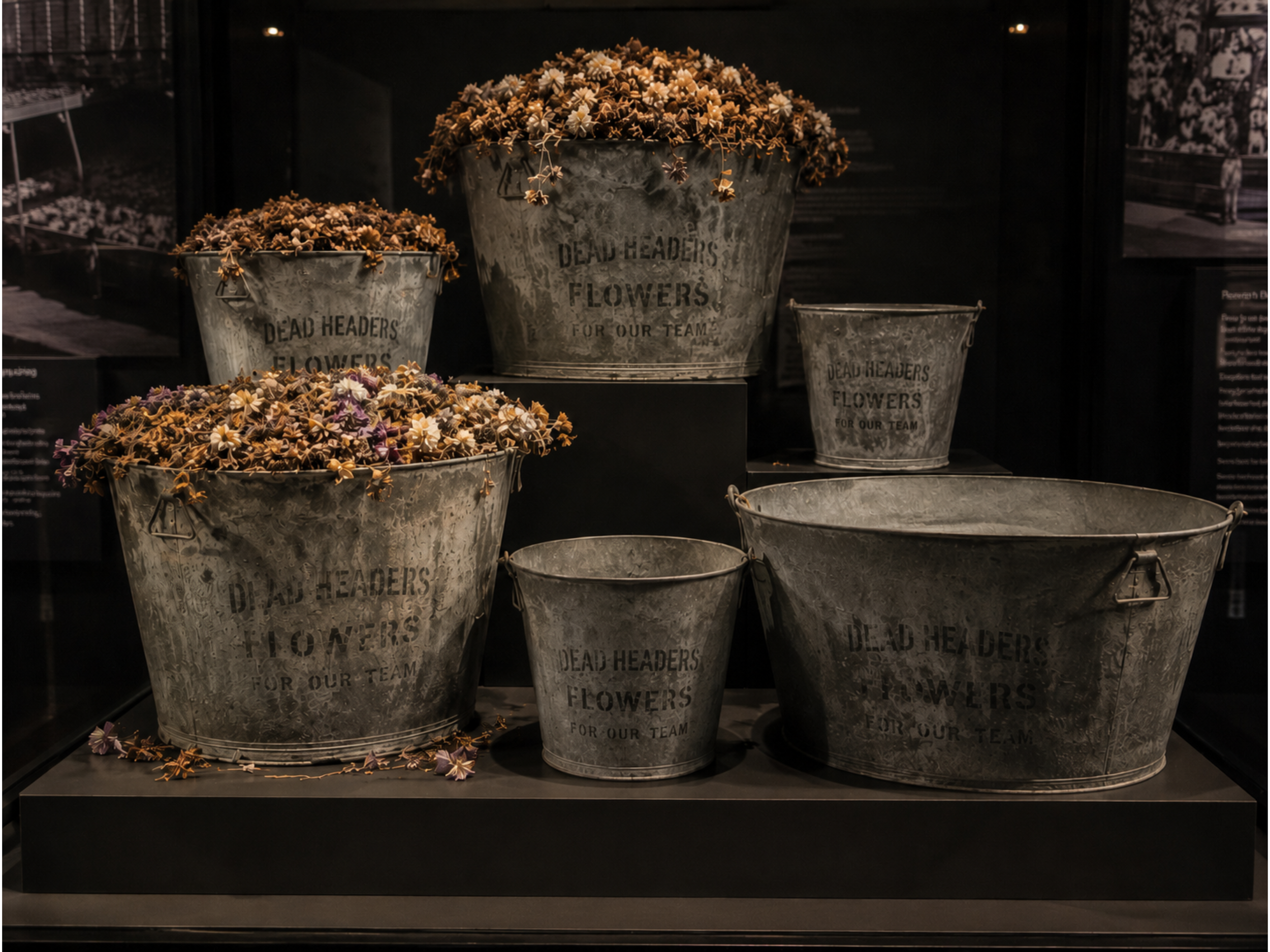
| Home-Victory Custom | Supporters donated deadheaded blooms in galvanized gate buckets before first pitch, then threw flowers from brown paper bags after Davenport victories |
| Postwar Honorific | The Team That Beat the Roses |
| Primary Club Emblem | The Deadhead—a spent flower wearing a Davenport cap |
| Official Mascot Name | None; club publications referred to the figure simply as “the Deadhead” |
| Cap Mark Adopted | 1931 |
| Deadhead Emblem Adopted | 1938 |
| Motto First Used | 1946 |
| Club President, 1946 | Emil Sorensen |
| Manager, 1946 | Walter “Red” Donnelly |
| Club Captain, 1946 | Eddie Larkin, catcher |
| Division Titles | 1931, 1946 |
| Best-Known Inter-Circuit Opponent | Tyler Roses |
| 1946 Official Result | Northern Division champions |
| 1946 Inter-Circuit Result | Defeated Tyler, four games to three |
| Series Status | Privately arranged inter-circuit series; not recognized by either league office |
| Final Season | 1951 |
| Recordkeeping Note | Complete club records before 1928 have not survived |
Club Uniforms and Marks
The Deadheaders’ appearance was plain by design. Their uniforms relied on flannel, block lettering, and a narrow set of club colors: navy blue, cream, and red. The result was not decorative, but it was immediately recognizable.
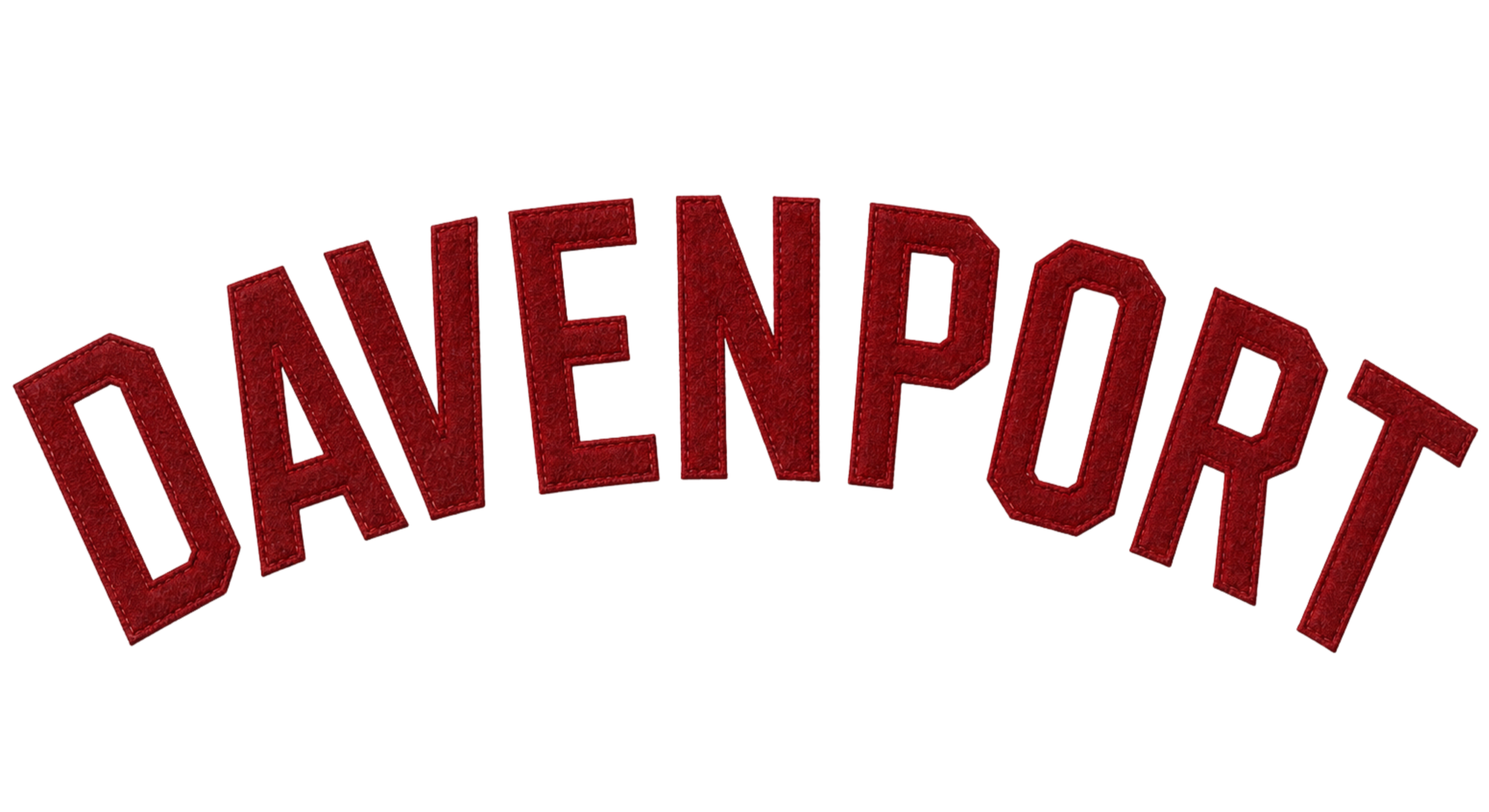
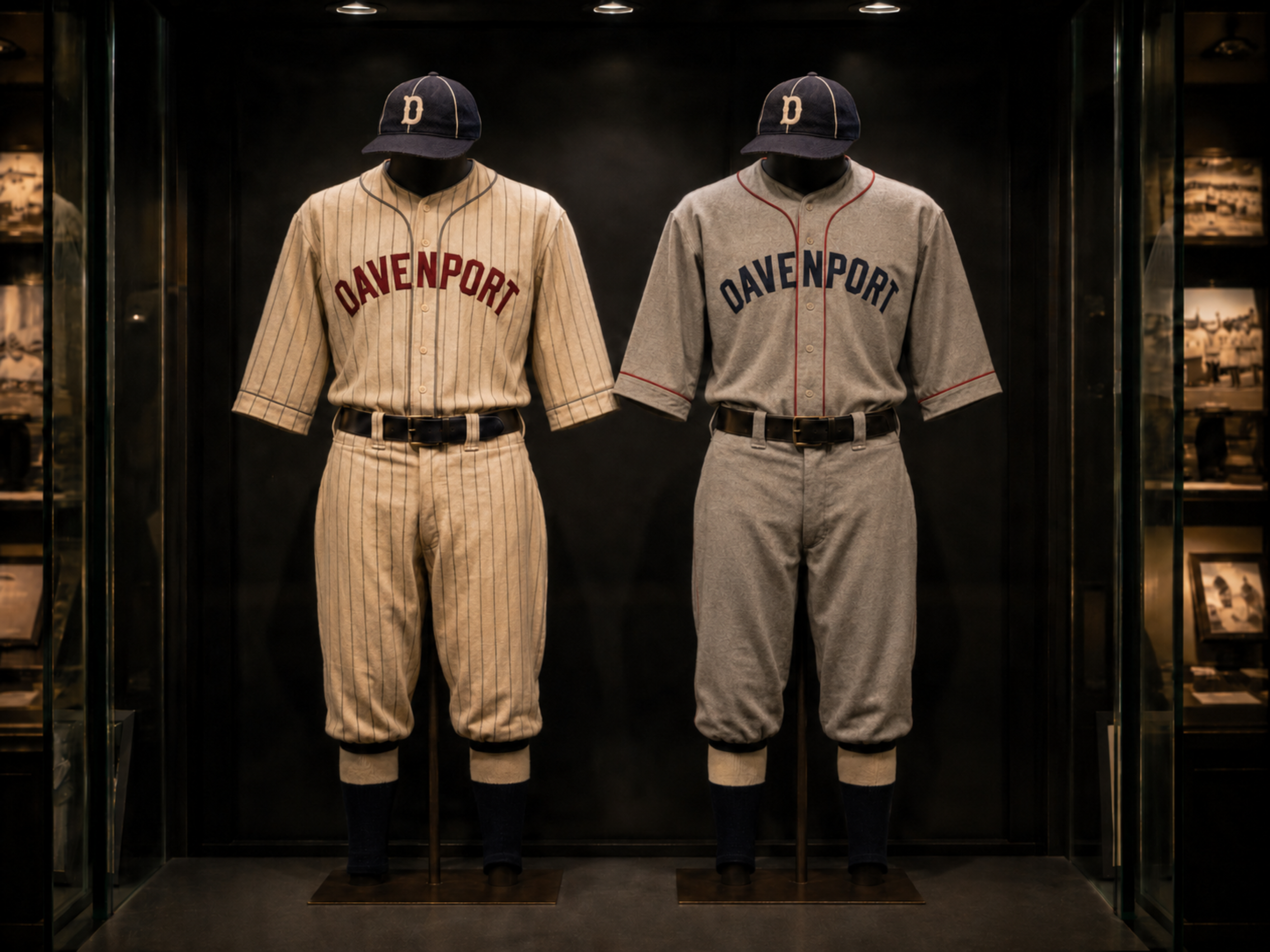
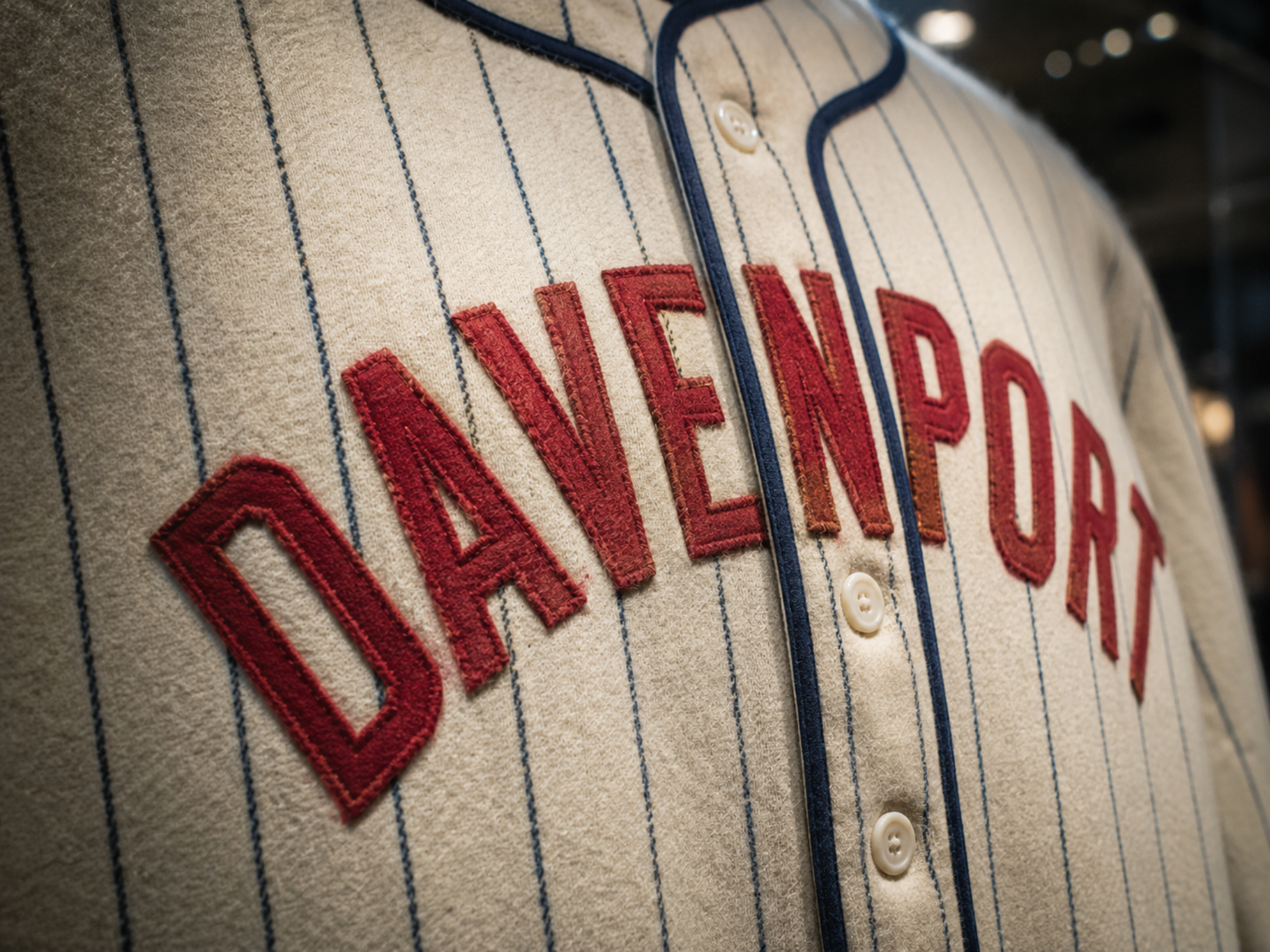
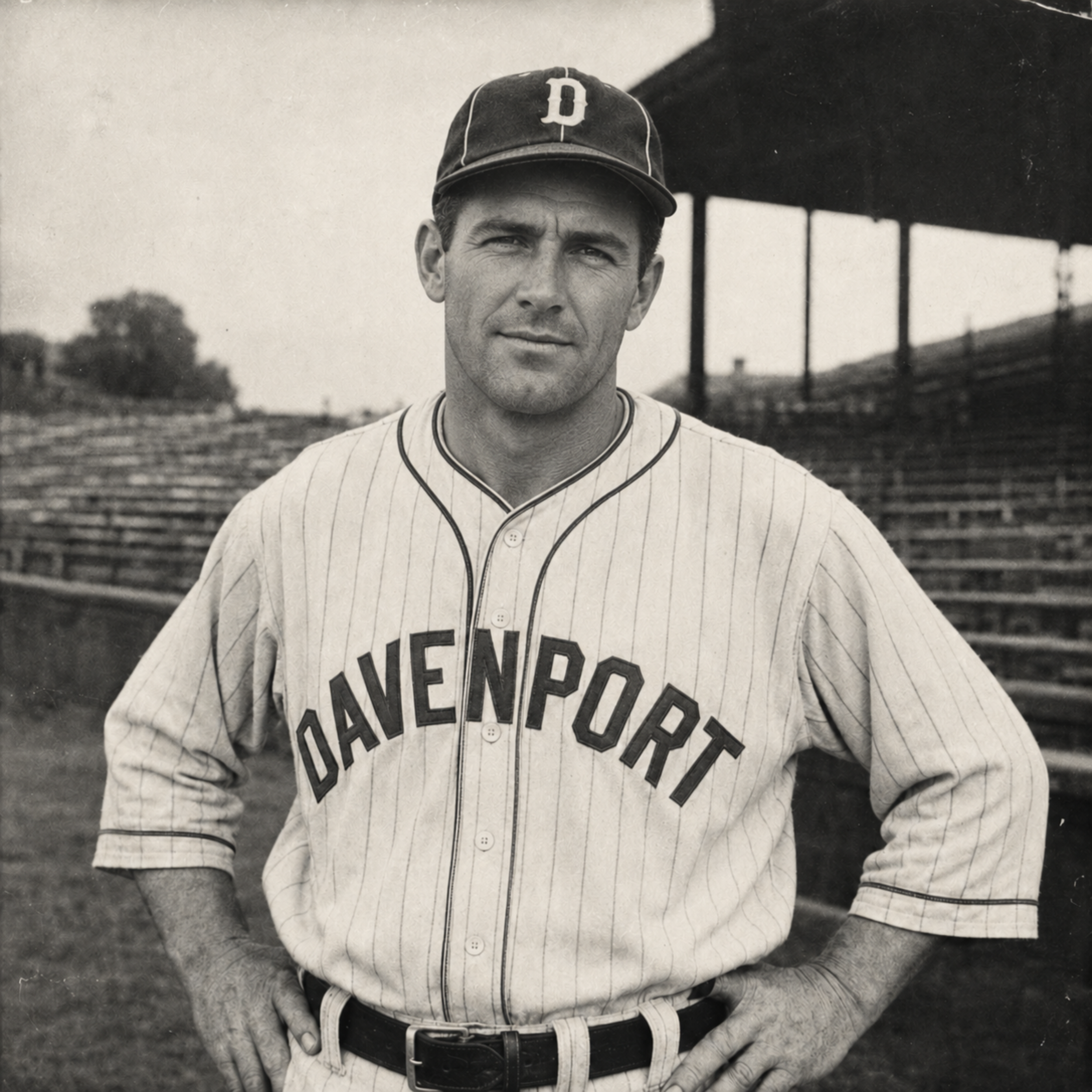
Davenport’s primary uniform was cream flannel with navy pinstripes, red DAVENPORT lettering, and navy trim. It was the club’s clearest field presentation: light in color, formal in construction, and severe enough to match the west-end grounds where it was worn.
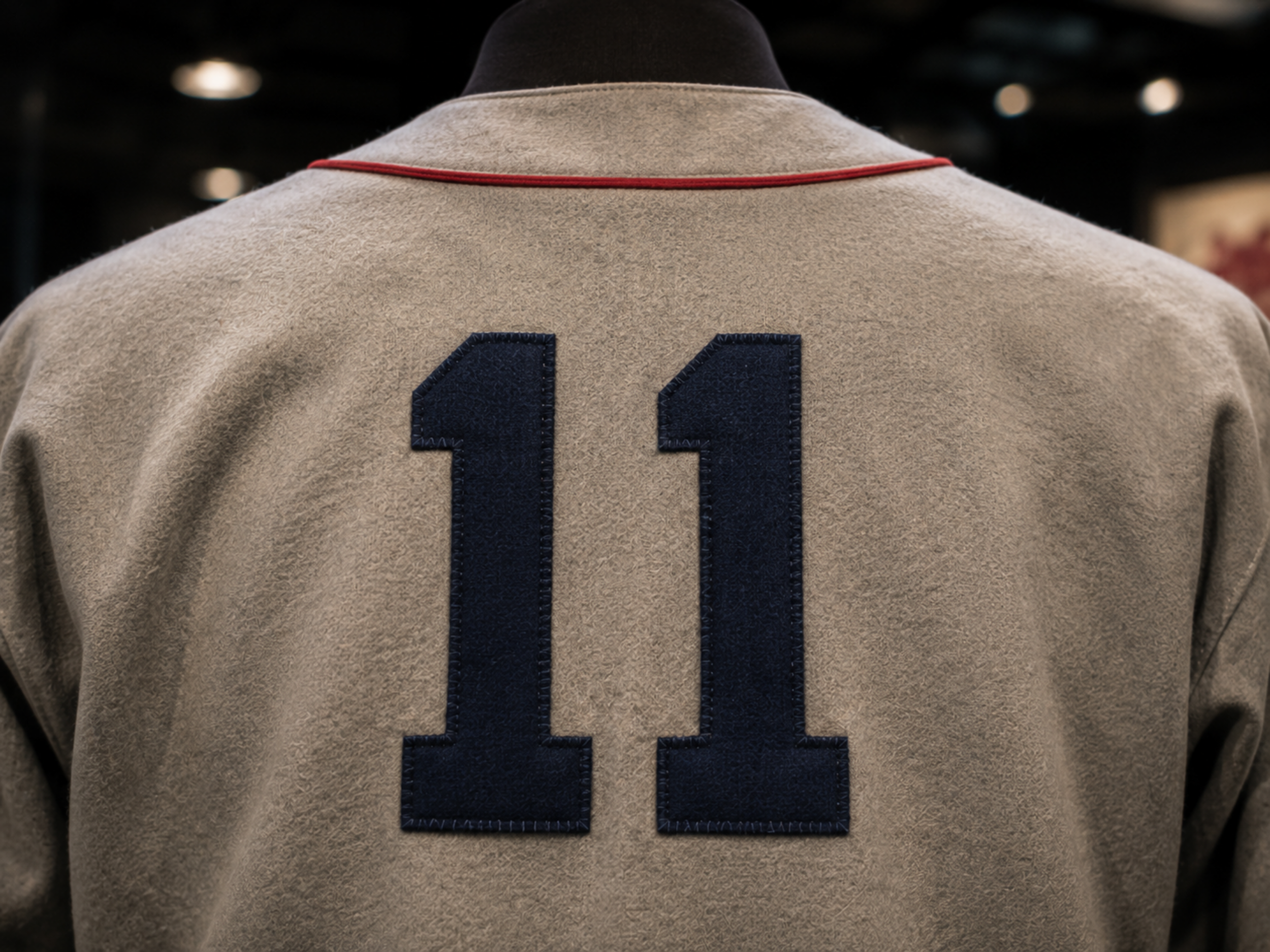
The travel uniform was gray flannel with navy DAVENPORT lettering and red trim. It carried the same arched lettering across the chest, but with less contrast and a more practical character. In photographs from the period, the travel uniform appears heavier and quieter, suited to rail travel, visiting parks, and long afternoons away from West End Park.
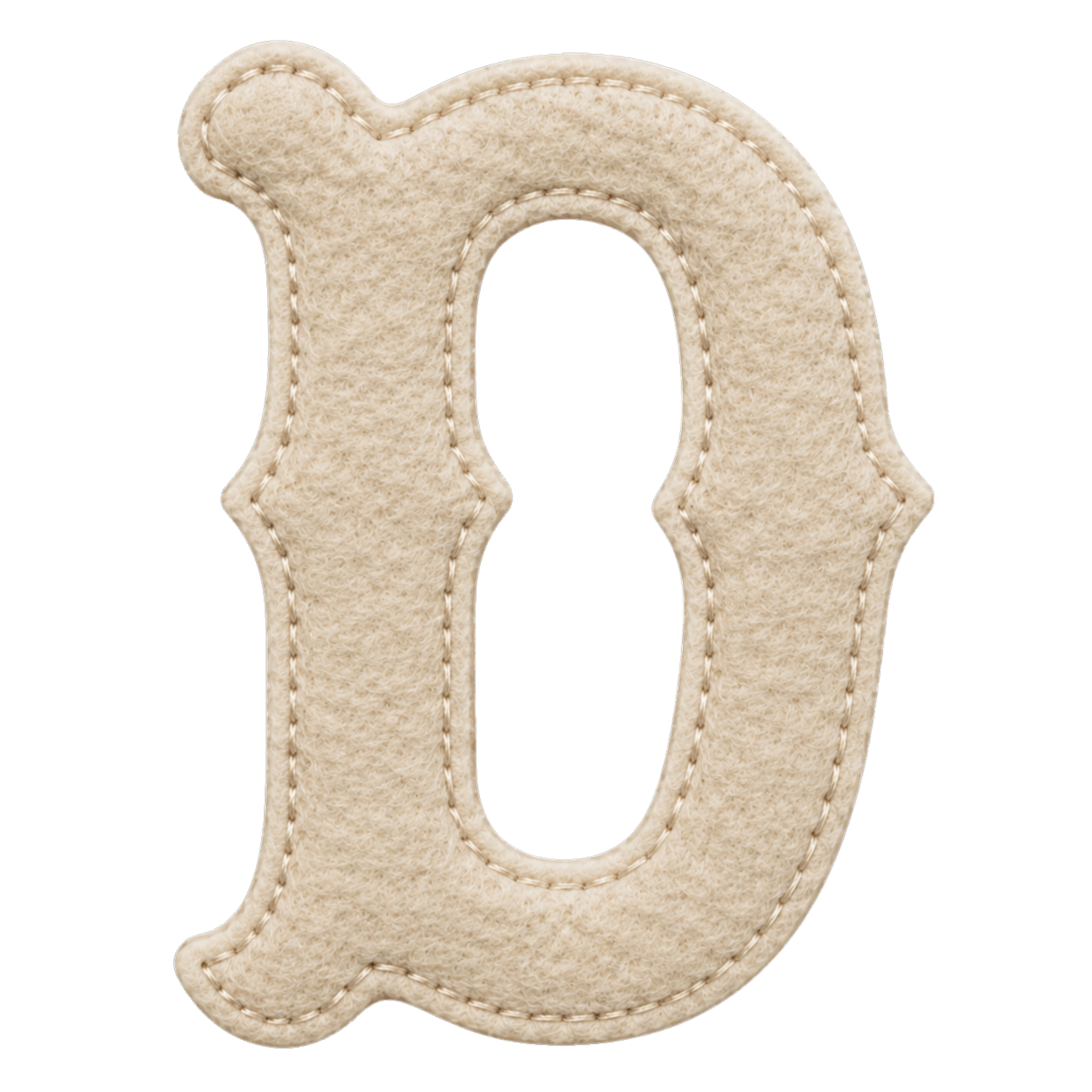
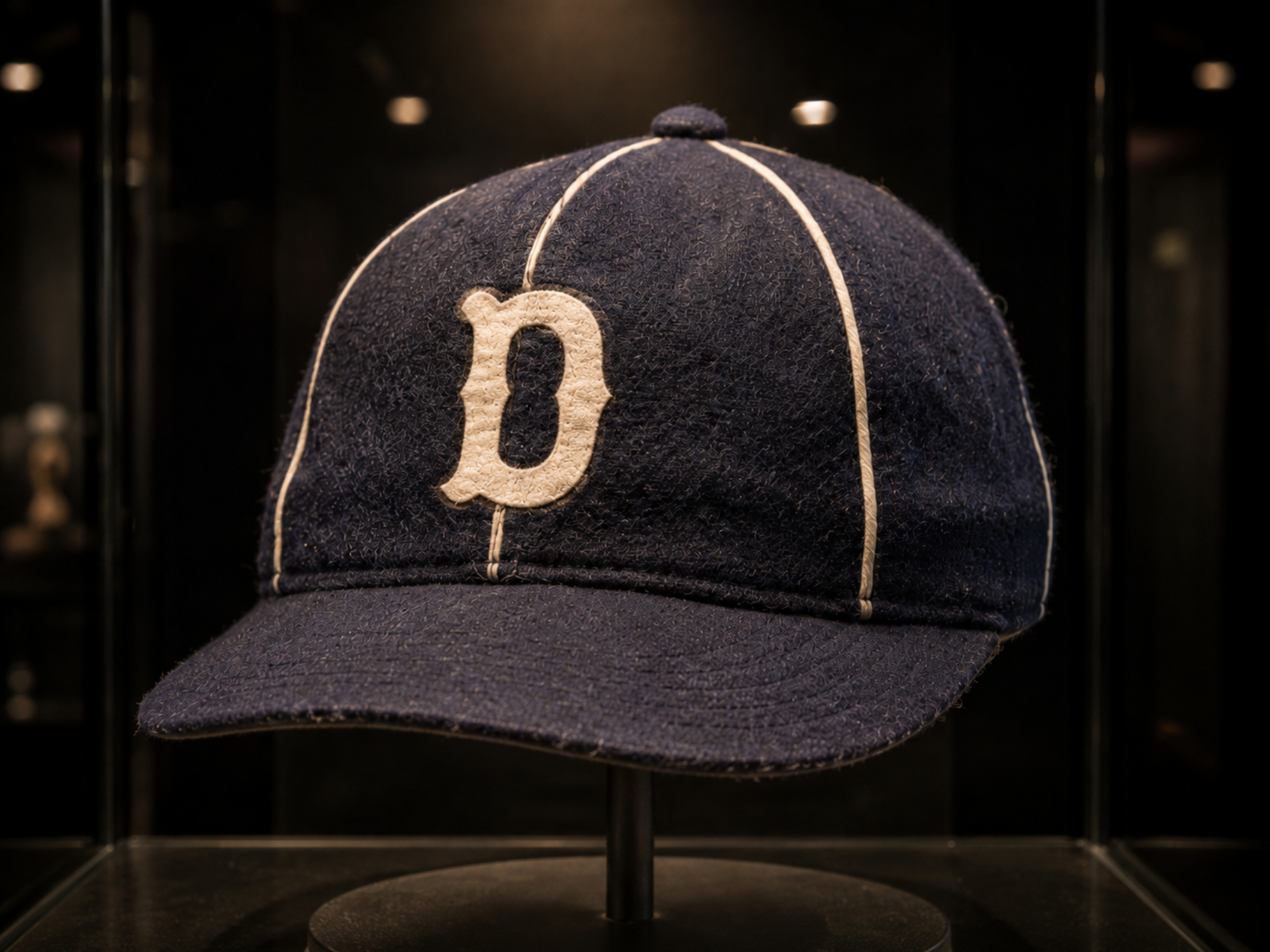
The cap remained Davenport’s most consistent uniform element. Navy with cream seam piping, it bore a cream block D at the front. The mark was standardized during the 1931 pennant season and continued as the club’s uniform mark through the final season of 1951.
The spent-bloom emblem appeared later. First printed in a 1938 program, the drawing showed a drooping flower wearing the same Davenport cap as the players. By the postwar season, the Deadhead had become the club’s primary display mark, used on advertisements, scorecards, pennants, ticket books, and stationery.
The figure was never given a personal name. Club publications referred to it simply as the Deadhead.
Together, the uniforms and marks gave Davenport two related identities. On the field, the club was represented by flannel, pinstripes, and the block D. In print, it was represented by the Deadhead itself — worn down, plainly drawn, and still standing.
Flannel, Felt and Thread
-
![Davenport Deadheaders primary and travel baseball uniforms displayed side by side in a museum case, each with a navy cap bearing the cream block D.]()
Primary and Travel Uniforms
Primary and Travel Uniforms · Museum Display
Displayed together, Davenport’s cream primary uniform and gray travel set show the two field looks most closely associated with the club. The same navy cap, finished with cream seam piping and the cream block D, was worn with both uniforms and remained the Deadheaders’ clearest mark on the diamond.
-
![Navy Davenport Deadheaders baseball cap with cream seam piping and a cream block D on the front.]()
Primary Cap
Cream Block D · c. 1930s–1940s
The navy cap was worn with both the primary and travel uniforms and remained Davenport’s most consistent field identifier. Finished with cream seam piping and the cream block D, it carried the club’s clearest mark from the 1931 pennant season through the final years of play.
-
![Close-up museum photograph of the Davenport Deadheaders’ primary uniform, showing red stitched DAVENPORT lettering across a cream flannel jersey with navy pinstripes, navy trim, and a button front.]()
Primary Chest Lettering
Arched DAVENPORT Lettering · Primary Uniform Detail
The arched DAVENPORT lettering served as the primary uniform’s central field identifier. Individually stitched in red against cream flannel and navy pinstripes, the letters gave the shirt its clearest note of contrast and finish.
-
![Close-up of the back of a gray Davenport Deadheaders travel jersey with red collar piping and a navy number 11.]()
Travel Back Numbering
Navy Number 11 · Travel Uniform Detail
The back of Davenport’s travel uniform was intentionally spare: gray flannel, red collar piping, and a navy felt number centered beneath the shoulder seam. Number 11 was stitched directly to the back panel, giving the travel uniform a clean, practical finish for rail travel and long afternoons away from West End Park.
-
![Davenport Deadheaders dugout jacket with arched lettering and the Deadhead emblem sewn on the back.]()
Dugout Jacket
Cold-Weather Outerwear · Museum Display
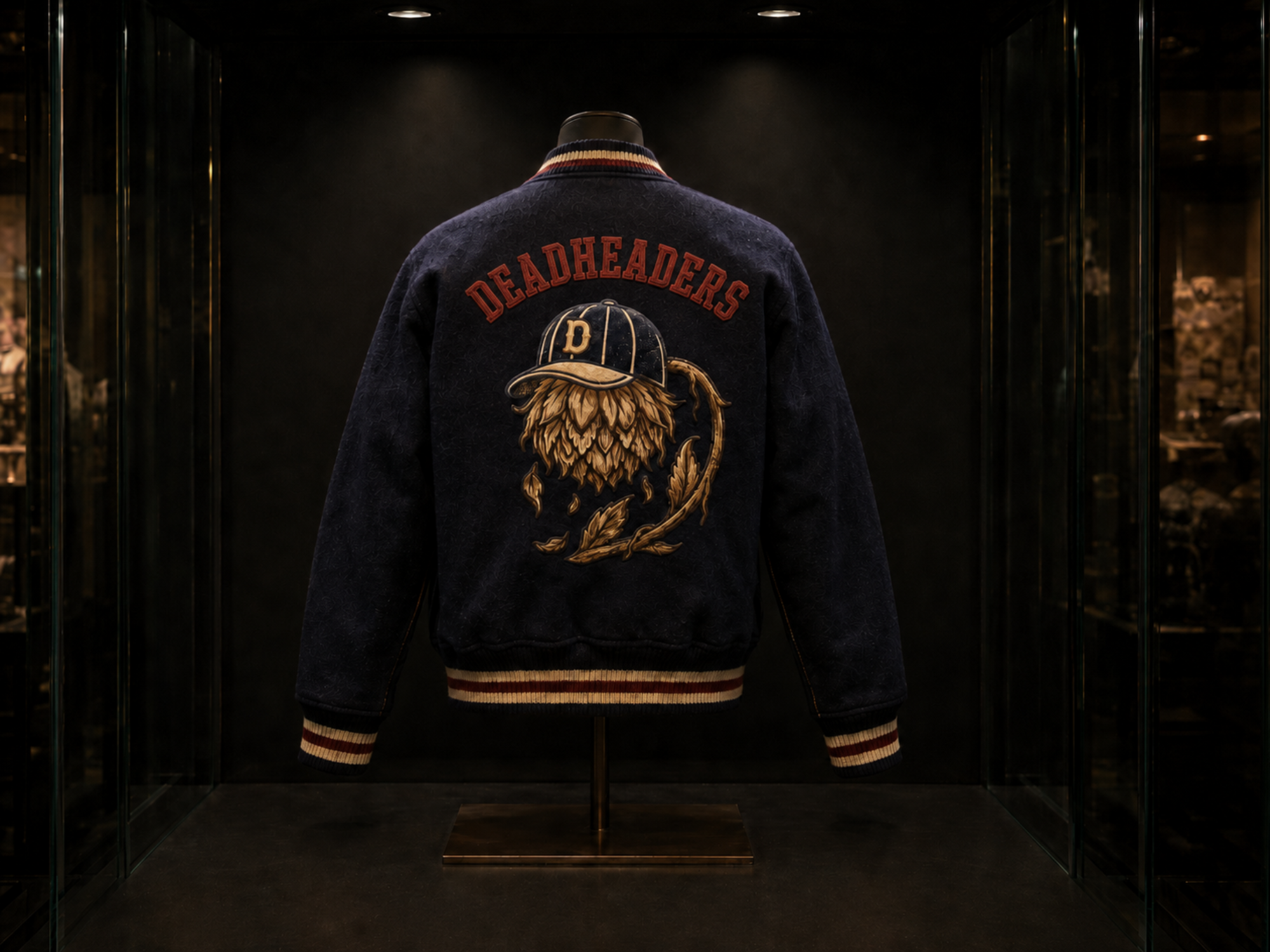
The back of Davenport’s cold-weather dugout jacket carried the club’s Deadhead emblem as a sewn patch beneath arched red DEADHEADERS lettering. Unlike the cap D, which served as the club’s field mark, the Deadhead gave the jacket its display character and tied the club’s outerwear to its printed identity.
West End Park
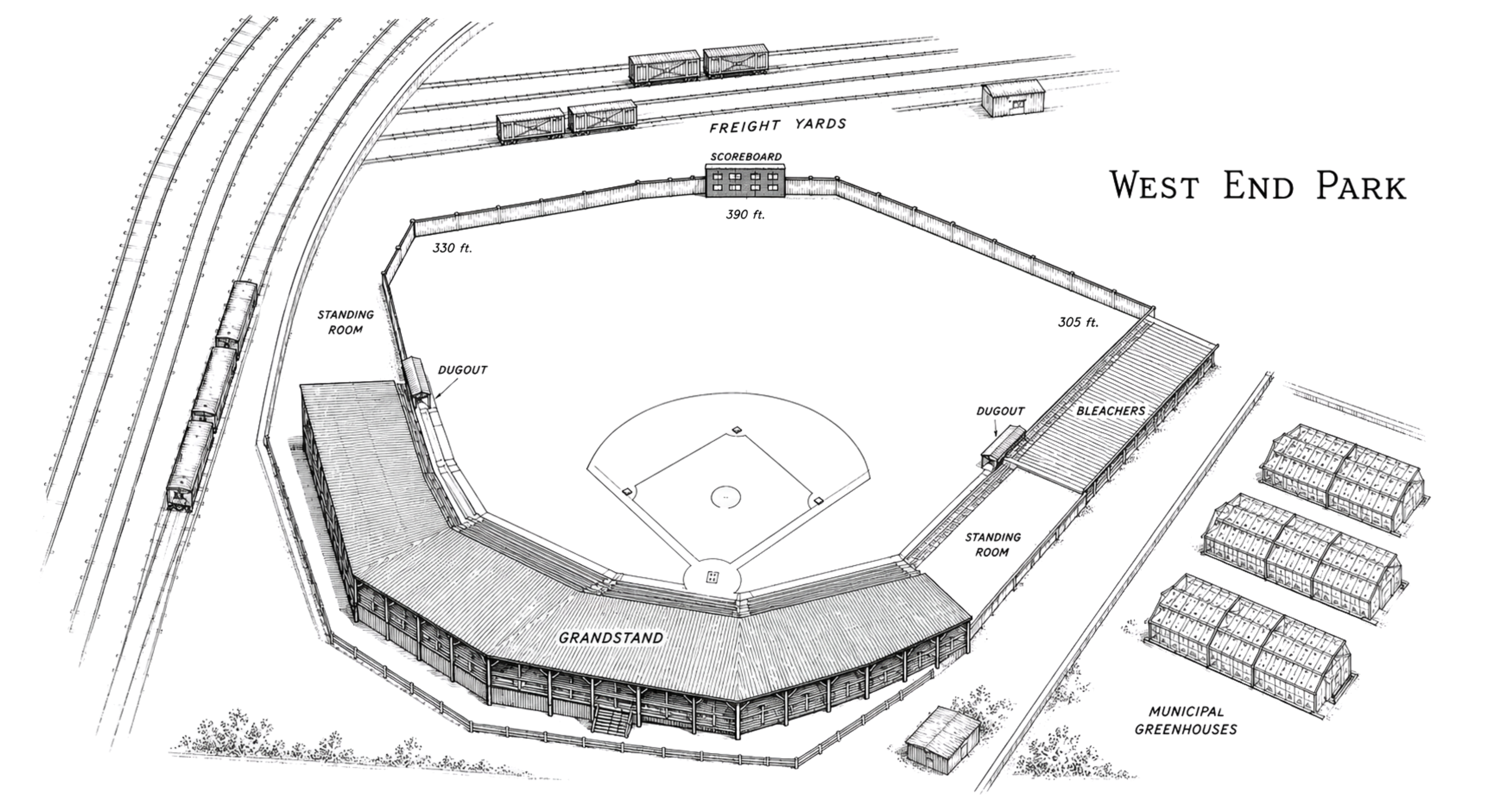
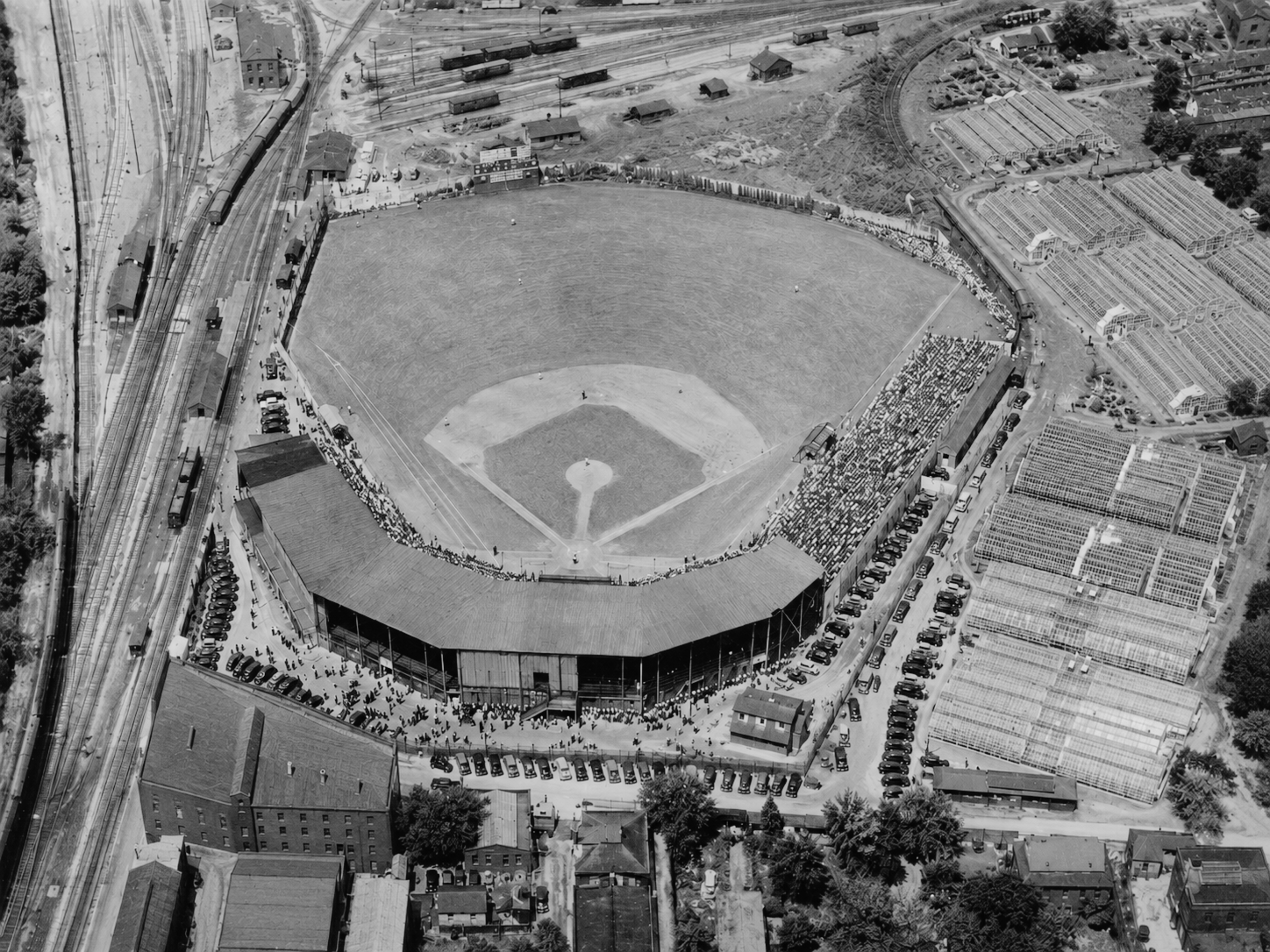
West End Park occupied a narrow pocket of Davenport’s industrial west end, hemmed in by freight tracks on one side and municipal greenhouses on the other. After spending their first two seasons on borrowed grounds, the Deadheaders began using the field, and subscriptions from neighborhood merchants paid for the first fence and grandstand before the club entered the Midland Association.
Nothing about the park was symmetrical. The outfield followed the surrounding property lines, producing a short right-field corner, a deep center field, and a left-field wall running beside active tracks. Trains passed within sight of the field throughout afternoon games, and smoke or steam occasionally drifted across the outfield. A hand-operated scoreboard stood in straightaway center field.
The roofed grandstand pressed unusually close to home plate. Players claimed they could hear individual remarks from the front rows, while visiting catchers complained that the low roof caught every shout and sent it back toward the field. Factory workers often arrived directly from their shifts, and Sunday doubleheaders drew railroad families and spectators from across the Mississippi.
By the middle of the 1930s, every Davenport home victory ended with the organ’s familiar three-note jingle. The crowd answered in unison:
“One, two, three—throw those flowers!”
Brown paper bags opened throughout the park, and spent blooms flew from the grandstand, bleachers, and foul-line ropes until the field and dugout roof were scattered with wilted petals.
For the deciding game against Tyler in 1946, supporters secretly reserved red and white roses for the final victory. After the last out, the organ sounded, the crowd counted together, and the flowers poured onto the field. The players had known nothing about the agreement, and several stopped before reaching the dugout, visibly moved by the tribute.
West End Park remained the Deadheaders’ home through 1951. After the lease was not renewed following the 1951 season, the grandstand was dismantled in 1952, portions of its lumber were sold locally, and the grounds were absorbed into the surrounding freight and industrial property.
Field and Park
| Ballpark | West End Park |
|---|---|
| Location | Davenport, Iowa |
| Setting | A narrow industrial tract between Davenport’s freight yards and municipal greenhouses |
| Key Dates | First used after the club’s first two seasons on borrowed grounds; permanent home by 1928; expanded in 1931; refurbished in 1946; final season in 1951 |
| Left Field | 330 feet |
| Center Field | 390 feet |
| Right Field | 305 feet |
| Scoreboard | Hand-operated nine-inning board in center field with runs, hits, errors, and telephoned out-of-town scores |
| Lighting | None; all games were played in daylight |
| Seating and Admission | |
| Roofed Grandstand | Approximately 2,400 seats close behind home plate |
| First-Base Bleachers | Approximately 800 uncovered wooden bench seats |
| Seated Capacity | Approximately 3,200 |
| Largest Recorded Crowd | More than 4,000 for Game Seven against Tyler in 1946 |
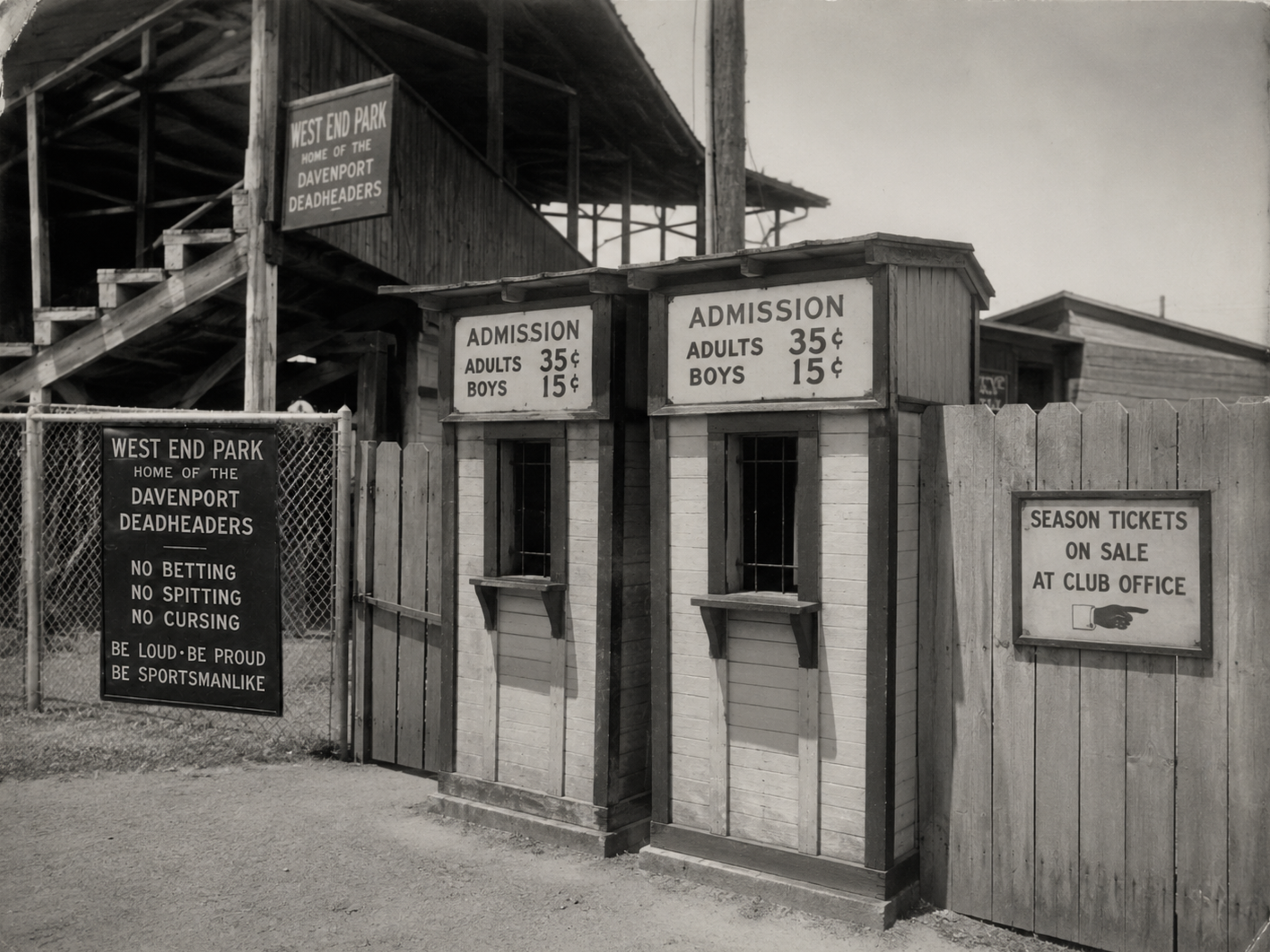
| Ticket Booths and Gates | Two exterior wooden ticket booths with barred sales windows beside a fenced main entrance and service access near the grandstand |
| Displayed Admission Prices | Adults 35¢; boys 15¢ |
| Parking | 186 marked spaces beside the park, with more than 300 overflow spaces provided by neighboring factories |
| Concessions and Amenities | |
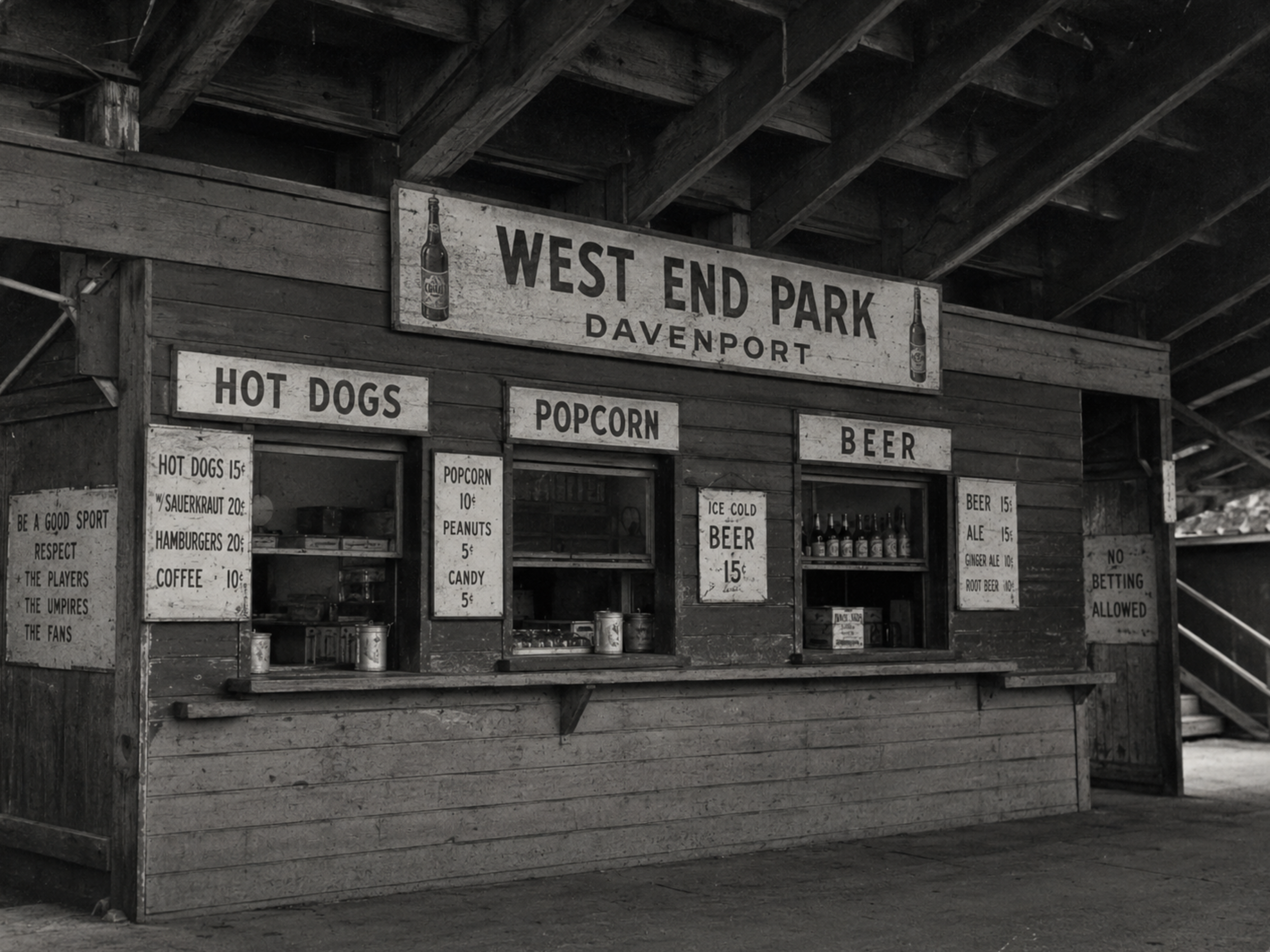
| Concession Windows | Three visible service windows beneath the grandstand: hot dogs, popcorn, and beer |
| Posted Food Prices | Hot dogs 15¢; hot dogs with sauerkraut 20¢; hamburgers 20¢; popcorn 10¢; peanuts 5¢; candy 5¢ |
| Posted Drink Prices | Coffee 10¢; beer 15¢; ale 15¢; ginger ale 10¢; root beer 10¢ |
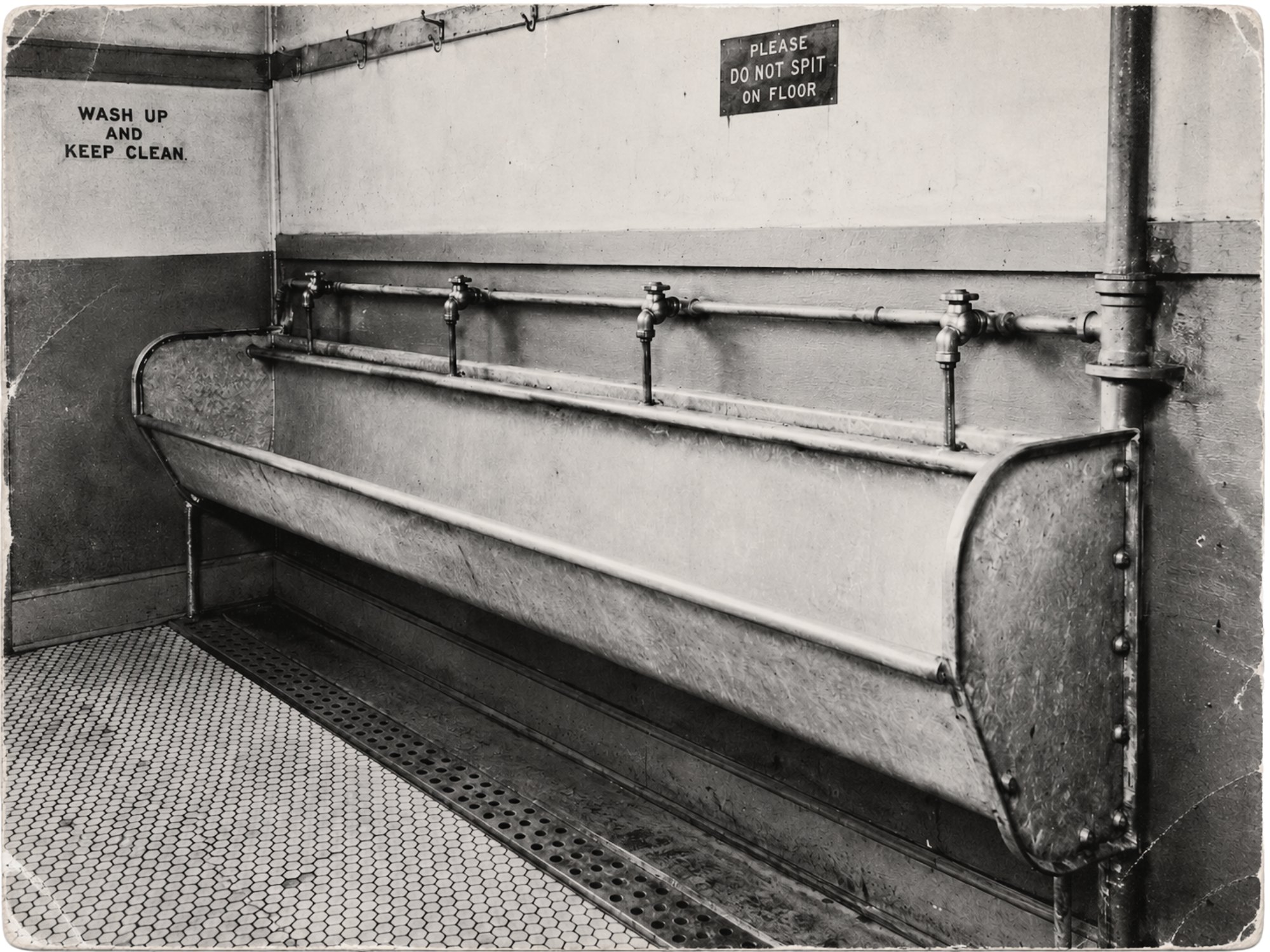
| Public Restrooms | Four total; the men’s rooms used wall-length metal trough urinals |
| Public Amenities | Four drinking fountains, two pay telephones, a first-aid room, and a lost-and-found desk |
| Clubhouse and Traditions | |
| Home Clubhouse | Beneath the third-base grandstand with 24 open wooden lockers, four showers, a trainer’s table, and equipment storage |
| Manager’s Office | Small private room with a desk, chalkboard, lineup board, and scorebook cabinet |
| Visiting Clubhouse | Beneath the first-base bleachers with 18 lockers and two showers |
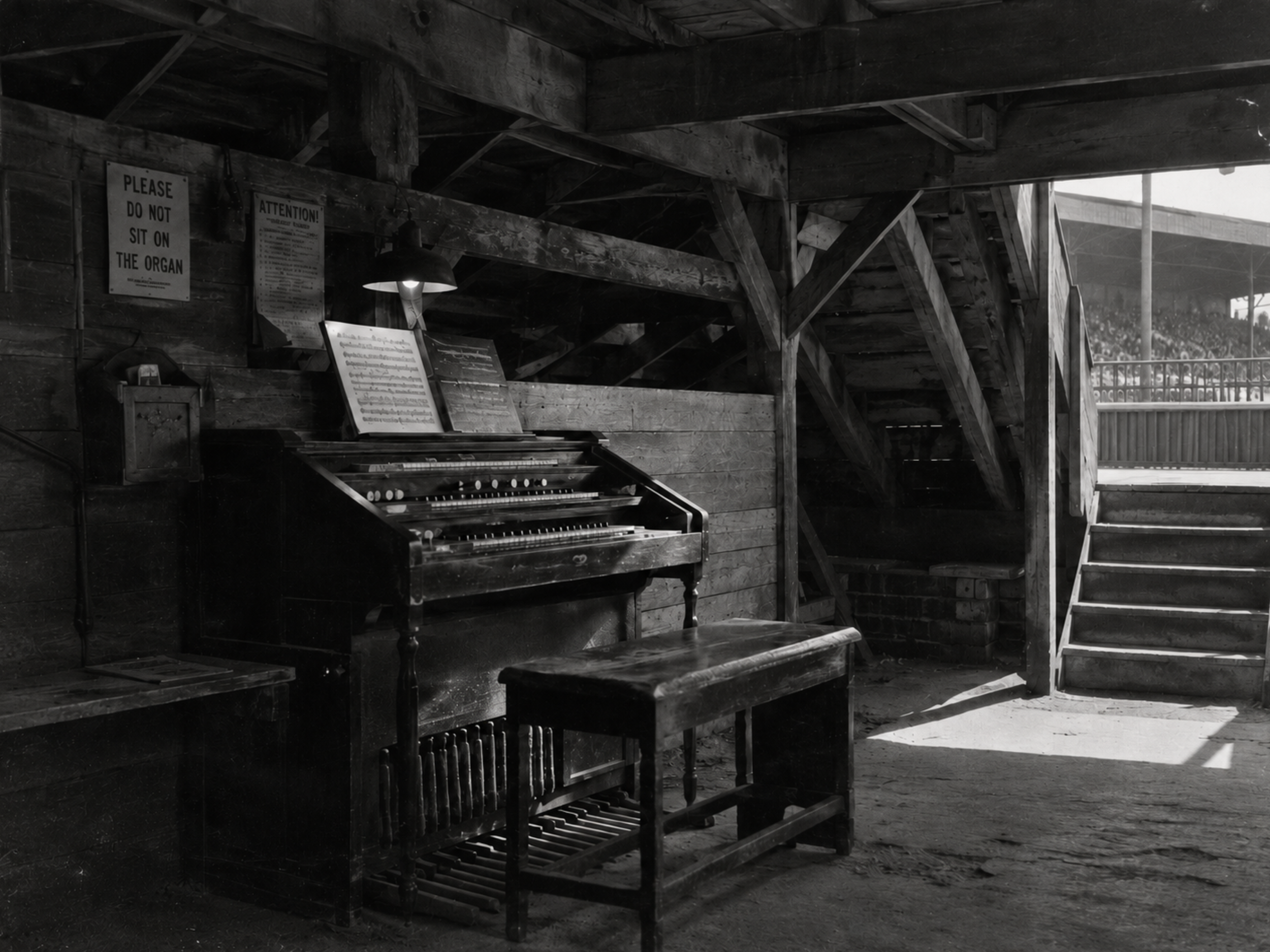
| Ballpark Organ | Organ installed beneath the grandstand; a three-note jingle followed every Davenport home victory |
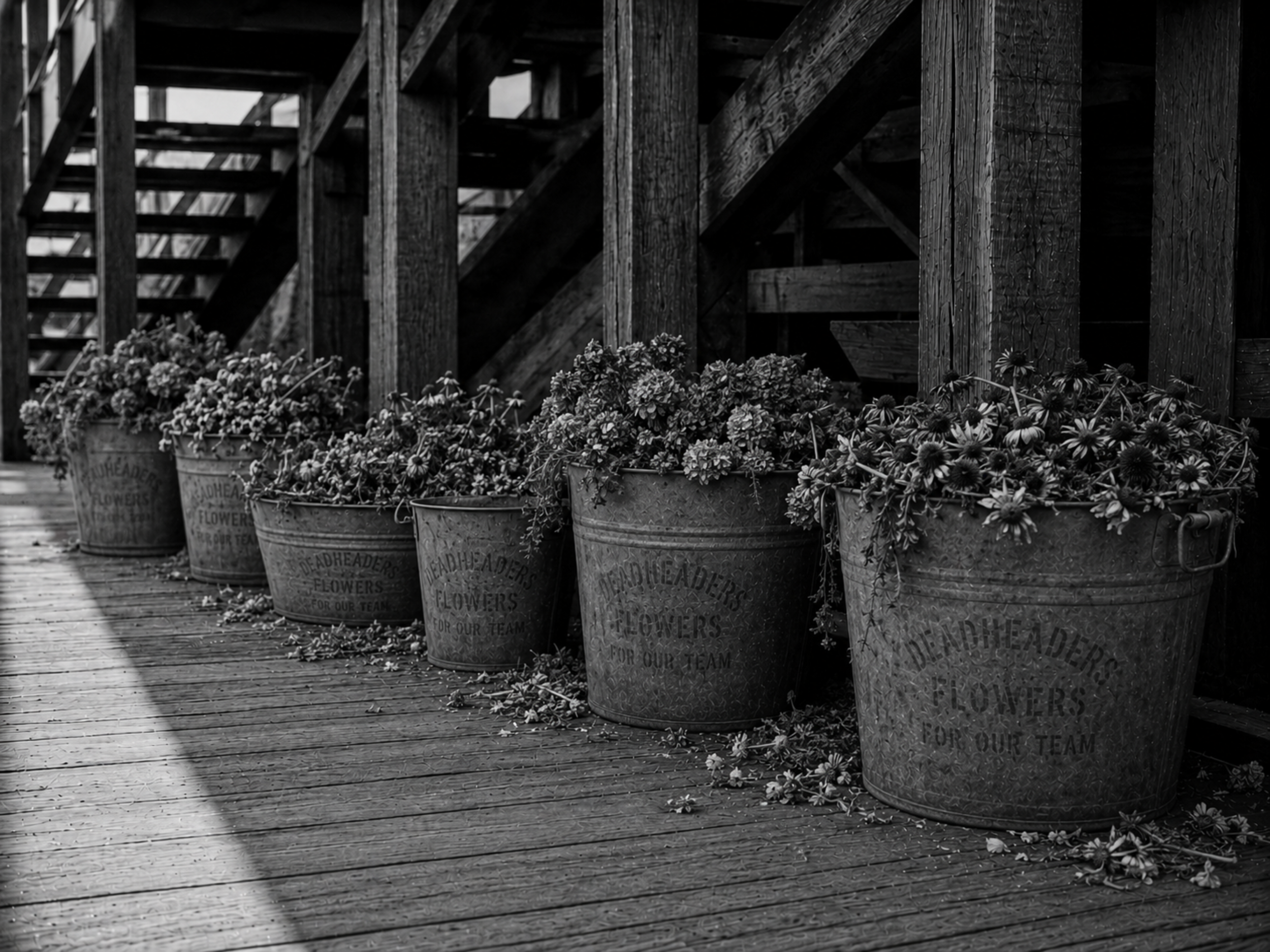
| Flower Buckets | Galvanized buckets near the gates collected donated deadheaded blooms before first pitch |
| Victory Tradition | Fans chanted “One, two, three—throw those flowers!” before tossing blooms collected at the gates and carried in brown paper bags |
| 1946 Final-Game Tribute | Red and white roses were reserved for the deciding victory over Tyler and thrown after the final out |
| Postgame Flower Collection | Groundskeepers delivered the spent blooms to the municipal greenhouse for composting |
| Closure | The grandstand was dismantled in 1952, and the site was absorbed into the surrounding industrial property |
Snapshots from West End Park
-
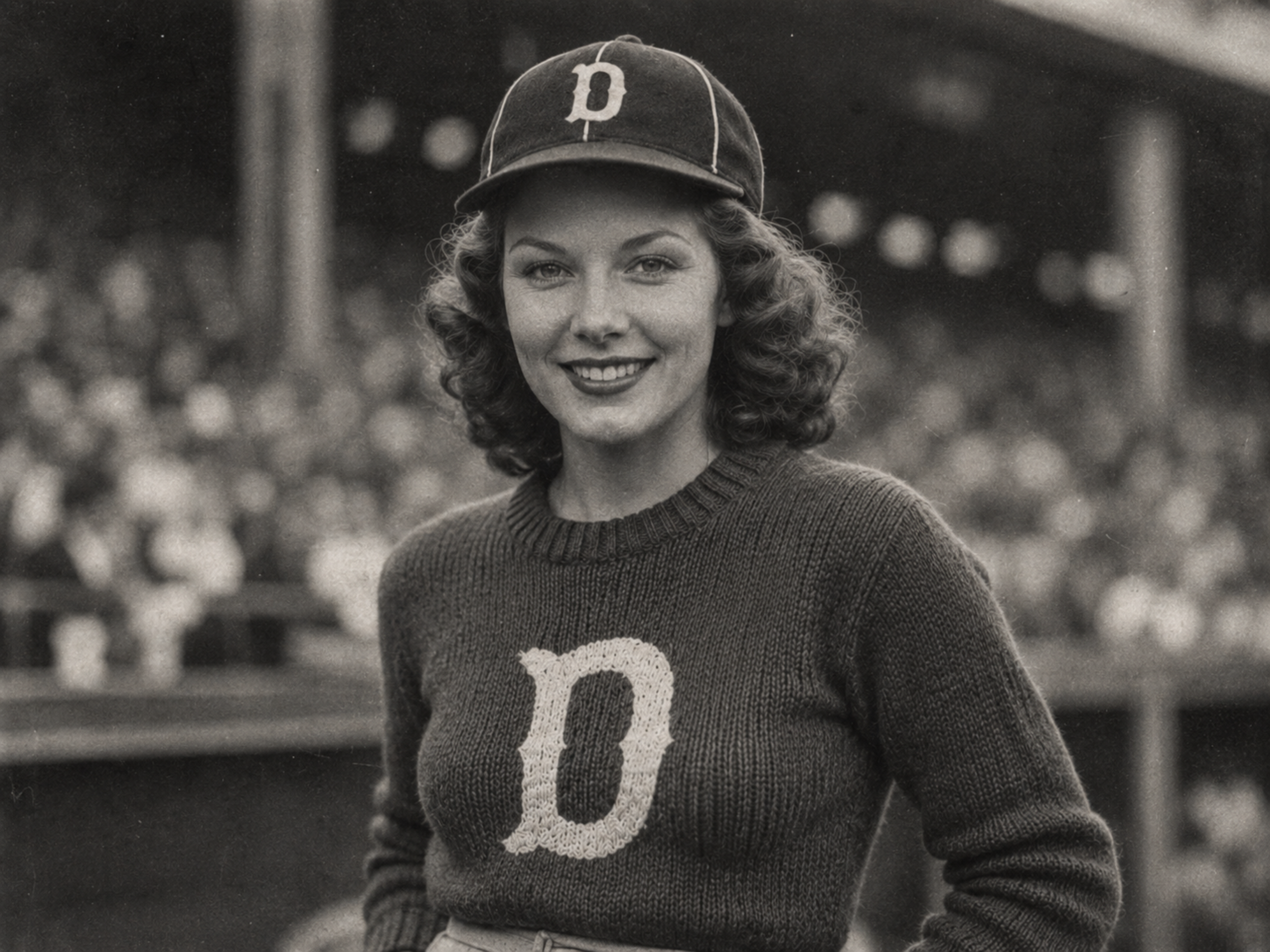
![Black-and-white portrait of a smiling young woman at West End Park wearing a hand-knit Davenport D sweater and Deadheaders cap.]()
The West End Smile
Deadheaders Supporter · West End Park, Circa 1940s
Smiling at West End Park in a hand-knit Davenport D sweater and Deadheaders cap, the unidentified supporter shows how the club’s identity moved beyond the field. Homemade knitwear, club caps, and game-day photographs carried the Deadheaders into family scrapbooks long after the final score was forgotten.
-
![Aerial view of West End Park during a Davenport Deadheaders game, surrounded by freight yards and industrial buildings.]()
West End Park on Game Day
Aerial Game-Day View · Circa 1946
From above, West End Park shows its true shape: a small daylight ballpark wedged into Davenport’s industrial west end, with the roofed grandstand tight behind home plate, first-base bleachers filled for the afternoon, and freight yards and factory buildings pressing in around the outfield. The photograph captures the park at its busiest — not grand, but crowded, practical, and unmistakably Davenport.
-
![Organ beneath the West End Park grandstand beside a sign reading “Please Do Not Sit on the Organ.”]()
Please Do Not Sit on the Organ
Grandstand Organ · Victory Ritual
Set beneath the timber ribs of the West End Park grandstand, Davenport’s organ was part instrument, part civic alarm bell. After every home victory, its three-note jingle signaled the crowd to rise, chant, and send deadheaded flowers onto the field — a small ritual that turned the park’s rough underside into one of its most beloved corners.
-
![Black-and-white 1940s photograph of a metal trough urinal with exposed plumbing, hexagonal tile, coat hooks, and hand-painted signs beneath the West End Park grandstand.]()
The Grandstand Trough
Men’s Room Fixture · West End Park
One of the wall-length metal trough urinals installed beneath the West End Park grandstand. Exposed plumbing, hexagonal floor tile, coat hooks, and hand-painted cleanliness notices reflected the ballpark’s practical, working-class character.
-
![Two West End Park ticket booths with barred admission windows, posted price boards, and wooden fencing near the ballpark entrance.]()
The Ticket Booths
Admission Windows · West End Park Entrance
Two wooden ticket booths stood outside the grandstand near the main entrance. Barred sales windows, weathered price boards, and plain board fencing reflected the park’s practical construction, while the posted prices made clear that West End Park was built for working families as much as baseball regulars.
-
![Empty West End Park concession stand with service windows for hot dogs, popcorn, and beer beneath the grandstand.]()
The Concession Windows
Ballpark Fare · Beneath the Grandstand
Three service windows beneath the West End Park grandstand handled the essentials: hot dogs, popcorn, peanuts, coffee, soft drinks, beer, and ale. The hand-painted price boards, rough plank counter, and posted conduct signs gave the stand the same practical character as the park itself.
-
![Galvanized Davenport Deadheaders flower buckets lined beneath the West End Park grandstand and filled with donated blooms.]()
The Deadhead Buckets
Victory Toss Collection · West End Park Gates
Set near the West End Park gates, galvanized buckets collected deadheaded flowers before first pitch. Supporters dropped in clipped blooms from gardens, greenhouses, and porch boxes so that everyone had something to throw if Davenport won. When the organ sounded its three-note jingle, the buckets became part of the ritual — a humble ballpark object turned into a shared ceremony.
The Championship Season
The 1946 Deadheaders were assembled quickly and entered the season without the expectations carried by the larger independent clubs. Donnelly’s roster contained experience but little excess. Starting players were expected to remain in the lineup, and Davenport relied more heavily on complete games than most of its rivals.
By midsummer, the arrangement had become an advantage. Kovac established himself at the front of the rotation, DeLuca supplied consistent power, and Larkin kept an experienced defense organized behind the pitching staff. Davenport remained within reach of first place and secured the division during the final weekend.
1946 at a Glance
| Regular-Season Record | 68–40 |
|---|---|
| Home Record | 39–15 |
| Road Record | 29–25 |
| Division Finish | First |
| Manager | Walter “Red” Donnelly |
| Club Captain | Eddie Larkin |
| Leading Pitcher | Sam Kovac, 18–7 |
| Leading Hitter | Frank DeLuca, .327 |
| Division Title | Clinched on the final weekend |
| Tyler Series | Davenport won, four games to three |
| Deciding-Game Score | Davenport 3, Tyler 2 |
| Deciding-Game Pitcher | Sam Kovac, complete game |
| Estimated Final-Game Crowd | More than 4,000 |
The Tyler Series
| Game One — Tyler | Tyler 5, Davenport 2 |
|---|---|
| Game Two — Tyler | Davenport 4, Tyler 1 |
| Game Three — Tyler | Tyler 6, Davenport 3 |
| Game Four — Davenport | Davenport 2, Tyler 0 |
| Game Five — Davenport | Tyler 4, Davenport 3 |
| Game Six — Davenport | Davenport 6, Tyler 3 |
| Game Seven — Davenport | Davenport 3, Tyler 2 |
| Series Result | Davenport defeated Tyler, four games to three |
| Series Status | Privately arranged inter-circuit series; not recognized by either league office |
Tyler carried a three-games-to-two advantage into Game Six and needed only one more victory. Davenport responded with a 6–3 win, forcing the series to a final afternoon at West End Park.
In Game Seven, Kovac surrendered two early runs before settling into the strongest stretch of his season. Davenport reduced the deficit in the middle innings, and DeLuca’s sixth-inning double brought home the tying run. The Deadheaders scored once more in the eighth and protected the lead behind Kovac’s complete game.
The crowd remained in place long after the final out. With no official trophy to present, supporters opened the brown paper bags they had carried through the gates and showered the infield with red and white roses saved for the moment. The players left the field amid newspaper photographers, children, and spectators who had crossed the rope lines.
Men of the 1946 Club
-
![Black-and-white 1940s portrait of Walter “Red” Donnelly, manager of the 1946 Davenport Deadheaders, wearing a Davenport uniform.]()
Walter “Red” Donnelly
Manager · 1946 Northern Division Champions
Donnelly played infield for Davenport from 1928 through 1936 before joining the coaching staff. When the Deadheaders resumed play in 1946, he rebuilt the club around returning servicemen, veterans of the prewar roster, and a small scorebook he was known to carry in his back pocket.
-
![Black-and-white 1940s portrait of Eddie Larkin, catcher and club captain of the 1946 Davenport Deadheaders, wearing a Davenport uniform.]()
Eddie Larkin
Catcher & Club Captain · 1946
Larkin was one of the few players from the 1942 club to return after the war. As captain and starting catcher, he helped Donnelly assemble the roster that took the field in 1946, then caught every inning of the seven-game series against Tyler.
-
![Black-and-white 1940s portrait of Sam Kovac, right-handed pitcher for the 1946 Davenport Deadheaders, wearing a Davenport uniform.]()
Sam Kovac
Right-Handed Pitcher · 1946
Kovac led Davenport’s 1946 pitching staff with an 18–7 record. He worked quickly, relied on control, and completed most of his starts without relief. Against Tyler, he started twice and pitched all nine innings of the deciding game, allowing two runs in Davenport’s 3–2 victory at West End Park.
-
![Black-and-white 1940s portrait of Frank DeLuca, first baseman for the 1946 Davenport Deadheaders, wearing a Davenport uniform.]()
Frank DeLuca
First Baseman · 1946
DeLuca led Davenport with a .327 average and nine home runs during the 1946 regular season. He finished among the club leaders in hits, doubles, and runs batted in, then drove home the tying run with a sixth-inning double in Game Seven against Tyler.
The Later Years
The Tyler series did not make Davenport a dynasty. It gave the club something more durable: an identity that outlived winning. In the seasons that followed, newspaper notices, tavern windows, ballpark signs, and homemade souvenirs returned to the same phrase — The Team That Beat the Roses — even as the Midland Association settled back into its ordinary rhythm.
The postwar roster aged quickly. Some returning servicemen left baseball for steadier work, while younger players were drawn toward better-paying clubs and sponsored industrial teams. Davenport remained stubborn at West End Park, where the low grandstand, short right-field corner, freight-line backdrop, and noisy Sunday crowds still made the grounds one of the circuit’s least comfortable stops. But the Deadheaders never again assembled a club as balanced as Donnelly’s 1946 side.
The late years did deepen the club’s place in Davenport. The flower toss became less a novelty than a civic habit. Children brought clipped blooms in lunch sacks, greenhouse workers delivered boxes of spent flowers, and galvanized buckets near the gates became as familiar as the ticket windows. By then, the Deadhead emblem had moved beyond scorecards and programs. It appeared on coolers, shag bags, banquet steins, pruning shears, buttons, hand-painted signs, and the small objects that followed supporters back into homes, taverns, garages, and factory lockers.
By 1951, the practical difficulties that had always defined the club had become harder to ignore. West End Park had no lights, its wooden grandstand required constant repair, and the industrial tract around the grounds was too valuable to remain a small daylight ballpark indefinitely. When the lease was not renewed after the season, Davenport’s directors chose not to relocate the club.
The grandstand was dismantled the following year, and the site disappeared into the freight and industrial property that had shaped it from the beginning. What remained was unusually tangible. Because the Deadheaders’ traditions depended on small objects — caps, buckets, ticket stubs, scorecards, equipment trunks, flower bags, and keepsakes — much of the club’s memory survived in attics and workshops rather than in official archives.
The collectibles below are not simply remnants of a championship season. They are evidence of how closely Davenport held the Deadheaders after the games were gone.
Deadheaders Collectibles
-
![Museum display of a weathered dimpled-glass stein etched “Davenport Deadheaders 1946,” shown with softly focused baseball artifacts.]()
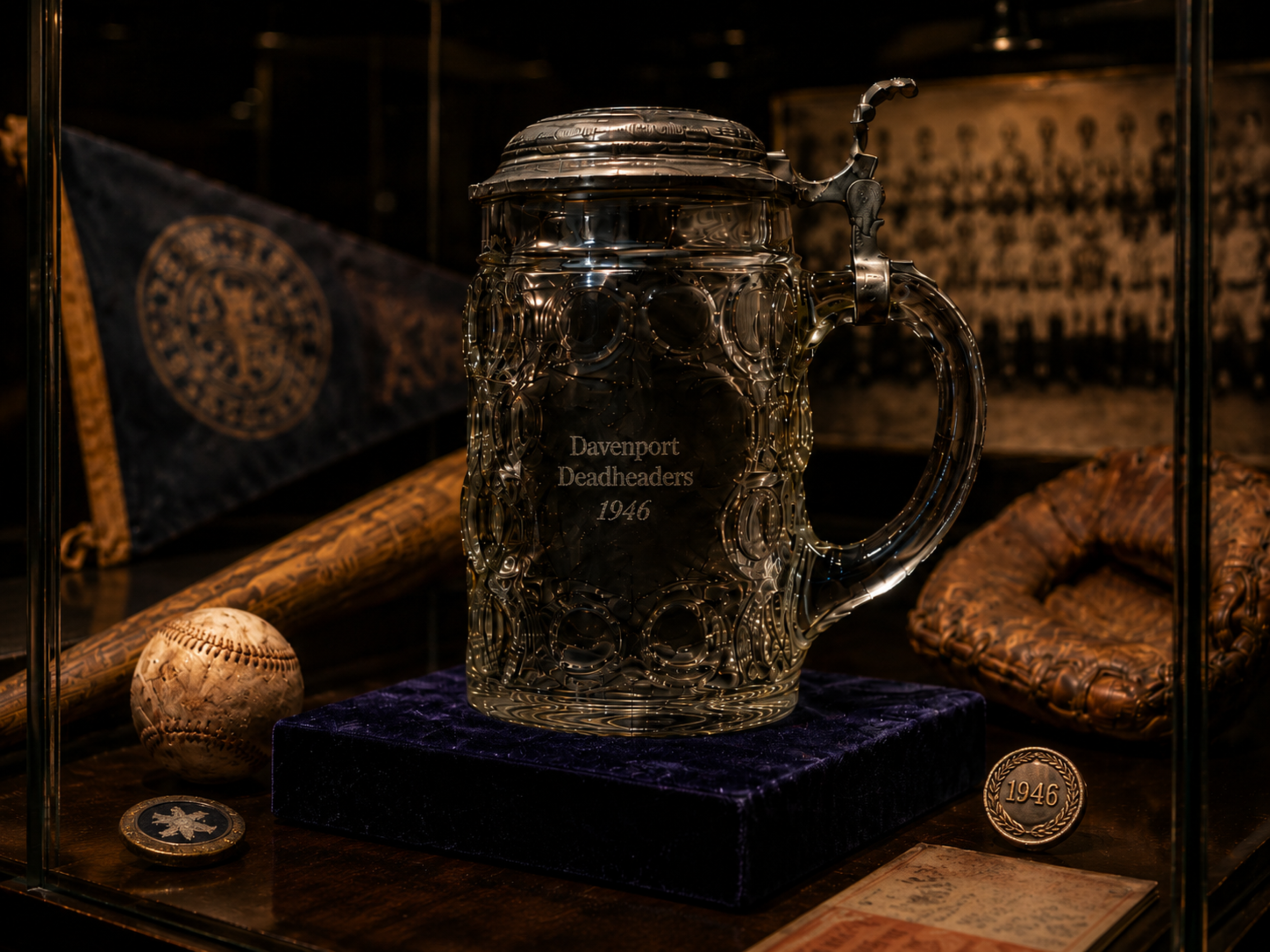
1946 Presentation Stein
Championship Banquet Memento · Museum Display
Commissioned after the seven-game victory over Tyler, the heavy dimpled-glass stein was presented at the club’s winter banquet. Its pewter lid and understated Davenport Deadheaders · 1946 etching reflected the tavern traditions of Davenport’s west end, where the Tyler upset was retold long after the season ended.
-
![West End Hardware pruning shears with wooden handles, displayed as a 1946 Davenport Deadheaders fan giveaway.]()
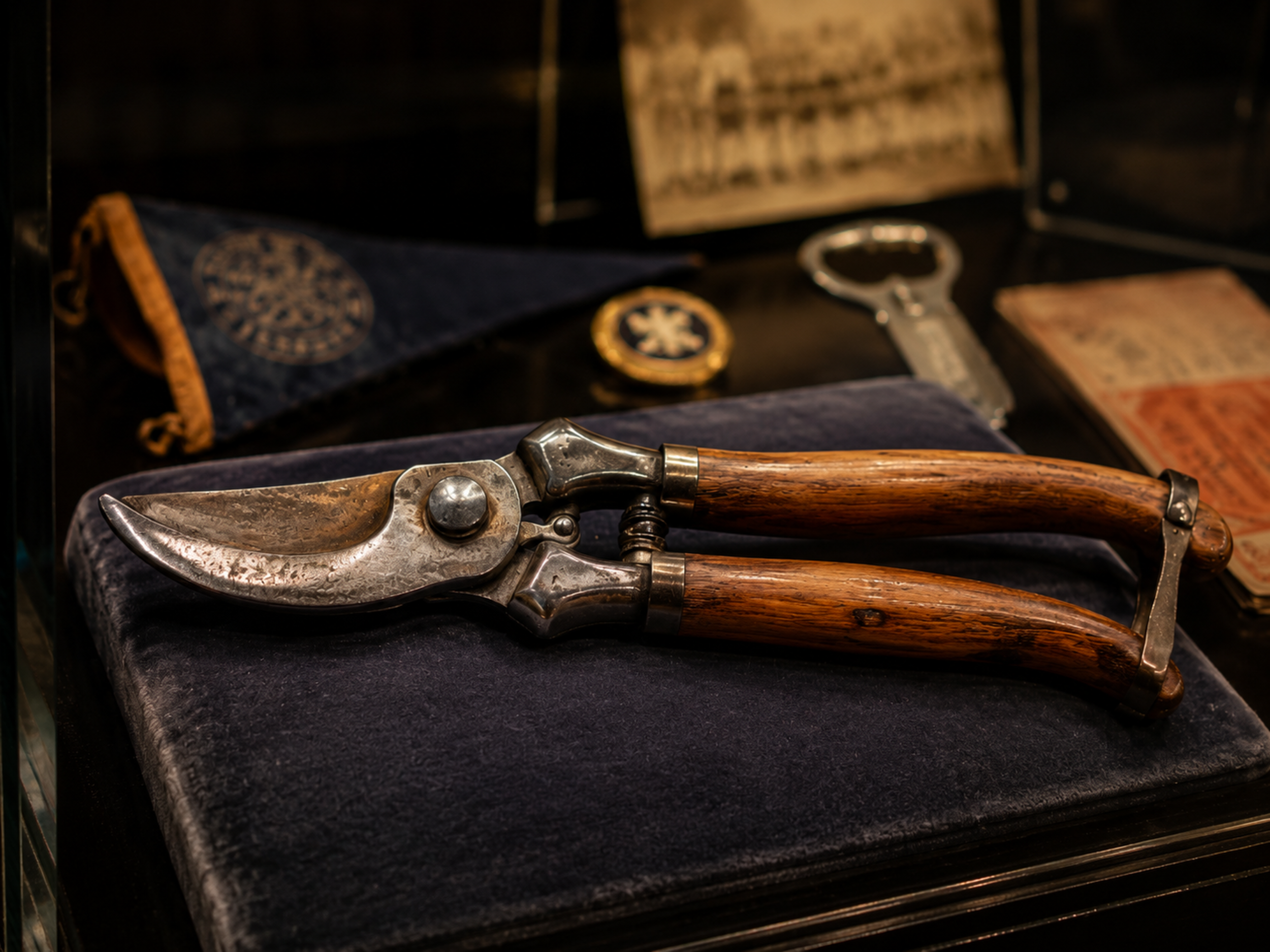
West End Hardware Pruning Shears
Fan Giveaway · July 1946
West End Hardware Company sponsored one of the club’s more unusual promotions during the 1946 pennant drive. Adult ticket holders received claim cards at the gate and collected a pair of wooden-handled bypass shears after the final out. Most were put to work; this example survives with its aged steel, brass fittings, and original handles largely intact.
-
![Museum display of weathered baseballs, scorecards, ticket stubs, a 1922 Davenport Deadheaders pin, and an early team photograph arranged on blue velvet.]()
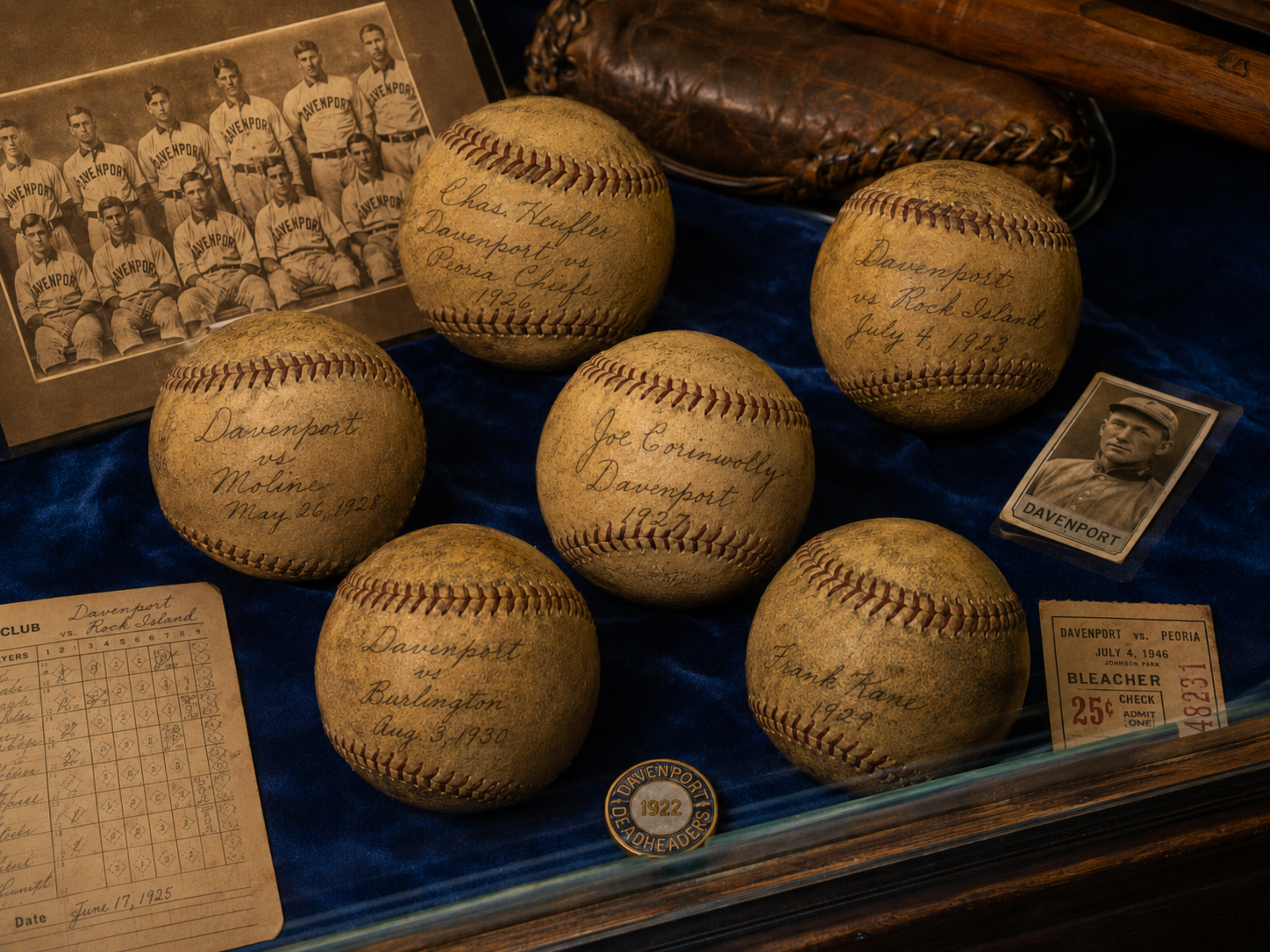
The West End Archive
Club Ephemera · Museum Display
Players, scorekeepers, and club officers saved balls from notable games and marked them by hand with dates, opponents, and brief notes. The collection includes early contests against Moline, Rock Island, Burlington, and Peoria, along with score sheets, ticket stubs, a 1922 club pin, and an early team photograph.
-
![Museum display of a worn leather baseball shag bag and dented 1940s metal cooler, each stenciled “DEADHEADERS” in faded white.]()
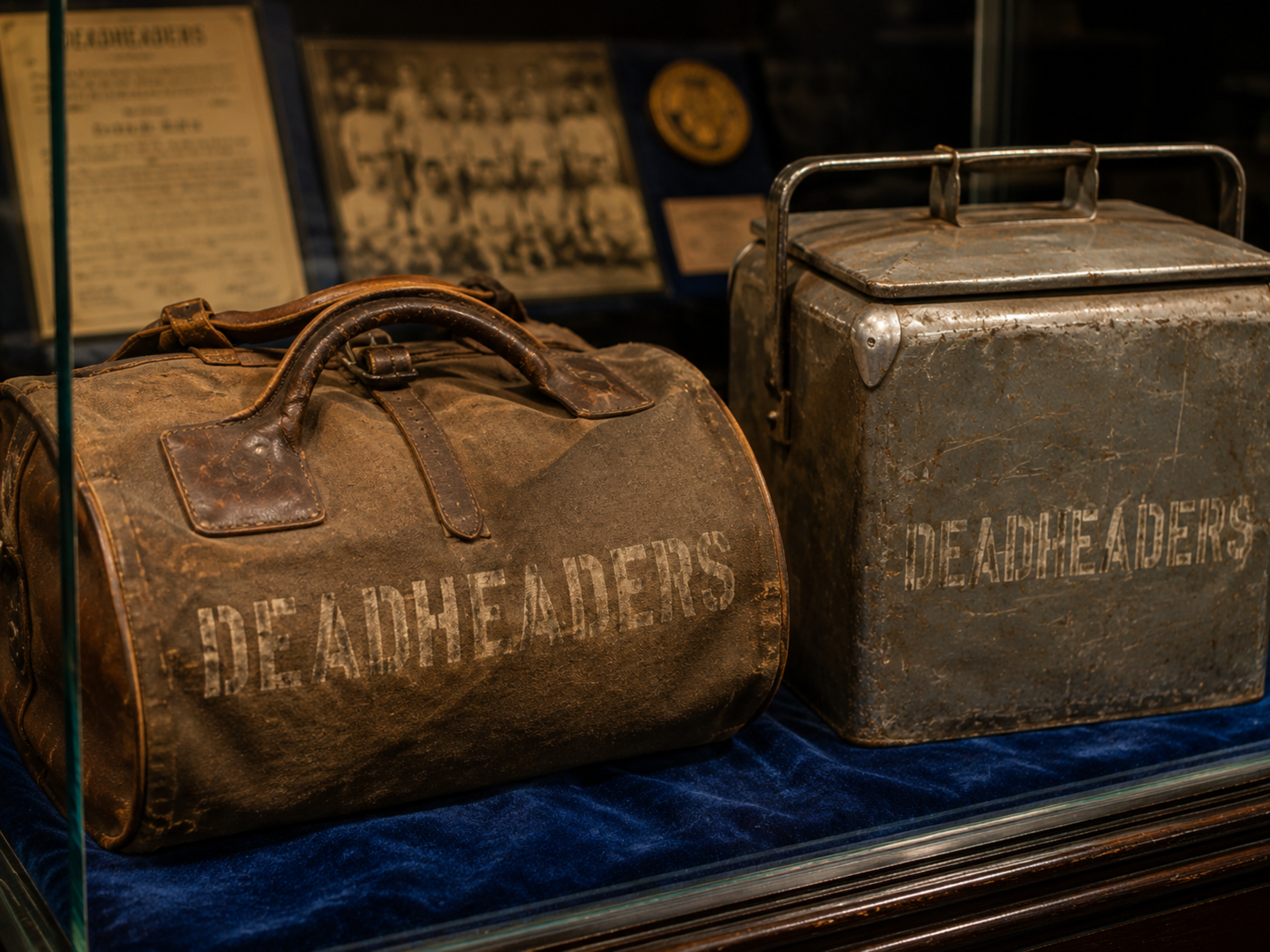
The Travel Set
Club Travel Equipment · 1946
The leather shag bag carried practice balls, tape, and spare laces. The galvanized cooler traveled in the rear compartment of the club bus with water, fruit, and cold towels. Both were marked with the same faded white DEADHEADERS stencil so they could be identified quickly in crowded depots and visiting clubhouses.
-
![Museum display of Davenport Deadheaders galvanized flower buckets filled with dried blooms under spotlights.]()
For Our Team
Flower Bucket Display · Museum Display
Among the most coveted Deadheaders artifacts are the galvanized flower buckets once set near the West End Park gates. Before each game, supporters dropped in deadheaded blooms from gardens, greenhouses, and porch boxes so the whole crowd would have flowers to throw after a Davenport victory. Dented, stained, and still marked with the club’s plainspoken stencil, the surviving buckets turn one of the ballpark’s humblest customs into a museum-piece ritual.