
A City of Rails and Gardens
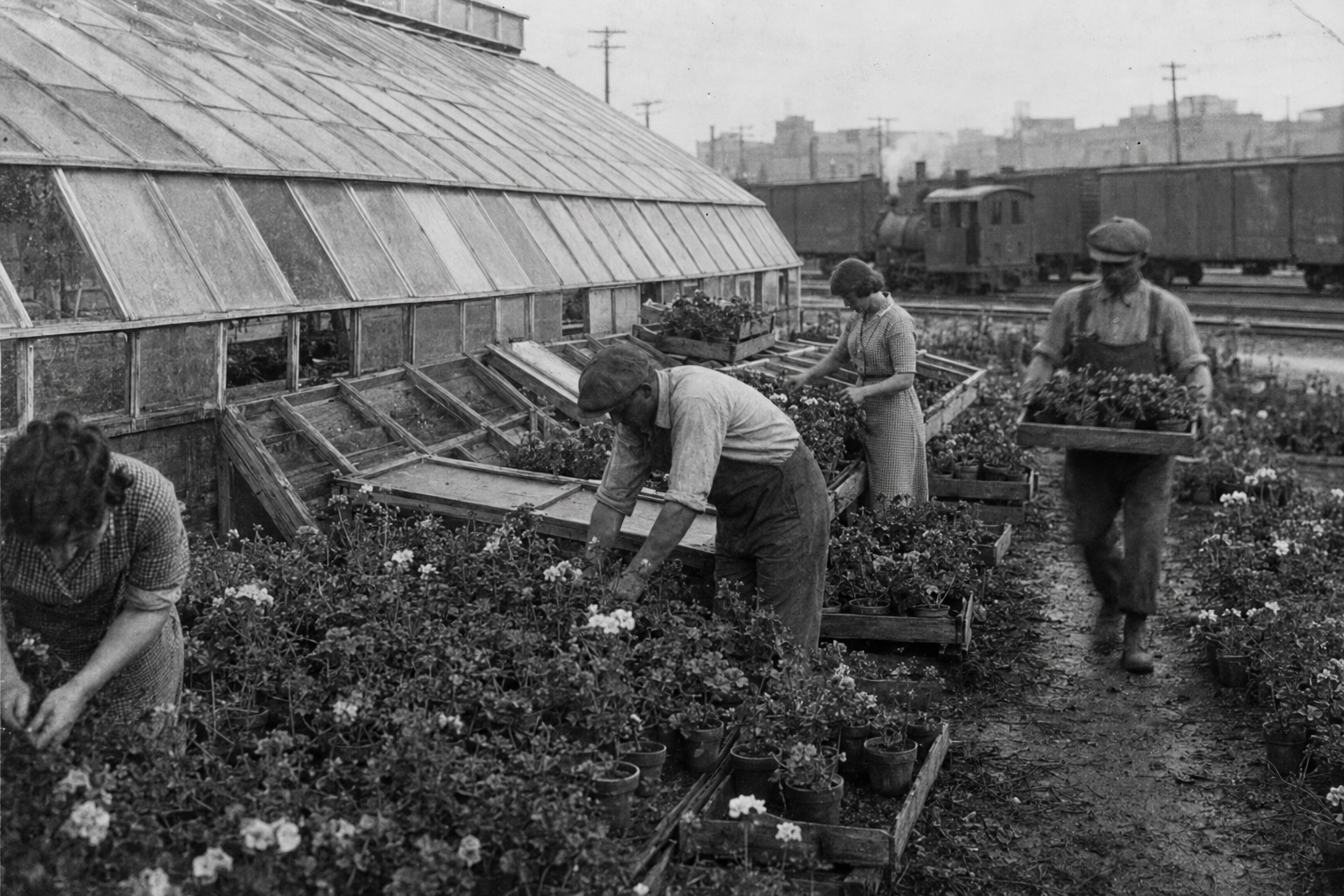
Municipal greenhouse workers tend flowering plants beside Davenport’s freight yards in the late 1920s. The setting brought the two meanings of “deadheading” into the same working landscape. A Ball Club Register historical reconstruction.
The two working traditions behind the Davenport Deadheaders
Before it was the name of a baseball club, “deadheader” was a word of work.
In the railroad yards, it described an employee traveling on a company pass or being carried without paying fare so that he could report for duty somewhere farther down the line. In a greenhouse, deadheading meant removing flowers that had passed their bloom, keeping the plant healthy and encouraging it to flower again.
Both definitions belonged in Davenport.
By the opening decades of the twentieth century, the city had become both an important railroad center and a place with an unusually ambitious tradition of municipal horticulture. Trains moved through its freight yards beside the Mississippi. Inside the city’s greenhouses, workers raised the plants that filled conservatories, park beds and public grounds.
The two trades required different tools, but they shared a word. In Davenport’s West End, they eventually shared a baseball club as well.
The Bridge Across the Mississippi
Davenport’s railroad history begins with a bridge.
On April 22, 1856, the first railroad bridge across the Mississippi River opened between Rock Island, Illinois, and Davenport, Iowa. The wooden crossing connected eastern railroads with a developing network that would carry passengers and freight farther west.
It also challenged the commercial order of the river.
Steamboat operators had long depended on the Mississippi as the principal route for moving people and goods through the region. A permanent railroad bridge represented more than an obstacle in the channel. It threatened to redirect commerce from north and south to east and west.
The conflict became immediate.
On May 6, only two weeks after the bridge opened, the steamboat Effie Afton struck one of its piers. The vessel caught fire, and the flames spread to part of the bridge. The boat’s owners blamed the crossing for obstructing navigation. The railroad interests blamed the pilot.
The resulting legal dispute reached a Chicago courtroom in 1857. Among the attorneys representing the railroad was Abraham Lincoln, then still a lawyer from Springfield. Lincoln argued that railroads possessed the same right to cross the river that steamboats had to travel along it. The jury failed to reach a unanimous verdict, but the bridge remained. A later Supreme Court decision allowed the crossing to stand, helping establish the legal future of railroad bridges across the Mississippi.
The case was larger than one damaged steamboat. It marked a change in how the country moved.
For Davenport, that movement increasingly passed through town.
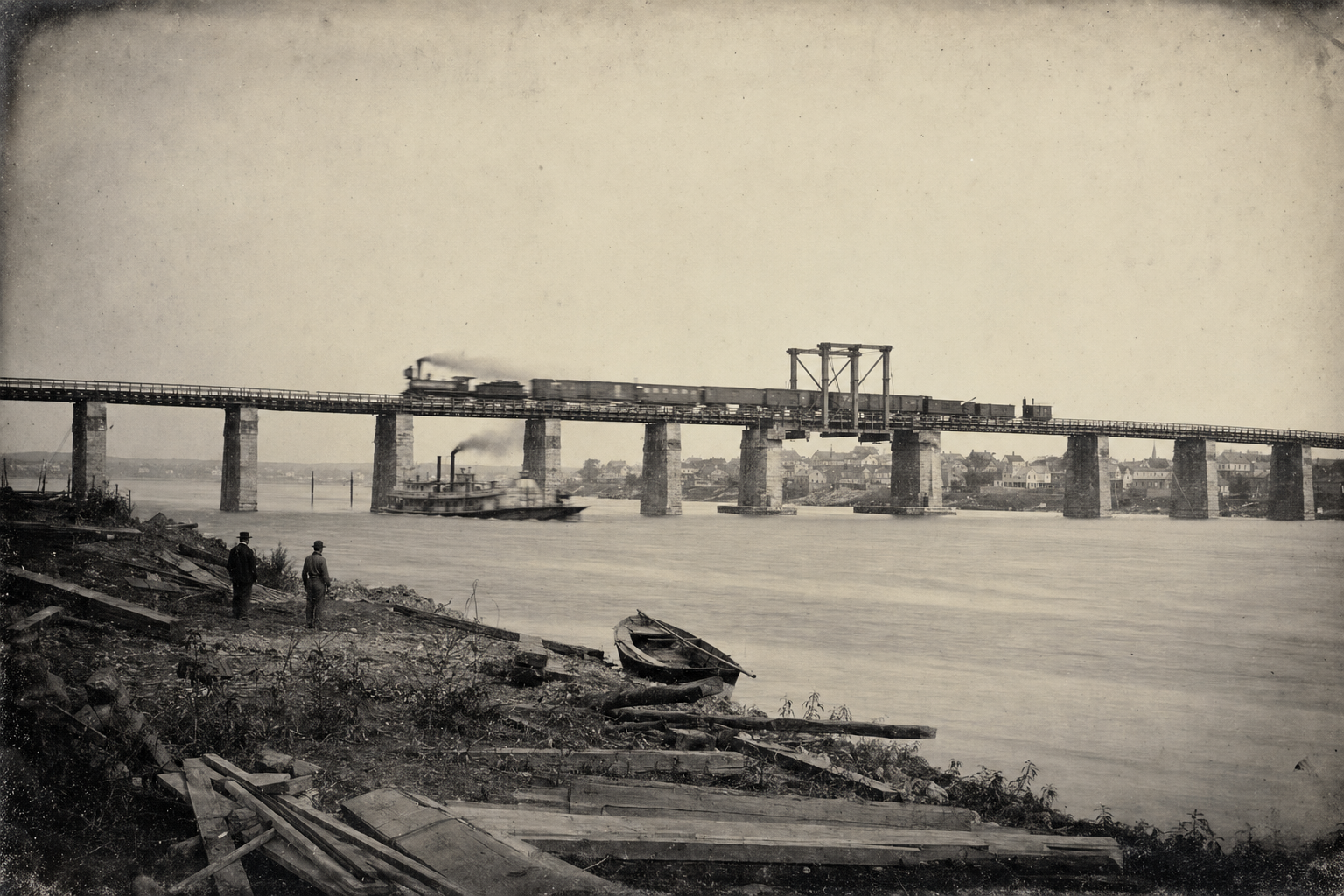
The first railroad bridge across the Mississippi connected Davenport and Rock Island in 1856, redirecting commerce toward the expanding railroads of the West. A Ball Club Register historical reconstruction.
A City Built Around Freight
The original bridge did not survive for long, but the connection it created endured. Successive bridges carried heavier trains across the river, while tracks, depots, repair shops and freight buildings became part of Davenport’s physical landscape.
Railroad infrastructure spread along the riverfront and through the commercial districts behind it. Warehouses stood beside sidings so that goods could be transferred directly between buildings and railcars. Freight trains moved agricultural products, manufactured goods, lumber and merchandise through the city. Passenger trains brought workers, salesmen and families into Davenport from both sides of the Mississippi.
In 1917, the Chicago, Milwaukee, St. Paul and Pacific Railroad completed a substantial freight house near the river. Union Station followed in 1924, replacing three separate passenger stations and consolidating service near the Arsenal and Crescent railroad bridges.
The railroad was not limited to its tracks and buildings. It created its own schedules, habits and language.
A train moving without passengers or cargo could be running dead. An employee carried to another terminal could be deadheading. A worker riding on his railroad pass was a deadhead. The term was practical, familiar and not necessarily insulting. It described someone being transported without producing revenue on that particular trip.
In a railroad city, the word traveled beyond the yards. It could be heard in boardinghouses, lunch counters, taverns and the residential blocks where crews waited for their next assignment.
But elsewhere in Davenport, the same word meant something completely different.
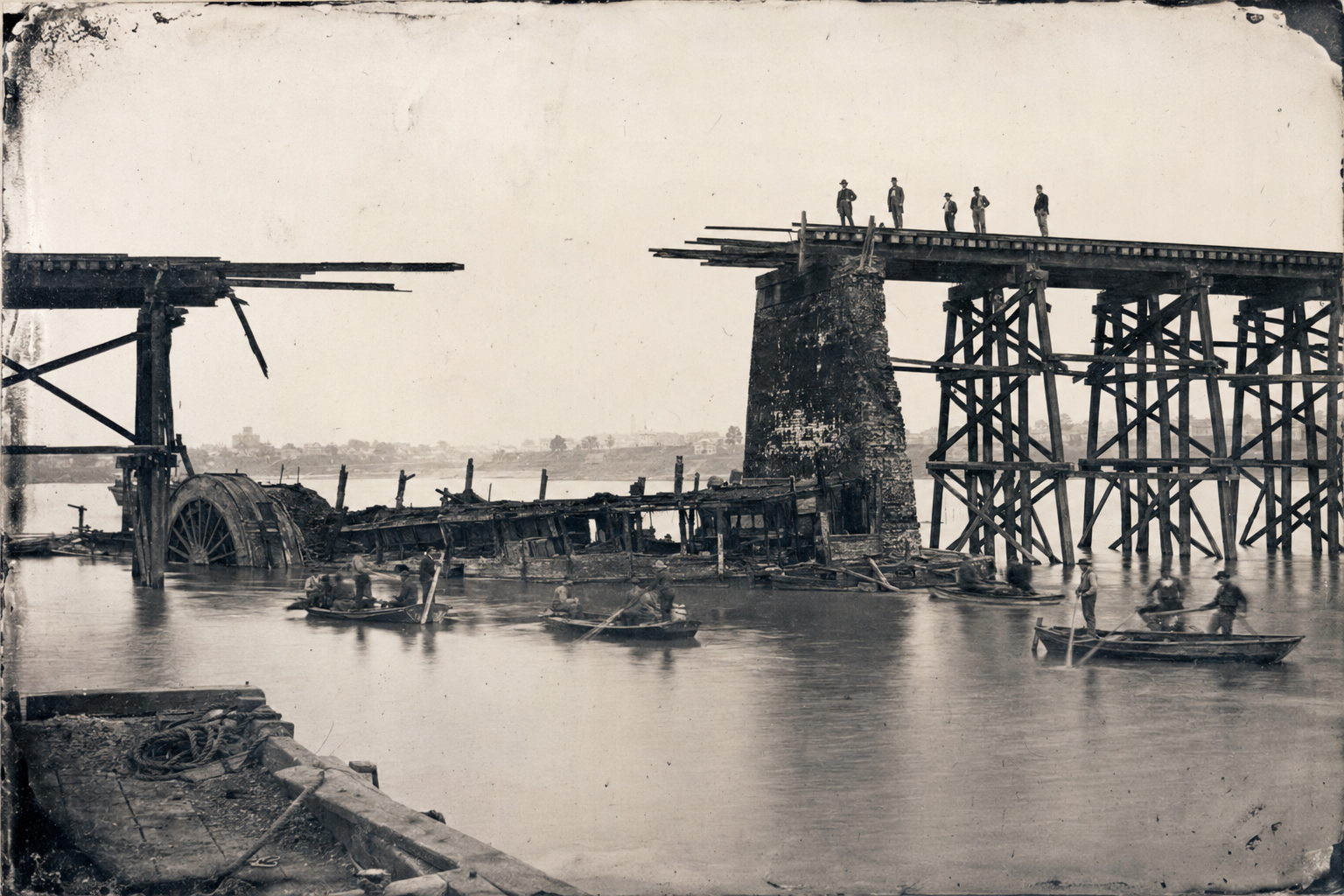
The charred remains of the Effie Afton lie beneath the damaged railroad bridge after the steamboat struck a pier on May 6, 1856. A Ball Club Register historical reconstruction.
Davenport in Bloom
Davenport’s horticultural tradition developed alongside its railroad system.
In 1885, the city purchased more than thirty acres of the former Scott County Fairgrounds and converted the property into Central Park. Its naturalistic design drew inspiration from New York’s Central Park, with curving paths, open lawns and carefully planned plantings. The grounds were renamed Vander Veer Park in 1912 in honor of A. W. Vander Veer, the first secretary of Davenport’s park board.
The park’s floral program quickly became one of its defining features. A conservatory was constructed in 1897, and heated greenhouses allowed plants to be cultivated throughout the year. Spring gardens, seasonal displays and formal beds turned municipal horticulture into a visible part of Davenport’s civic identity.
Those displays required constant labor.
Greenhouse workers prepared soil, propagated cuttings, managed boilers, watered seedlings and moved rows of plants through the growing cycle. Once flowers were placed in public beds, the work continued. Faded blossoms had to be removed before the plants spent their energy producing seed.
That work was called deadheading.
Deadheading plants was not simply cosmetic. Removing spent blooms kept public beds orderly and encouraged many varieties to flower again. A skilled worker learned where to pinch the stem, which plants should be trimmed and which seed heads should be allowed to remain.
The most visible part of the job was the finished garden. The labor behind it took place in humid propagation houses, potting sheds and planting beds, often before the public arrived.
A greenhouse deadheader and a railroad deadhead might have had little else in common. One clipped fading flowers. The other rode toward his next assignment. Yet in Davenport, each could hear the word and recognize his own working life in it.
Two Meanings, One Neighborhood
The two definitions came closest together in Davenport’s West End.
This was a district of freight tracks, warehouses, factories, seed houses, modest homes and municipal work grounds. The railroad was never far away, but neither was the labor of cultivation. Greenhouse crews and parks workers passed through the same streets as brakemen, switchmen, freight handlers and shop hands.
West End Park stood between those worlds.
When the ball club began playing there in 1922, its earliest crowds came from the surrounding district. Men arrived after shifts in the yards and shops. Municipal workers came directly from the planting grounds. Families walked in from the nearby residential blocks. Some spectators still carried the marks of the working day on their clothes and hands.
The name Davenport Deadheaders could be understood immediately, but not always in the same way.
Railroad men claimed it as their own term. Greenhouse workers knew that the word belonged to them as well. Around the park, the disagreement became part of the appeal. The club did not need to choose one definition and discard the other. The name was stronger because it carried both.
To one part of the crowd, a deadheader was a railroad employee riding on a pass.
To another, it was the worker who removed spent flowers so that new blooms could follow.
At West End Park, both were correct.
The West End Nine
The Deadheaders never presented themselves as a club detached from the neighborhood. Their identity grew from the working landscape around the grounds.
West End Park sat close enough to the freight yards for whistles and switching cars to interrupt an afternoon game. Beyond another edge of the property stood the municipal greenhouses, their long panes reflecting the changing light. The setting placed the ball club directly between the two meanings of its name.
The team became known locally as the West End Nine. Its supporters included railroad employees, greenhouse crews, warehouse workers and the families who lived among them. A Deadheaders cap did not simply identify someone as a baseball follower. It marked an attachment to a particular part of Davenport.
The club suspended play during the Second World War, then returned in 1946. That season carried the Deadheaders beyond their neighborhood audience. Davenport won the Northern Division and met the Tyler Roses in a seven-game inter-circuit series.
The deciding game was played at West End Park.
More than four thousand people crowded into and around grounds built to seat roughly thirty-two hundred. Davenport won the series four games to three, giving the club the honorific that followed it through its final years: “The Team That Beat the Roses.”
The victory expanded the Deadheaders’ reputation, but it did not change what the name meant at home. It still belonged to the railroad employees arriving on passes, the workers tending city plantings and the families that gathered between the greenhouses and tracks.
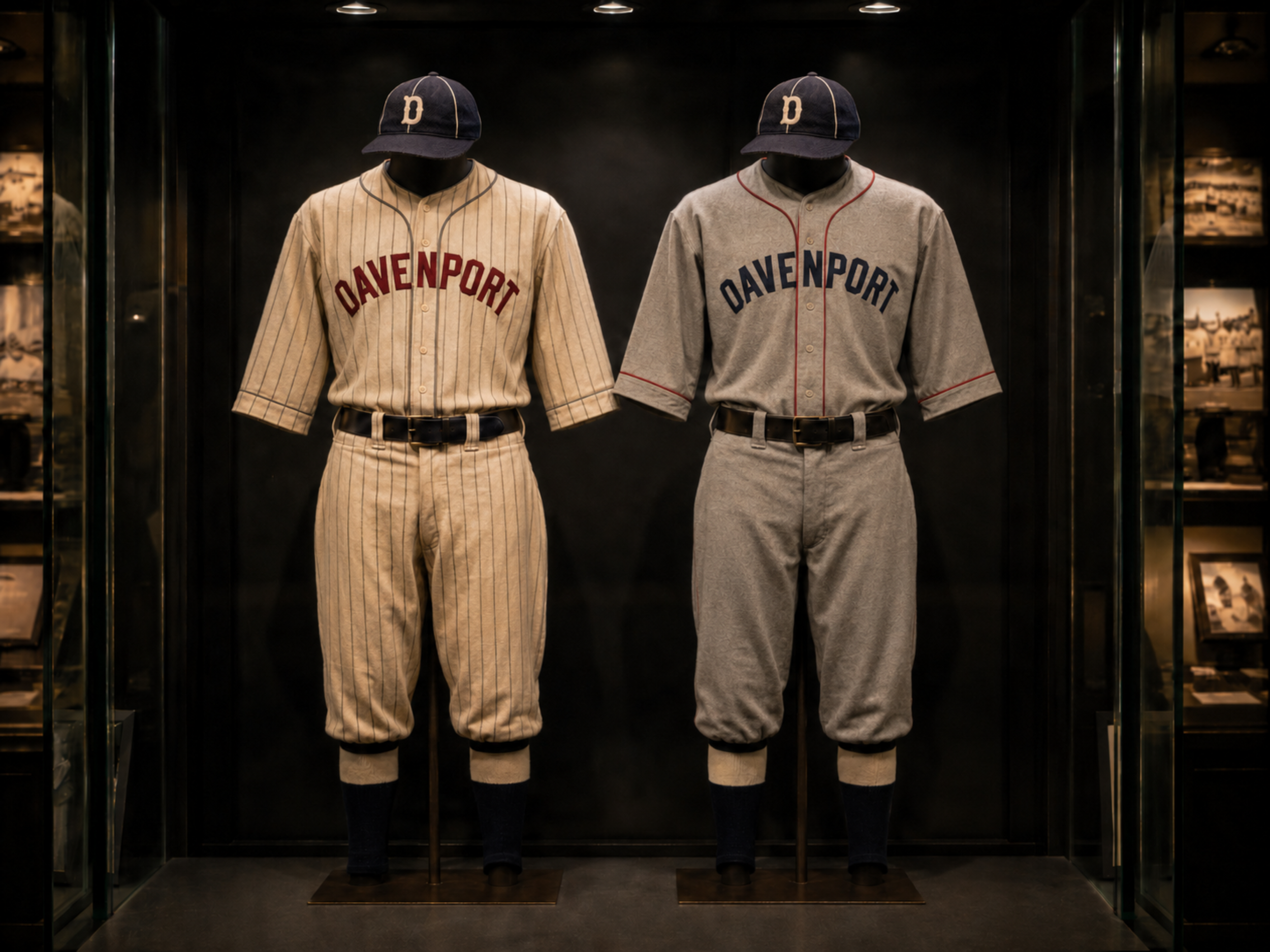
Davenport Deadheaders home and travel uniforms, circa 1946.
A Name Rooted in Davenport
Baseball club names often reduce a city to one symbol. The Davenport Deadheaders did the opposite.
Their name held two forms of labor at once. It acknowledged the railroad system that connected Davenport to the country and the greenhouse work that kept the city in bloom. It belonged to movement and cultivation, steel rails and glass houses, departures and returns.
That is why no single explanation of the name is sufficient.
The Deadheaders were not named only for railroad men. They were not named only for greenhouse workers. They represented a neighborhood where both definitions could exist without contradiction.
On one side of West End Park, trains carried men and freight toward the next terminal. On the other, workers removed the flowers that had faded so that another bloom could follow.
Between them, Davenport played ball.
Sources and Further Reading
The Davenport Deadheaders are an original Ball Club Register creation. The historical setting of this essay was informed by the following resources on Davenport’s horticultural, industrial, and civic history.
Richardson-Sloane Special Collections Center, Davenport Public Library
Davenport Local History Collections and Research Resources, Davenport Public Library
Marlys A. Svendsen and Martha H. Bowers, Davenport, Where the Mississippi Runs West: A Survey of Davenport History and Architecture. City of Davenport, 1982.
Nature and Garden Programs, Davenport Parks and Recreation
Deadheading Plants: How and Why, Royal Horticultural Society
Deadheading, Penn State Extension
