
How Burnet Became the Bluebonnet Capital of Texas
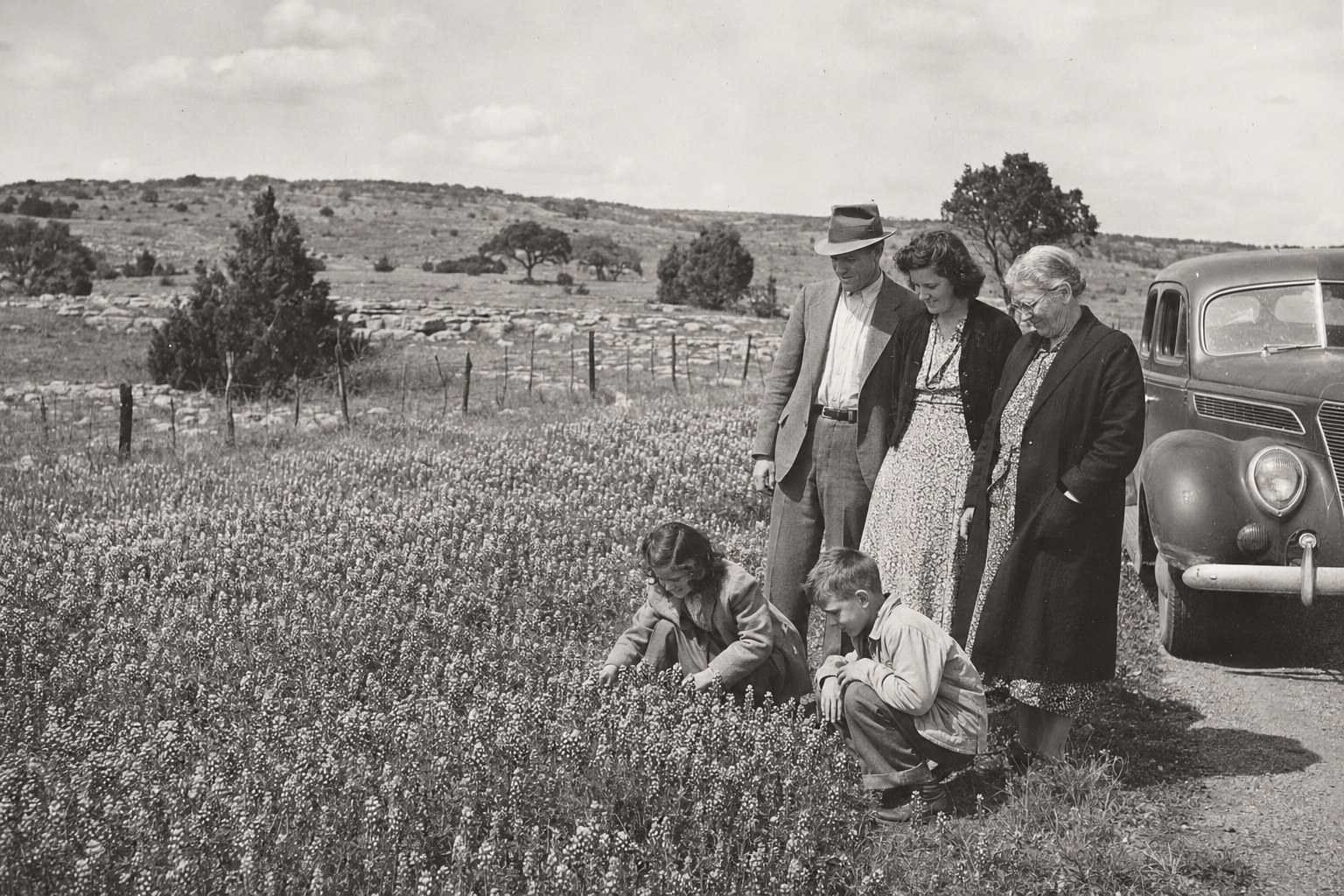
A Burnet County family pauses beside a Hill Country bluebonnet field in the late 1930s. A Ball Club Register historical reconstruction.
How the state flower became part of the landscape, traditions, and public identity of a Texas Hill Country town.
Each spring, the country around Burnet changes color.
Bluebonnets appear beside the highways, across open pastures, along fence lines, and between the limestone outcroppings of the Texas Hill Country. The bloom does not last long. It begins in March, reaches its height around the opening weeks of April, and then gives way to the heat and other wildflowers of the season.
For a few weeks, however, blue seems to belong to the landscape.
Burnet has built much of its public identity around that annual transformation. It calls itself the Bluebonnet Capital of Texas. A festival fills the courthouse square each April. Visitors arrive in search of flowering roads, family photographs, and the particular Hill Country spring that the bluebonnet has come to represent.
The title feels natural today, but it was not simply inherited. It grew from the history of the Texas state flower, the spread of bluebonnets along the state’s highways, a legislative compromise between neighboring counties, and Burnet’s decision to turn an honorary designation into a civic tradition.
A flower before a capital
The bluebonnet belonged to Texas long before any town claimed it.
Several species of the genus Lupinus grow within the state, including Lupinus subcarnosus and Lupinus texensis. The flowers rise in dense clusters along a central stem, with each individual bloom resembling the shape of a small bonnet.
That resemblance is generally credited with giving the flower its familiar name. It has also been known as buffalo clover, wolf flower, and el conejo, Spanish for “the rabbit.”
On March 7, 1901, the Texas Legislature adopted Lupinus subcarnosus as the official state flower. The choice did not end the discussion. Texans from other regions favored different varieties, particularly the more widely recognized Lupinus texensis of Central Texas. In 1971, the Legislature resolved the dispute by extending the official designation to include Lupinus texensis and every other bluebonnet variety native to the state.
Texas did not receive a single official bluebonnet. It received an entire family of them.
By then, the flower had long since escaped the boundaries of botany. It appeared in paintings, postcards, school lessons, roadside photographs, commercial labels, songs, pageants, and public ceremonies. The bluebonnet had become a visual abbreviation for Texas itself.
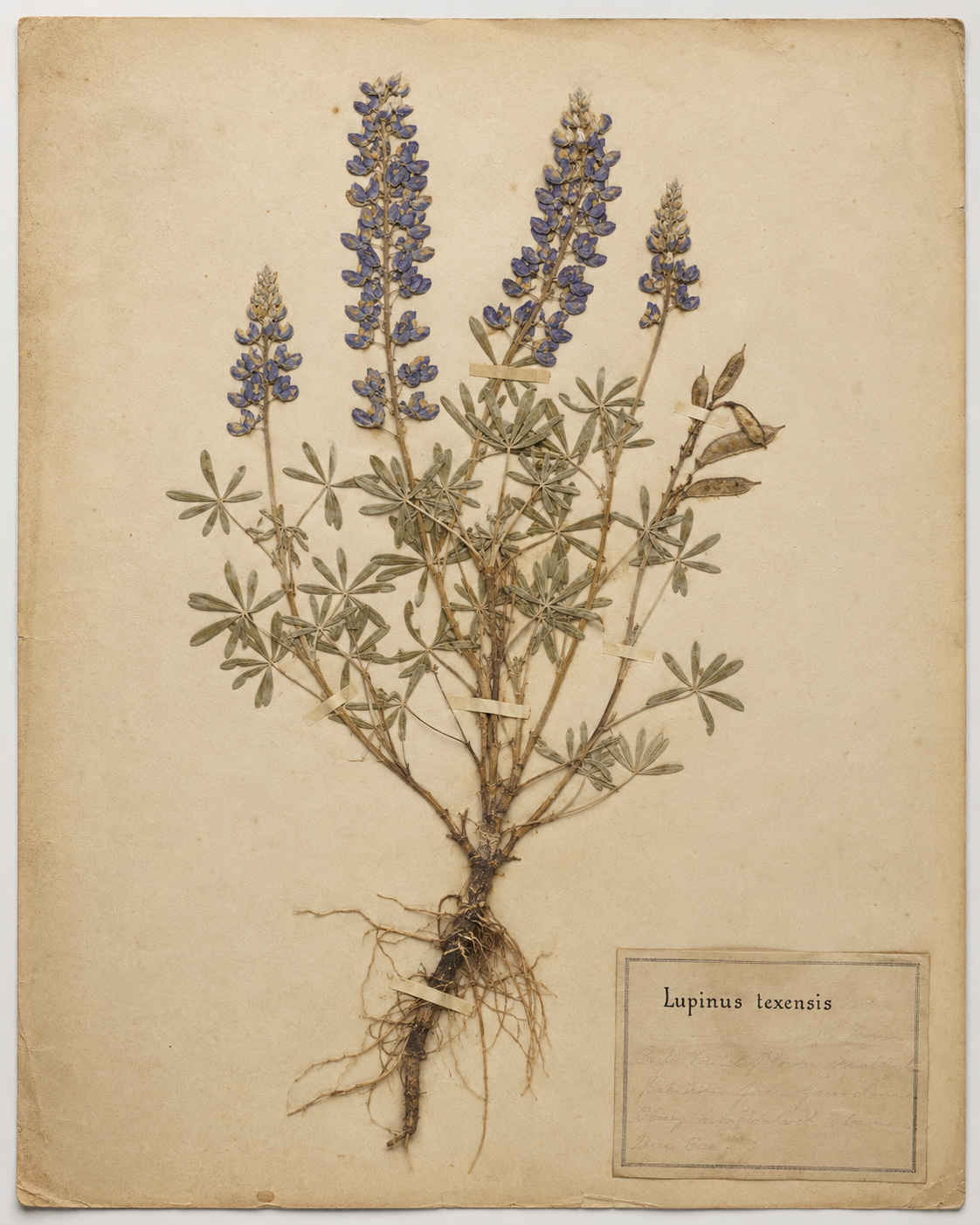
A preserved specimen of Lupinus texensis, the bluebonnet species selected as the Texas state flower in 1901.
Bluebonnet country
The bluebonnet is found in many parts of Texas, but it is particularly associated with the central counties and the eastern edge of the Hill Country.
Around Burnet, the landscape gives the flower a distinctive setting. Open pastures meet rocky slopes. Ranch roads curve between low hills. Granite and limestone, cedar and live oak, cultivated fields and roadside cuts all contribute to a country that changes quickly with the season.
The bluebonnet’s appearance is never entirely predictable. Autumn rain, winter temperatures, soil conditions, grazing, mowing, and the timing of the spring warmth all influence the bloom. One year may produce broad fields of blue. Another may yield smaller, scattered patches. The uncertainty is part of the ritual.
The flower is also temporary. By the time summer approaches, most of the blue has disappeared. That briefness concentrates attention. Families return to familiar roads. Drivers slow near promising fields. The same slopes and pastures are compared from one spring to the next.
Burnet did not create the bluebonnet landscape, but it learned how to make that landscape part of the town’s identity.
The roads that carried the flower
The familiar image of bluebonnets beside a Texas highway is partly natural and partly the result of deliberate public policy.
Soon after the Texas Highway Department was organized in 1917, highway officials observed that native wildflowers were among the first plants to return along roadside cuts and disturbed ground. In 1932, the department hired its first landscape architect, Jac Gubbels, with instructions to preserve and encourage native vegetation along highway rights of way.
By 1934, department rules restricted mowing during the spring and early summer wildflower seasons unless safety required it. Seeds were collected and redistributed, while roadside maintenance increasingly allowed native plants time to bloom and reseed.
Bluebonnets became one of the most visible beneficiaries.
The program did more than beautify the roads. It made the state flower publicly accessible. Travelers no longer needed to enter a ranch or search across private land to find bluebonnets. They encountered them through the windshield.
The flowering roadside became one of the defining images of travel in Texas. It also strengthened the association between bluebonnets and places such as Burnet, where the highways passed through country already known for its spring displays.
Later efforts associated with Governor John Connally and Lady Bird Johnson expanded the public appreciation of Texas wildflowers, but the state’s roadside program had begun decades earlier. By the middle of the twentieth century, the bluebonnet was both a native flower and part of the designed experience of traveling across Texas.
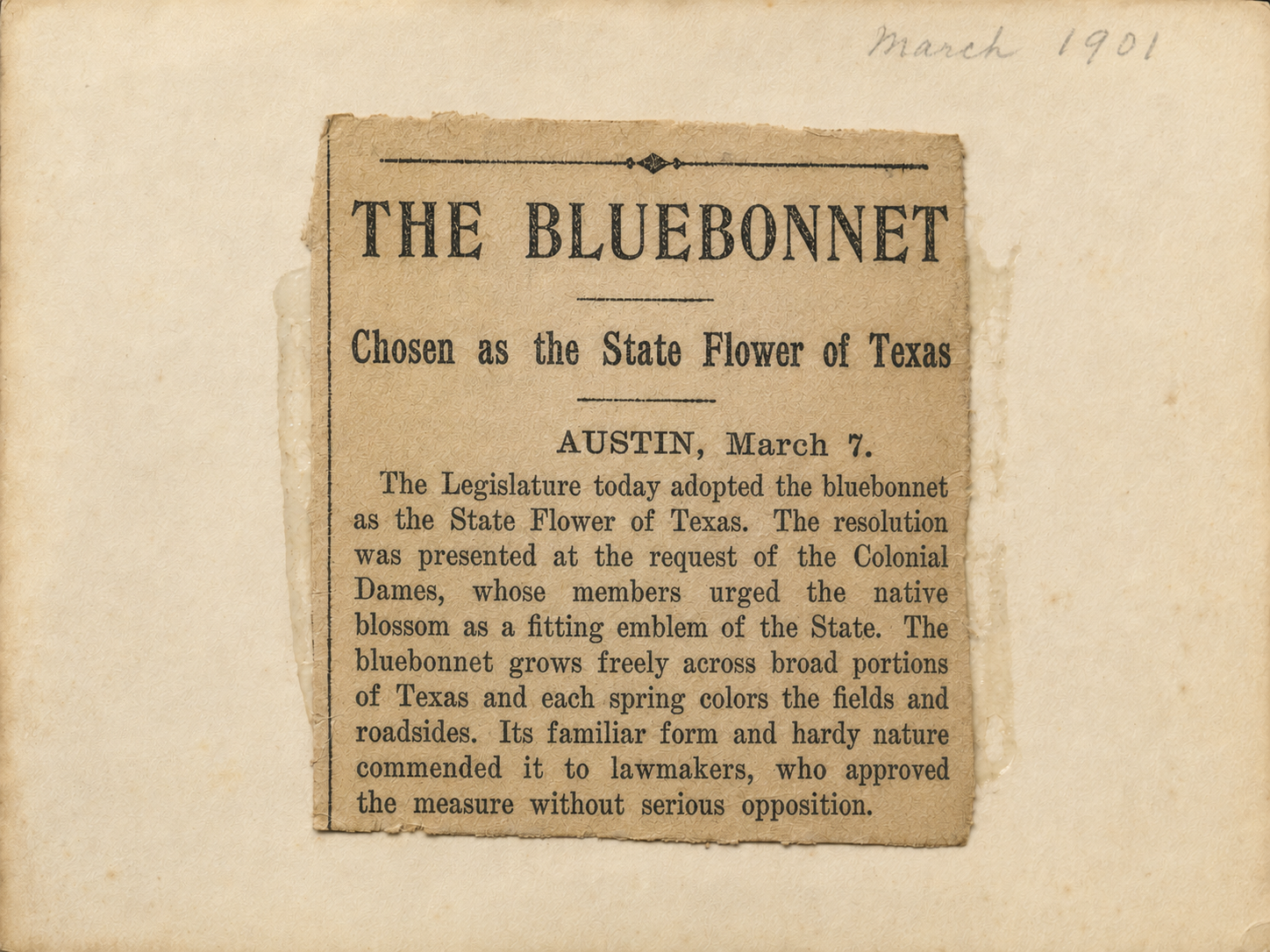
A reconstructed 1901 newspaper clipping announcing the bluebonnet’s selection as the Texas state flower. A Ball Club Register historical reconstruction.
Burnet makes its claim
By the late twentieth century, several Texas communities had become known for their bluebonnets.
Burnet had a strong claim. The town sat within one of the state’s most familiar wildflower regions, surrounded by ranchland, lakes, hills, and roads that drew spring visitors from Austin and beyond. Bluebonnets were not confined to a municipal garden or a single planted trail. They appeared throughout the surrounding county.
Llano County, immediately to the west, could make a similar argument.
In 1981, proposals reached the Texas Legislature seeking formal recognition for the region. What emerged was not a victory for one town over another, but an unusual shared designation.
Senate Concurrent Resolution 108 recognized Burnet County and Llano County as the Bluebonnet Co-Capitals of Texas.
It was the first time Texas granted the same symbolic capital designation to two places. Later rules would discourage duplicate capital titles, but the Burnet and Llano arrangement was allowed to remain.
The exact designation belongs to both counties. In common use, however, Burnet embraced the shortened title that now appears throughout its public identity:
The Bluebonnet Capital of Texas.
A capital shared
The shared title reflects the landscape better than a boundary could.
Bluebonnets do not stop at a county line. The spring display extends across roads, ranches, hills, parks, and communities throughout the Highland Lakes region. Burnet and Llano belong to the same larger wildflower country, and both have continued to celebrate the designation.
Yet Burnet did something especially important with its half of the title. It turned legislative recognition into a public tradition.
An honorary designation can remain little more than a line in a resolution. Burnet treated it as an invitation.
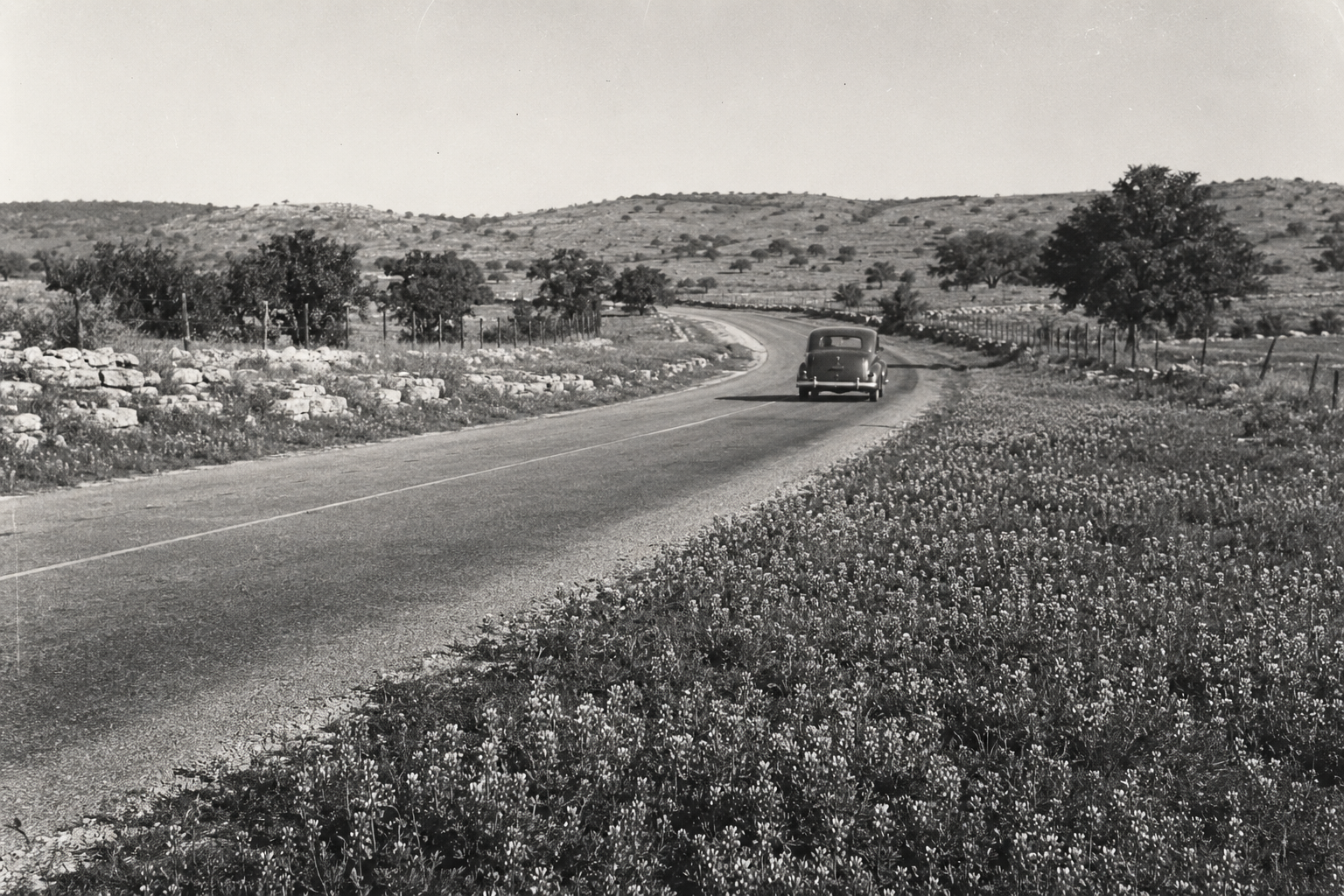
A motorist travels through the Texas Hill Country near Burnet during bluebonnet season in the late 1930s. A Ball Club Register historical reconstruction.
Turning the title into a festival
Two years after the legislative designation, community leaders organized the first Burnet Bluebonnet Festival.
Pat Riddell and Cary Johnson helped establish and fund the event with the support of the Burnet Chamber of Commerce, its board, and dozens of community volunteers. The first festival was held in 1983 around Burnet’s historic courthouse square.
Its timing was central to the idea. The festival would take place during the bluebonnet bloom, on the second weekend of April, when the roads approaching Burnet were most likely to show the flower at its best.
The early event grew into a community-wide celebration. Music, arts and crafts, food, races, pageants, parades, antique cars, children’s activities, and local organizations gradually filled the program. The festival drew visitors into town, but it remained rooted in Burnet’s own civic life.
The courthouse square gave it a recognizable center. The bluebonnet fields and roads beyond town supplied the larger setting.
Over time, the festival became one of the best-known small-town celebrations in Central Texas. Tens of thousands of visitors could arrive during a single weekend, temporarily multiplying Burnet’s population and turning the legislative title into an economic and cultural event.
The Bluebonnet Capital was no longer merely proclaimed. It was performed each spring.
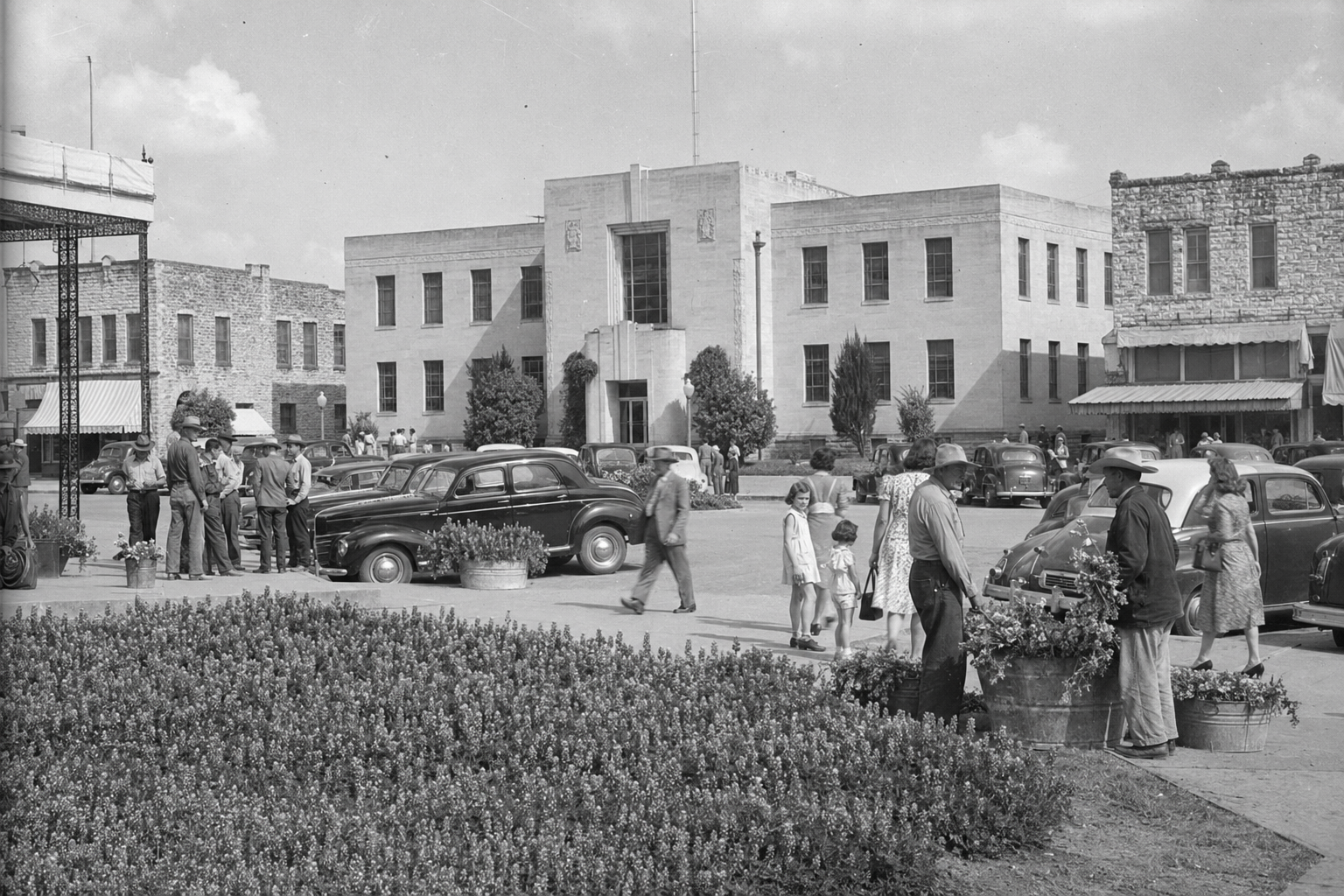
Downtown Burnet during bluebonnet season in the late 1940s. A Ball Club Register historical reconstruction.
More than a festival
Burnet’s connection to the bluebonnet is now visible throughout the community.
The flower appears in public art, civic promotions, local businesses, pageants, souvenirs, landscaping, and event imagery. Visitors plan spring drives around bloom reports and familiar viewing locations. The annual question is not whether bluebonnets belong to Burnet, but when they will appear and how long they will remain.
The association has become strong enough that the modern festival can seem like the beginning of the story. It was not.
The festival formalized a relationship that had been developing for generations. The flower had been adopted by Texas in 1901. Its visibility increased along the highways during the 1930s. Families, merchants, photographers, civic groups, and local institutions had already made it part of the visual culture of the Hill Country.
Burnet’s 1981 designation recognized that history. The 1983 festival gave it an annual form.
Before the designation
Long before the Legislature named Burnet County a bluebonnet co-capital, the flower was already available as a local symbol.
It represented the countryside around Burnet without requiring an elaborate explanation. It was native, recognizable, seasonal, and unmistakably Texan. Its name also carried an older visual association: the bonnet from which the flower was believed to have taken its name.
In the records of The Ball Club Register, those associations reached the baseball field in 1921.
The connection began with twelve dark-blue wool caps.
Baseball in bluebonnet country
The Burnet Blue Bonnets were organized in the spring of 1921 by railroad workers, granite-yard hands, ranch workers, dam laborers, and clerks from the businesses around the county square.
The club’s first subscription drive paid for baseballs, bats, rail fare, and twelve matching caps purchased through a local dry-goods merchant. The rest of the uniforms varied from player to player. The dark-blue caps were the only consistent part.
After an early road game, a county sportswriter described the visitors as “Burnet’s blue-bonneted nine.” A later box score shortened the phrase to Blue Bonnets, and the name remained.
The club preserved the unusual two-word spelling throughout its history. The flower was a bluebonnet. Burnet’s ball club was the Blue Bonnets.
What began as a description of the caps soon absorbed the larger meaning of the flower. By the middle of the 1930s, a bluebonnet bloom appeared on the club’s cream home uniform. A bonneted-baseball emblem entered its scorecards and season-ticket books. The annual Bluebonnet Queen greeted the crowd at Fair Grounds Park.
The identity belonged equally to the club and the country surrounding it.
Burnet’s strongest season came in 1937, during the same decade in which the Texas Highway Department was preserving and spreading wildflowers along the state’s roadsides. The Blue Bonnets won the Hill Country League championship before a crowd of more than 3,700, many of them standing behind rope lines extending into the outfield corners.
By the time Burnet received its state designation in 1981, the Blue Bonnets had been gone for nearly three decades. Yet the title would have been immediately familiar to anyone who remembered the dark-blue caps, the flower on the uniform, and spring baseball beside Hamilton Creek.
Decades before Burnet formally became the Bluebonnet Capital of Texas, its ball club had already carried the flower’s name.

Late 1930s uniforms worn by the Burnet Blue Bonnets.
