Burnet Blue Bonnets
Burnet, Texas
Established 1921
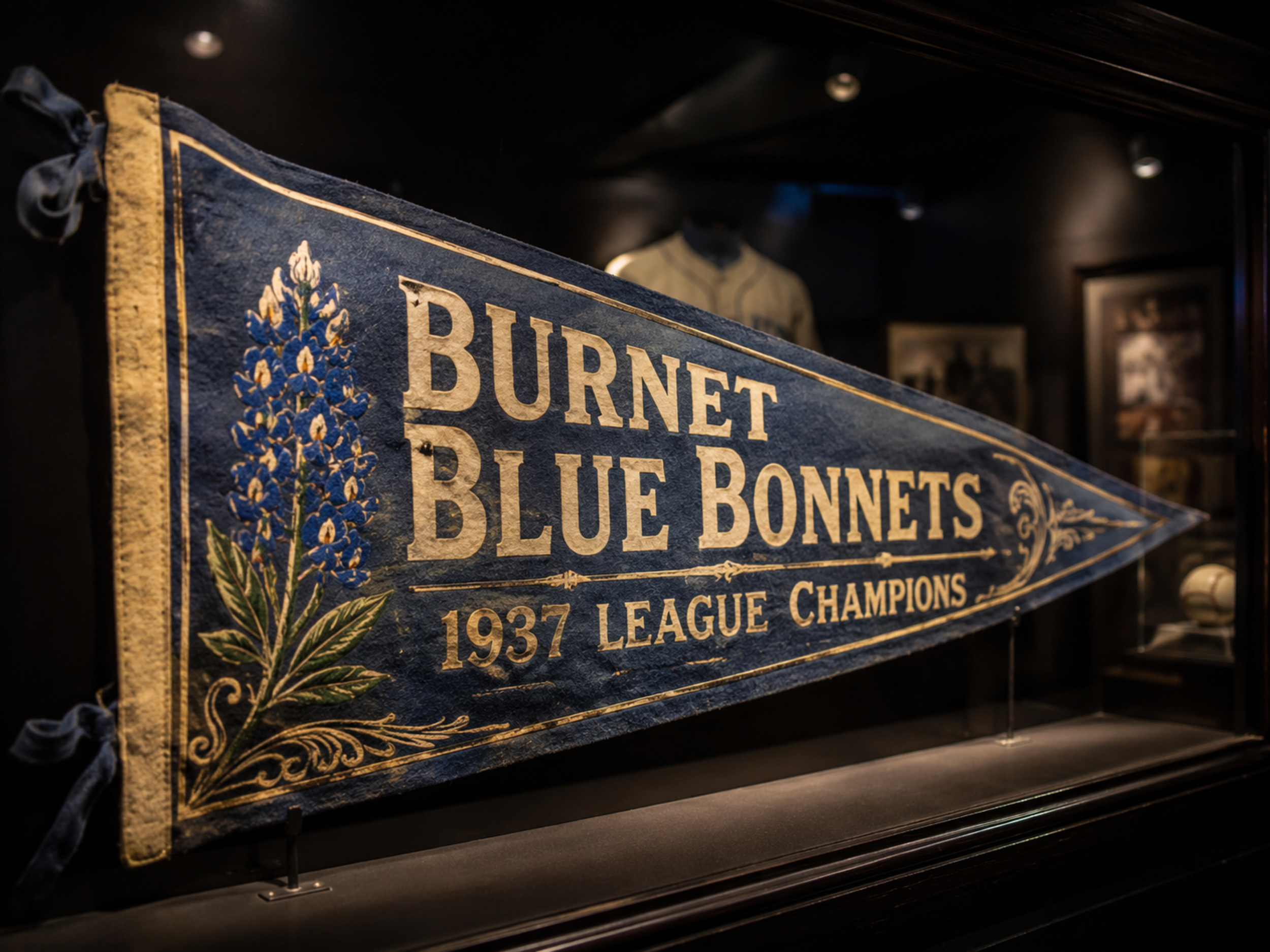
1937 Hill Country League Champions
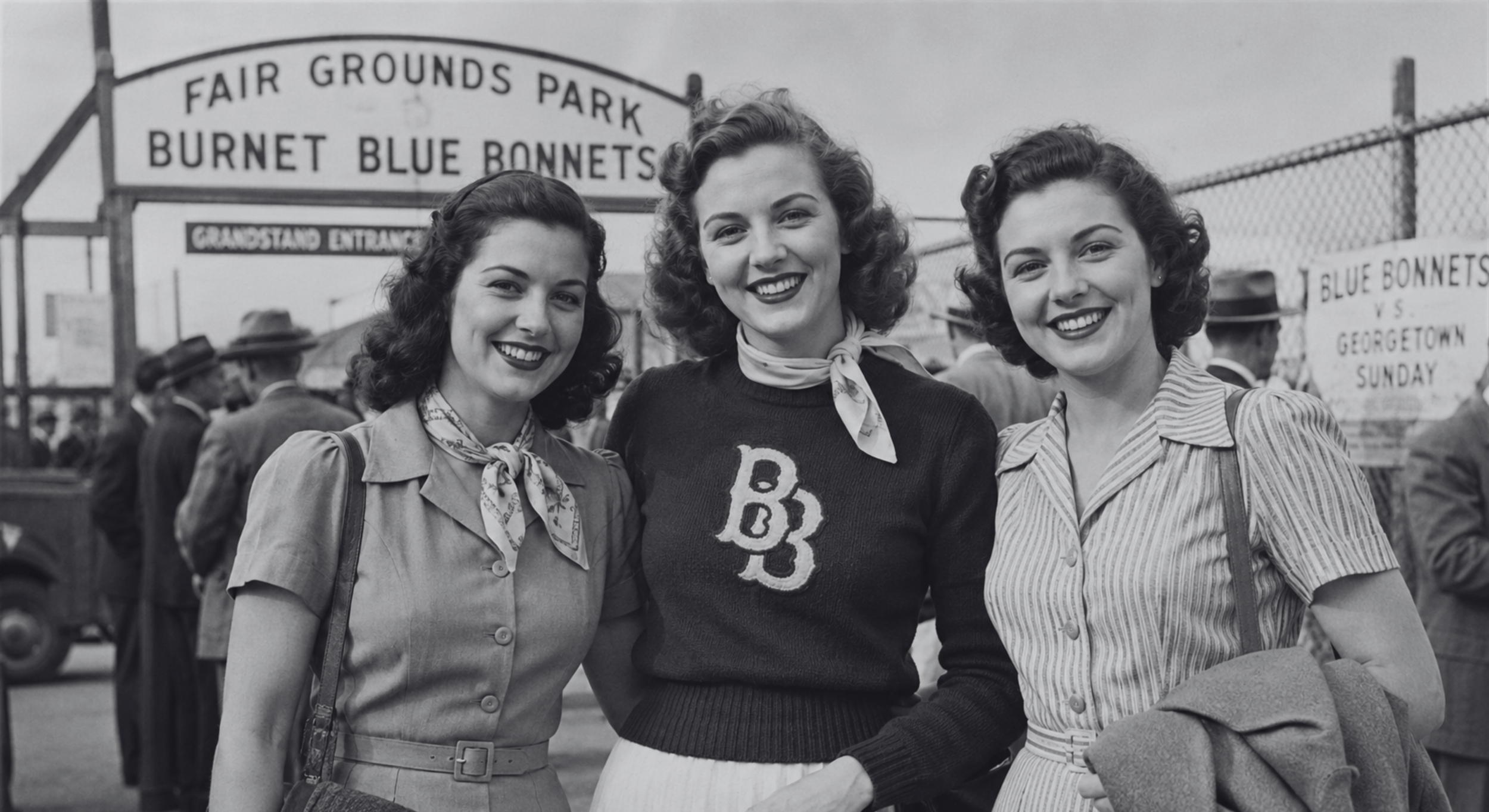
Club History
The Burnet Blue Bonnets were organized in the spring of 1921 by railroad men, granite-yard hands, ranch workers, dam laborers, and clerks from the businesses around the county square. The first subscription drive was practical rather than grand: baseballs, rail fare, a few bats, and twelve dark-blue wool caps purchased through a local dry-goods merchant. Those caps were the only matching part of the original uniform.
The name came almost by accident. After an early road game, a county sportswriter described the visitors as “Burnet’s blue-bonneted nine.” The following week’s box score shortened the phrase to Blue Bonnets, and the club kept the two-word spelling for the remainder of its history, even as the flower the town became famous for was commonly written as one word.
The early Blue Bonnets played Sunday schedules against company clubs, ranch-town nines, and independent teams from across the Hill Country. They moved to Fair Grounds Park in 1925, when local subscribers helped enclose a field near Hamilton Creek and the railroad siding. Burnet joined the Hill Country League the following season, and its strongest rivalry quickly developed with Llano. Those games drew crowds that often had little to do with the standings and everything to do with county pride.
The club nearly disappeared during the Depression. Home dates were reduced, several road trips were canceled, and players sometimes passed a hat through the grandstand to cover the next week’s expenses. Burnet’s recovery began in the middle of the 1930s, when new workers, wages, and spectators reached town through construction west of Burnet and the growing activity around the Highland Lakes projects.
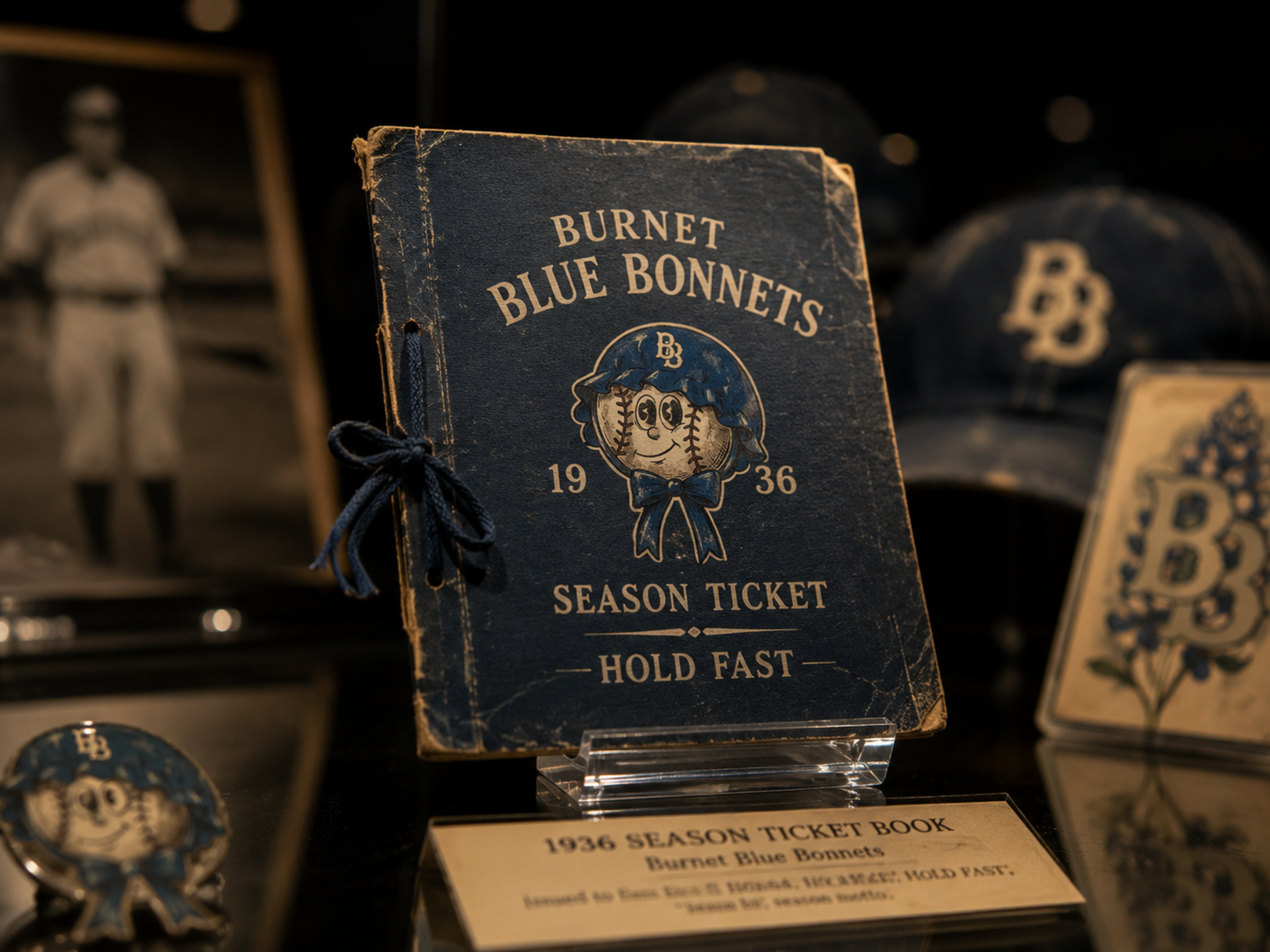
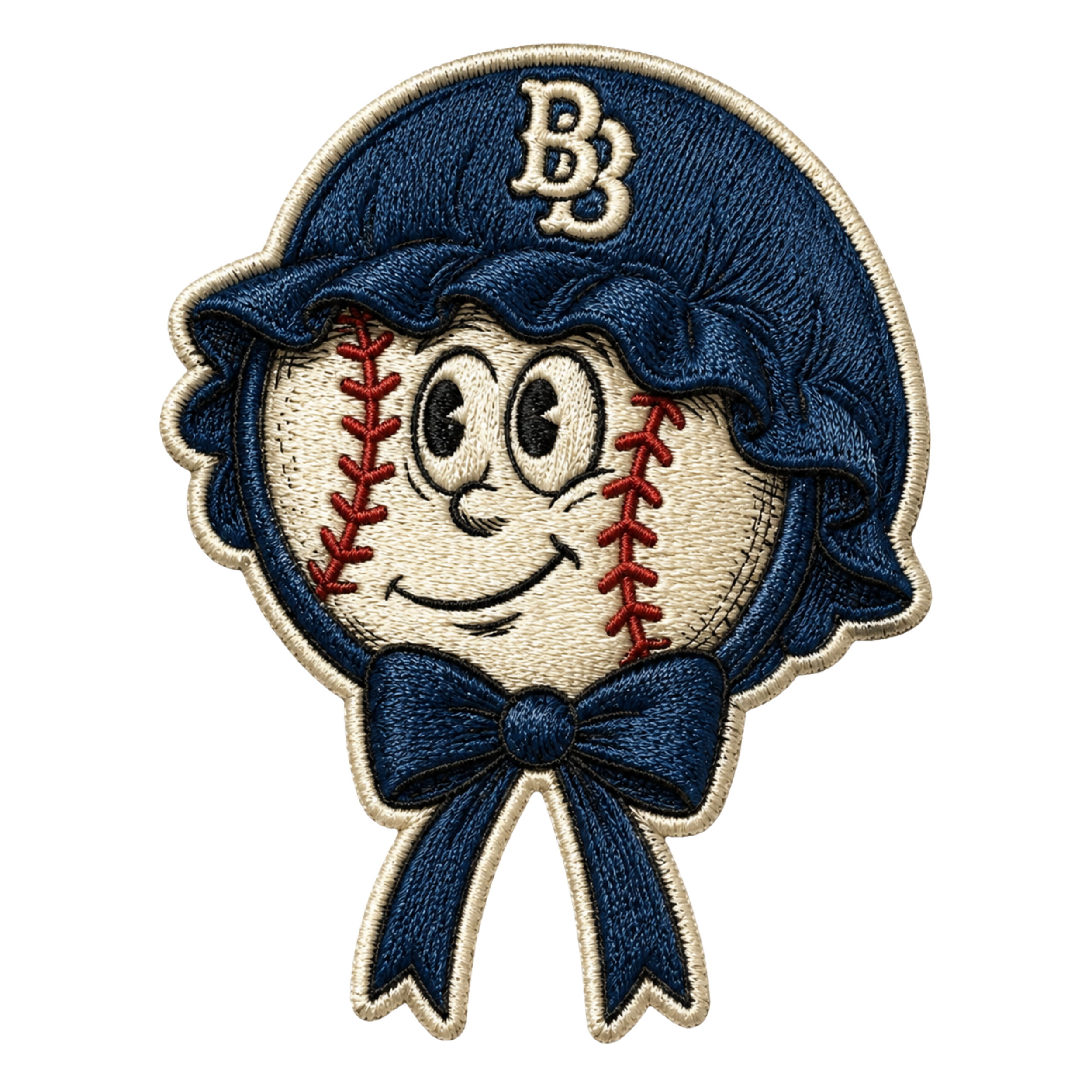
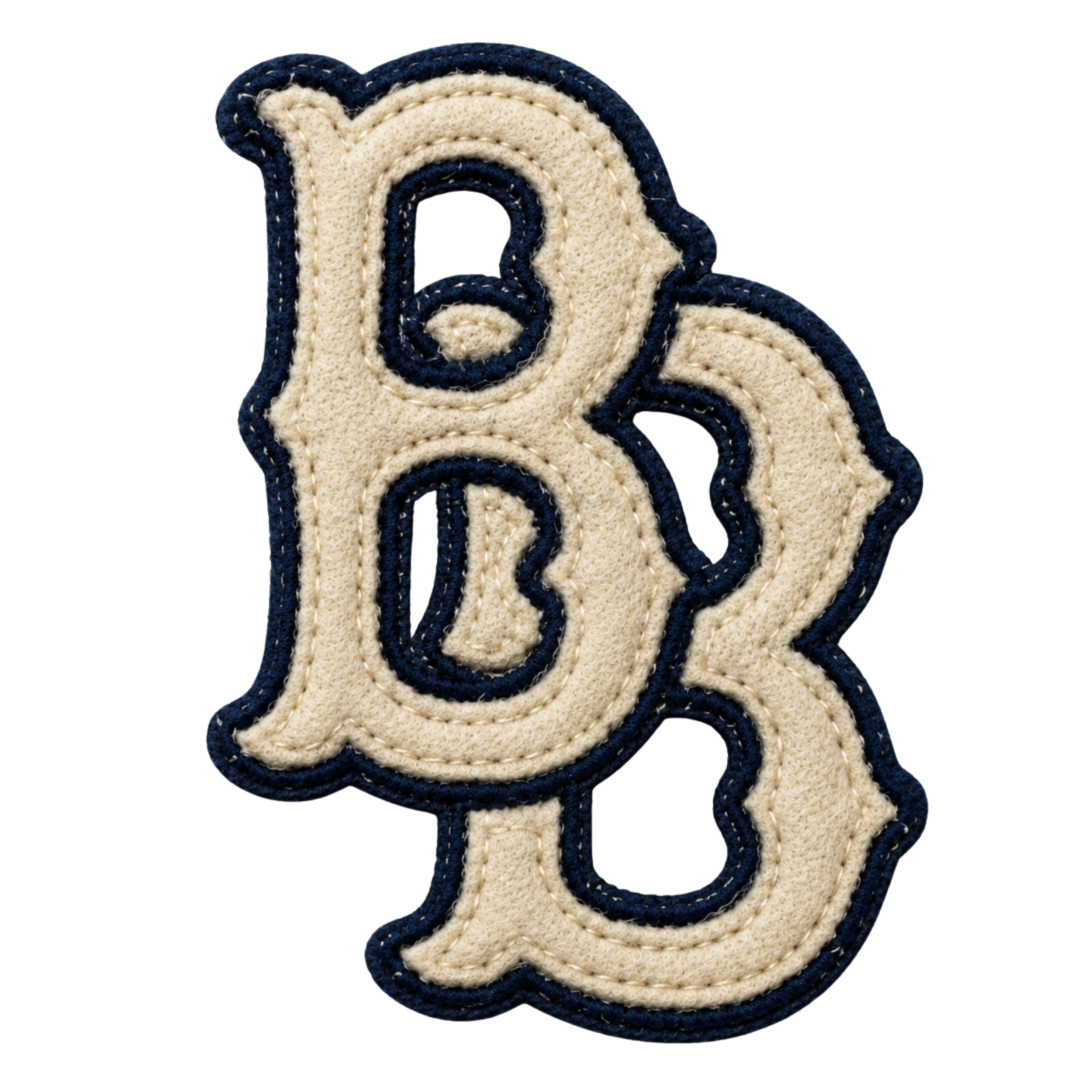
Local merchants reorganized the club before the 1935 season. Former catcher Virgil “Vick” Hall was appointed manager, and a cream interlocking BB monogram appeared on the dark-blue caps. The following spring, season-ticket books and scorecards introduced the bonneted-baseball emblem now associated with the club. Printed beneath it were the two words that became Burnet’s motto: Hold Fast.
By 1937, Burnet had developed the small public customs that made Blue Bonnets games feel like town events. Supporters pinned bluebonnet sprigs or dark-blue ribbons to hats, dress collars, shirt pockets, and Sunday jackets before walking toward Fair Grounds Park. During rivalry weeks, especially before Llano games, the gesture became a quiet way of saying that the town had taken the field with its club.
Within two seasons, Hall had assembled the strongest club in Blue Bonnets history. Burnet and Llano finished the 1937 regular season tied at 54–32, forcing a best-of-three playoff for the Hill Country League pennant. The Blue Bonnets lost the opening game in Llano, returned home to even the series at Fair Grounds Park, and then played the deciding game before one of the largest baseball crowds Burnet had ever seen.
The final game remained tied 1–1 through ten innings. In the bottom of the eleventh, second baseman Paul Gattis singled and advanced to second on a sacrifice. Center fielder Leon Baird followed with a two-out hit through the left side, scoring Gattis and giving Burnet a 2–1 victory. Right-hander Ellis “Buck” Harlan pitched all eleven innings.
Contemporary estimates placed the crowd at more than 3,700, with spectators standing behind rope lines that extended into both outfield corners. The championship was formally recorded as Burnet’s first Hill Country League title. It proved to be the club’s last.
Burnet suspended play during the war and returned in 1946 wearing the same dark-blue caps and cream flannels. The postwar clubs remained competitive, finishing second in 1948, but never returned to the championship series. In the spring of 1952, a severe windstorm damaged the Fair Grounds Park grandstand and first-base seating. The Blue Bonnets completed one final season using temporary seats and borrowed diamonds, then did not reorganize for 1953.
No complete collection of club records is known to survive. What remains includes scattered box scores, ticket books, a faded team photograph, a championship pennant, pieces of game equipment, several park fixtures, and the story of the twelve blue caps that gave Burnet’s ball club its name.
Club and Community
-
![Black-and-white 1940s portrait of the Bluebonnet Queen smiling at a Burnet Blue Bonnets game, wearing a sash and floral corsage with the Fair Grounds Park crowd blurred behind her.]()
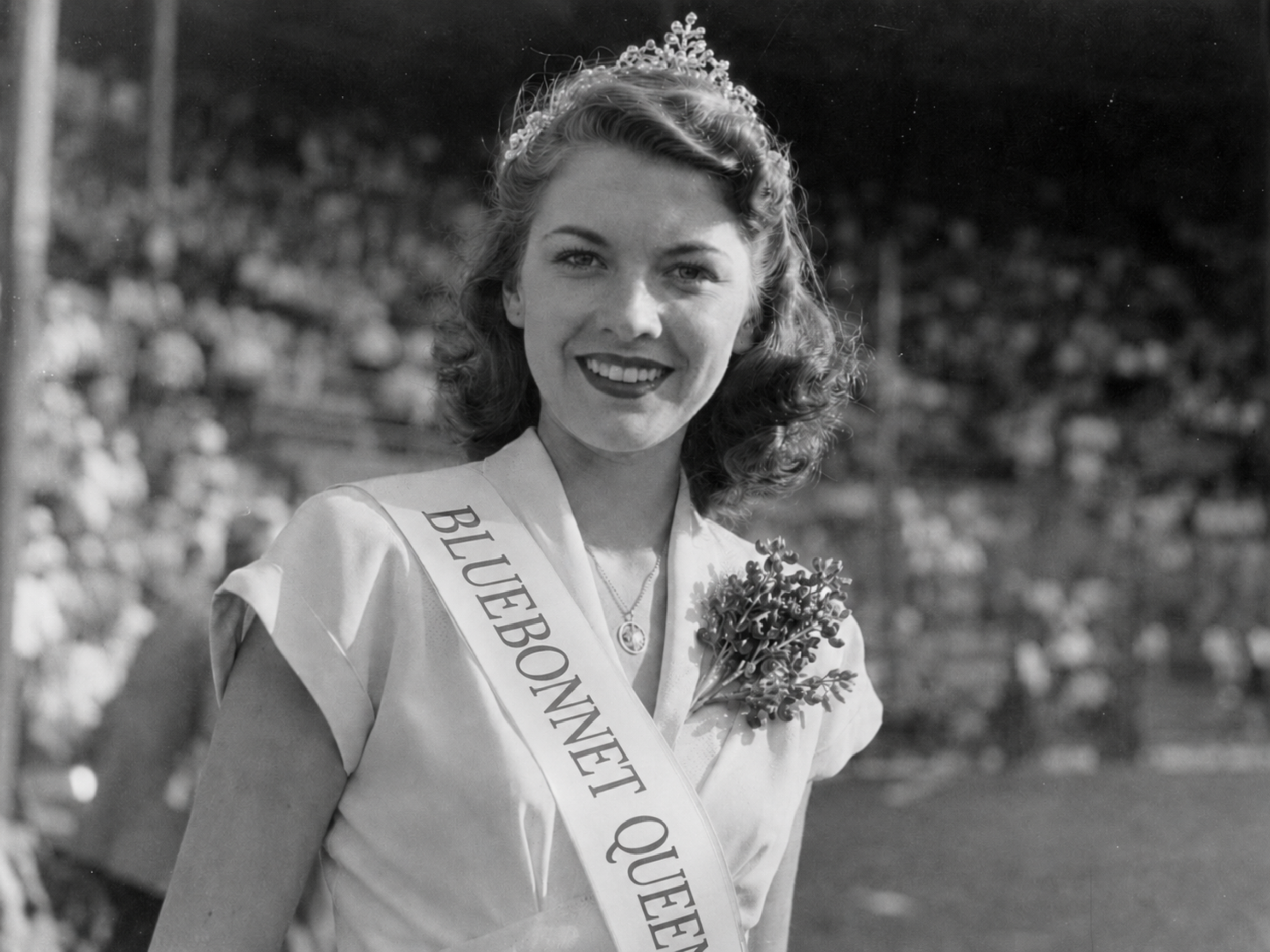
The Bluebonnet Queen
Game-Day Ceremony · Fair Grounds Park, Circa 1940s
Wearing her BLUEBONNET QUEEN sash and a pinned spray of flowers, Burnet’s game-day honoree stands before the Fair Grounds Park crowd during a Blue Bonnets afternoon. The portrait captures the club’s softer civic traditions: spring flowers, local ceremony, fairgrounds baseball, and the town’s pride gathered around the same Sunday game.
-
![Black-and-white 1940s portrait of an older Texas cowboy at a Burnet Blue Bonnets game, wearing a cowboy hat with a bluebonnet flower tucked into the hatband.]()
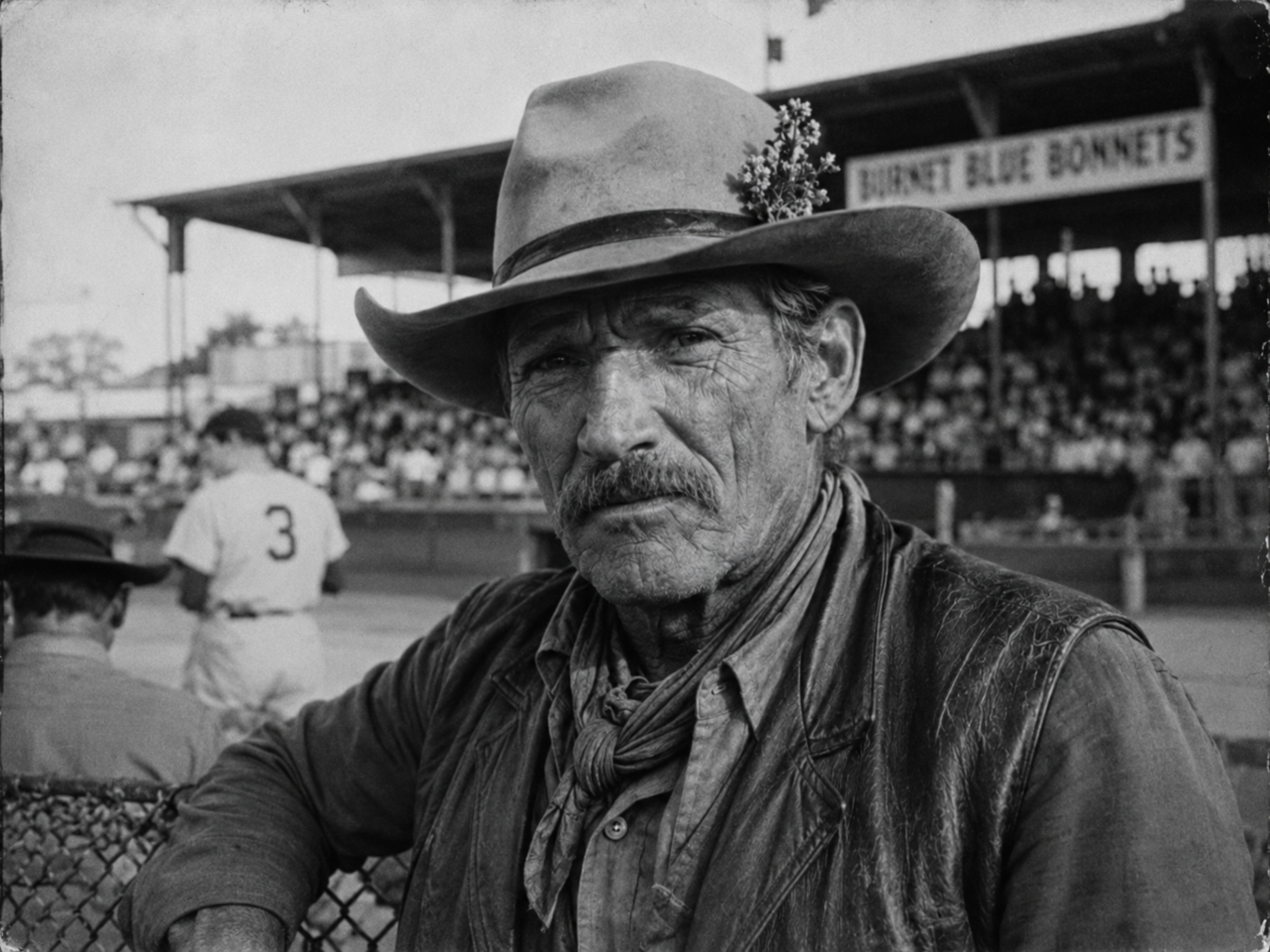
The Ranchman’s Bluebonnet
Hill Country Supporter · Fair Grounds Park, Circa 1940s
With a bluebonnet tucked into his weathered hatband, an old Hill Country cowboy watches the Blue Bonnets from the edge of the crowd. The portrait captures Burnet baseball beyond the grandstand: ranch families, fairgrounds dust, local custom, and the quiet pride of a town that made its ballclub part of county life.
-
![Black-and-white 1940s photograph of a smiling young girl holding a basket of bluebonnet flowers outside the Fair Grounds Park entrance, with game-day spectators gathered behind her.]()
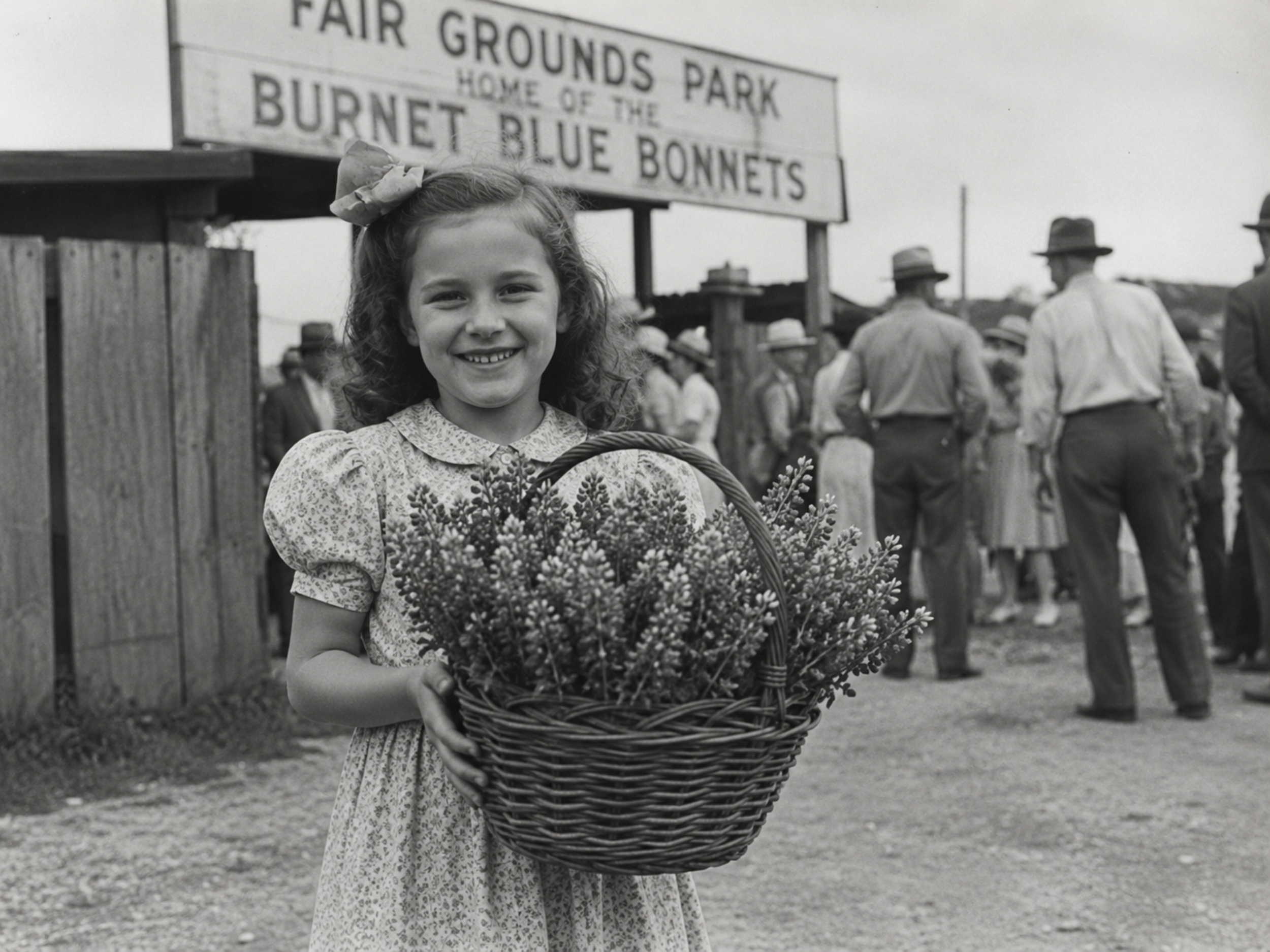
A Basket of Bluebonnets
Young Burnet Supporter · Fair Grounds Park Entrance, Circa 1940s
Outside the Fair Grounds Park gate, a young Burnet supporter carries a basket of bluebonnet flowers toward the afternoon crowd. The gesture belonged naturally to Blue Bonnets baseball: part springtime civic pride, part fairgrounds custom, and part small-town welcome before a Sunday game.
-
![Black-and-white 1940s photograph of the Burnet Blue Bonnets team bus parked outside the Fair Grounds Park fence with club lettering painted on the side.]()
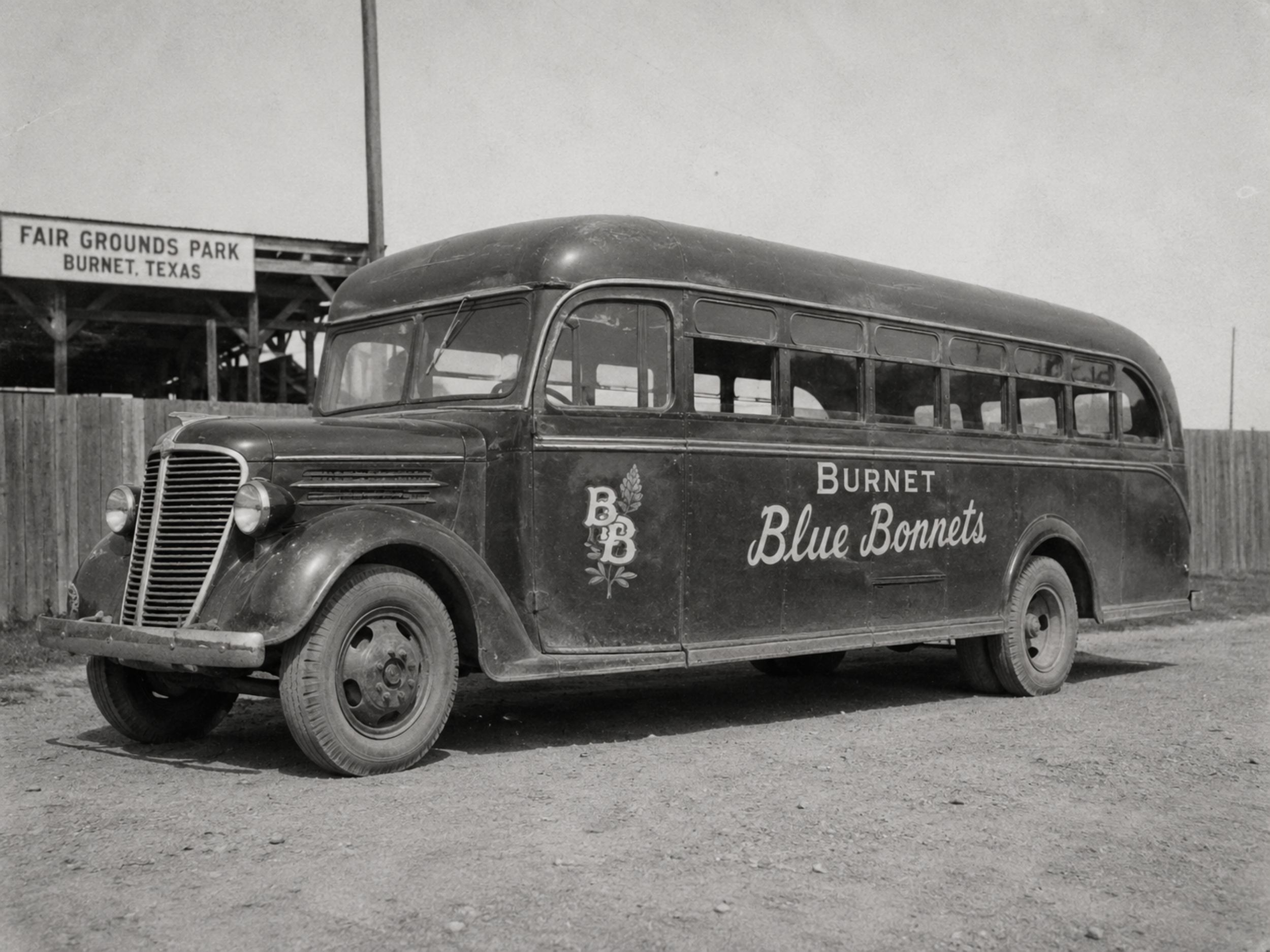
The Blue Bonnets Bus
Team Travel · Fair Grounds Park, Circa 1940s
Parked outside the Fair Grounds Park fence, the Blue Bonnets’ team bus was part transportation, part rolling advertisement, and part symbol of how Burnet carried its ball club across the Hill Country. For road dates against nearby league towns, the bus gathered players, equipment bags, scorebooks, and whatever good-luck tokens the town sent along — a practical machine for a practical club, painted with enough pride to make every trip feel official.
-
![Black-and-white 1940s photograph of a young girl in a bonnet-style hat seated with two boys at Fair Grounds Park, watching a Burnet Blue Bonnets game with the crowd blurred behind them.]()
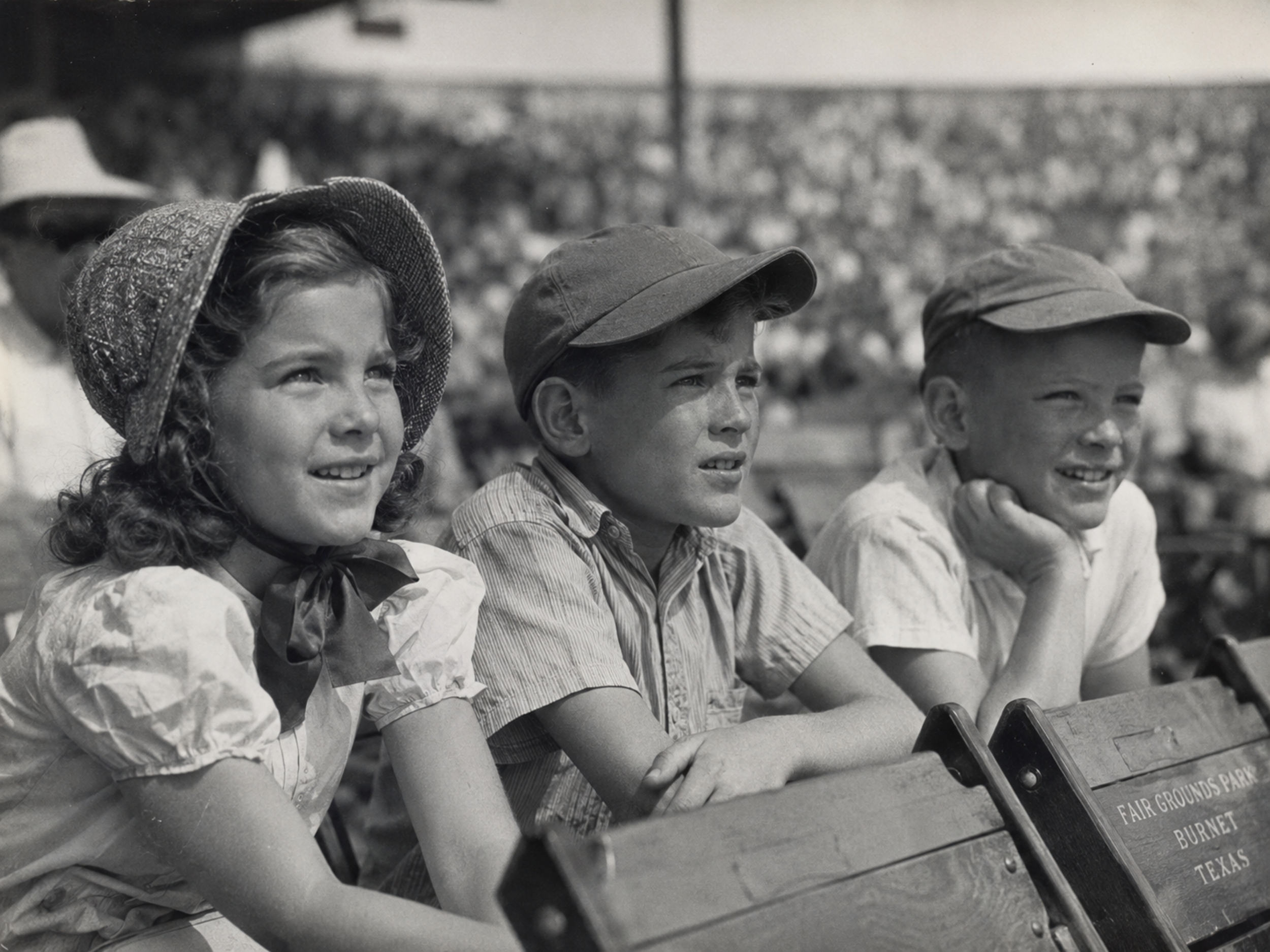
Three Seats at Fair Grounds Park
Young Supporters · Game Day, Circa 1940s
A young girl in a bonnet-style hat sits between two boys along the Fair Grounds Park seating, all three fixed on the game beyond the rail. The portrait captures Burnet baseball as a family afternoon: children leaning forward, caps and Sunday clothes in the sun, and the Blue Bonnets’ fairgrounds crowd fading into soft focus behind them.
-
![Black-and-white 1940s photograph of a large banner reading “GO BLUE BONNETS, BEAT LLANO” hanging on a brick building in downtown Burnet.]()
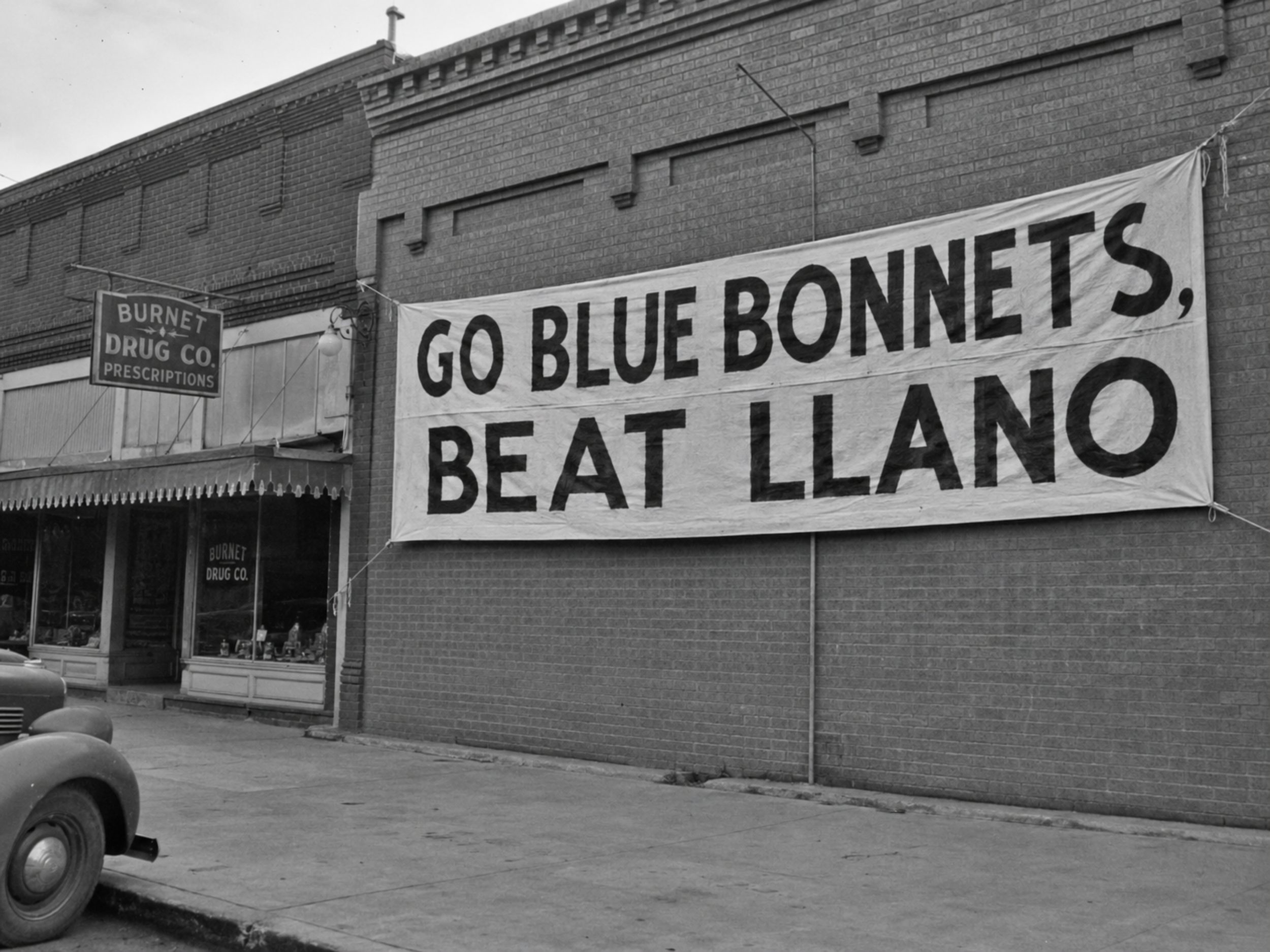
Go Blue Bonnets, Beat Llano
Downtown Burnet Rally Banner · Rivalry Week, Circa 1940s
Hung across a brick storefront in downtown Burnet, the banner made the town’s priorities plain: back the Blue Bonnets and beat Llano. Rivalry week changed the town before it changed the standings. Storefront banners went up, blue ribbons appeared on hats and shirtfronts, and the fairgrounds crowd arrived early, knowing that Burnet’s games against Llano carried county pride as much as league consequence.
Club Record
| Club | Burnet Blue Bonnets Baseball Club |
|---|---|
| Location | Burnet, Texas |
| Established | 1921 |
| Years Active | 1921–1942; 1946–1952 |
| Operations Suspended | 1943–1945 |
| League | Hill Country League |
| Status | Independent regional club |
| Home Park | Fair Grounds Park |
| Ballpark Capacity | Approximately 2,400 seated; more than 3,700 with standing room |
| Club Colors | Dark blue, cream, and brick red |
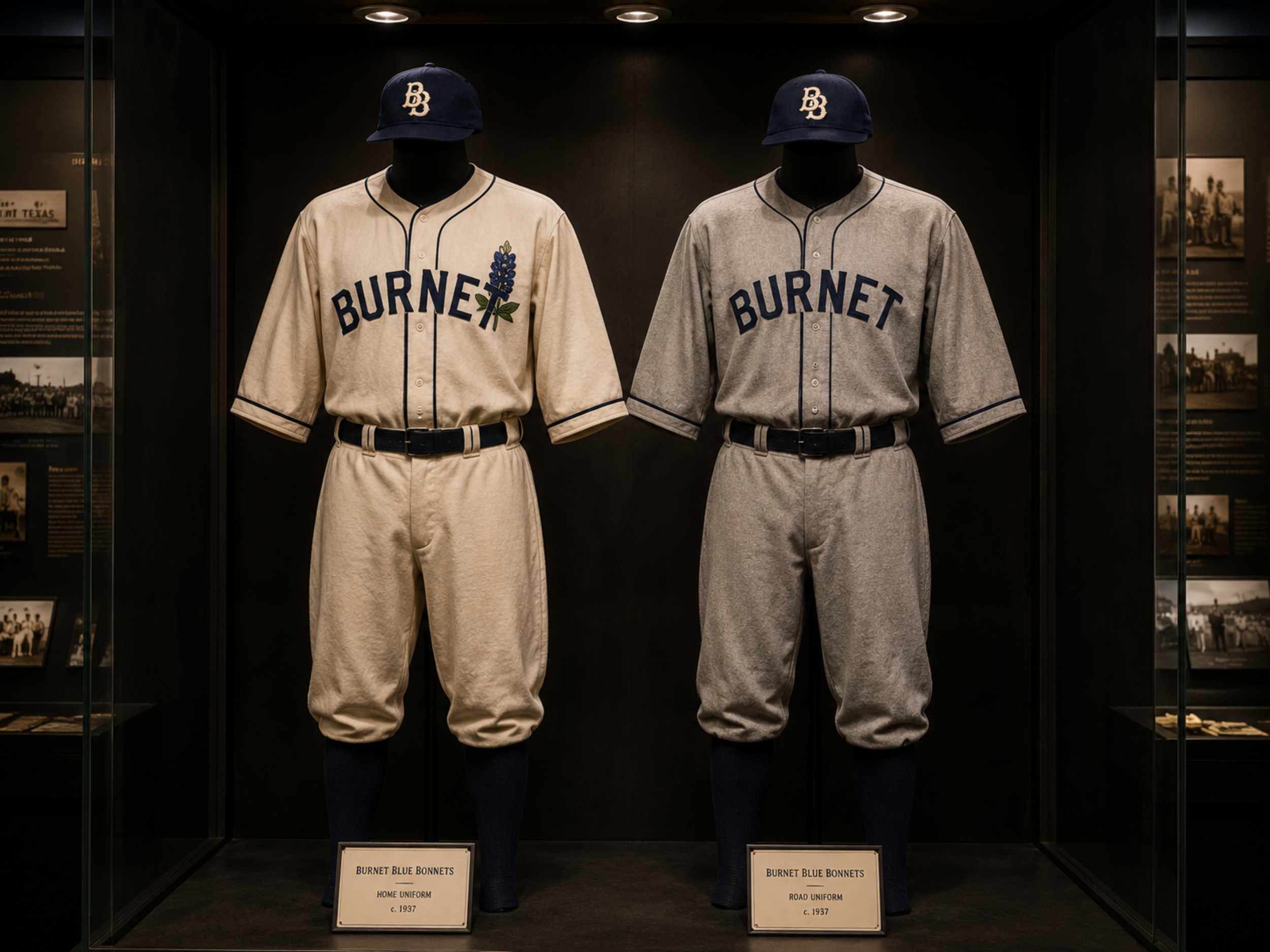
| Primary Uniform | Cream flannel with dark-blue BURNET lettering, dark-blue trim, and a bluebonnet bloom on the left breast |
| Travel Uniform | Gray flannel with dark-blue BURNET lettering and simplified trim |
| Cap | Dark-blue wool cap with a cream interlocking BB monogram |
| Common Shortened Name | The Bonnets |
| Informal Nickname | The Blue Caps |
| Name Usage | The club used Blue Bonnets as two words; references to the flower use bluebonnet as one word |
| Club Motto | Hold Fast. |
| Home-Crowd Custom | Supporters pinned bluebonnet sprigs or dark-blue ribbons to hats, shirt pockets, and dress collars during larger home dates, especially games against Llano |
| Primary Cap Mark | Cream interlocking BB |
| Primary Club Emblem | A bonneted baseball wearing a dark-blue cloth bonnet and bow |
| Uniform Mark | Bluebonnet bloom on the left breast of the primary jersey |
| Alternate Mark | Interlocking BB over a bluebonnet bloom |
| Official Mascot Name | None; club publications generally referred to the figure as “the Bonnet” |
| Cap Monogram Adopted | 1935 |
| Bonnet Emblem Adopted | 1936 |
| Uniform Mark Adopted | 1937 |
| Motto First Used | 1936 season-ticket books and scorecards |
| Club President, 1937 | Arthur L. Galloway |
| Manager, 1937 | Virgil “Vick” Hall |
| Club Captain, 1937 | Wade Morrow, catcher |
| League Titles | 1937 |
| Best-Known Rival | Llano |
| 1937 Playoff Result | Defeated Llano, two games to one |
| Final Season | 1952 |
| Recordkeeping Note | Complete box scores before the 1926 Hill Country League season have not survived |
Club Uniforms and Marks
The Blue Bonnets’ appearance began with the simplest possible uniform element: twelve dark-blue caps. Those caps gave the club its name before bluebonnet flowers, bonneted-baseball drawings, or championship pennants entered the record.
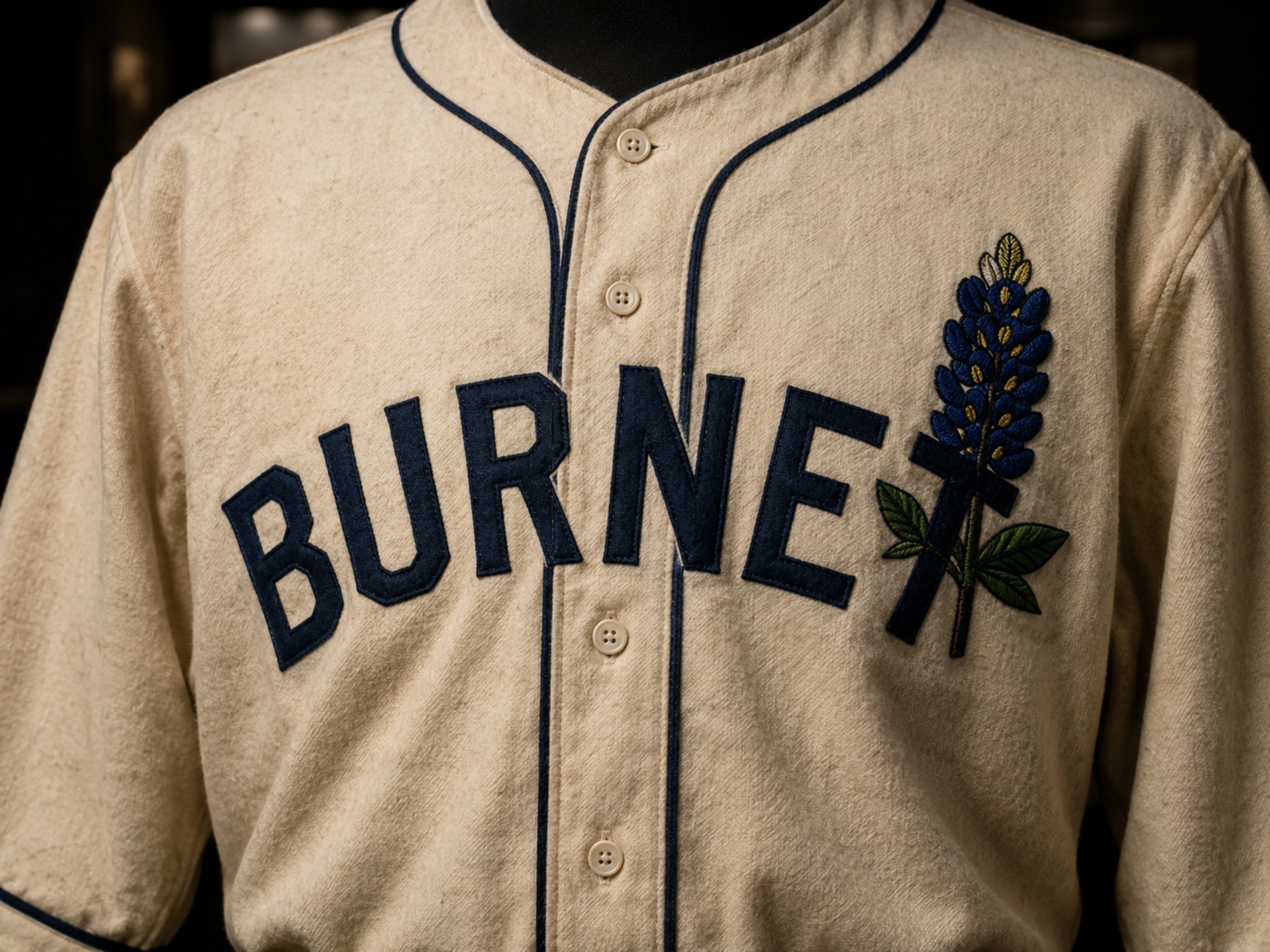
By the middle of the 1930s, Burnet had developed a more complete visual identity. The primary uniform used cream flannel, the travel uniform used gray flannel, and both carried dark-blue lettering. The primary jersey carried BURNET across the chest and, beginning with the 1937 season, a small bluebonnet bloom on the left breast. The detail was modest enough for a working ballclub, but distinctive enough to separate Burnet from the other Hill Country nines.
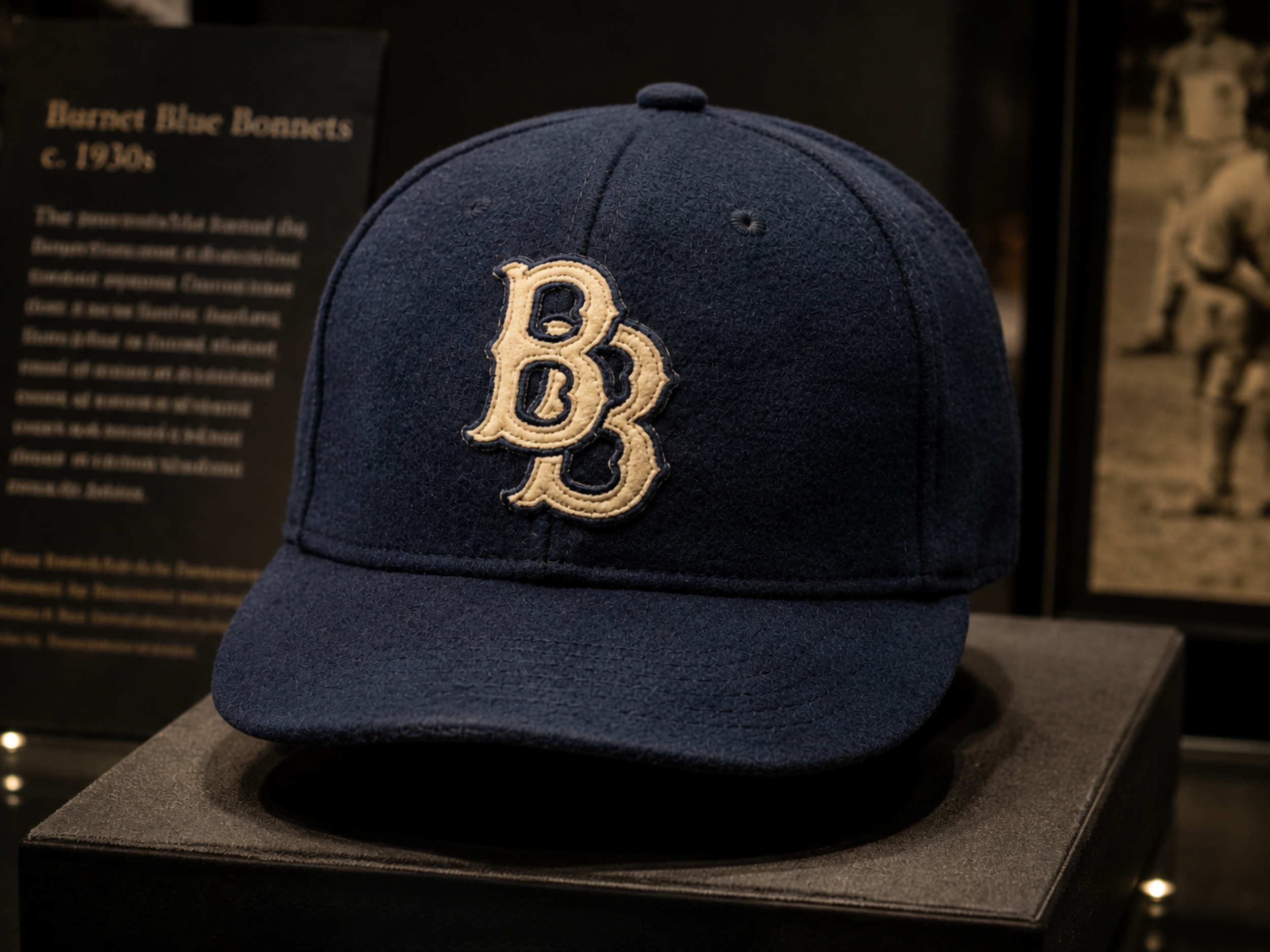
The cap remained the club’s clearest field mark. Introduced during the 1935 reorganization, the cream interlocking BB monogram appeared on dark-blue wool and stayed with the team through its final season. In photographs, the cap reads more plainly than the jersey: two letters, one color field, and the origin story of the club made visible.
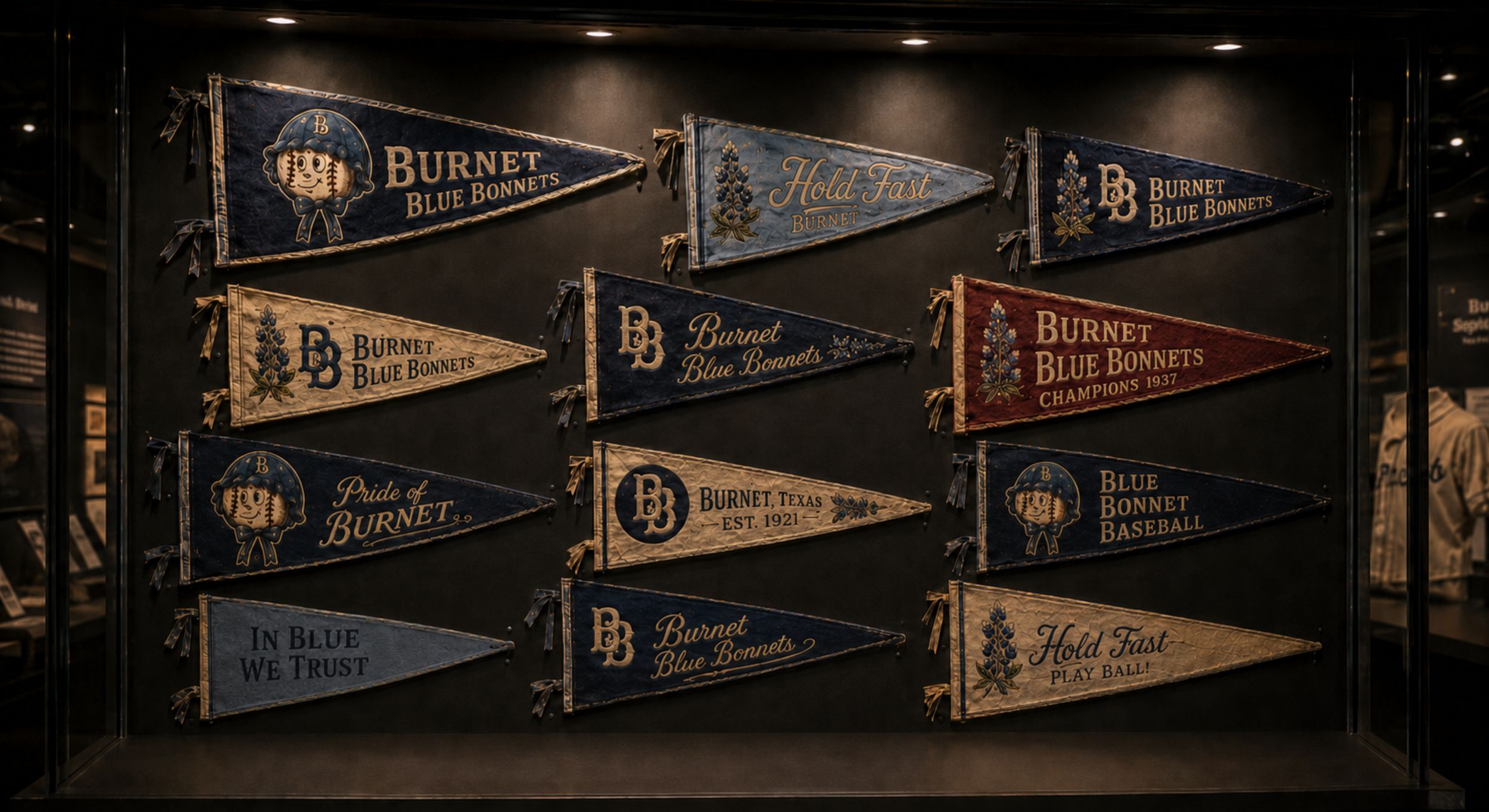
The bonneted-baseball emblem was a printed mark rather than a field mark. First used on 1936 scorecards and season-ticket books, the drawing showed a smiling baseball wearing a dark-blue cloth bonnet tied beneath the chin. It appeared on advertisements, pennants, letterhead, and postseason souvenirs, usually beside the motto Hold Fast.
The Blue Bonnets never gave the bonneted baseball a personal name and never employed a costumed mascot. Club publications generally referred to the figure simply as “the Bonnet.” That restraint helped keep the mark from becoming a novelty. Like the club itself, it remained small, local, and unmistakably Burnet.
The two-word spelling mattered. Even as the flower became commonly written as one word, the ball club continued to use Blue Bonnets, preserving the wording of the newspaper phrase from which the name originated.
Flannel, Felt and Thread
-
![Burnet Blue Bonnets primary and travel baseball uniforms displayed on mannequins in a museum case, with dark-blue caps, BURNET lettering, and a bluebonnet emblem on the primary jersey.]()
Primary and Travel Uniforms
Primary and Travel Uniforms · Museum Exhibit
Displayed together, Burnet’s cream primary uniform and gray travel set show the club at its most complete. Both uniforms carry dark-blue BURNET lettering and matching dark-blue caps, while the primary jersey adds the small bluebonnet bloom that became closely associated with the 1937 championship club.
-
![Dark-blue 1930s Burnet Blue Bonnets baseball cap displayed on a museum pedestal with a cream interlocking BB monogram on the front.]()
Primary Cap
Interlocking BB · Adopted 1935
The cap remained Burnet’s clearest field mark. Its dark-blue wool crown and cream interlocking BB monogram tied the 1930s club back to the original twelve blue caps that gave the Blue Bonnets their name before the flower emblem, pennants, or championship souvenirs entered the record.
-
![Close-up of a cream Burnet Blue Bonnets primary jersey showing dark-blue BURNET lettering, dark-blue piping, buttons, and a stitched bluebonnet chest emblem.]()
Primary Chest Detail
BURNET Lettering & Bluebonnet Bloom
The primary jersey placed dark-blue BURNET lettering across cream flannel, with a small bluebonnet bloom stitched near the left breast. The detail was modest enough for a regional ballclub, but distinctive enough to make Burnet instantly recognizable among the Hill Country nines.
-
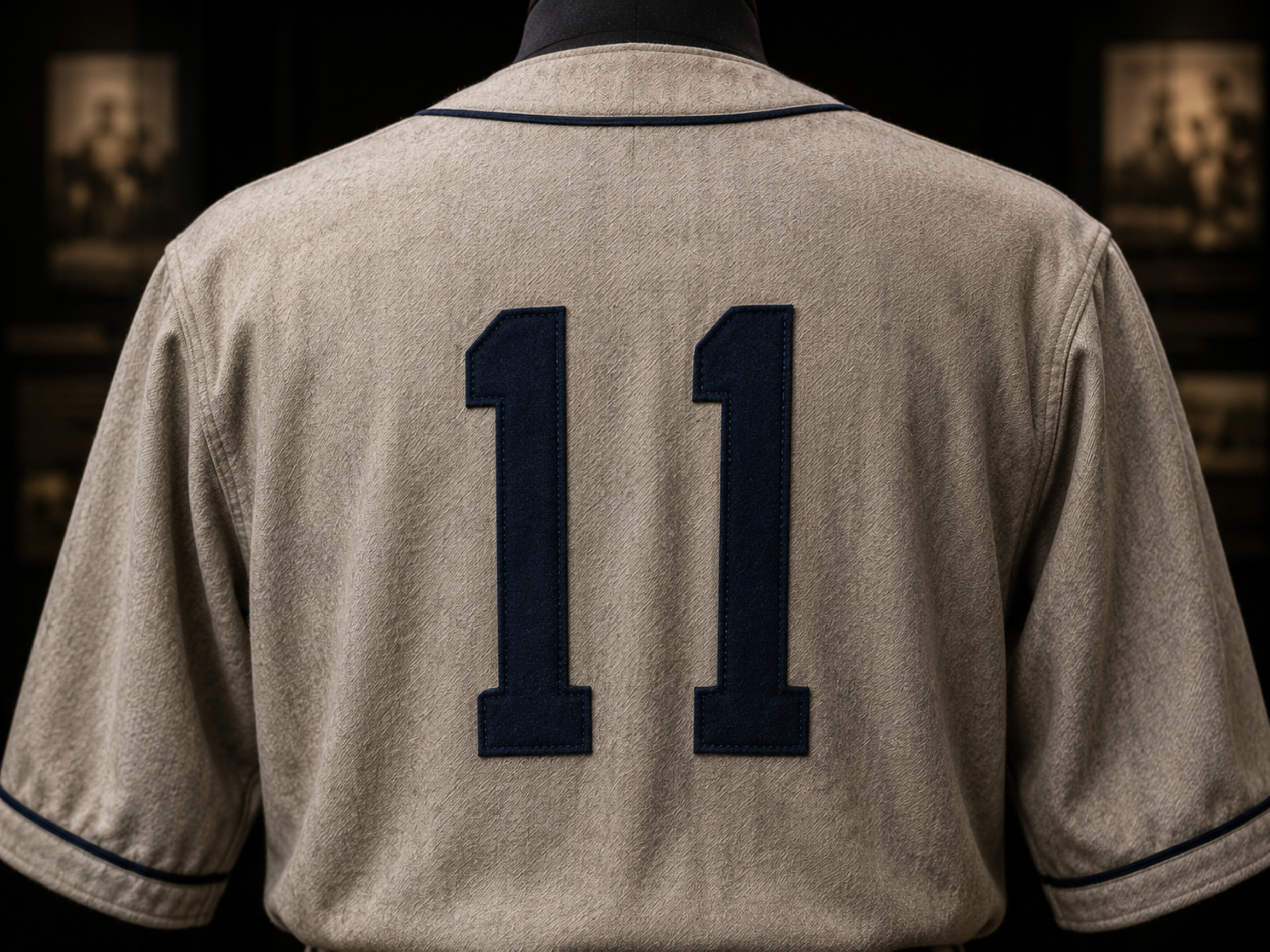
![Close-up of the back of a gray Burnet Blue Bonnets travel jersey with dark-blue number 11 sewn onto the flannel.]()
Travel Uniform Number
Dark Blue Number 11
The travel uniform kept its decoration practical: gray flannel, dark-blue sleeve piping, and block dark-blue numerals sewn cleanly to the back. The number 11 shows the restrained workmanship of a working Hill Country club — sturdy felt, visible stitch lines, and no ornament beyond what the game required.
-
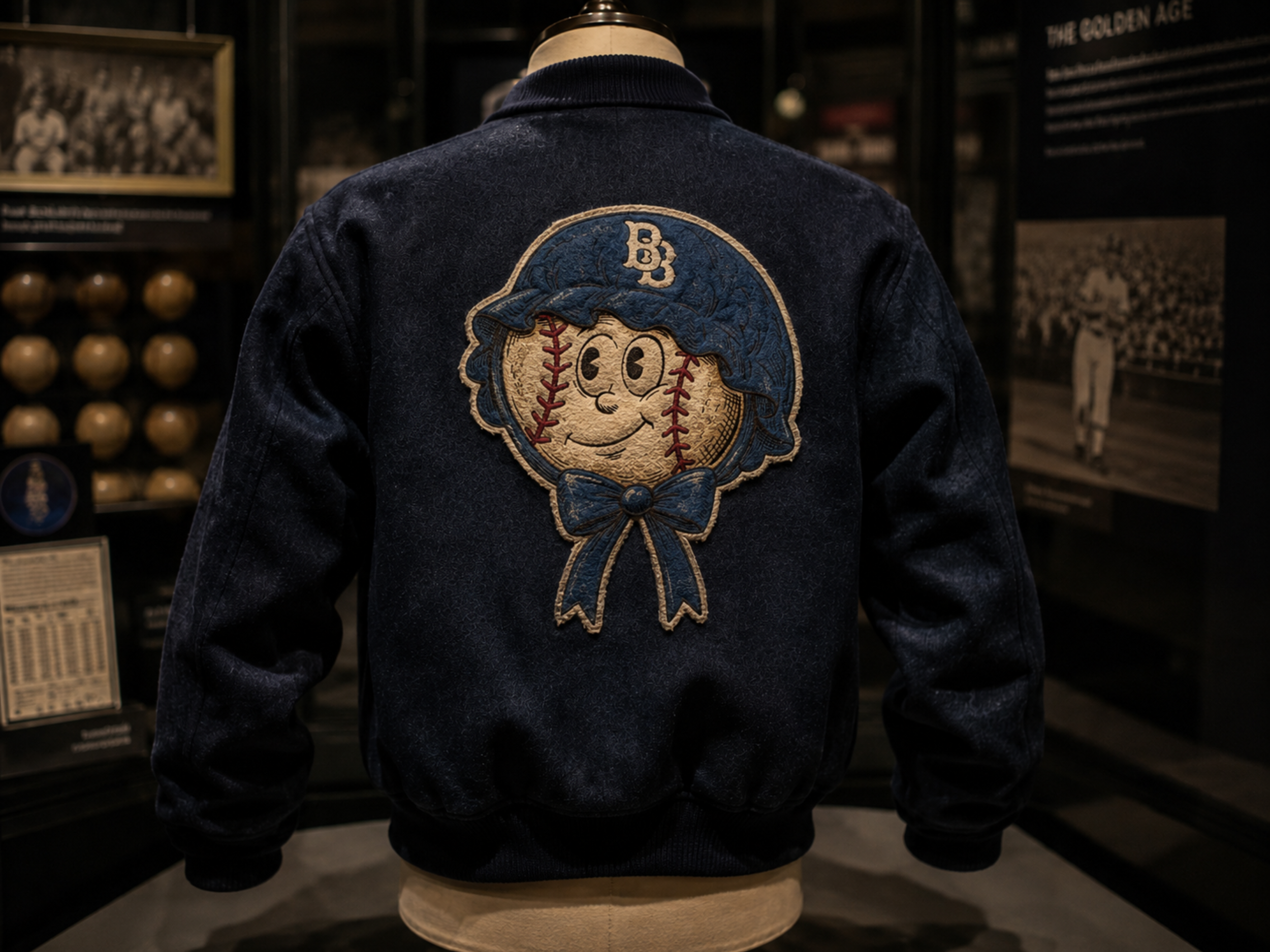
![Back of a dark-blue Burnet Blue Bonnets dugout jacket with a large embroidered bonneted-baseball patch displayed in a museum exhibit.]()
Dugout Jacket
Cold-Weather Outerwear
The bonneted baseball was never a field mark, but it became Burnet’s most memorable printed emblem. On this cold-weather dugout jacket, the figure is rendered as a raised embroidered patch, stitched directly into dark-blue wool and framed by the jacket’s heavy collar, cuffs, and game-worn texture.
Fair Grounds Park
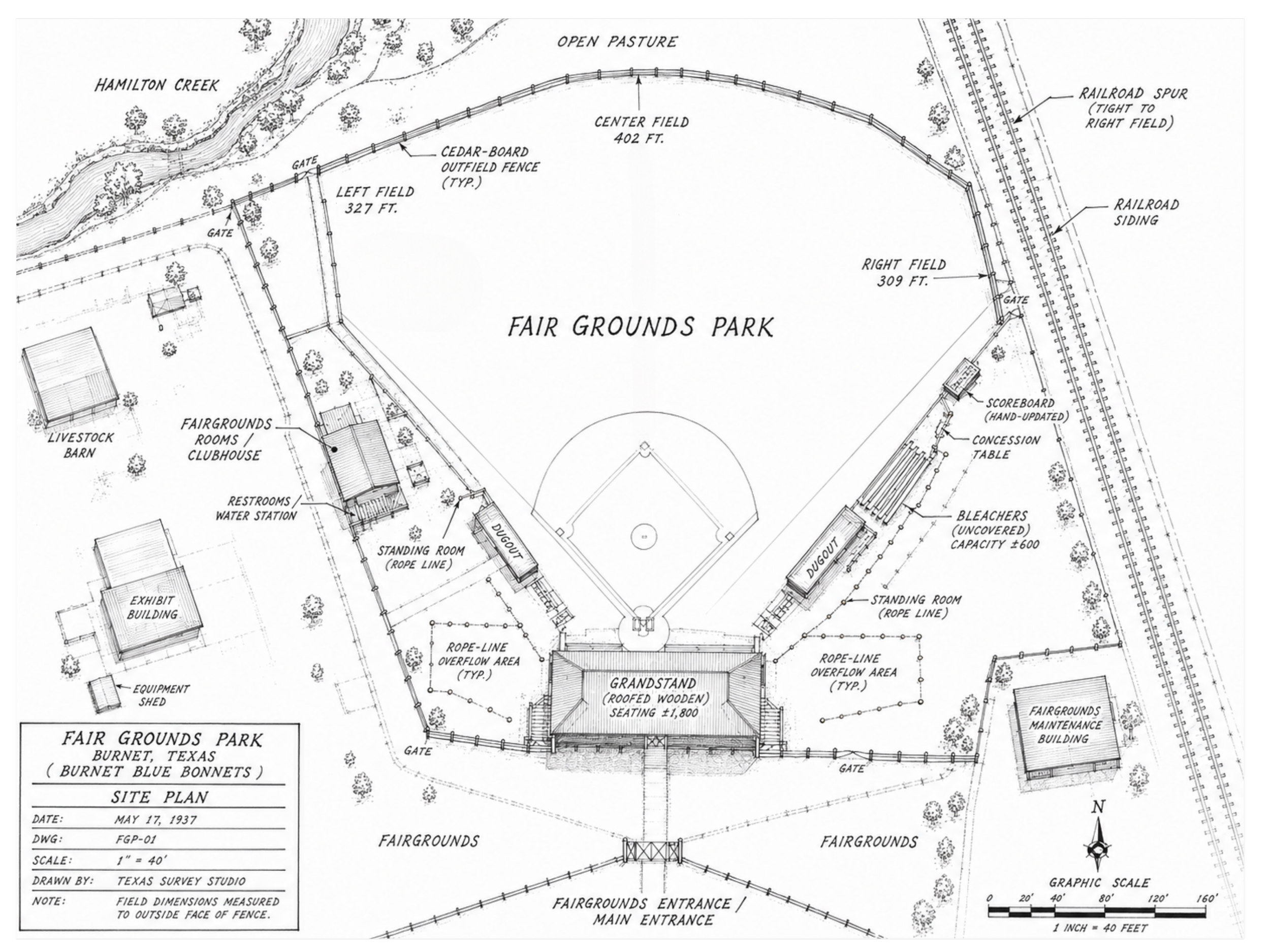
Fair Grounds Park occupied a narrow tract of land near Hamilton Creek and the railroad siding on the north side of Burnet. The Blue Bonnets began playing there in 1925 after local subscribers paid to enclose the field with a cedar-board fence. The setting was plain, dusty, and useful — a fairgrounds diamond shaped by the same practical habits that supported livestock shows, Saturday gatherings, and county events.
A roofed wooden grandstand was added before the 1928 season. It seated roughly 1,800, with uncovered bleachers extending beyond first base and standing areas behind the dugouts. For ordinary league dates, the park felt comfortable and local. For Llano games, fair-week crowds, and the 1937 playoff, it seemed to stretch beyond its own construction.
The property gave the field an unusual configuration. A railroad spur restricted the right-field boundary, while center field ran deep toward open pasture. Left-handed hitters learned to use the shorter right-field line. Right-handed hitters complained about the long carry toward left-center. The field rewarded placement, patience, and the occasional Hill Country gust.
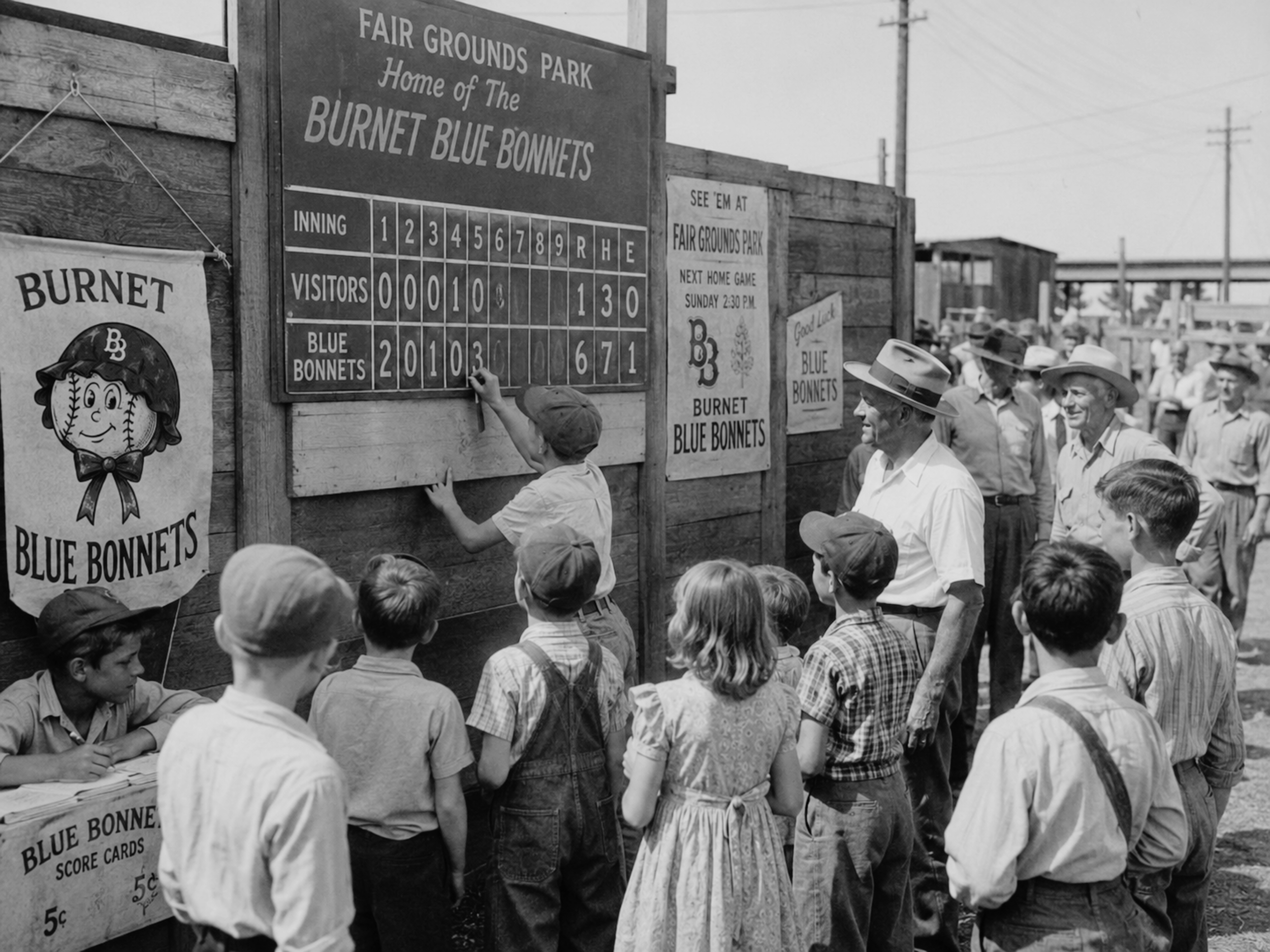
Scores from the game and reports from other league towns were posted by hand on a board beyond the first-base bleachers near the right-field gate. A young scorekeeper changed the numbers as results arrived by telephone, keeping spectators, late arrivals, and fair attendees informed throughout the afternoon.
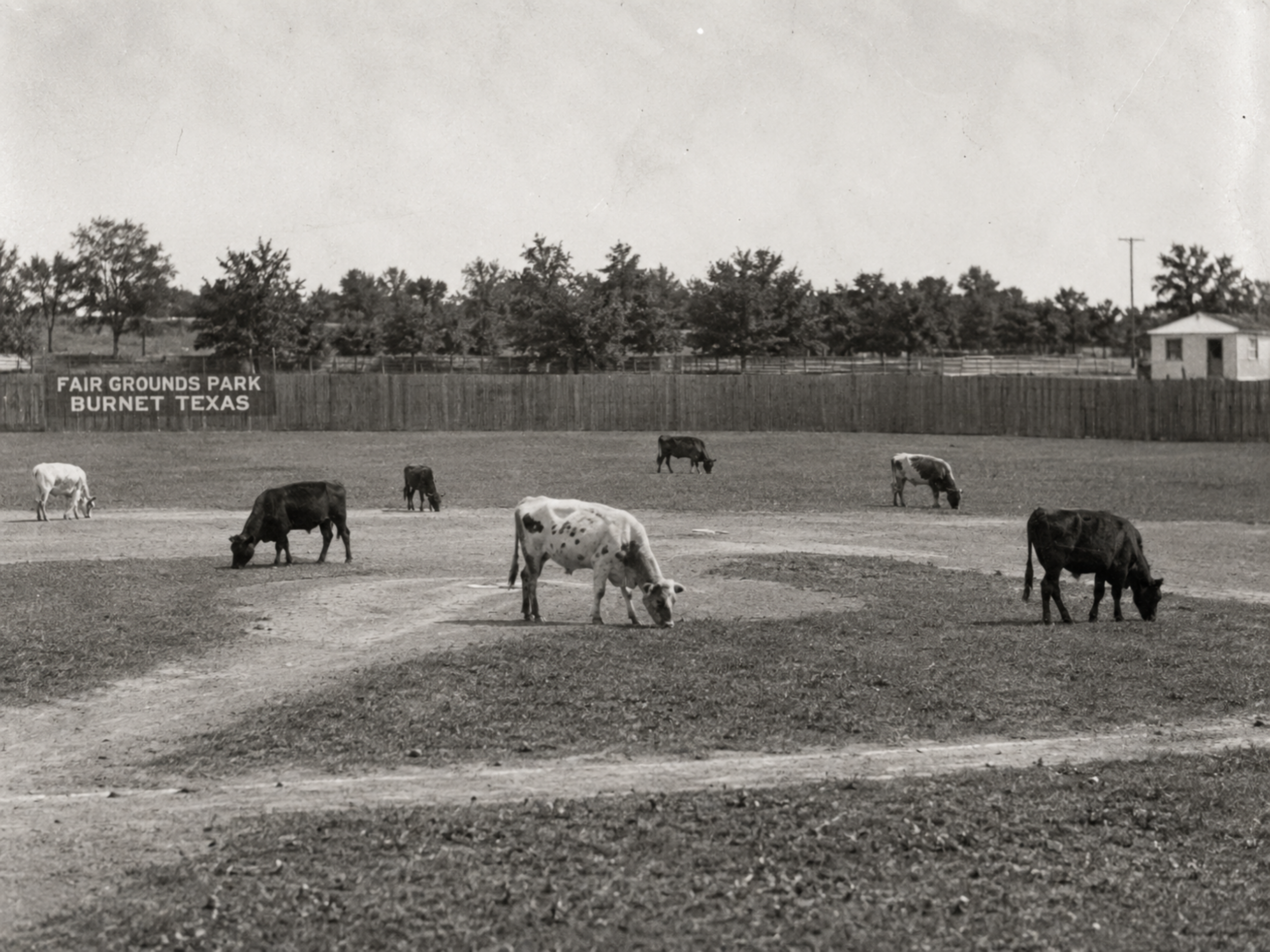
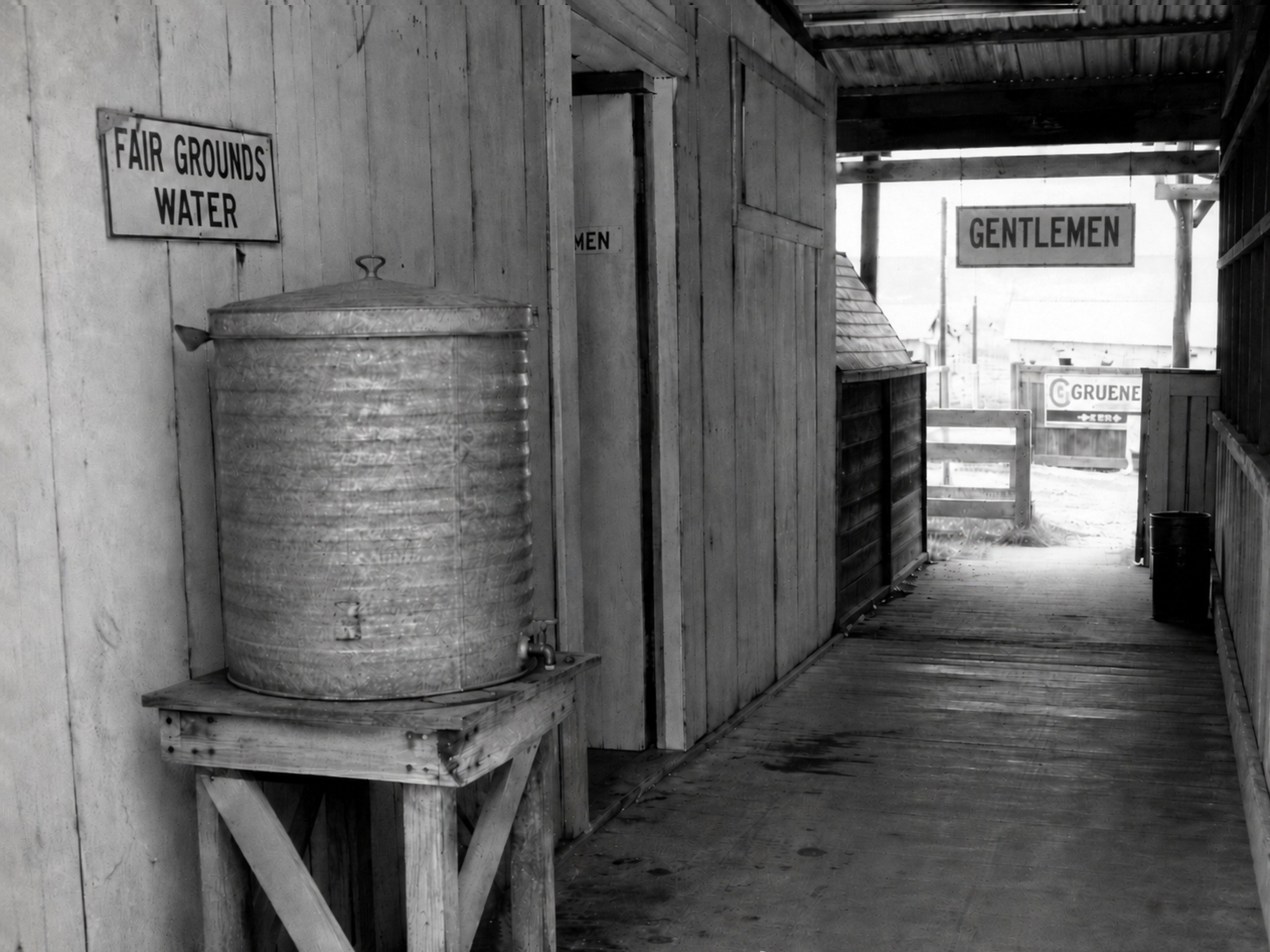
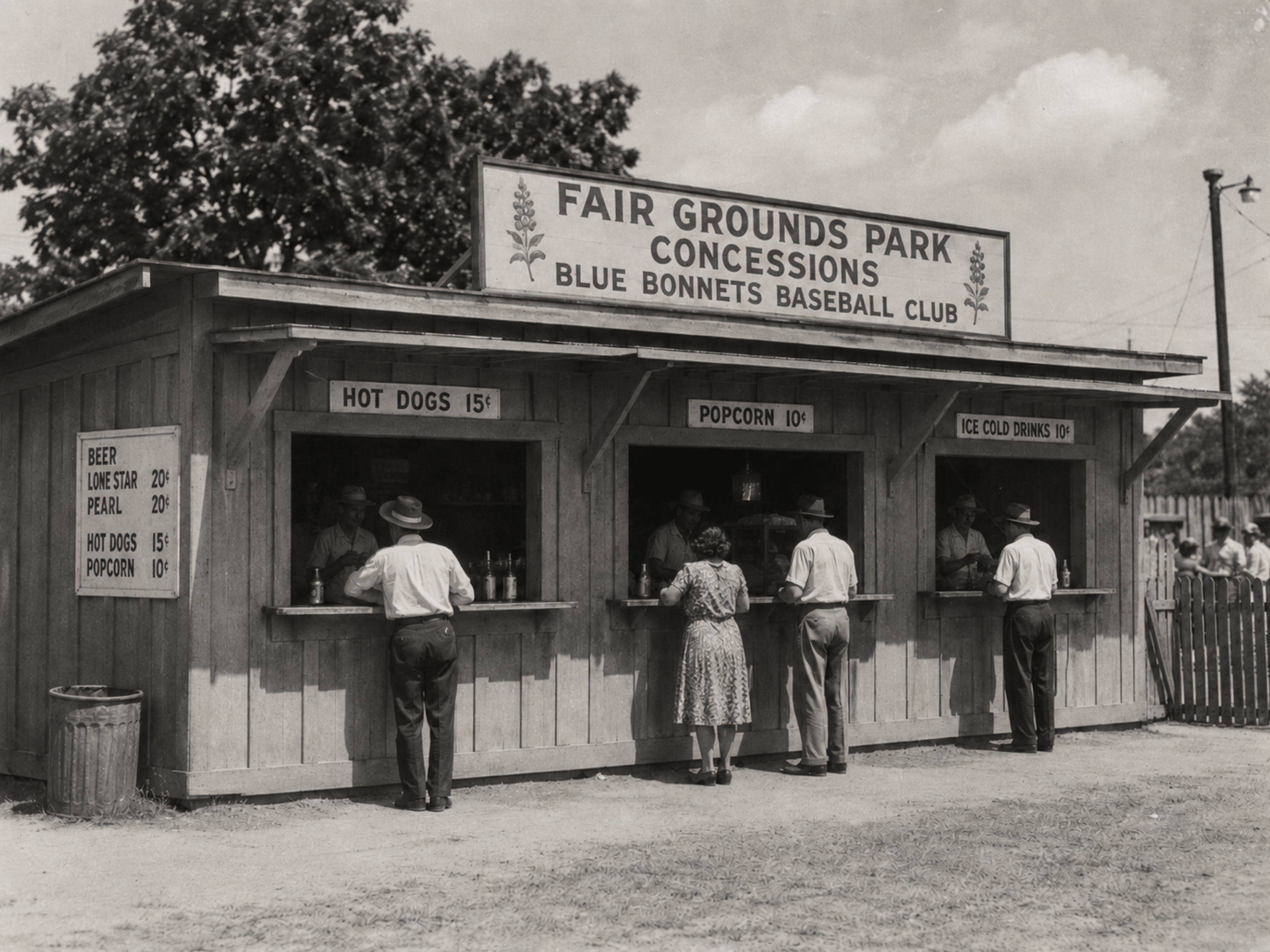
Fair Grounds Park still belonged to the fairgrounds around it. Livestock from neighboring pens were occasionally turned loose inside the fence to keep the playing surface cut to playable height. At the far end of the first-base bleachers, near the right-field gate, a simple game-day concession table served the park’s 1930s crowds; by the 1940s, it had been expanded into a small wooden serving counter. Spectators moved between the concession area, the water station near the restroom entrance, the shaded grandstand passage, and the rope lines that marked overflow space for larger crowds.
The park hosted the final game of the 1937 pennant playoff and remained Burnet’s home through 1952. A spring windstorm that year lifted part of the grandstand roof and damaged several sections of first-base seating. Temporary repairs carried the Blue Bonnets through one final schedule, but the structure was dismantled after the club ceased operations.
Park and Field
| Ballpark | Fair Grounds Park |
|---|---|
| Location | Burnet, Texas |
| Setting | Fairgrounds tract near Hamilton Creek and the railroad siding on the north side of town |
| Years Used | 1925–1952 |
| Key Dates | Field enclosed in 1925; roofed grandstand added before 1928; hosted the 1937 playoff finale; damaged by windstorm in 1952 |
| Fence | Cedar-board outfield fence with temporary rope lines added for overflow crowds |
| Left Field | 327 feet |
| Center Field | 402 feet |
| Right Field | 309 feet |
| Field Shape | Short right-field line restricted by railroad property; deep center field extending toward open pasture |
| Field Maintenance | Livestock from the neighboring fairgrounds were occasionally turned loose inside the park to keep the playing surface cut to playable height |
| Lighting | None; games were played in daylight |
| Seating and Gates | |
| Roofed Grandstand | Approximately 1,800 seats behind home plate |
| Bleachers | Uncovered wooden benches extending beyond first base |
| Standing Areas | Rope-line areas behind the dugouts and into both outfield corners for rivalry games, fair-week crowds, and playoff dates |
| Seated Capacity | Approximately 2,400 |
| Largest Recorded Crowd | More than 3,700 for the 1937 playoff finale against Llano |
| Entrances | Main fairgrounds entrance behind home plate, with additional gates along the third-base side and near the right-field corner |
| Concessions and Public Amenities | |
| Scoreboard | Hand-updated game board beyond the first-base bleachers near the right-field gate, with inning totals changed by hand and out-of-town scores received by telephone |
| Concession Area | Located at the far end of the first-base bleachers near the right-field gate; shown as a simple serving table on the 1937 site plan and expanded into a small wooden counter by the 1940s |
| Common Concession Fare | Cold drinks, peanuts, sandwiches, hot dogs, popcorn, and fair-week vendor fare |
| Water Station | Galvanized fairgrounds water cooler set near the restroom entrance |
| Public Restrooms | Fairgrounds restrooms near the shaded walkway and water station |
| Public Amenities | Fairgrounds restrooms, the water station, shaded walkways, the concession area beside the first-base bleachers, and temporary crowd ropes for larger dates |
| Clubhouse and Fairgrounds Use | |
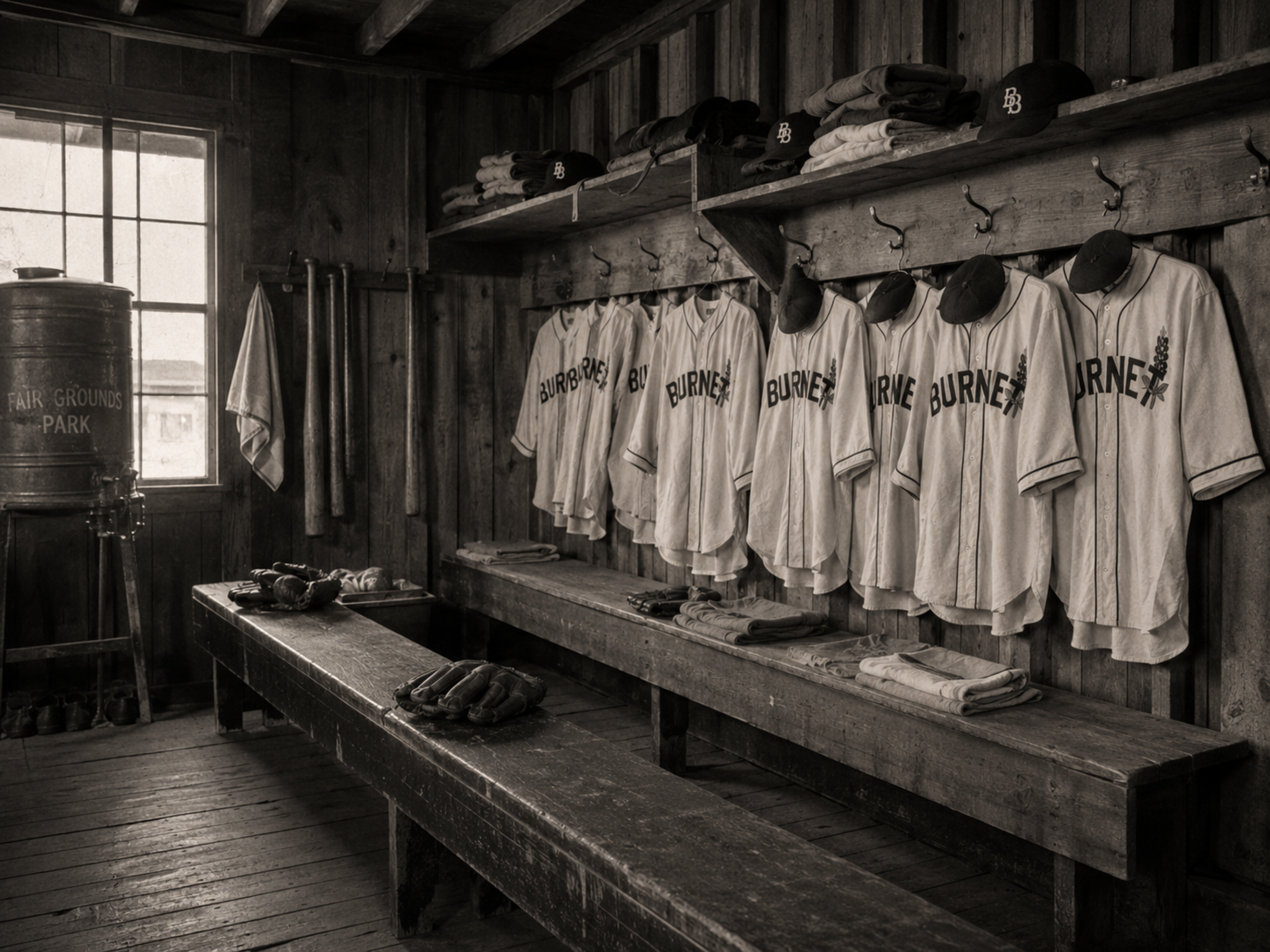
| Clubhouse Arrangement | Home players dressed in a plain frame room near the third-base side; visiting clubs used shared fairgrounds rooms when available |
| Home Dressing Room | Open wooden shelves, benches, hanging flannels, caps, bats, gloves, and a shared water tank |
| Fairgrounds Use | The park shared its setting with livestock shows, county gatherings, fair-week vendors, ranch wagons, and Saturday crowds |
| Traditions and Closure | |
| Notable Tradition | Blue ribbons and pinned bluebonnet sprigs appeared in the crowd during larger home dates, especially games against Llano |
| Rivalry Dates | Llano games drew the largest regular-season crowds and often carried courthouse-square banners, early-arriving spectators, and overflow rope lines |
| Final Season | 1952 |
| Closure Note | Spring windstorm damage and failed repair fundraising ended the park’s use as a permanent Blue Bonnets home |
Snapshots from Fair Grounds Park
-
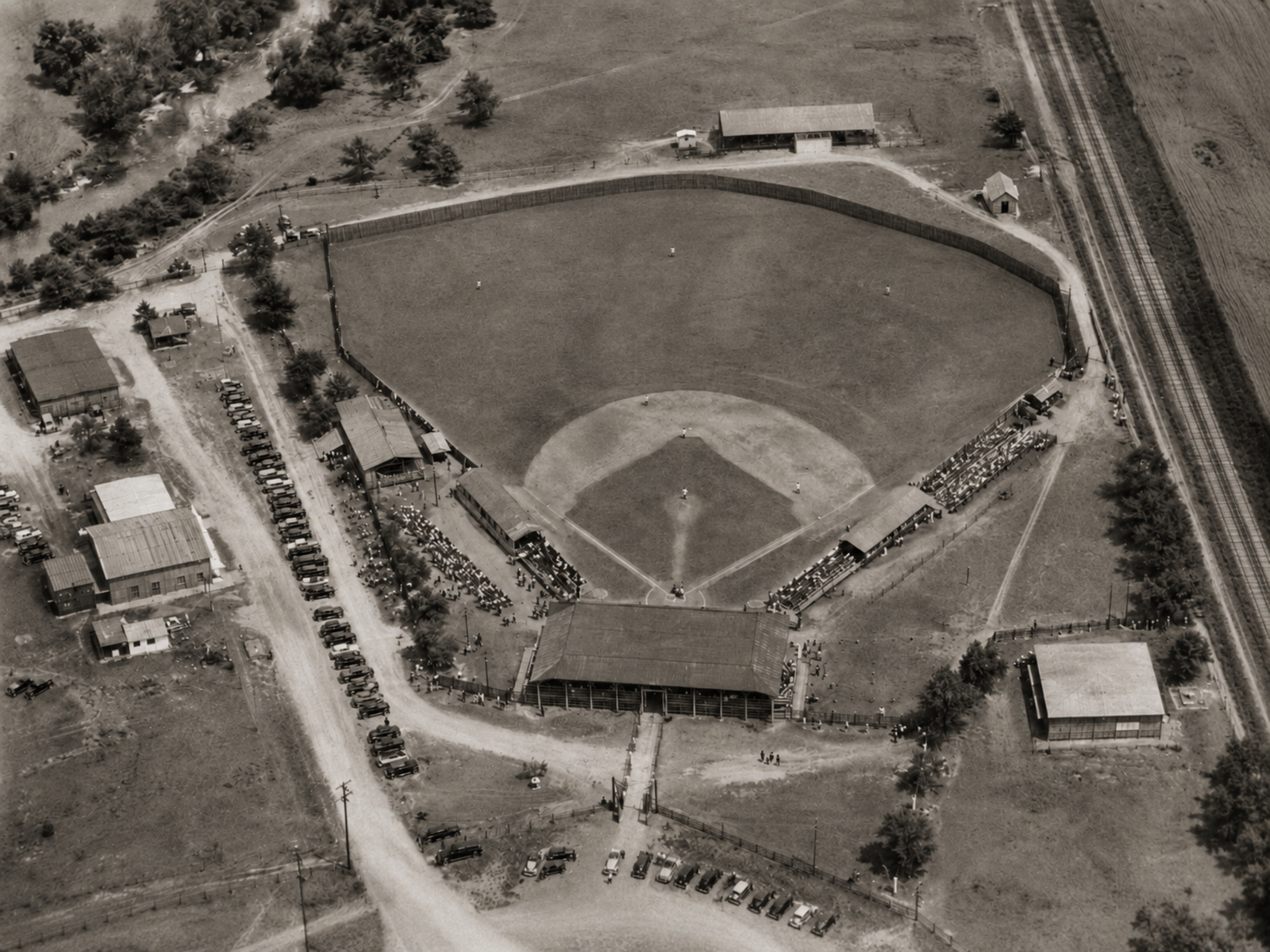
![Black-and-white aerial view of Fair Grounds Park in Burnet, Texas, showing the baseball diamond, roofed grandstand, first-base bleachers, outfield fence, nearby roads, parked cars, and railroad siding.]()
Fair Grounds Park from Above
Aerial Ballpark View · Burnet, Texas, Circa 1940s
From the air, Fair Grounds Park shows its true shape: a practical fairgrounds diamond pressed between open pasture, local roads, a railroad siding, and the cedar-board outfield fence. The roofed grandstand sits close behind home plate, with uncovered bleachers along first base and the right-field boundary pulled tight by the nearby rail line. It was a plain, useful ballpark — built for county crowds, rivalry games, and the Blue Bonnets’ championship memory.
-
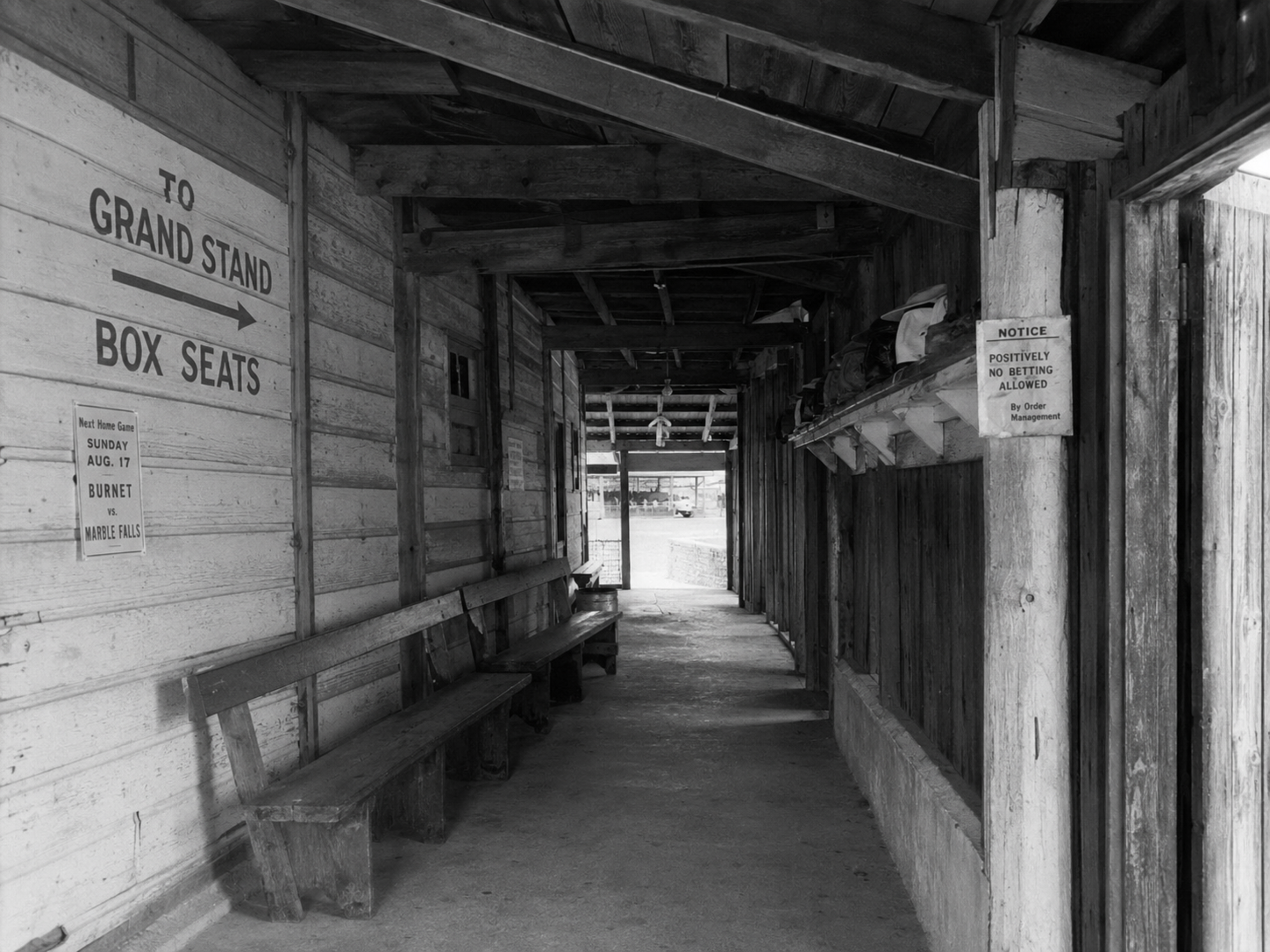
![Black-and-white 1940s photograph of a wooden passageway beneath the Fair Grounds Park grandstand, with signs pointing toward box seats and the grandstand.]()
Under the Grandstand
Passage to Box Seats · Fair Grounds Park, Circa 1940s
Beneath the roofed wooden grandstand, a narrow plank hallway directed spectators toward the field, box seats, and shaded seating behind home plate. Hand-painted signs, rough benches, exposed beams, and scuffed floorboards made the passage feel less like a formal stadium concourse than a fairgrounds walkway adapted for Sunday baseball.
-
![Black-and-white 1940s photograph of the Burnet Blue Bonnets home clubhouse at Fair Grounds Park, with uniforms hanging on wooden walls, caps on shelves, bats, gloves, benches, and a water tank.]()
The Home Clubhouse
Home Dressing Room · Fair Grounds Park, Circa 1940s
Burnet’s players dressed in a plain frame room near the third-base side of Fair Grounds Park, surrounded by open shelves, wooden benches, hanging flannels, caps, bats, gloves, and a shared water tank. The room was practical rather than polished — the kind of clubhouse where uniforms dried on wall hooks, equipment stayed within arm’s reach, and the Blue Bonnets prepared for Sunday baseball without ceremony.
-
![Black-and-white 1940s photograph of a young boy kneeling beside a hand-operated Fair Grounds Park scoreboard near the right-field gate, updating the score for a Burnet Blue Bonnets game.]()
The Scoreboard Boy
Hand-Operated Game Board · Near the Right-Field Gate, Circa 1940s
Set beyond the first-base bleachers near the right-field gate, the hand-operated scoreboard kept spectators, late arrivals, and fair attendees informed throughout the afternoon. A young scorekeeper changed the numbers by hand as reports came from the field and by telephone from other league towns, turning runs, innings, and the Blue Bonnets’ progress into a public notice for the crowd moving between the bleachers, concessions, and gate.
-
![Black-and-white 1940s photograph of cattle grazing across the infield at Fair Grounds Park, with the outfield fence and Burnet park signage in the background.]()
Grazed to Playing Height
Livestock Field Maintenance · Fair Grounds Park, Circa 1940s
Livestock from the neighboring fairgrounds were turned loose inside Fair Grounds Park to keep the playing surface cut to playable height. It was practical field maintenance by Burnet standards: fairground cattle, cedar-board fencing, a rough infield, and a ballpark that belonged as much to county life as to Sunday baseball.
-
![Black-and-white 1940s photograph of a Fair Grounds Park walkway with a galvanized water cooler, restroom signage, wooden walls, and a shaded passage near the grandstand.]()
The Water Station
Public Amenities · Fair Grounds Park, Circa 1940s
Near the restroom entrance, a galvanized water cooler stood on a wooden platform beneath hand-painted fairgrounds signs. It was one of the park’s simplest but most important fixtures, especially on hot Hill Country afternoons when spectators moved between the grandstand, the concession area beside the first-base bleachers, the restrooms, and the shade before returning to the game.
-
![Black-and-white 1940s photograph of the wooden Fair Grounds Park concession counter at the far end of the first-base bleachers, with spectators ordering through service windows beneath Blue Bonnets baseball signage.]()
The Fair Grounds Counter
Concessions at Fair Grounds Park · Circa 1940s
By the 1940s, the simple concession table shown on the 1937 park plan had been expanded into a small wooden serving counter at the far end of the first-base bleachers near the right-field gate. It served the practical comforts of a Hill Country ballgame: cold drinks, peanuts, sandwiches, hot dogs, popcorn, and whatever fair-week vendors brought through the grounds. It was less a restaurant than a gathering point — somewhere spectators could buy lunch, check the nearby scoreboard, and carry food back toward the bleachers and rope lines.
The Championship Season
The 1937 Blue Bonnets were not built like a traditional powerhouse. Burnet had no deep bench, lavish backer, or large-city talent pool to draw from. What the club did have was a settled lineup, dependable pitching, a strong partnership between manager Virgil “Vick” Hall and catcher Wade Morrow, and a town that treated every home date against Llano as a public obligation.
Hall’s club won steadily rather than spectacularly. Ellis “Buck” Harlan led the pitching staff, Morrow caught the most important innings, and Leon Baird gave Burnet a center fielder who could change a game with both his bat and his range. By late summer, Burnet and Llano had separated themselves from the rest of the Hill Country League but not from each other.
Llano week changed Burnet before it changed the standings. Storefront banners appeared around the square, dark-blue ribbons were pinned to hats and shirtfronts, and bluebonnet sprigs showed up on collars and dress pockets. By game time, the rivalry had moved from the streets to Fair Grounds Park, where the shaded grandstand, first-base bleachers, and overflow rope lines filled earlier than usual.
After eighty-six games, Burnet and Llano stood even at 54–32. The league ordered a best-of-three playoff to decide the pennant. Llano won Game One at home, 4–2. The series then moved to Burnet, where Games Two and Three were both played at Fair Grounds Park.
Burnet answered with a 5–1 victory in Game Two, evening the series and setting up the deciding game on the same field. The finale remained tied 1–1 through ten innings. Harlan worked quickly and stayed in command despite the heat and the crowd pressing close behind the rope lines.
In the bottom of the eleventh, Paul Gattis singled and advanced to second on a sacrifice. Leon Baird then lined a two-out single through the left side, bringing Gattis home with the championship run.
Burnet won, 2–1. Harlan had pitched all eleven innings, and the Blue Bonnets had secured the first Hill Country League title in club history. No later Burnet team matched it.
1937 at a Glance
| Regular-Season Record | 54–32 |
|---|---|
| Home Record | 31–12 |
| Road Record | 23–20 |
| League Finish | Tied for first with Llano |
| Manager | Virgil “Vick” Hall |
| Club Captain | Wade Morrow |
| Leading Pitcher | Ellis “Buck” Harlan, 17–6 |
| Leading Hitter | Leon Baird, .338 |
| Pennant Playoff | Burnet defeated Llano, two games to one |
| Deciding-Game Score | Burnet 2, Llano 1 |
| Deciding-Game Length | 11 innings |
| Deciding-Game Pitcher | Ellis “Buck” Harlan, complete game |
| Winning Hit | Leon Baird, two-out single |
| Winning Run | Paul Gattis |
| Estimated Final-Game Crowd | More than 3,700 |
The Llano Playoff
| Game One — at Llano | Llano 4, Burnet 2 |
|---|---|
| Game Two — at Burnet | Burnet 5, Llano 1 |
| Game Three — at Burnet | Burnet 2, Llano 1 — 11 innings |
| Series Result | Burnet defeated Llano, two games to one |
Llano took the early advantage by winning Game One at home, but the series shifted to Fair Grounds Park for the final two games. Burnet’s 5–1 victory in Game Two evened the playoff and set up the deciding game before the home crowd. For the finale, spectators filled the roofed grandstand, packed the first-base bleachers, and stood behind rope lines extending into the outfield corners.
Harlan allowed one run in Game Three and remained on the mound for all eleven innings. Morrow caught the complete game, Baird delivered the winning hit, and the crowd stayed long after the final out. With no elaborate trophy ceremony recorded, the celebration moved naturally from the fairgrounds toward the town square: handshakes, truck beds, storefront congratulations, dark-blue ribbons still pinned to shirtfronts, and championship pennants soon appearing in windows across Burnet.
Men of the 1937 Club
-
![Virgil “Vick” Hall, manager of the 1937 Burnet Blue Bonnets, shown in vintage baseball uniform.]()
Virgil “Vick” Hall
Manager · 1937 Hill Country League Champions
Hall joined the Blue Bonnets as a catcher in 1924 and remained with the club through the abbreviated 1932 season. When local merchants reorganized the team before 1935, he was the natural choice to manage it: known, steady, and familiar with every practical limit of Burnet baseball.
He rebuilt the Blue Bonnets around experienced pitching, dependable fielding, and players drawn from the workers arriving in and around town during the mid-decade revival. Hall reportedly kept the same lineup card folded inside his scorebook throughout the 1937 playoff, making only two substitutions across the three games against Llano.
-
![Wade Morrow, catcher and club captain of the 1937 Burnet Blue Bonnets, posed in a Burnet uniform.]()
Wade Morrow
Catcher & Club Captain · 1937
Morrow served as Burnet’s starting catcher and club captain from 1935 until the wartime suspension of play. He helped Hall recruit several of the players who carried the club through its mid-decade recovery and was regarded as the roster’s practical voice: direct, durable, and trusted by the pitching staff.
He caught all twenty-nine innings of the 1937 playoff and drove in two runs during Burnet’s Game Two victory. In the deciding game, Morrow stayed with Harlan for all eleven innings, guiding the right-hander through the final frame before Baird’s winning hit.
-
![Black-and-white 1940s portrait of Leon Baird, center fielder for the 1937 Burnet Blue Bonnets, wearing a Burnet uniform and holding a glove.]()
Leon Baird
Center Fielder · Hill Country League Batting Leader
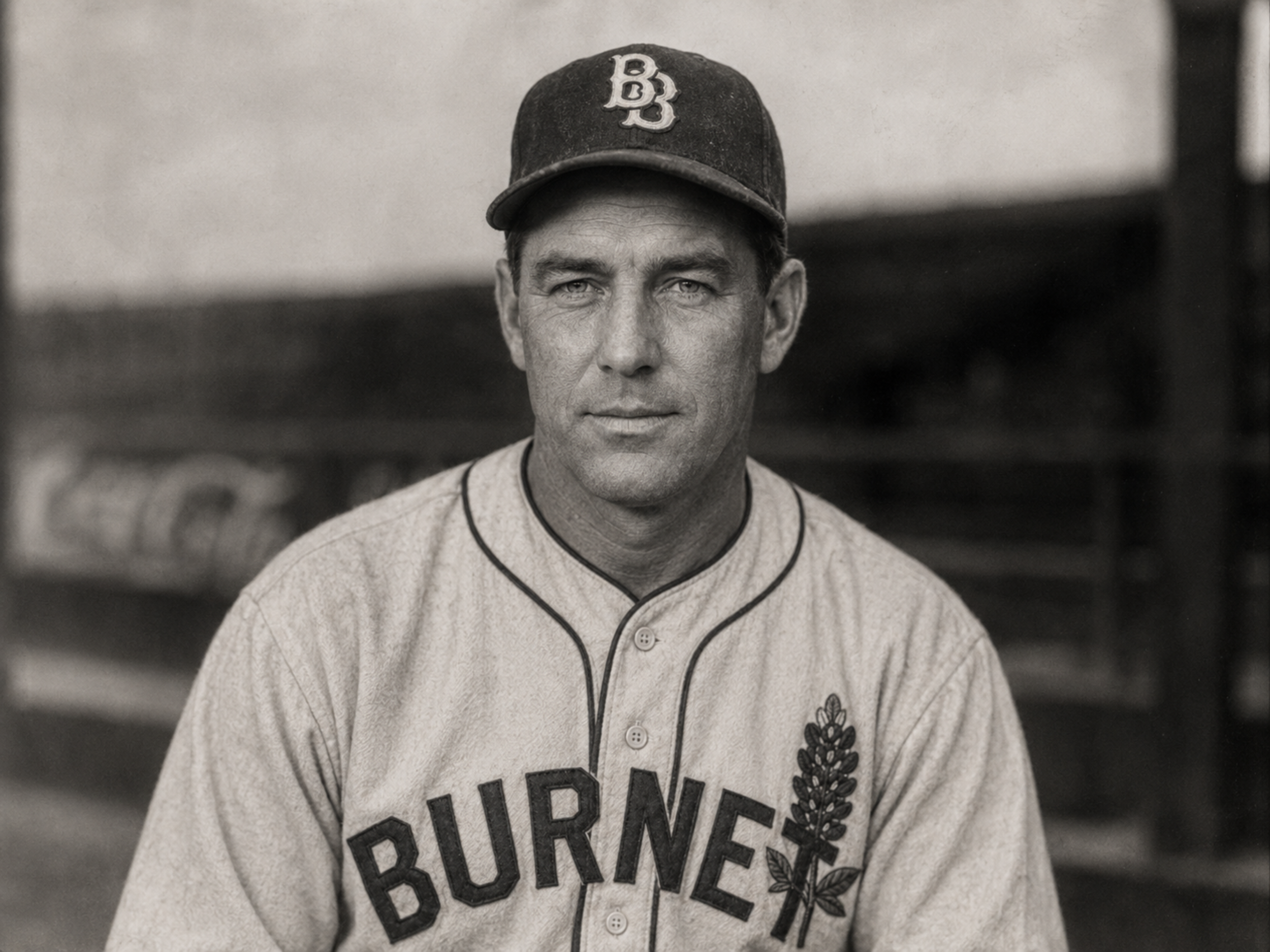
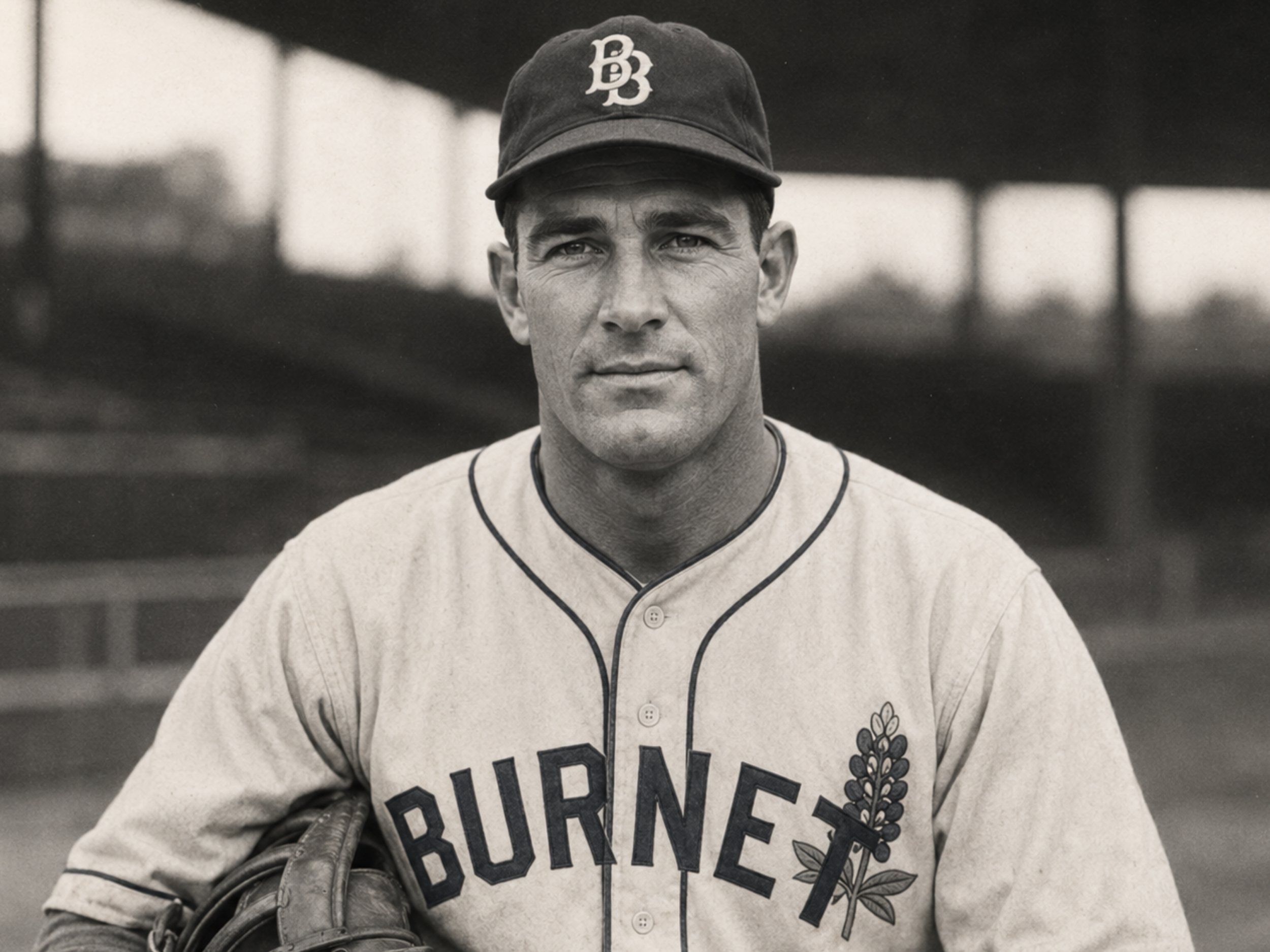
Baird joined Burnet in 1936 after playing for independent clubs in Austin and San Antonio. His signing drew objections from several opponents who believed Burnet had reached too far outside the usual Hill Country pool, but manager Vick Hall refused to alter the lineup.
In 1937, Baird led the Hill Country League with a .338 average and paced Burnet in hits, doubles, and runs scored. His eleventh-inning single in the deciding playoff game brought Paul Gattis home and secured the only championship in Blue Bonnets history.
-
![Ellis “Buck” Harlan, right-handed pitcher for the 1937 Burnet Blue Bonnets, shown in vintage uniform.]()
Ellis “Buck” Harlan
Right-Handed Pitcher · 17–6 in 1937
Harlan led Burnet’s pitching staff with a 17–6 record in 1937. Known for working quickly and rarely shaking off his catcher, he completed nineteen regular-season starts and gave Hall the kind of dependable arm a small roster required.
In the deciding playoff game against Llano, Harlan allowed one run over eleven innings. He retired the side in order in the top of the eleventh, then watched from the bench as Gattis reached, moved into scoring position, and Baird ended the season with a line single through the left side.
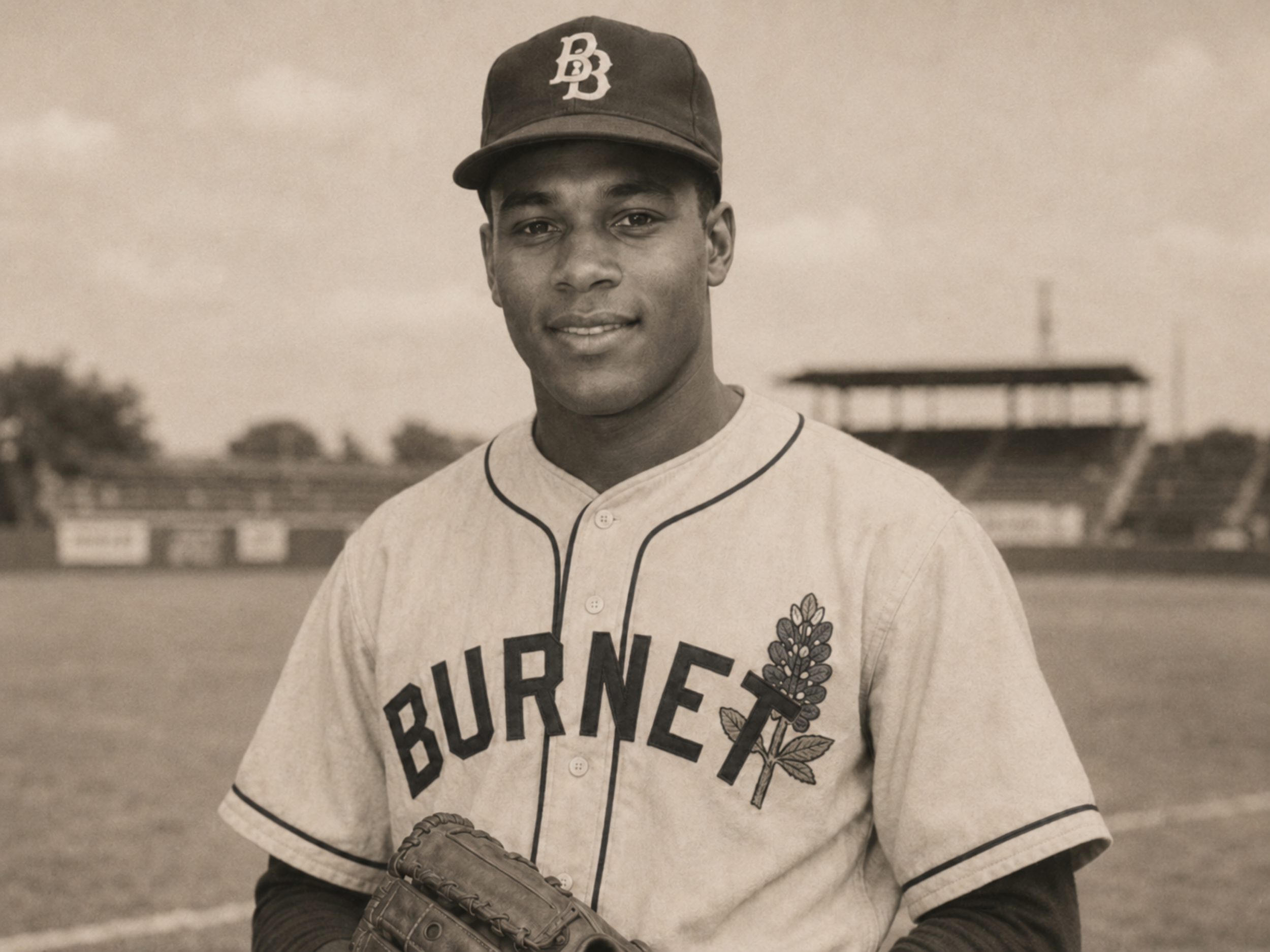
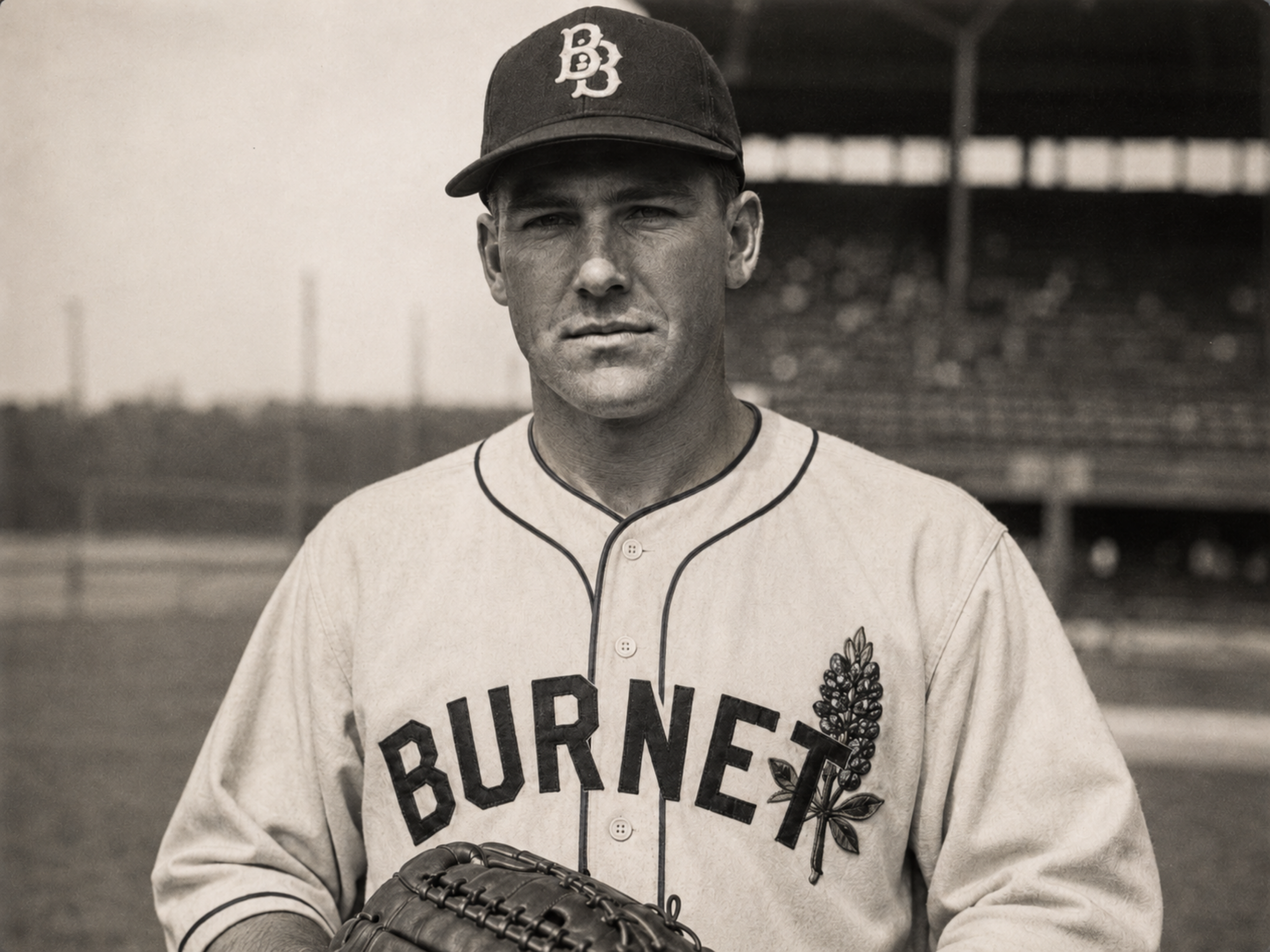
The Later Years
The 1937 championship did not turn Burnet into a powerhouse. It gave the town something more durable: a single, settled memory that outlived the standings. In later years, the Blue Bonnets were measured against Vick Hall’s 1937 club even when the roster, schedule, and league had changed around them.
The wartime suspension broke the team’s continuity. When Burnet resumed play in 1946, five members of the prewar club returned, along with younger players drawn from local jobs, road crews, ranch families, and neighboring independent teams. The Blue Bonnets finished fourth in their first season back and rose to second place in 1948, their best postwar result.
The late clubs still made Fair Grounds Park difficult for visitors. The field’s deep center, short right-field line, dust, rope-line crowds, and close wooden grandstand gave Burnet an advantage that did not always show in the league table. Games against Llano remained the emotional center of the schedule, and older supporters still measured each new catcher, pitcher, or center fielder against Morrow, Harlan, and Baird.
By then, the club’s public identity had moved beyond box scores. The interlocking BB appeared on caps, sweaters, bus doors, handbills, and pennants. The bonneted baseball turned up on ticket books, holiday cards, dugout jackets, and small keepsakes that followed supporters back into homes, ranch offices, workshops, and downtown stores. Bluebonnet sprigs and dark-blue ribbons remained part of larger home dates, especially when Llano came to Burnet.
By the early 1950s, the practical strain had become harder to ignore. Regional travel costs increased, longtime sponsors aged or stepped back, and several home dates were reduced or combined with fairgrounds events to save money. The Blue Bonnets were still loved, but love did not repair wood, pay rail fare, or keep a small independent club solvent.
The 1952 windstorm brought the matter to an end. Fair Grounds Park’s grandstand roof was damaged, first-base seating was left unsafe, and Burnet completed the season with temporary seating and borrowed diamonds for several late dates. A winter effort to finance repairs fell short. The club did not enter the Hill Country League for 1953.
Long after the final season, Burnet’s association with the bluebonnet flower made the club’s name seem inevitable. Older supporters maintained that the explanation was simpler. Burnet’s ball club had worn blue caps. Everything else came later.
The collectibles below are not simply souvenirs from a single pennant. They are evidence of how a fairgrounds ballclub became part of Burnet’s civic memory.
Blue Bonnets Collectibles
-
![Museum display of a vintage Burnet Blue Bonnets 1937 League Champions pennant, shown under dark museum exhibit lighting with felt lettering and bluebonnet decoration.]()
1937 League Champions Pennant
Postseason Souvenir · Museum Display
Issued after Burnet’s eleven-inning playoff victory over Llano, the 1937 championship pennant became the club’s clearest surviving title artifact. Its felt lettering, bluebonnet decoration, and bold championship wording gave Burnet a keepsake large enough for storefront windows, bedrooms, club offices, and the fairgrounds display cases that followed.
-
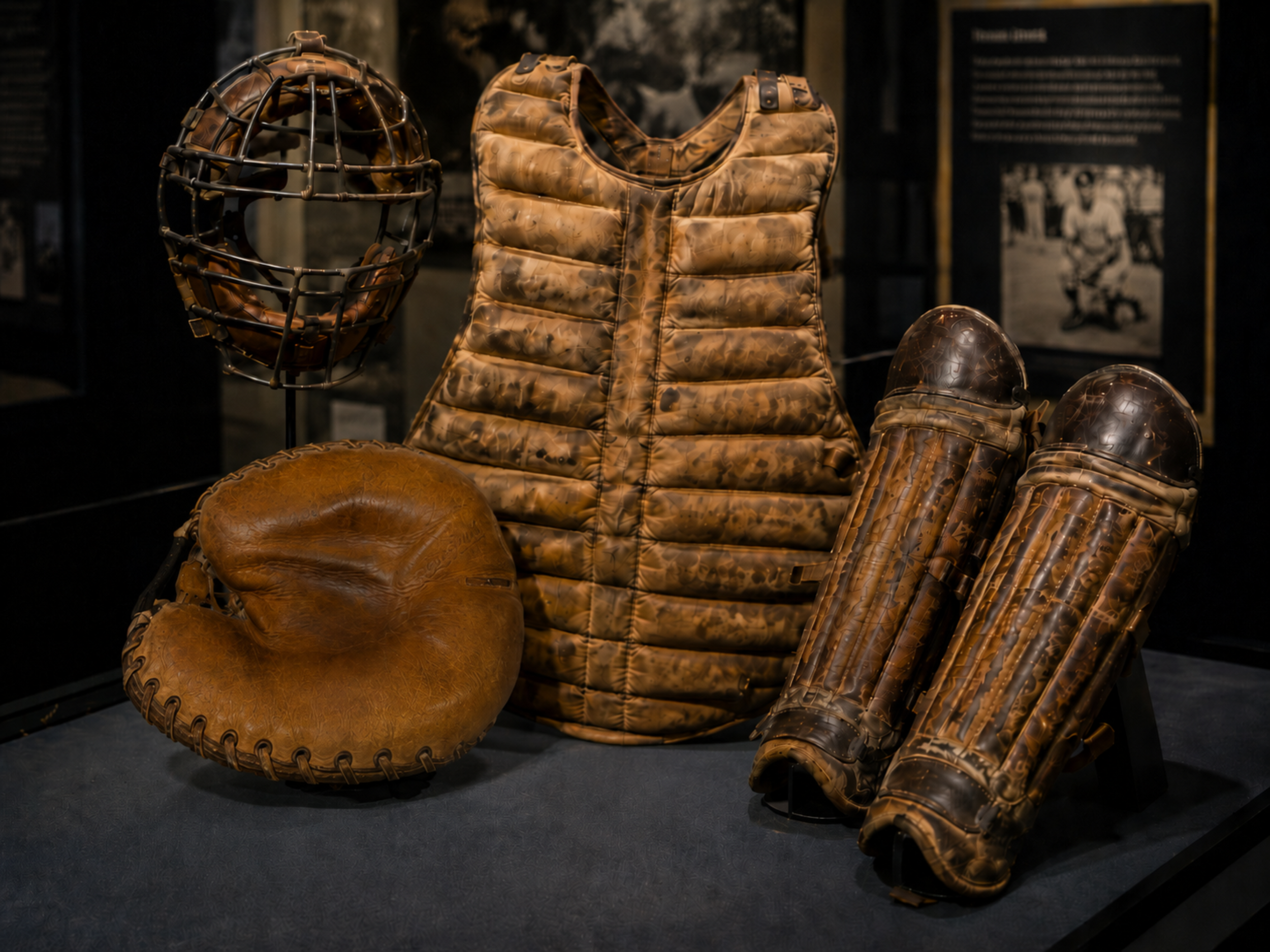
![Museum display of vintage Burnet Blue Bonnets catcher’s gear, including a wire mask, quilted chest protector, two leather shin guards, and a round catcher’s mitt under dark exhibit lighting.]()
The Catcher’s Kit
1936 Burnet Blue Bonnets Catcher’s Gear · Museum Display
This 1936 catcher’s set shows the practical weight carried behind the plate at Fair Grounds Park: wire mask, quilted chest protector, paired leather shin guards, and a heavy round mitt shaped by years of use. The gear belongs to the Blue Bonnets’ working-club world — dusty afternoons, close wooden grandstands, small rosters, and catchers expected to hold the game together inning after inning.
-
![Museum display of a 1936 Burnet Blue Bonnets season ticket book with Hold Fast on the cover, surrounded by blurred Blue Bonnets keepsakes under museum lighting.]()
Hold Fast Season Ticket Book
1936 Season Ticket Book · Museum Display
Issued before Burnet’s championship season, the 1936 Blue Bonnets season ticket book carried the motto that came to define the club: Hold Fast. Displayed under museum light with caps, pennants, and printed keepsakes nearby, the booklet reflects the practical loyalty of Fair Grounds Park baseball — a small-town club selling admission one season at a time while asking its supporters to stay with it through every road trip, rivalry game, and late-inning test.
-
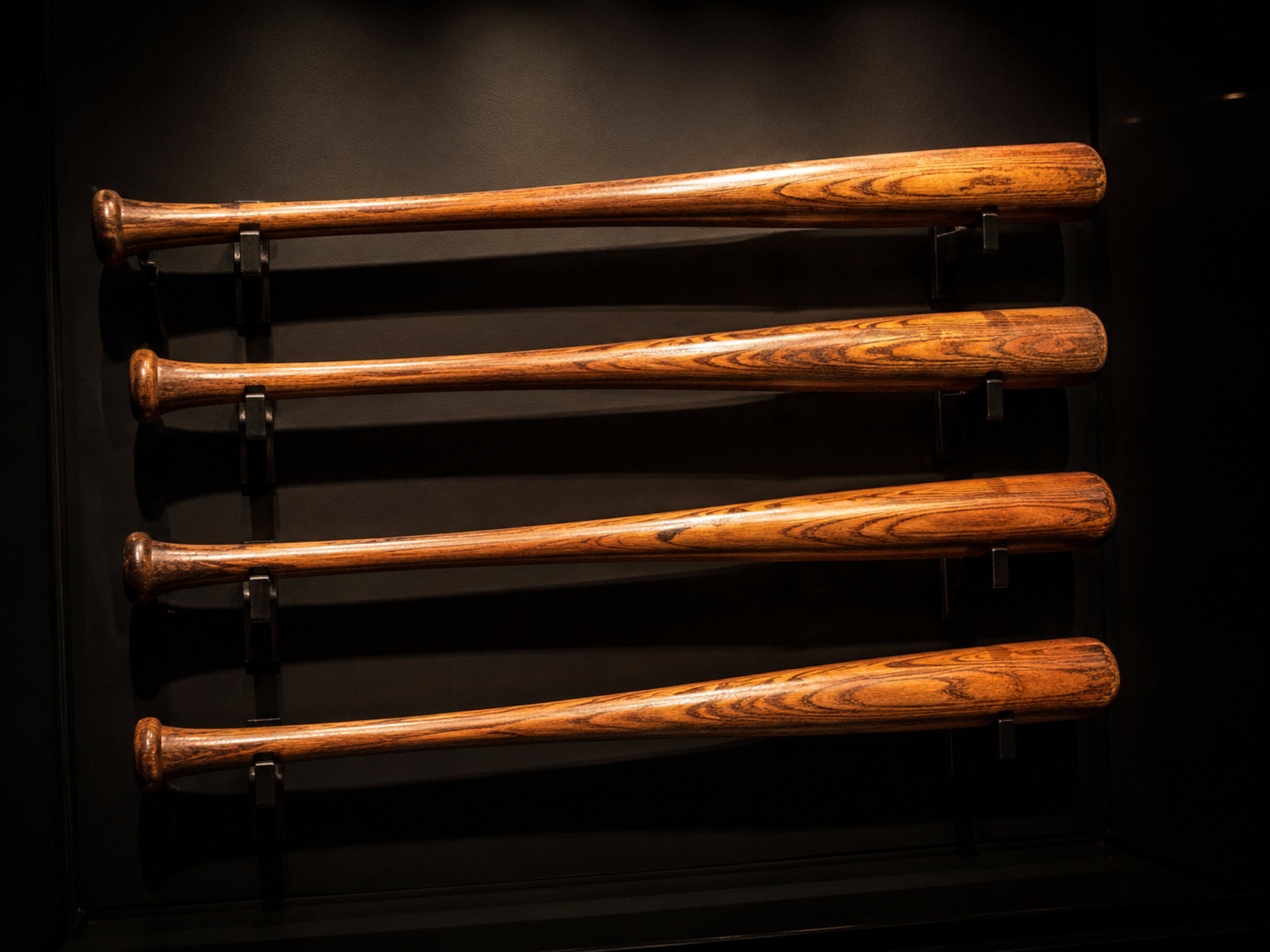
![Museum display of four vintage Burnet Blue Bonnets wooden baseball bats mounted horizontally under dark exhibit lighting.]()
The 1936 Bat Rack
Game Bats · Museum Display
These 1936 Burnet Blue Bonnets bats show the quiet workmanship behind a fairgrounds ballclub: polished wood, darkened grain, worn handles, and barrel marks softened by use. They belong to the season just before Burnet’s championship year, when Vick Hall’s club was taking shape and Fair Grounds Park was becoming the center of the town’s baseball memory.
-
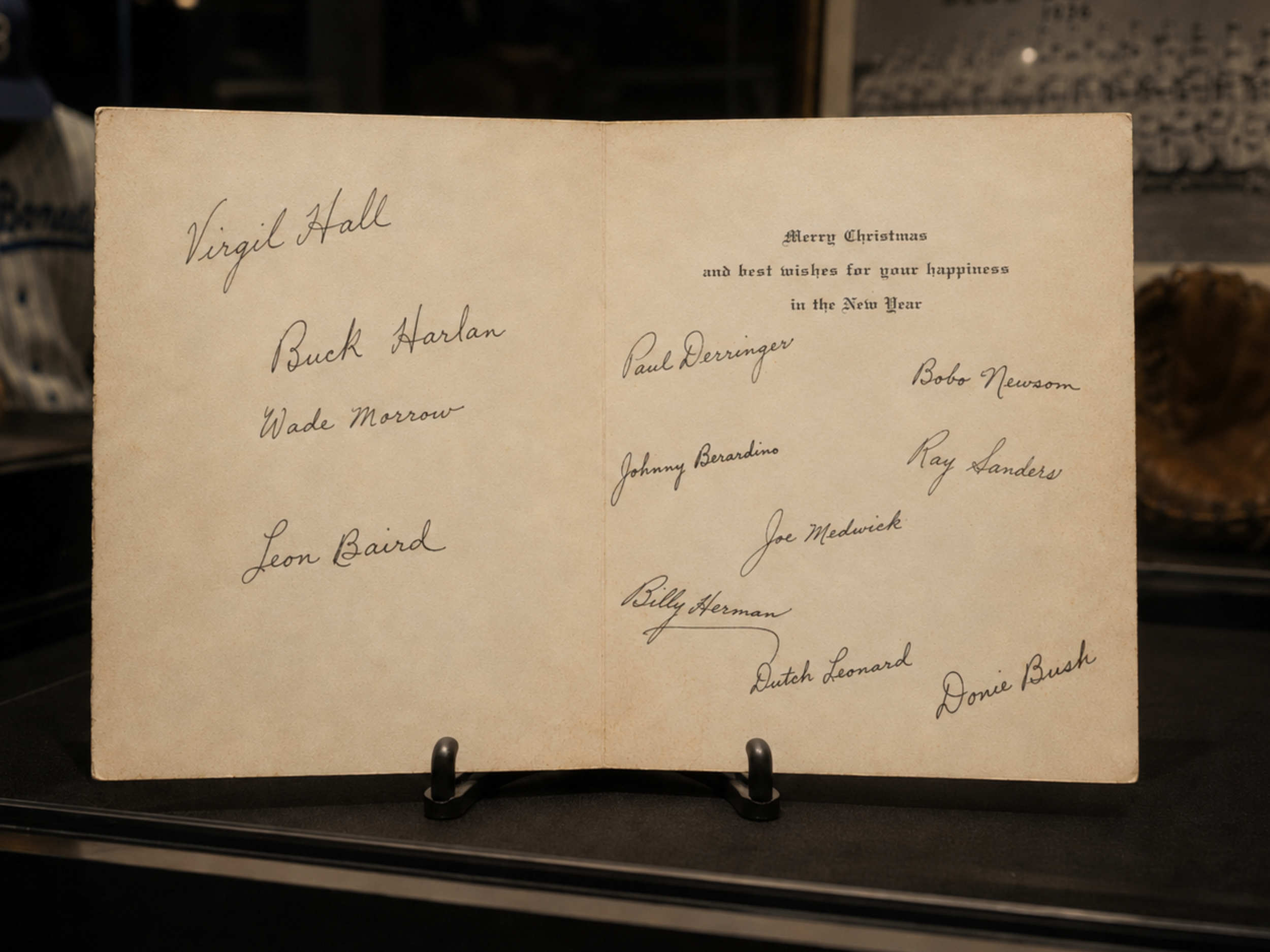
![Museum display of an open 1936 Burnet Blue Bonnets holiday card with twelve team signatures.]()
The 1936 Holiday Card
Team-Signed Christmas Keepsake · Museum Display
Opened on a small display stand, this 1936 Burnet Blue Bonnets holiday card carries a printed Christmas greeting and twelve team signatures, including manager Virgil “Vick” Hall and players Wade Morrow, Leon Baird, and Ellis “Buck” Harlan.
-
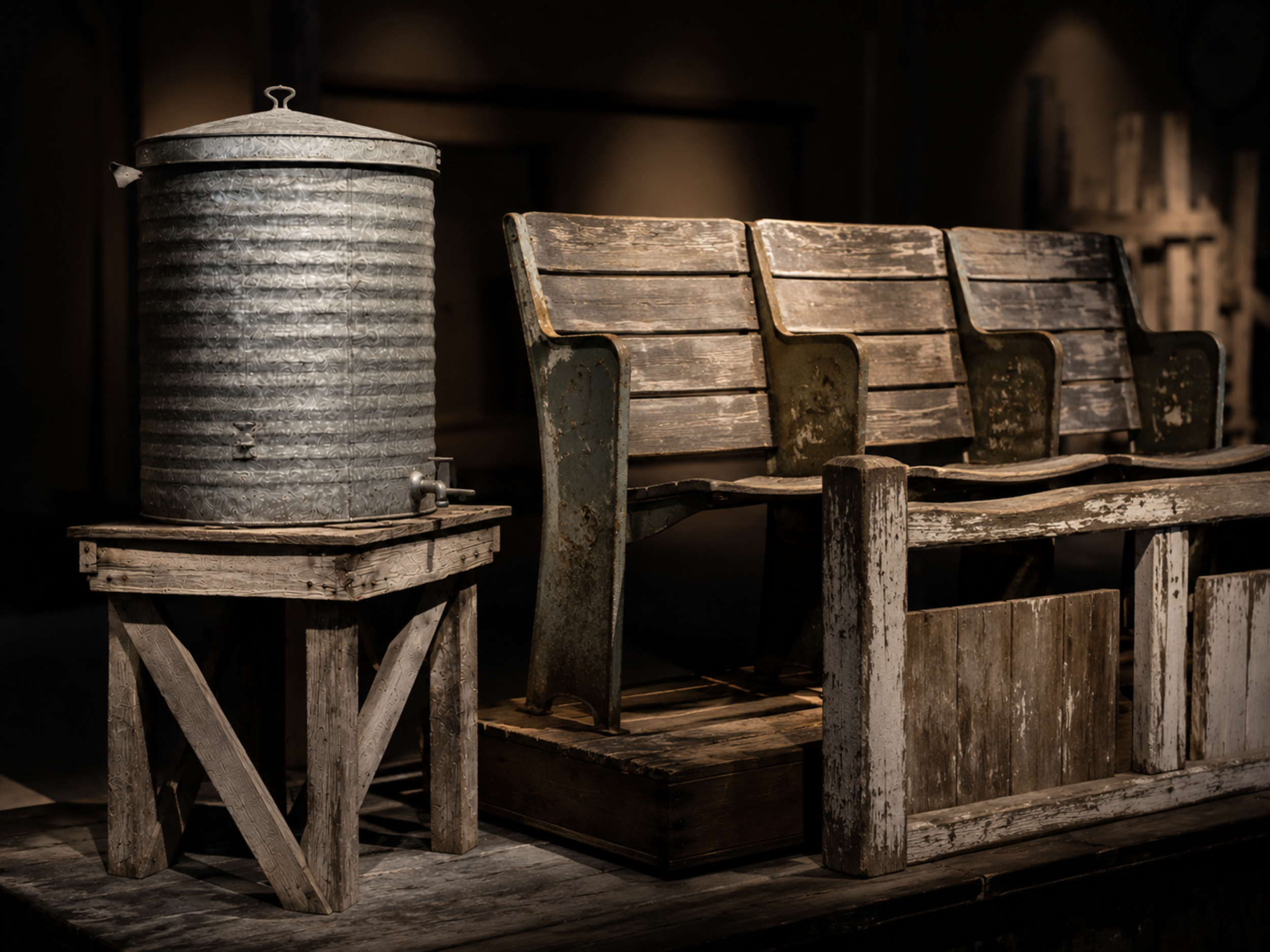
![Museum display of Fair Grounds Park artifacts, including original wooden seating, weathered rail sections, and a galvanized fairgrounds water cooler under dark exhibit lighting.]()
Ballpark Fixtures
Seats and Water from Fair Grounds Park · Museum Display
Displayed under museum spotlights, these surviving Fair Grounds Park fixtures show the plain materials that shaped Burnet baseball: weathered wooden seating, worn rail sections, and the galvanized water cooler that served spectators on hot Hill Country afternoons. They are humble objects, but they carry the texture of the place — splintered boards, sun-faded paint, dusty walkways, and the practical comforts of a fairgrounds ballpark built for Sunday crowds.