Albany Orange Wonders
Albany, New York
Established 1948
1949 Orange Wonder Veteran Series Winners
Club History
The Albany Orange Wonders were organized in the winter of 1948, but their story began before anyone ordered uniforms, packed bats, or drew up a lineup card. It began with Nijmegen.
In the first years after the war, Nijmegen was not a distant European city to Albany. It was the Dutch city Albany had taken into its care. Reports of damaged streets, broken homes, shortages, and returning families moved through City Hall, churches, schools, veterans’ posts, merchant associations, and neighborhood clubs. Relief drives gathered clothing, blankets, household goods, school supplies, and money. Shipping labels, collection notices, civic letters, and committee minutes carried the name Nijmegen through Albany long before a baseball team ever did.
In 1947, Albany’s relief campaign sent roughly 300 tons of food, clothing, medical supplies, household goods, and building materials to Nijmegen, turning the Dutch city from a distant war story into a civic responsibility Albany residents could see, pack, and ship.
The relationship was practical before it was ceremonial. Albany’s first gifts to Nijmegen were the things a damaged city needed. They were packed, sorted, listed, and shipped by people who understood that postwar friendship could not live on speeches alone. By the time the Dutch gift arrived in return, Nijmegen had already become part of Albany’s public vocabulary.
That return gift changed the shape of the bond. Queen Wilhelmina’s tulip bulbs gave Albany something living to hold from the Netherlands, and her selection of the Orange Wonder as Albany’s tulip gave the city a name, a color, and a spring ritual around which its Dutch friendship could gather. The tulips did not feel like decoration. They felt like an answer.
So when local officials, veterans’ groups, merchants, and baseball men began asking what Albany might send back, the question carried more weight than ordinary civic pageantry. Another shipment would have repeated the old language of relief. A monument would have stayed in one place. Albany wanted something public, local, human, and temporary enough to belong to the moment.
The answer was a ballgame.
Albany already had organized baseball. The Senators gave the city a professional baseball presence at Hawkins Stadium, and the local schedule was familiar to anyone who followed the Eastern League box scores. The Orange Wonders were separate from that operation. They never played at Hawkins Stadium, did not borrow the Senators’ schedule, and were not presented as a farm club or reserve side. Hawkins belonged to Albany’s ordinary baseball life. The Orange Wonders belonged to a single journey.
The club was commissioned through a small Albany veterans’ baseball committee chaired by Edward J. McNulty, a lawyer and former Navy officer who had helped coordinate civic benefit games after the war. McNulty understood the tour as a return visit in baseball form. Albany had already traveled to Nijmegen by crate, letter, ledger, and relief shipment. Now Albany would travel there by roster.
McNulty’s committee made two decisions that shaped everything that followed. First, the tour would be played overseas, not unveiled at home. Second, every uniformed man would be a veteran of the war. No college additions, no sponsored ringers, no promising boys from the sandlots. If a man wore the Orange Wonder uniform, he had already worn another.
That rule gave the tour its force. These were not ballplayers sent to perform innocence abroad. They were men who knew what ruin meant, crossing the ocean to play in cities still repairing themselves. The games were meant as public amusement, but also as a kind of civic recognition. Baseball would be the gift. The veterans would be the message.
To make a series, Albany needed two clubs. The Orange Wonders took their name from the tulip selected for the city: bronzy orange, shaded with scarlet, and already bound to Albany’s Dutch inheritance. Their opponent was the Albany Nassau Blues, a second veteran nine assembled from the same local network of service clubs, neighborhood teams, and returning players. The rivalry was not old, but it was immediate. The Blues wore dark traveling uniforms with orange trim and carried the more formal name. The Wonders carried the flower.
Harold “Hal” Ten Eyck was appointed manager of the Wonders. A former infantry captain and prewar semipro infielder, Ten Eyck preferred a settled lineup and few speeches. His captain was second baseman Abraham “Abe” Van Alstyne, whose service in the Army Air Forces had interrupted what local writers once expected to become a long independent baseball career. Catcher Gabriel “Gabe” Marro handled the pitching staff and, almost as importantly, the equipment ledger. Right-hander Joseph Picard was chosen for the final-game assignment before the team ever left Albany.
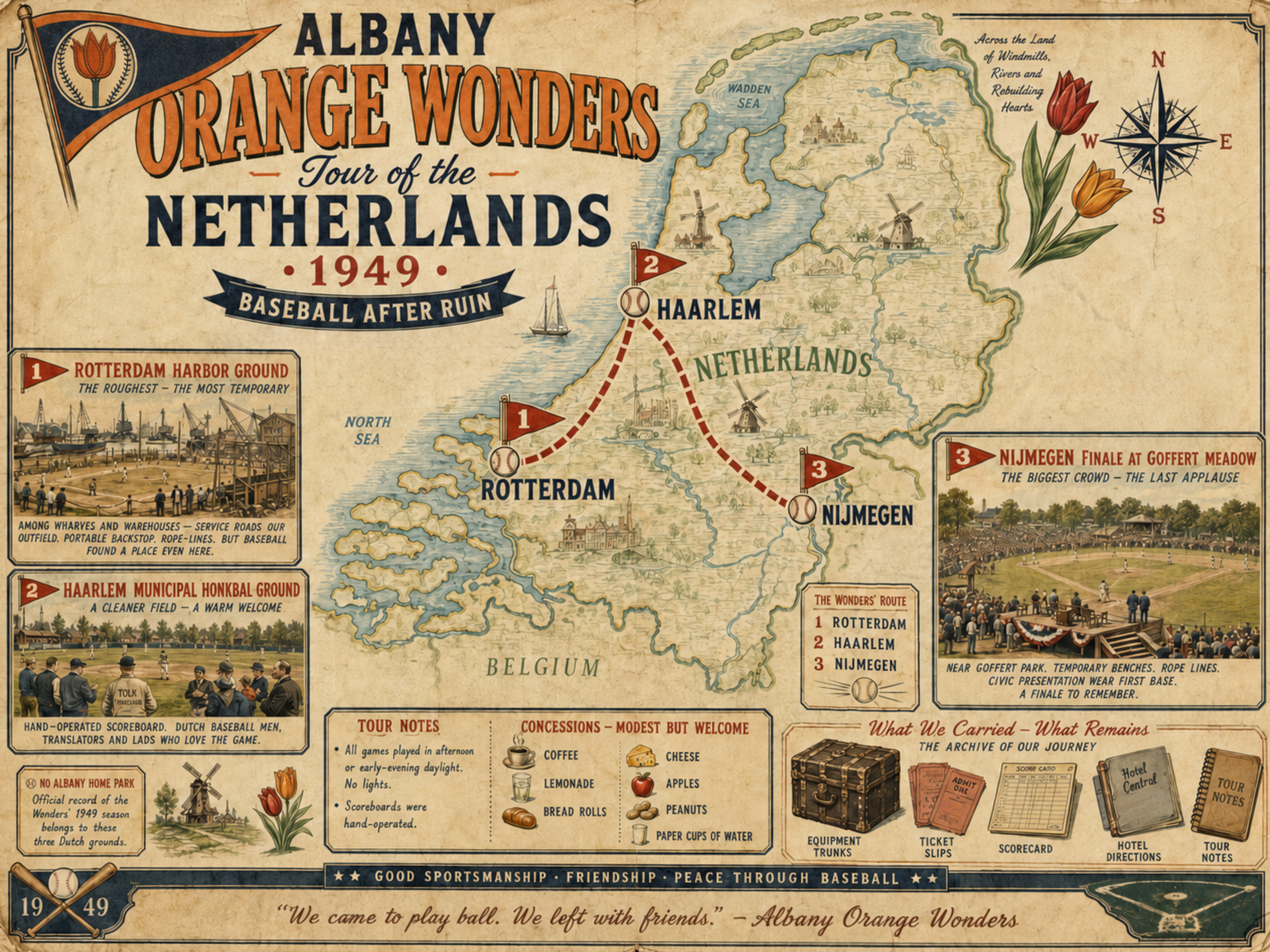
The itinerary followed the emotional logic of the relationship. Rotterdam would be the arrival game, played near the harbor in a city where the work of rebuilding could still be seen beyond the outfield. Haarlem would be the most fluent honkbal stop, arranged with local baseball men who knew the sport, helped prepare the ground, and met the Albany scorekeeper on familiar terms. Nijmegen would be the finale, because the tour was always moving toward the sister city that had brought Albany into the Netherlands in the first place.
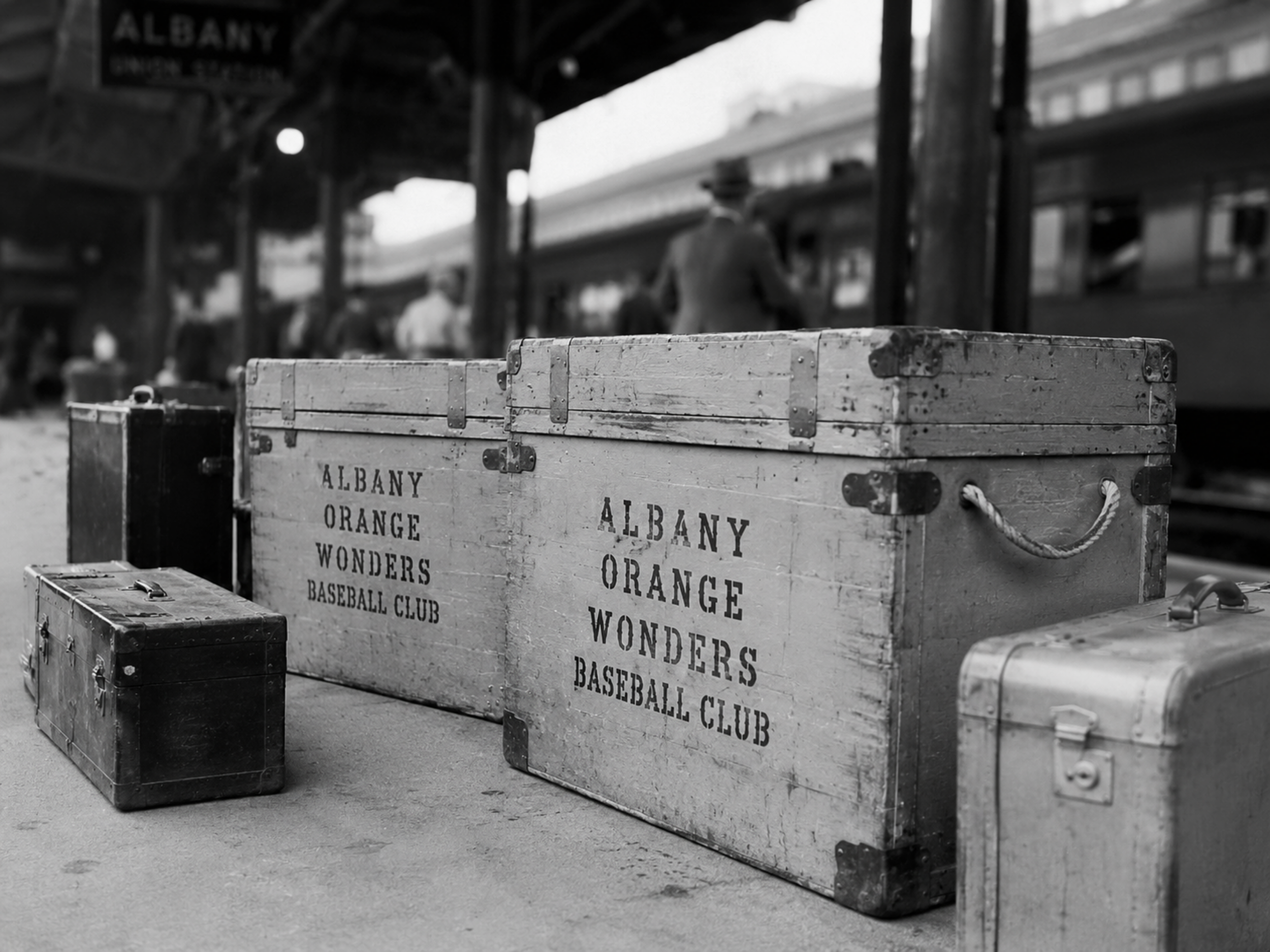
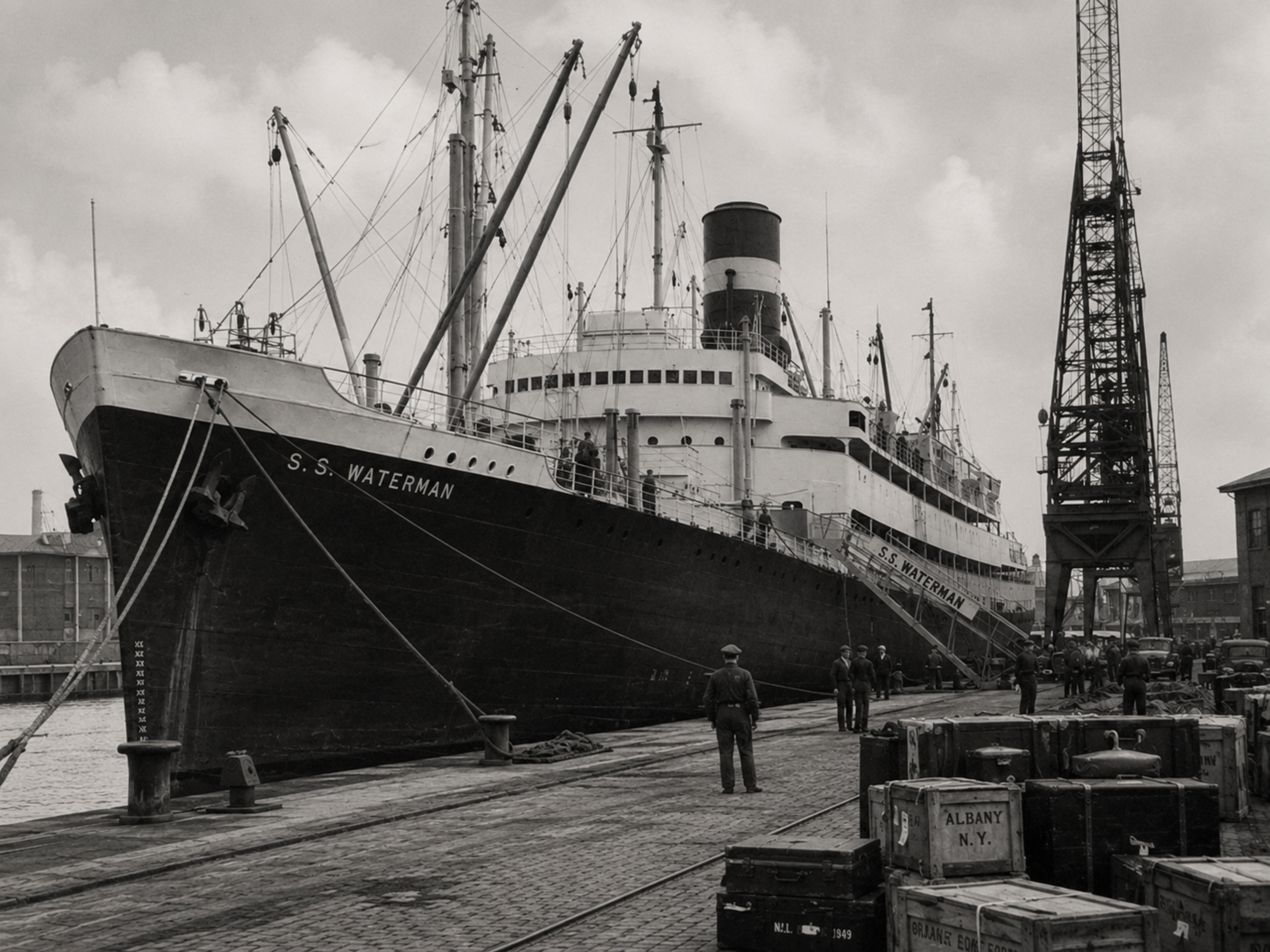
The official party departed Albany by rail for New York, crossed the Atlantic by ship, and reached the Netherlands with trunks marked in black paint. It included the two clubs, two managers, a trainer, a scorekeeper, a small group of civic representatives, and enough bats, balls, catcher’s gear, bases, chalk, and uniforms to leave behind after the last game. Baseball did not need to be introduced to the Netherlands. The printed programs acknowledged honkbal by name, and the Haarlem date in particular was arranged with local baseball men who understood the game before the Albany party arrived.
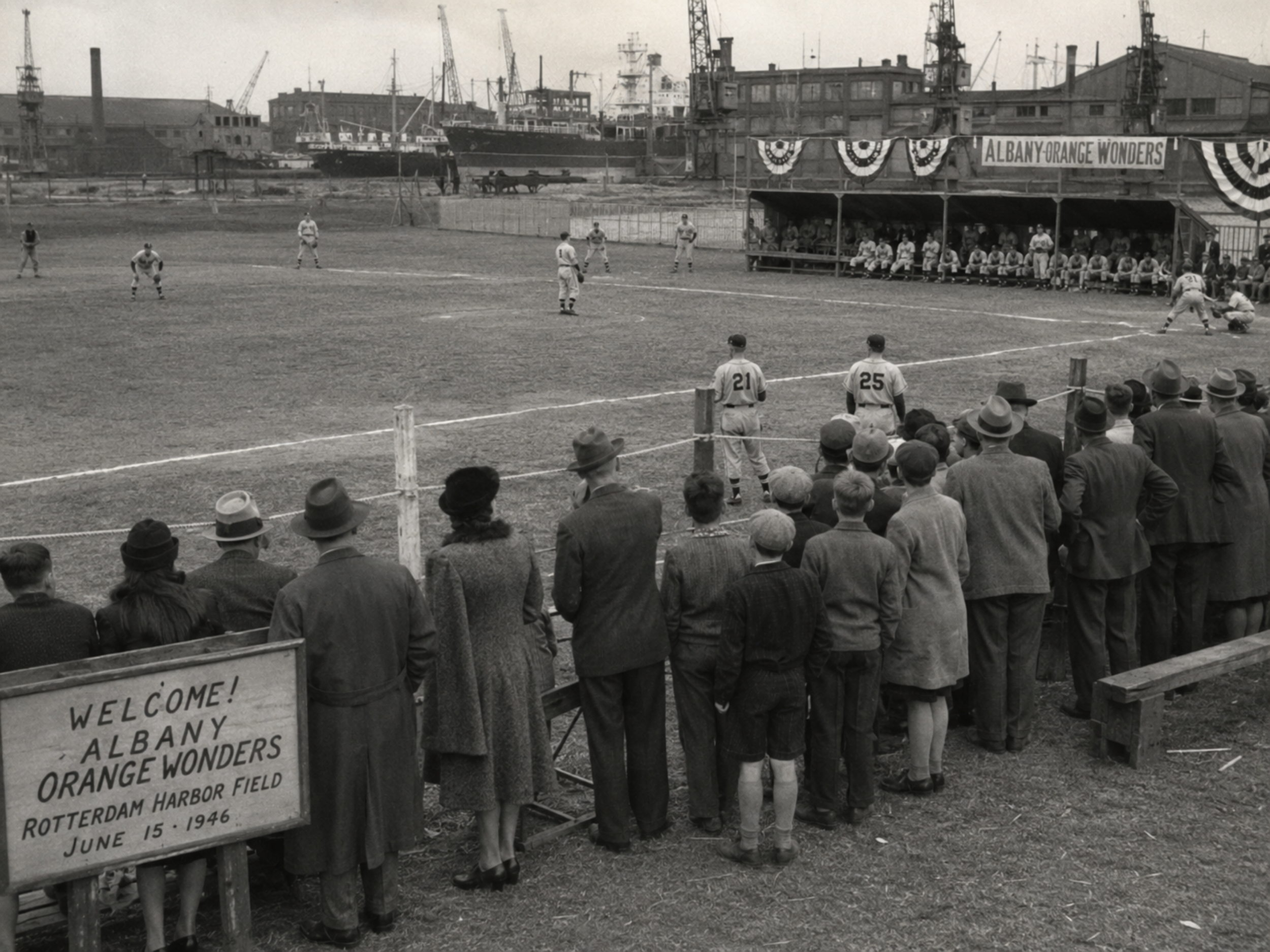
The first game was played at Rotterdam Harbor Ground, a temporary field near Rotterdam’s harbor. The setting gave the tour its phrase. Behind the rope lines were cranes, warehouse walls, freight sheds, and the visible work of a city still rebuilding itself. The Nassau Blues won the opener, 5–3, while the Wonders looked like a club still getting its legs after the crossing.
Four days later, the series moved to Haarlem. That game had the most baseball knowledge in the crowd and the least ceremony on the field. Local honkbal men helped repair the base paths after morning rain, argued scoring points with the Albany official scorer, and supplied a Dutch-language lineup board. The Wonders won, 4–2, behind Daniel O’Rourke’s pitching and two late runs driven in by Van Alstyne.
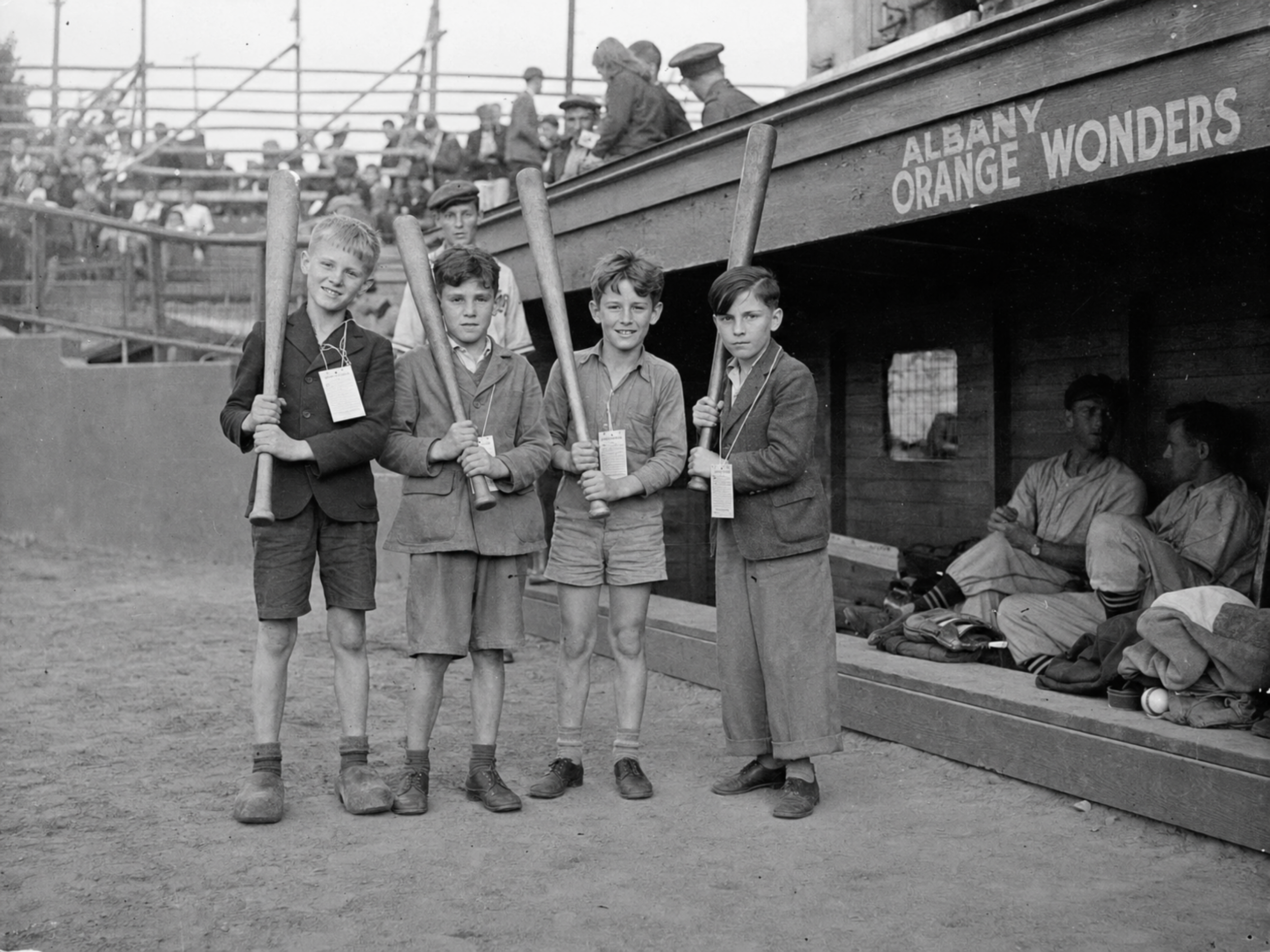
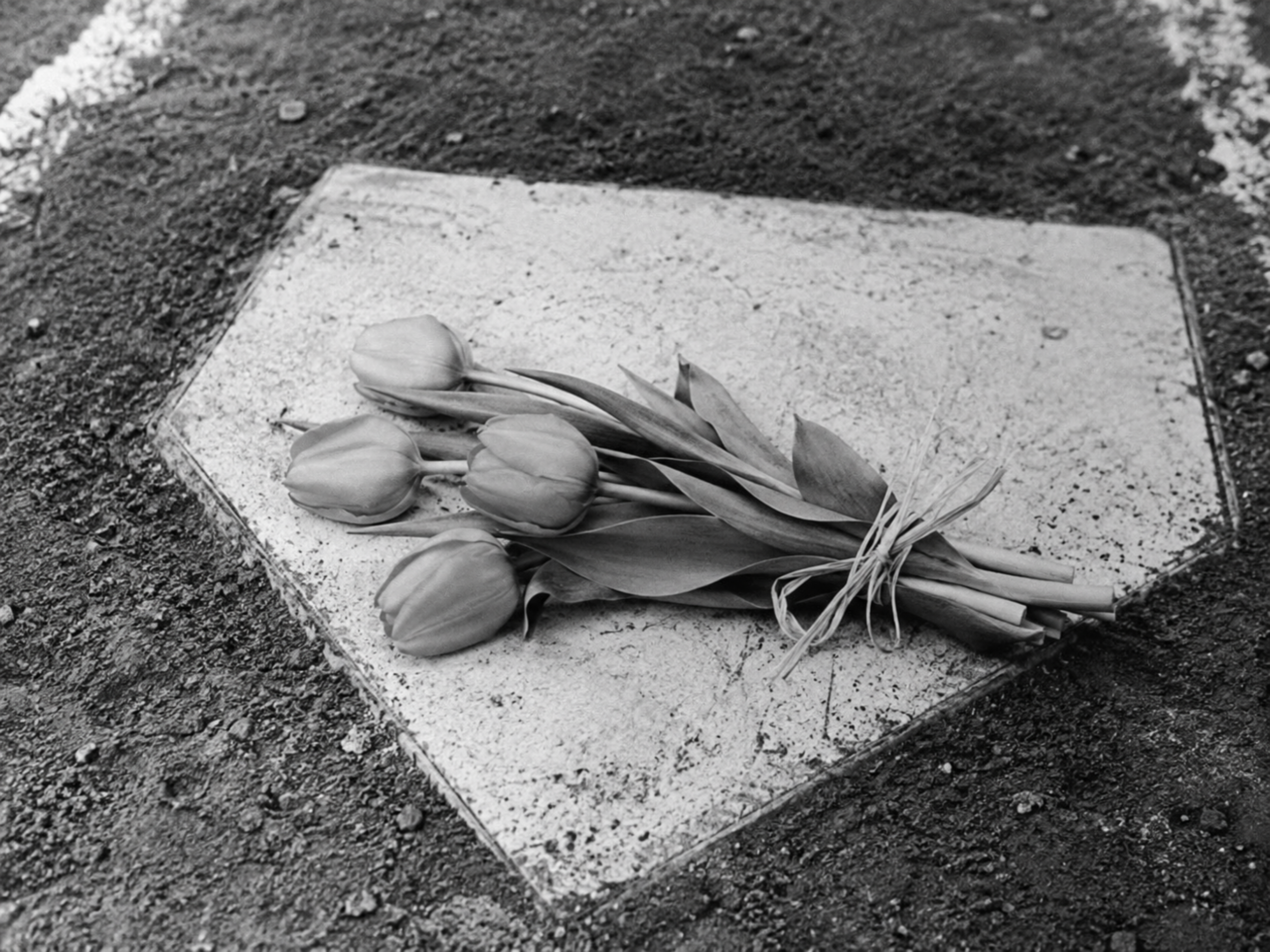
The finale was played in Nijmegen, the city at the emotional center of the tour. The field was laid out on a municipal sports meadow near Goffert Park, with temporary dugouts, standing rope lines, and a small civic platform set near the first-base side. Dutch children carried bats for both clubs. Before the lineups were exchanged, a small Orange Wonder bouquet was placed beside home plate.
Picard pitched the deciding game for Albany. The Blues scored first, but Marro tied the game with a fourth-inning single. In the sixth, Van Alstyne lined a two-run single through the right side. Picard allowed nothing after the third inning, and the Orange Wonders won, 3–1.
The Orange Wonder Veteran Series was not a league championship. It had no office to certify it, no standings to settle, and no park to return to the following week. Its record was three games long. But in Albany, that was enough. The tour completed a civic exchange that had begun with relief shipments and answered with tulips. Nijmegen had made the Netherlands personal to Albany. Albany answered with thirty veterans, two ballclubs, three Dutch fields, and a game played after ruin.
Club and Community
-
![Black-and-white photograph of two women holding a “We Love Albany” sign at the Albany Orange Wonders sendoff.]()
We Love Albany
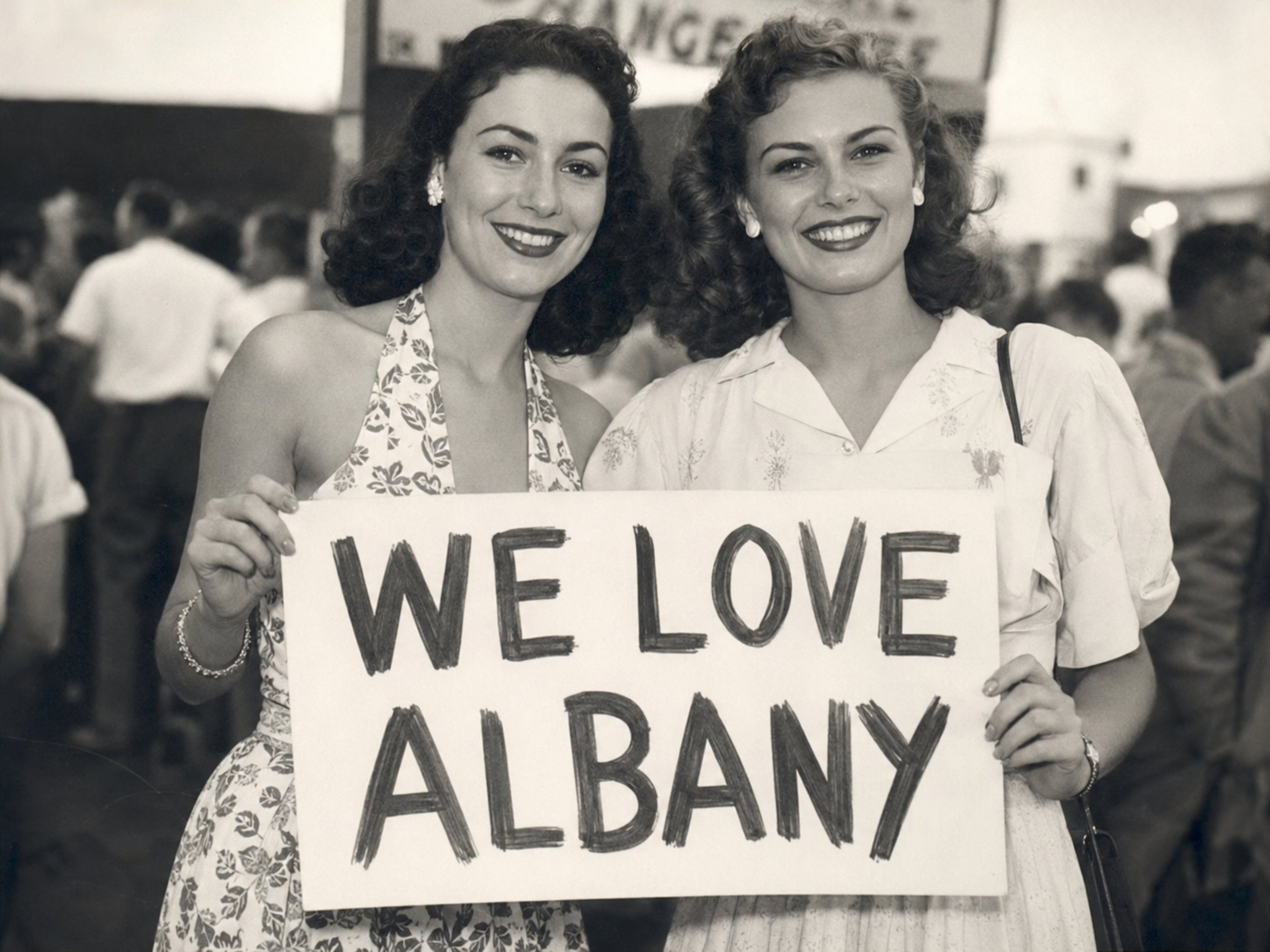
Sendoff Supporters · Albany, 1949
Two young supporters pose with a hand-painted sign at the Orange Wonders’ departure gathering before the Netherlands tour. The photograph gives the sendoff its personal scale: beyond the banners, officials, trunks, and speeches were Albany people turning out simply to wish the club well.
-
![Black-and-white aerial photograph of an open Albany municipal baseball field used by the Orange Wonders for practice.]()
The Practice Ground
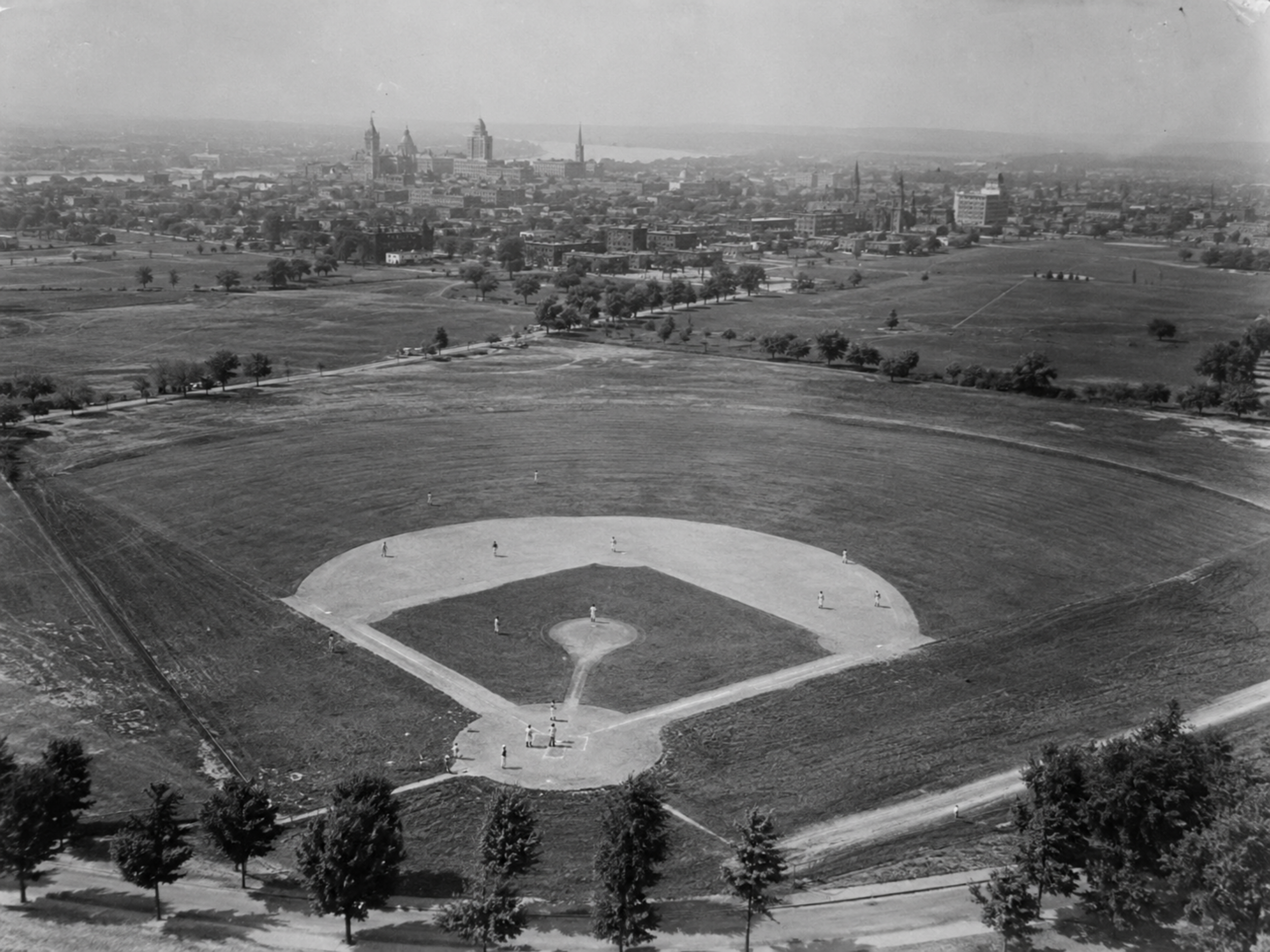
Albany Municipal Field · Spring 1949
Before the Orange Wonders became a touring club, they worked out on an open municipal diamond outside the center of Albany. The field had no fence, grandstand, or permanent scoreboard — only a clean infield, broad grass, and the city skyline hazed in the distance. It was practical ground for a practical club, used to settle lineups and legs before the team’s home field became the itinerary.
-
![Black-and-white 1949 sendoff crowd for the Albany Orange Wonders on the steps of Albany City Hall.]()
City Hall Sendoff
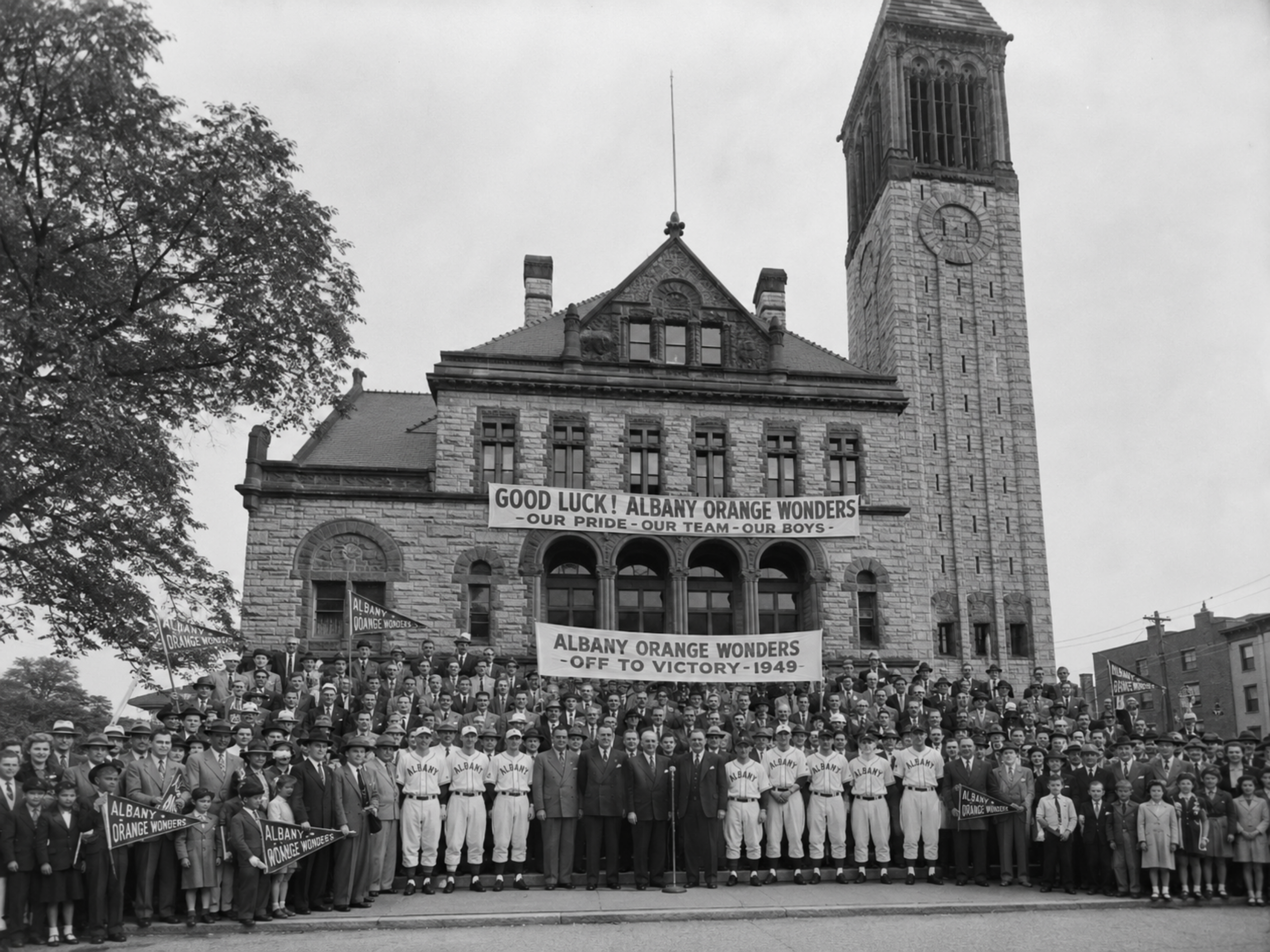
Albany City Hall · 1949
Albany officials, veterans, players, and supporters filled the City Hall steps before the Orange Wonders and Nassau Blues departed for their 1949 overseas tour. Banners, pennants, uniforms, and civic suits share the frame, placing the club’s sendoff somewhere between public ceremony and family photograph.
-
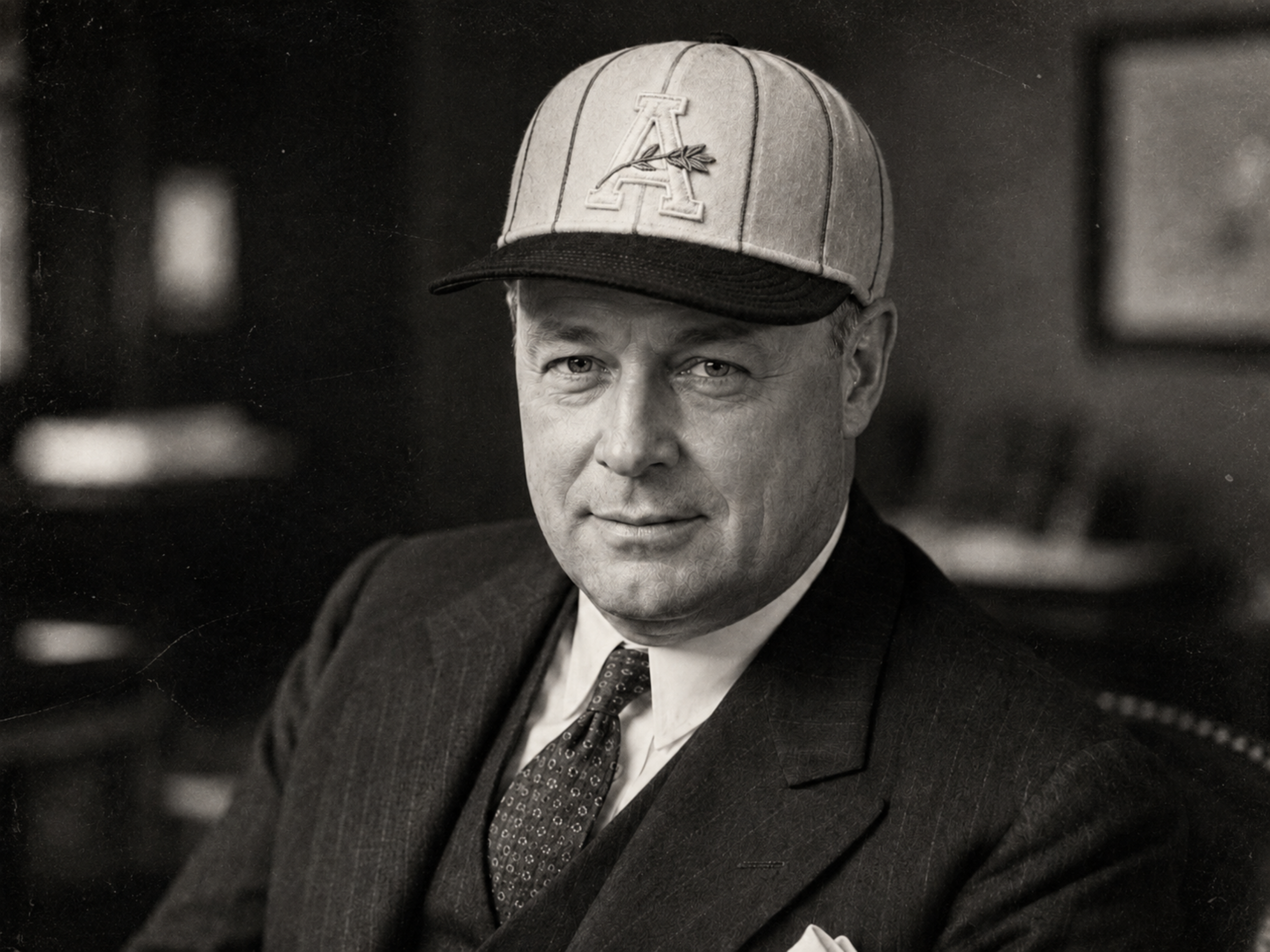
![Black-and-white portrait of Edward J. McNulty wearing an Albany Orange Wonders cap and dark suit.]()
Edward J. McNulty
Club President and Tour Chairman · Albany, 1949
A lawyer, former Navy officer, and coordinator of postwar civic benefit games, Edward J. McNulty chaired the small committee that turned Albany’s tulip gratitude into an overseas baseball tour. His portrait shows the practical blend that shaped the Orange Wonders: a business suit, a veteran’s bearing, and the club cap worn before the team ever reached a Dutch field.
-
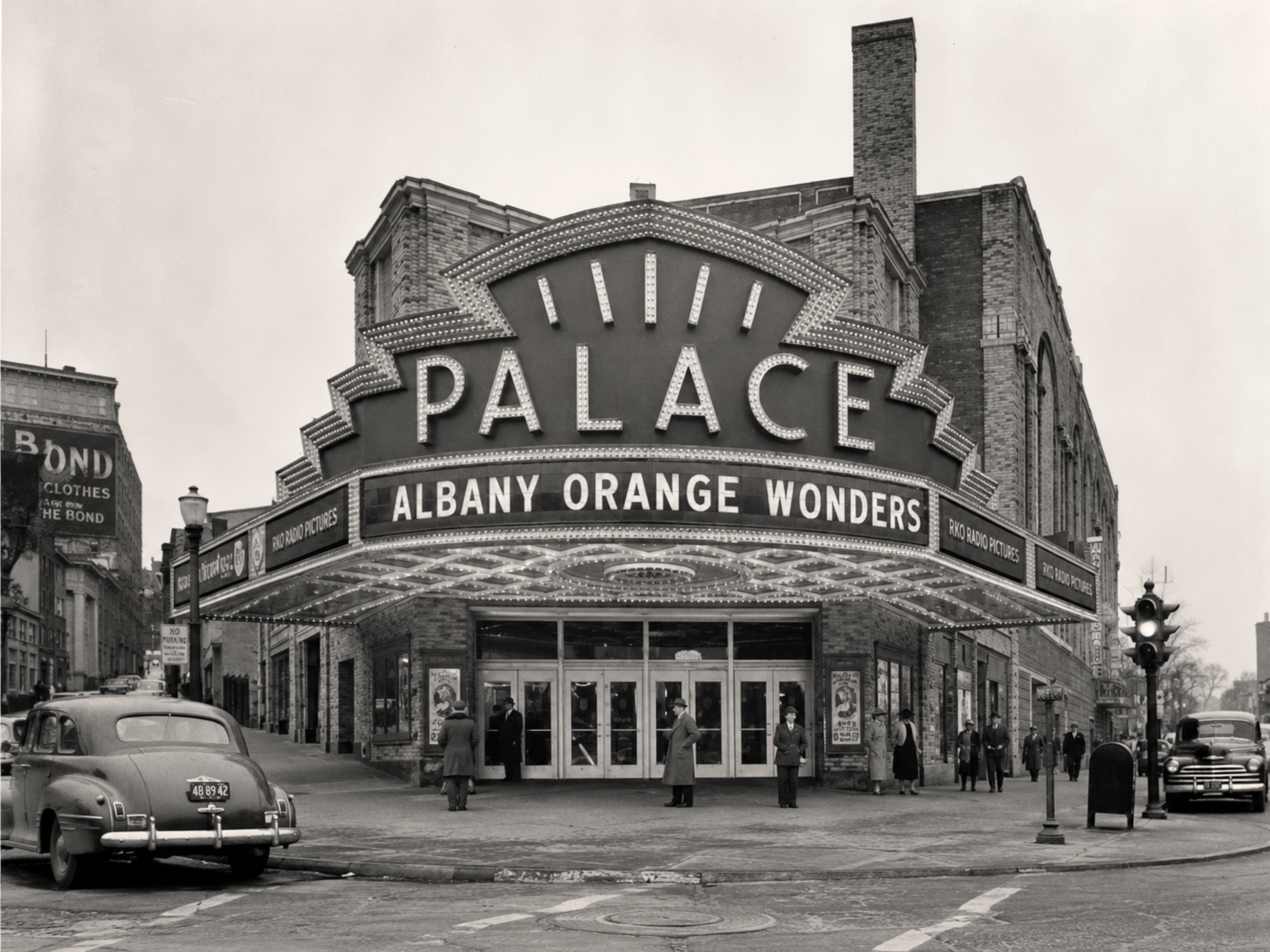
![Black-and-white photograph of the Palace Theatre marquee reading Albany Orange Wonders.]()
Palace Marquee
Downtown Sendoff Notice · Albany, 1949
The Palace Theatre marquee carried the Orange Wonders’ name into downtown Albany before the club departed for the Netherlands. More than a theater notice, the sign shows how the tour moved through the city’s public life: from City Hall steps and train platforms to storefronts, sidewalks, and evening crowds passing beneath the lights.
Club Record
| Club | Albany Orange Wonders Baseball Club |
|---|---|
| Location | Albany, New York |
| Established | 1948 |
| Years Active | 1949 |
| Operations Concluded | 1949, following the Netherlands tour |
| League | None. Team created for the Orange Wonder Veteran Series, an independent veteran goodwill tour |
| Status | Veteran touring club |
| Home Park | None in Albany; official games played at temporary or municipal grounds in Rotterdam, Haarlem, and Nijmegen |
| Ballpark Capacity | Approximately 1,200 to 3,000, depending on tour ground and standing-room rope lines |
| Club Colors | Orange Wonder orange, scarlet, Dutch navy, and cream. |
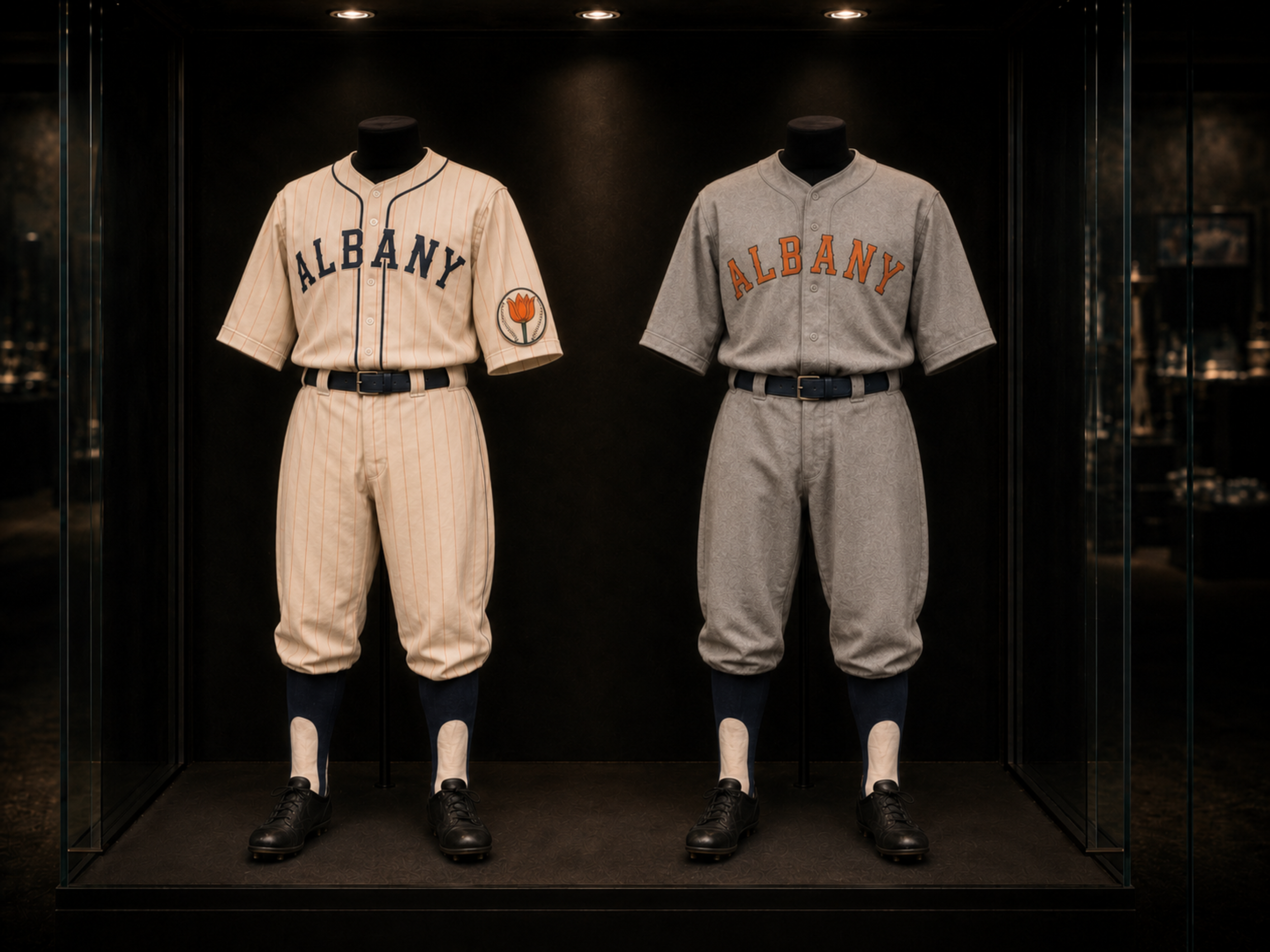
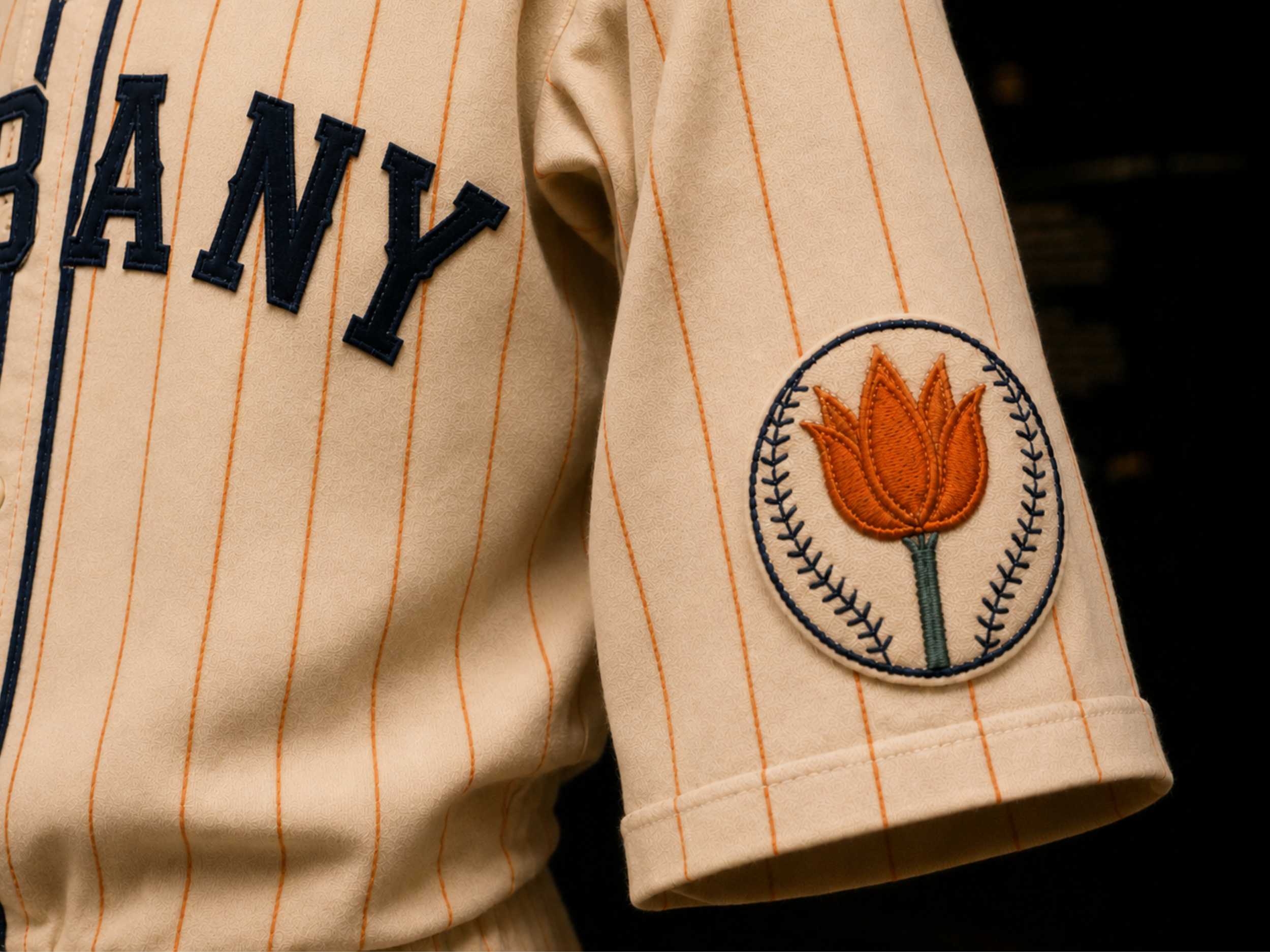
| Primary Uniform | Cream flannel with narrow Orange Wonder orange pinstripes, Dutch navy ALBANY lettering, Dutch navy trim, and a tulip-over-baseball sleeve patch |
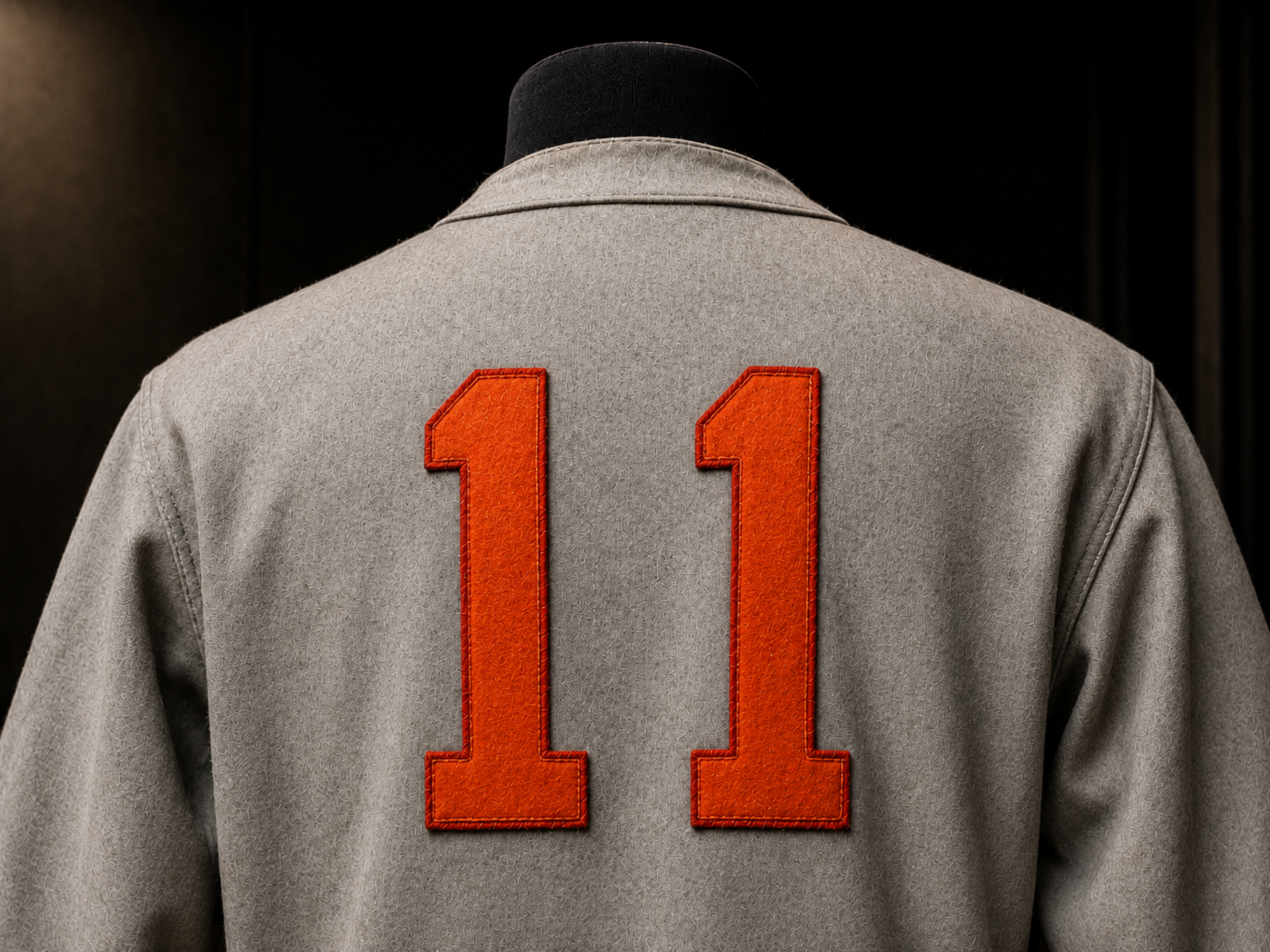
| Travel Uniform | Gray flannel with Orange Wonder orange ALBANY lettering, orange back numerals edged in scarlet, and simplified sleeve trim |
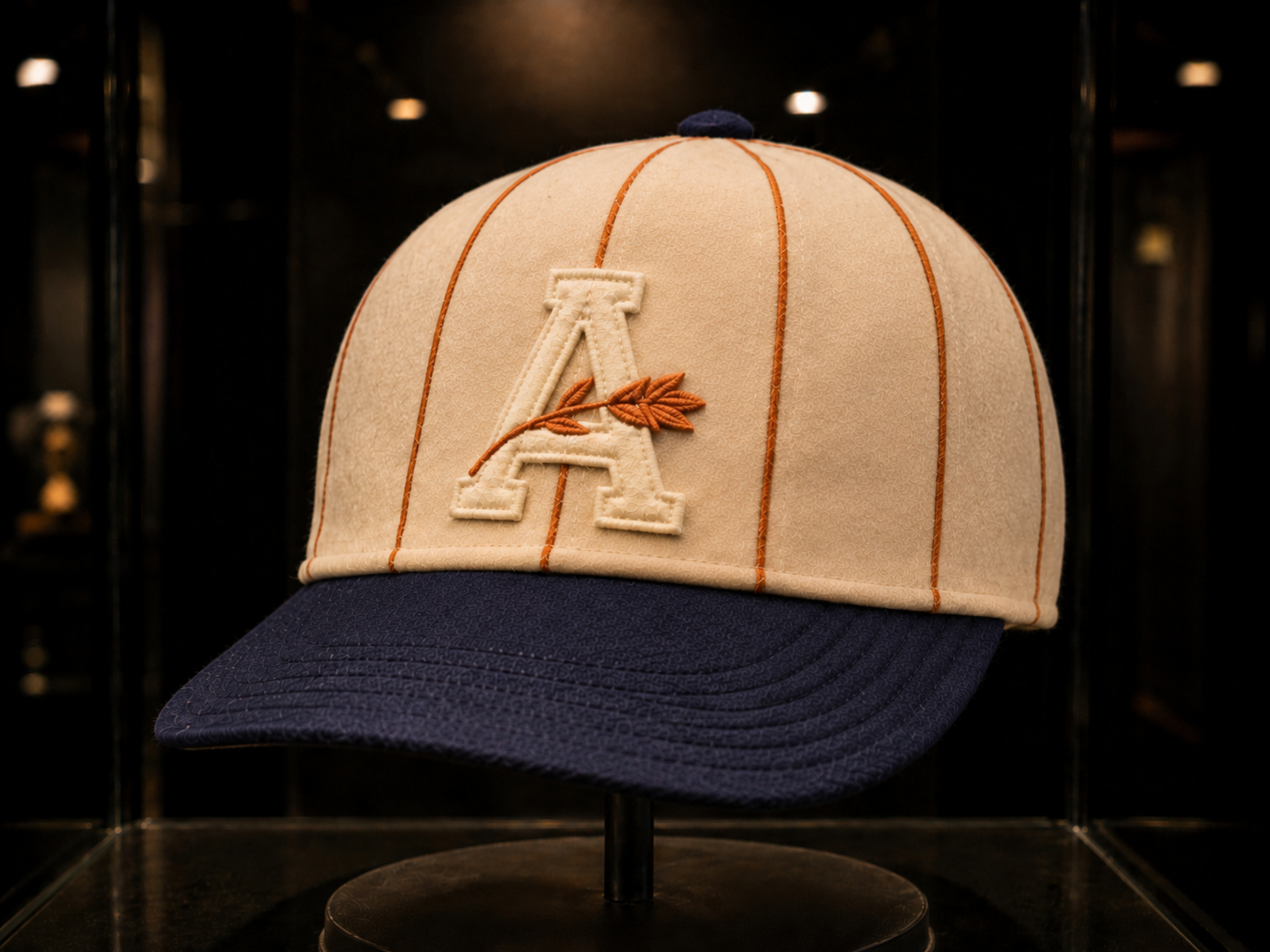
| Cap | Cream wool crown with Dutch navy bill, orange seam piping, and a cream block A crossed by a small orange tulip stem |
| Cap Mark | Cream block A with Orange Wonder tulip stem detail |
| Uniform Mark | Orange and scarlet Orange Wonder tulip set inside a stitched baseball on the left sleeve |
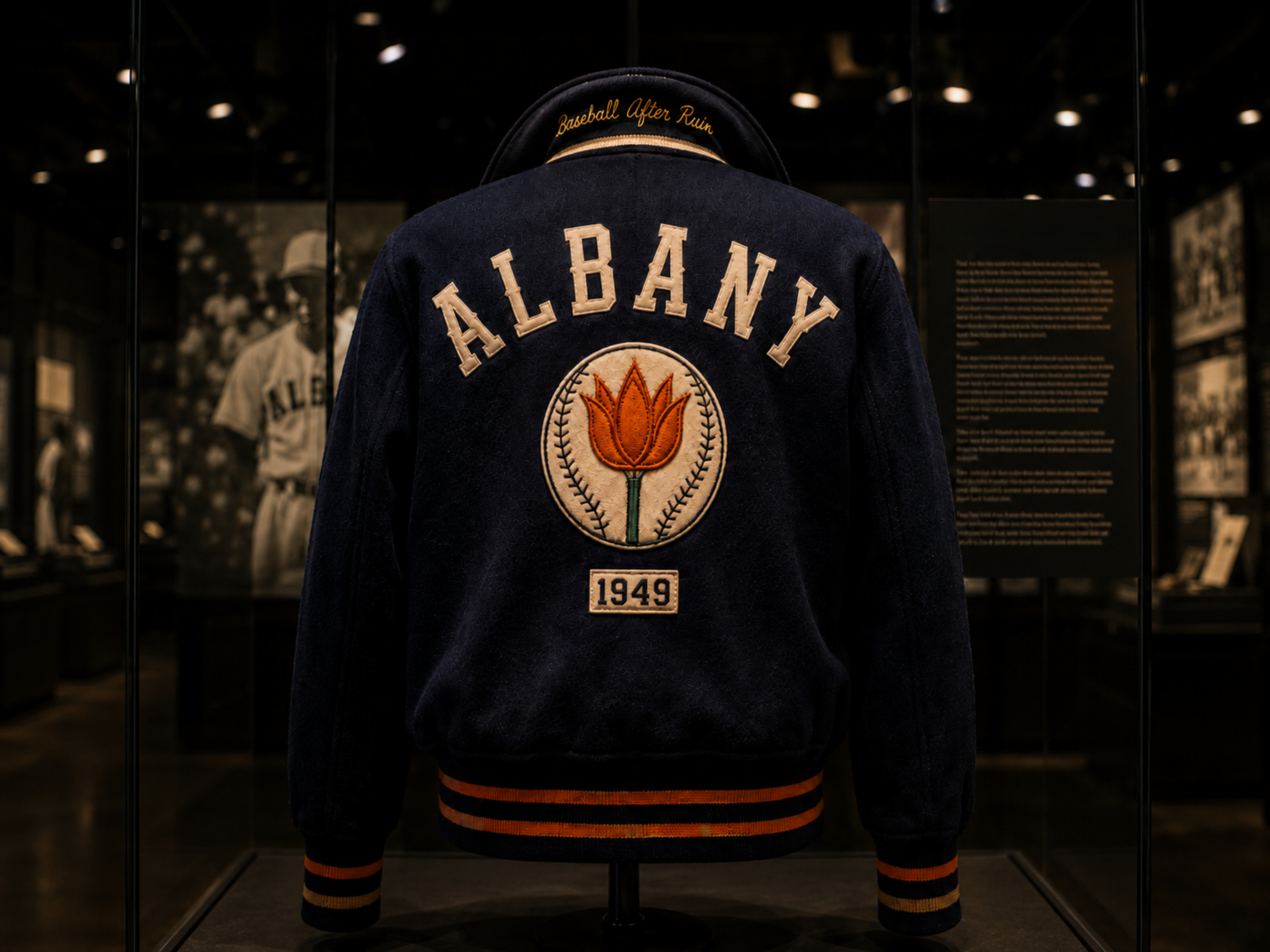
| Dugout Jacket Mark | Arched ALBANY lettering above the tulip-over-baseball emblem and small 1949 tour tab |
| Common Shortened Name | The Wonders |
| Informal Nickname | The Veteran Nine |
| Club Motto | Baseball After Ruin. |
| Pre-Game Tour Custom | At each Dutch tour stop, hosts placed an Orange Wonder bouquet or single tulip near home plate before the lineups were exchanged |
| Official Mascot Name | None; the club used lettering, tulip marks, and tour insignia rather than a character mascot |
| Cap Mark Adopted | March 1949 |
| Uniform Patch Adopted | March 1949 |
| Motto First Used | June 1949, in the tour program |
| Club President, 1949 | Edward J. McNulty |
| Manager, 1949 | Harold “Hal” Ten Eyck |
| Club Captain, 1949 | Abraham “Abe” Van Alstyne, second baseman |
| Pennants / League Titles | None |
| Best-Known Rival | Albany Nassau Blues |
| Defining-Season Result | 1949 Orange Wonder Veteran Series winners |
| Series Result | Defeated Albany Nassau Blues, two games to one |
| Final Season | 1949 |
| Recordkeeping Note | The official club ledger includes only the three Dutch series games; clinics, shared practices, civic appearances, and batting demonstrations were not entered as official contests |
Club Uniforms and Marks
The Orange Wonders’ uniforms were made for travel first and display second. The club had no long home schedule, so the garments had to survive rail platforms, steamship storage, hotel rooms, borrowed dressing areas, damp grass, and three different grounds over an eight-day span.
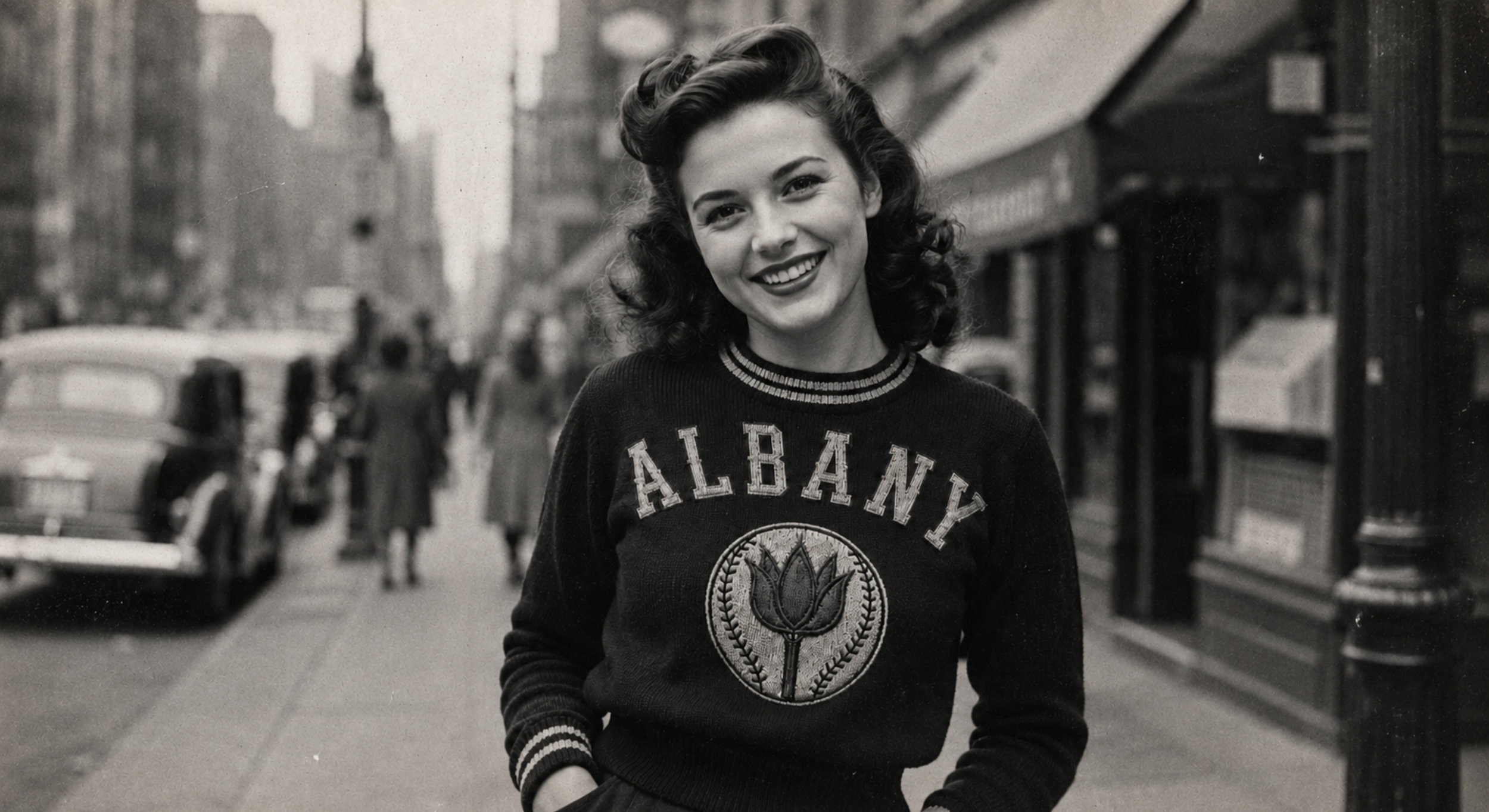
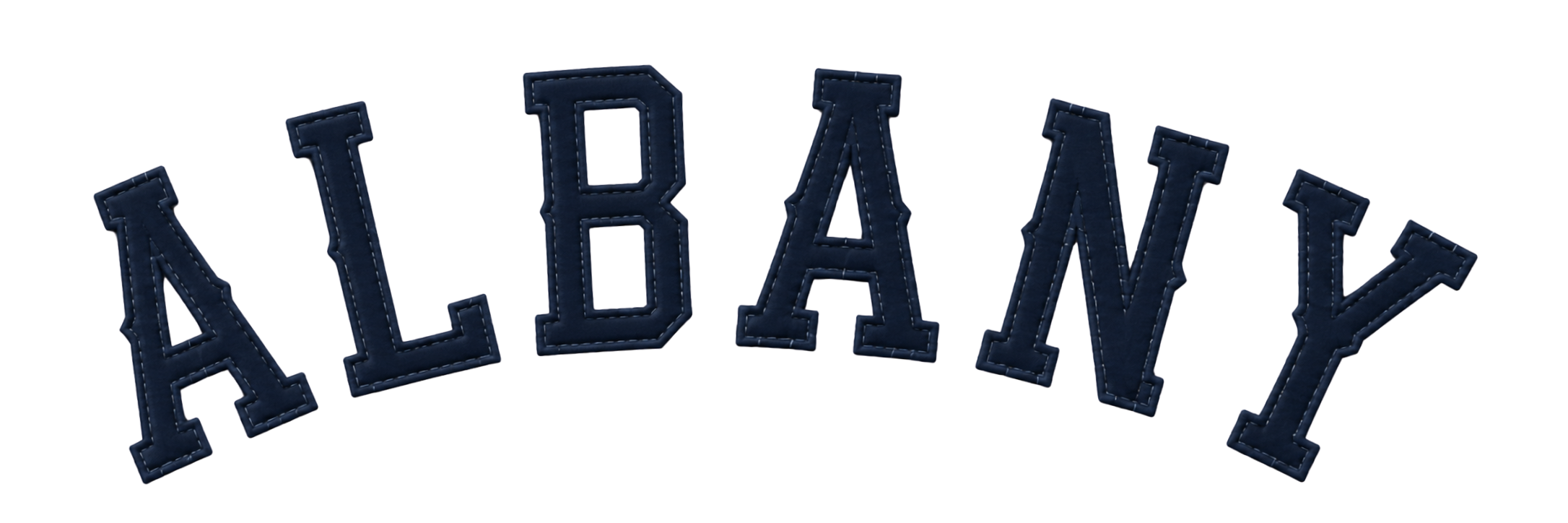
The primary uniform was cream flannel with narrow Orange Wonder pinstripes running through the jersey and trousers. Dutch navy ALBANY lettering arched across the chest in individually sewn felt letters, with the small midpoint notches and stitched edges visible in close photographs. The lettering was not printed cleanly onto the cloth. It sat on top of the flannel, pulling slightly at the edges and leaving the kind of puckering expected from a working uniform made quickly for use rather than display. Dutch navy trim ran along the collar and button placket, giving the cream-and-orange set enough formal contrast without turning the uniform into a novelty garment.
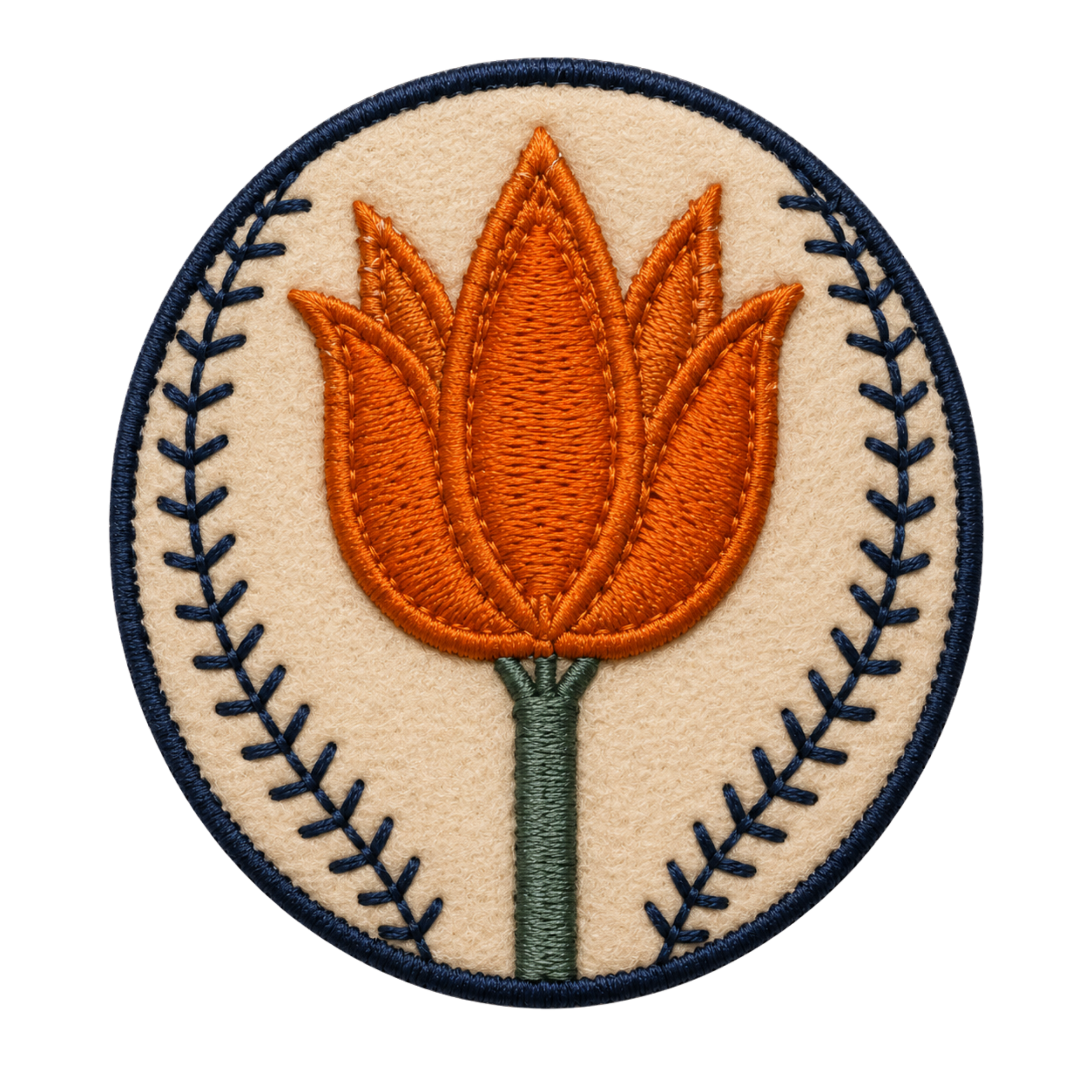
The left sleeve carried the club’s uniform mark: an orange and scarlet Orange Wonder tulip set inside a stitched baseball. The patch was practical embroidery, not polished insignia work. Raised thread, uneven felt edges, and slight puckering around the circle show how the mark was sewn onto the sleeve just above the cuff. It was the only floral mark on the primary uniform and the clearest reminder that the club’s name came from Albany’s Dutch tulip connection rather than from a mascot.
The travel uniform was gray flannel, heavier and plainer than the cream set. Its ALBANY wordmark was sewn in Orange Wonder orange across the chest, giving the travel uniform a stronger connection to the tour color while keeping the rest of the uniform restrained. The back numbers were also orange felt, edged narrowly in scarlet. Several players wore the gray shirts during rail transfers and practice days, which accounts for the more visible wear on surviving examples: collar darkening, rubbed elbows, softened felt edges, and light fraying around the numerals.
The cap was the club’s most important field mark. It paired a cream wool crown with a Dutch navy bill, orange seam piping, and a cream block A on the front panel. A small orange tulip stem crossed the letter by hand, leaving minor differences from cap to cap. On some examples the stem sits low across the crossbar. On others it rises toward the left side of the crown. That variation became part of the cap’s character: not a factory-perfect emblem, but a tour mark finished by hand before departure.
The dugout jacket carried the largest mark used by the club: arched ALBANY lettering above the tulip-over-baseball emblem and a narrow 1949 tab. Inside the collar, the motto Baseball After Ruin was chain-stitched in small cream thread, visible only when the collar was popped. The jacket appeared in hotel lobby photographs, the Nijmegen postgame portrait, and later exhibit displays, but it was not a mascot piece. The Wonders never adopted a character emblem. Their visual language stayed with the things that could be packed, worn, folded, repaired, and carried: flannel, felt, wool, stitched letters, travel trunks, and one flower rendered with restraint.
Together, the uniform program gave the Wonders a clear identity without making them look like a novelty team. On the field, they were Albany veterans in practical baseball dress. In the photographs, they are remembered by orange pinstripes, Dutch navy and orange lettering, a cream-and-Dutch navy cap with orange seams, the tulip-over-baseball sleeve patch, and the motto stitched inside the jacket collar: Baseball After Ruin.
Flannel, Felt, and Thread
-
![Albany Orange Wonders primary and travel baseball uniforms displayed together.]()
Primary and Travel Uniforms
Primary and Travel Sets · 1949
Displayed together, the cream primary uniform and gray travel set show how compact the Orange Wonders’ equipment program was. The primary uniform used orange pinstripes with Dutch navy ALBANY lettering, while the heavier gray travel set carried the club name in Orange Wonder orange. Both were built to travel rather than fill a home clubhouse.
-
![Albany Orange Wonders cream and navy cap with orange seam piping and cream A.]()
Primary Cap
Cream Block A · Orange Seam Piping
The cream-and-Dutch navy cap carried the club’s clearest field mark: a cream block A crossed by a small orange tulip stem, set between orange seam piping. The handwork varies slightly across surviving caps, a reminder that the tour order was finished quickly before departure.
-
![Close-up of Orange Wonder tulip patch on cream flannel sleeve.]()
Sleeve Patch
Orange Wonder Tulip · Uniform Mark Detail
The left-sleeve patch set an orange and scarlet tulip over a stitched baseball. The raised thread, uneven felt edge, and puckering around the patch show the mark as practical uniform work rather than polished embroidery.
-
![Back number on gray Albany Orange Wonders travel jersey.]()
Travel Jersey Number
Scarlet-Edged Number 11 · Gray Flannel Detail
The back of the travel jersey was spare: gray flannel, orange felt number, and narrow scarlet edging. The number shows the heaviest wear on the surviving set, consistent with a uniform packed, unpacked, folded, and worn through a short overseas schedule.
-
![Albany Orange Wonders dugout jacket with tulip back mark.]()
Dugout Jacket
Baseball After Ruin · Tour Outerwear
The Dutch navy wool dugout jacket carried arched ALBANY lettering above the tulip mark and 1949 tour tab. Inside the collar, the motto Baseball After Ruin was chain-stitched in small cream thread, visible only when the collar was flipped up.
The Three Dutch Grounds
The Orange Wonders had no Albany home park. Their official record belongs to three grounds in the Netherlands: a temporary harbor field in Rotterdam, a municipal honkbal ground in Haarlem, and a sports meadow in Nijmegen. Each field was prepared for one game, then returned to its ordinary use.
The Rotterdam ground was the roughest. It occupied a cleared municipal tract near the harbor, bordered by freight sheds, service roads, and the machinery of reconstruction. A portable backstop stood behind home plate. Rope lines marked the standing areas. A few rows of temporary plank seating were placed along the first-base side, while most spectators stood. The outfield was uneven enough that both managers agreed to ground rules before first pitch. A ball rolling under the right-field rope became a double. A ball striking the warehouse wall in left-center remained in play unless it entered the service lane.
Haarlem gave the series its cleanest baseball setting. The local ground had better base paths, a more settled infield, and a Dutch-language lineup board set near the scorer’s table. Dutch honkbal men helped chalk the foul lines and advised the Albany scorekeeper on names, positions, and substitutions. The Haarlem game had fewer civic speeches than Rotterdam or Nijmegen, but the dugouts were more crowded with baseball people: players, club officials, translators, scorers, and boys who already knew where to stand during batting practice.
The Nijmegen finale was arranged on a municipal sports meadow near Goffert Park. Temporary benches were brought in, rope lines extended down both foul territories, and a small civic platform was built near the first-base side for the presentations. The field had the broadest standing room of the three grounds, and the largest crowd. Its clubhouse arrangements were also the most improvised. The Orange Wonders dressed in a schoolroom, the Nassau Blues used a canvas tent, and the equipment trunks were kept under watch beside the scorer’s table.
None of the three grounds had lights. The tour was played in afternoon and early-evening daylight, with first pitch set around civic meals, train schedules, and the availability of municipal fields. Scoring was hand-kept at each stop. Concessions were modest: coffee, lemonade, bread rolls, cheese, apples, peanuts, and water poured from enamel pitchers into paper cups. The most reliable public amenity was the one the Albany men remembered most clearly: tables and chairs set aside by local hosts so the players could eat, write postcards, and exchange addresses after the games.
The grounds did not survive as Orange Wonders places in the usual ballpark sense. There was no grandstand to dismantle, no lease to lose, no permanent scoreboard to sell. What remained were site plans, chalk lists, photographs, admission slips, hotel directions, and handwritten notes in the tour ledger. The Wonders’ home field was the itinerary.
Park and Field
| Tour Grounds | Rotterdam Harbor Ground, Rotterdam; Haarlem Municipal Honkbal Ground, Haarlem; Goffert Meadow, Nijmegen |
|---|---|
| Key Dates | Rotterdam opener, June 18, 1949; Haarlem second game, June 22, 1949; Nijmegen finale, June 26, 1949 |
| Rotterdam Setting | Temporary municipal harbor field bordered by freight sheds, service roads, and dock machinery |
| Haarlem Setting | Municipal honkbal ground with established base paths, a scorer’s table, Dutch-language lineup board, and local club assistance |
| Nijmegen Setting | Sports meadow near Goffert Park adapted for the civic finale with temporary benches, rope lines, and a small presentation platform |
| Rotterdam Dimensions | Left field 318 feet; center field 382 feet; right field 304 feet |
| Haarlem Dimensions | Left field 326 feet; center field 388 feet; right field 312 feet |
| Nijmegen Dimensions | Left field 334 feet; center field 395 feet; right field 309 feet |
| Scoreboards and Scoring | Portable inning board at Rotterdam; scorer’s table and Dutch-language lineup board at Haarlem; scorer’s easel and chalk panels at Nijmegen |
| Lighting | None; all games were played in afternoon or early-evening daylight |
| Seating and Admission | |
| Rotterdam Capacity | Approximately 1,200, mostly standing room behind rope lines |
| Haarlem Capacity | Approximately 1,800, including small bleachers and standing areas |
| Nijmegen Capacity | Approximately 3,000 with temporary benches, civic platform, and extended rope-line standing room |
| Ticketing | Paper admission slips printed locally for each city; committee passes issued to veterans, municipal hosts, and school groups |
| Displayed Admission Prices | Adults ƒ0.75; children ƒ0.25; veterans admitted by pass |
| Programs | Bilingual scorecards with English and Dutch lineups, brief rules notes, and a honkbal glossary |
| Concessions and Public Amenities | |
| Concessions | Coffee, lemonade, bread rolls, cheese, apples, peanuts, and paper-wrapped sandwiches prepared by local hosts |
| Player Meals | Hotel breakfasts, civic luncheons, and postgame suppers recorded on the tour meal cards |
| Public Amenities | Water tables, first-aid station, lost-and-found box, bicycle areas, and directions to tram or rail connections where available |
| Postgame Exchange | Players signed scorecards, exchanged addresses, and left selected bats, balls, gloves, and catcher’s gear with Dutch hosts |
| Clubhouse and Traditions | |
| Orange Wonders Dressing Areas | Rotterdam warehouse room; Haarlem local club changing room; Nijmegen schoolroom near the meadow |
| Nassau Blues Dressing Areas | Rotterdam canvas screen; Haarlem visiting room; Nijmegen canvas tent beside the third-base rope line |
| Equipment Storage | Two painted Albany trunks kept behind the scorer’s table or under guard near the home bench |
| Pre-Game Custom | An Orange Wonder tulip or small bouquet was placed near home plate before lineup exchange |
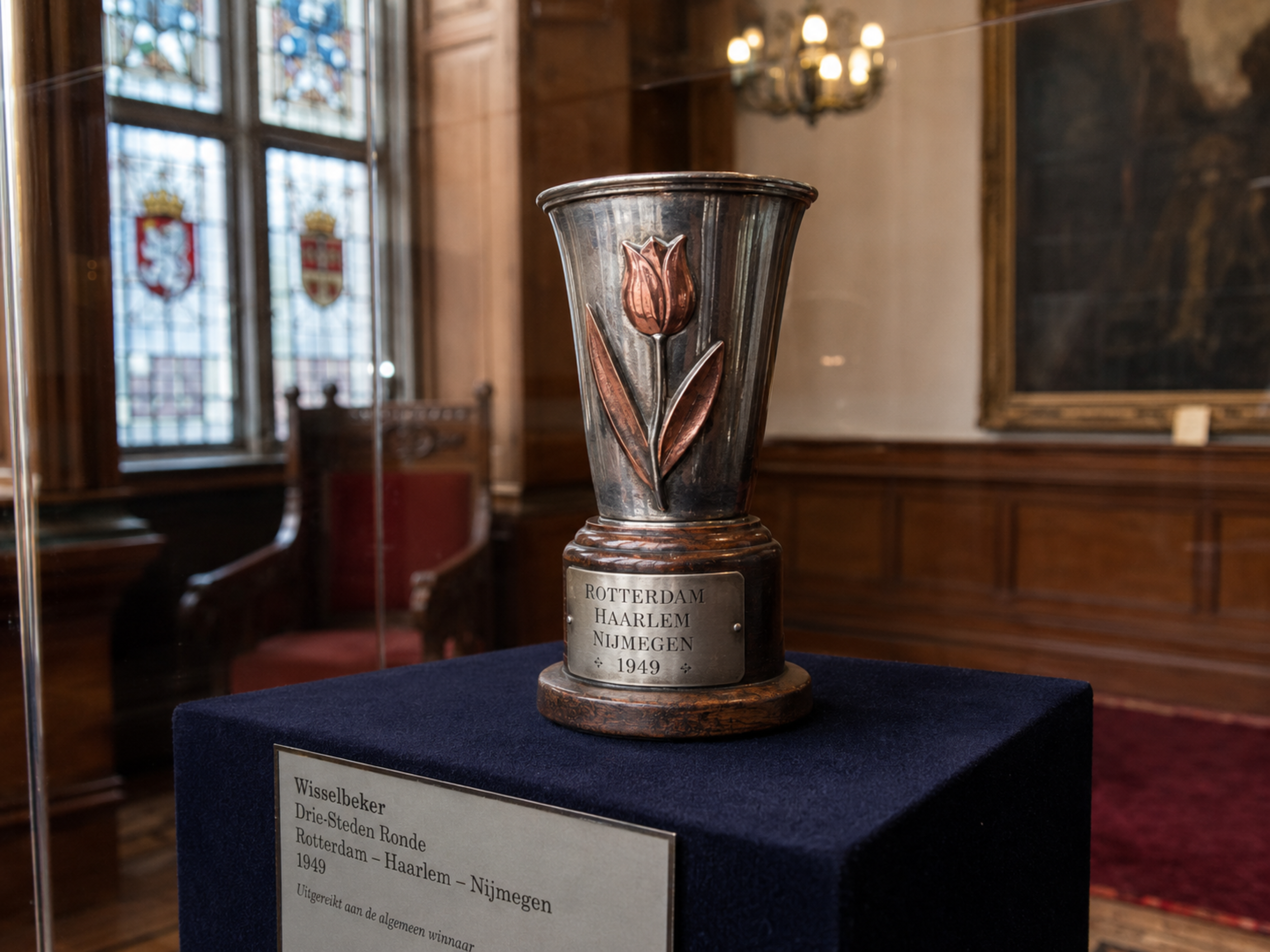
| Finale Presentation | The Orange Wonder Cup was presented at Nijmegen after the third game, photographed on the civic platform, and retained by municipal hosts as the series keepsake |
| Later Use | All three grounds returned to ordinary municipal or club use after the tour; no permanent Orange Wonders structure was built |
Snapshots from the Tour
-
![Albany Orange Wonders travel gear on train platform.]()
The Trunks at Union Station
Departure Morning · Albany, June 1949
Bats, catcher’s gear, wool uniforms, bases, chalk bags, and medical supplies were packed into two painted travel trunks before the party left Albany. The photograph shows the Orange Wonder mark before it reached a ballfield: stenciled on wood, tagged for New York, and handled like civic freight.
-
![Black-and-white photograph of the S.S. Waterman docked in Rotterdam with Albany Orange Wonders trunks on the quay.]()
The Waterman at Rotterdam
Arrival Harbor · Netherlands Tour, 1949
The ship that carried the Orange Wonders across the Atlantic sits docked at Rotterdam, with cranes, cargo lines, and Albany-marked trunks gathered along the quay. The photograph places the tour between travel and baseball: before the first chalk line was drawn, the club arrived as freight, uniforms, bats, and veterans stepping into a harbor still shaped by reconstruction.
-
![Black-and-white photograph of four Dutch women holding Albany Orange Wonders pennants before a 1949 Netherlands tour game.]()
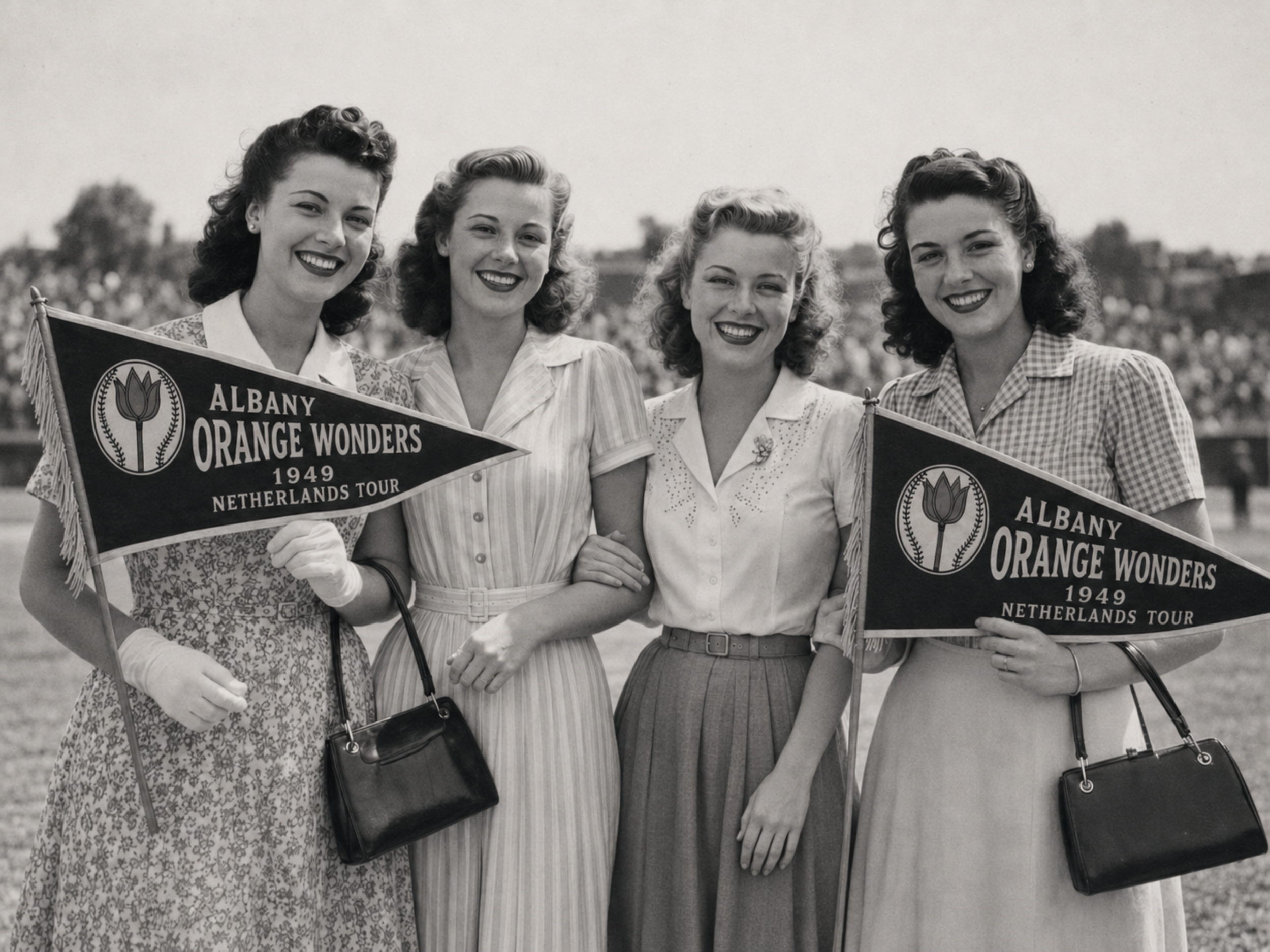
Pennants Before First Pitch
Dutch Supporters · Netherlands Tour, 1949
Four Dutch supporters pose before an Orange Wonders tour game, two of them holding club pennants marked with the tulip-over-baseball emblem. The photograph gives the tour a lighter public face: not just trunks, ceremonies, and scorecards, but young spectators dressed for an afternoon at the grounds, smiling before Albany’s veterans took the field.
-
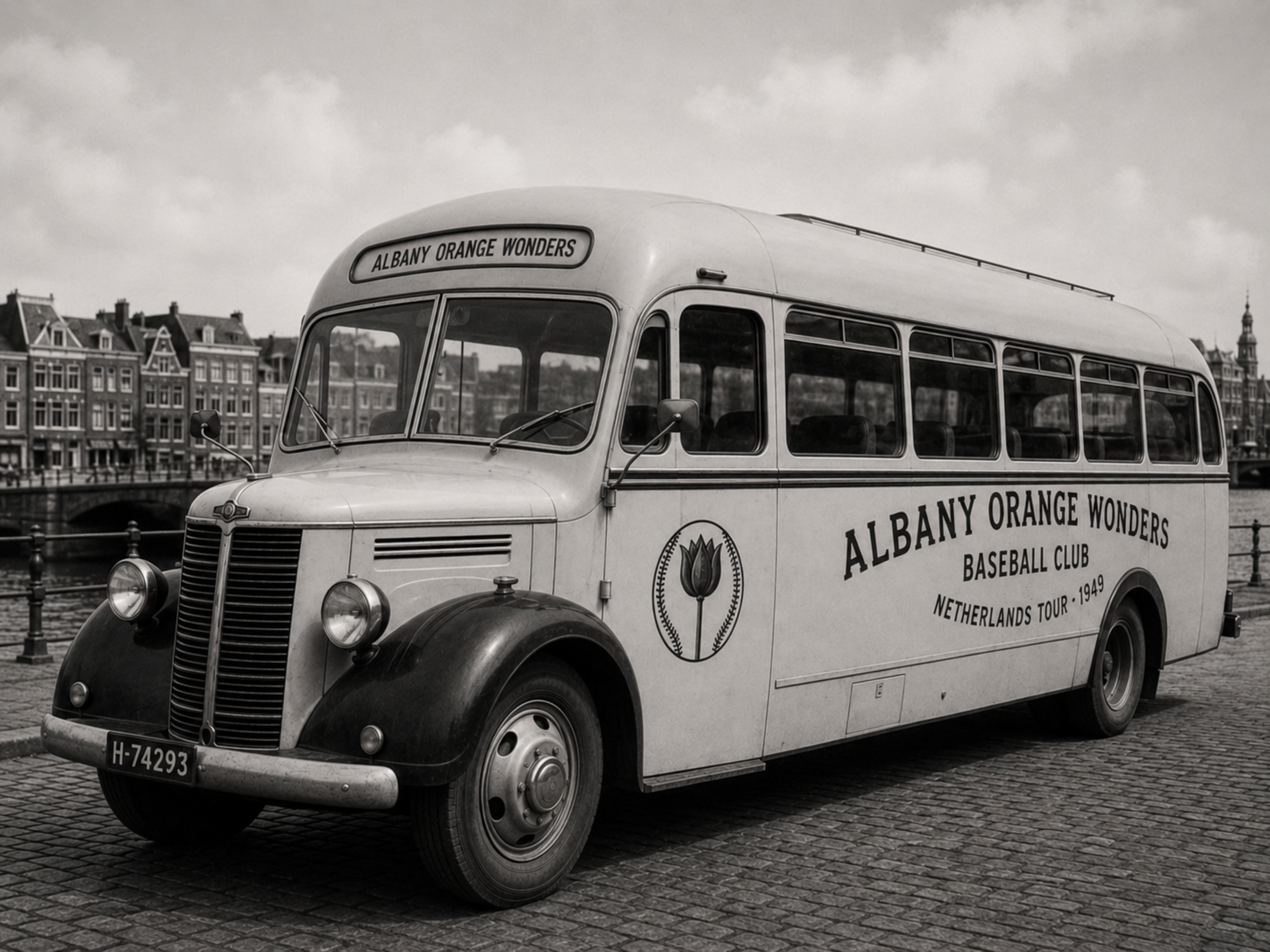
![Black-and-white photograph of the Albany Orange Wonders tour bus in the Netherlands.]()
The Netherlands Tour Bus
Rotterdam to Haarlem to Nijmegen · 1949
The Orange Wonders’ Dutch coach carried players, civic representatives, equipment bags, and scorebooks between the three tour grounds. Lettered with the club name and tulip-over-baseball mark, the bus became the team’s closest thing to a home park: a moving clubhouse for a club whose official field was the itinerary.
-
![Crowd behind rope lines at Rotterdam harbor baseball ground.]()
Rope Lines at the Harbor Ground
Game-Day Arrival · Rotterdam
Spectators gather behind temporary rope lines at the Rotterdam harbor field while dock buildings and cranes sit beyond the outfield. The field was not permanent, and the photograph shows it: chalked quickly, fenced lightly, and made useful for one afternoon of baseball.
-
![Black-and-white photograph of four Nijmegen boys holding baseball bats beside the Albany Orange Wonders dugout.]()
Nijmegen Batboys
Finale Helpers · Goffert Meadow, 1949
Four Nijmegen boys stand beside the Orange Wonders dugout holding bats too large for their arms, their paper admission badges hanging from string. The photograph gives the finale its remembered softness: Albany veterans resting in the shade, Dutch children pressed close to the game, and a temporary ballfield becoming civic ground for one afternoon.
-
![A bouquet of Orange Wonder tulips placed on home plate during pre-game ceremony.]()
The Bouquet at Home Plate
Pre-Game Ceremony · Nijmegen Finale
Before the deciding game, a small bouquet of Orange Wonder tulips was placed beside home plate. The players did not stand in a formal military line. They removed their caps, listened to the translations, and returned to warmups after the flowers were carried to the scoring table.
The Defining Season
The 1949 Orange Wonders did not play for a pennant in the ordinary sense. Their season was three games, all away from Albany, all arranged through civic hosts, and all played against the same opponent. What made the series matter was not the length of the schedule. It was the discipline of the roster and the meaning of the trip.
Every man in uniform had served during the war. Ten Eyck treated that rule as the club’s central obligation. The Wonders were not selected solely by batting average, and they were not chosen to resemble a polished professional club. They were selected because they could play, travel, represent the city appropriately in public, and understand why the games were being played in the Netherlands rather than at home.
The roster was small. Marro caught all three games. Van Alstyne started every inning at second base. Picard was saved for Nijmegen. Daniel O’Rourke handled the Haarlem start. Ten Eyck used substitutions only when the heat, travel, or public setting demanded it. The Wonders had no bench built for spectacle. Their strength was steadiness.
The Nassau Blues took the first game in Rotterdam, scoring three times in the seventh after two Orange Wonders errors. The loss was remembered less for the score than for the surroundings. Several Albany players later said the harbor ground felt like playing on the edge of a worksite. That description did not carry complaint. It became part of the tour’s meaning.
In Haarlem, the Wonders looked more like a baseball club. O’Rourke worked quickly, Marro controlled the running game, and Van Alstyne’s two-run single in the eighth inning gave Albany the lead. The Dutch crowd knew enough baseball to applaud a cutoff throw and argue a scorer’s decision. After the game, several Haarlem players remained on the field for batting practice with the Albany men.
The Nijmegen finale settled the series. The Blues scored in the third. Marro tied the game in the fourth. In the sixth, with two men on, Van Alstyne lined a two-run single through the right side. Picard finished the game himself, allowing one run and walking only two. After the last out, no players rushed the field. The teams shook hands, the cup was brought to the civic platform, and the tulip bouquet was placed in front of it for the photographs.
The series did not create a dynasty. It created a record that could be held in the hand: three scorecards, three admission slips, a penciled ledger, and a modest cup left in Nijmegen as the series’ civic keepsake.
The Netherlands Tour
| Official Record | 2–1 |
|---|---|
| Albany Home Record | None; the club played no games in Albany |
| Netherlands Tour Record | 2–1 |
| Series Finish | First; defeated Albany Nassau Blues in the Orange Wonder Veteran Series |
| Manager | Harold “Hal” Ten Eyck |
| Club Captain | Abraham “Abe” Van Alstyne |
| Leading Pitcher | Joseph Picard, 1–0 with a complete-game victory in the Nijmegen finale |
| Other Winning Pitcher | Daniel O’Rourke, Game Two victory at Haarlem |
| Leading Hitter | Gabriel “Gabe” Marro, .455 |
| Runs Batted In Leader | Abraham “Abe” Van Alstyne, 4 |
| Series Result | Orange Wonders defeated Nassau Blues, two games to one |
| Deciding-Game Score | Orange Wonders 3, Nassau Blues 1 |
| Deciding-Game Site | Goffert Meadow, Nijmegen |
| Deciding-Game Pitcher | Joseph Picard, complete game |
| Deciding-Game Hit | Abraham “Abe” Van Alstyne, two-run single in the sixth inning |
| Estimated Final-Game Crowd | Approximately 3,000 |
The Series Table
| Game One — Rotterdam | Nassau Blues 5, Orange Wonders 3 |
|---|---|
| Game Two — Haarlem | Orange Wonders 4, Nassau Blues 2 |
| Game Three — Nijmegen | Orange Wonders 3, Nassau Blues 1 |
| Series Result | Orange Wonders defeated Nassau Blues, two games to one |
| Series Status | Albany-commissioned veteran goodwill series; no league office or professional circuit recognized the result |
Men of the 1949 Club
-
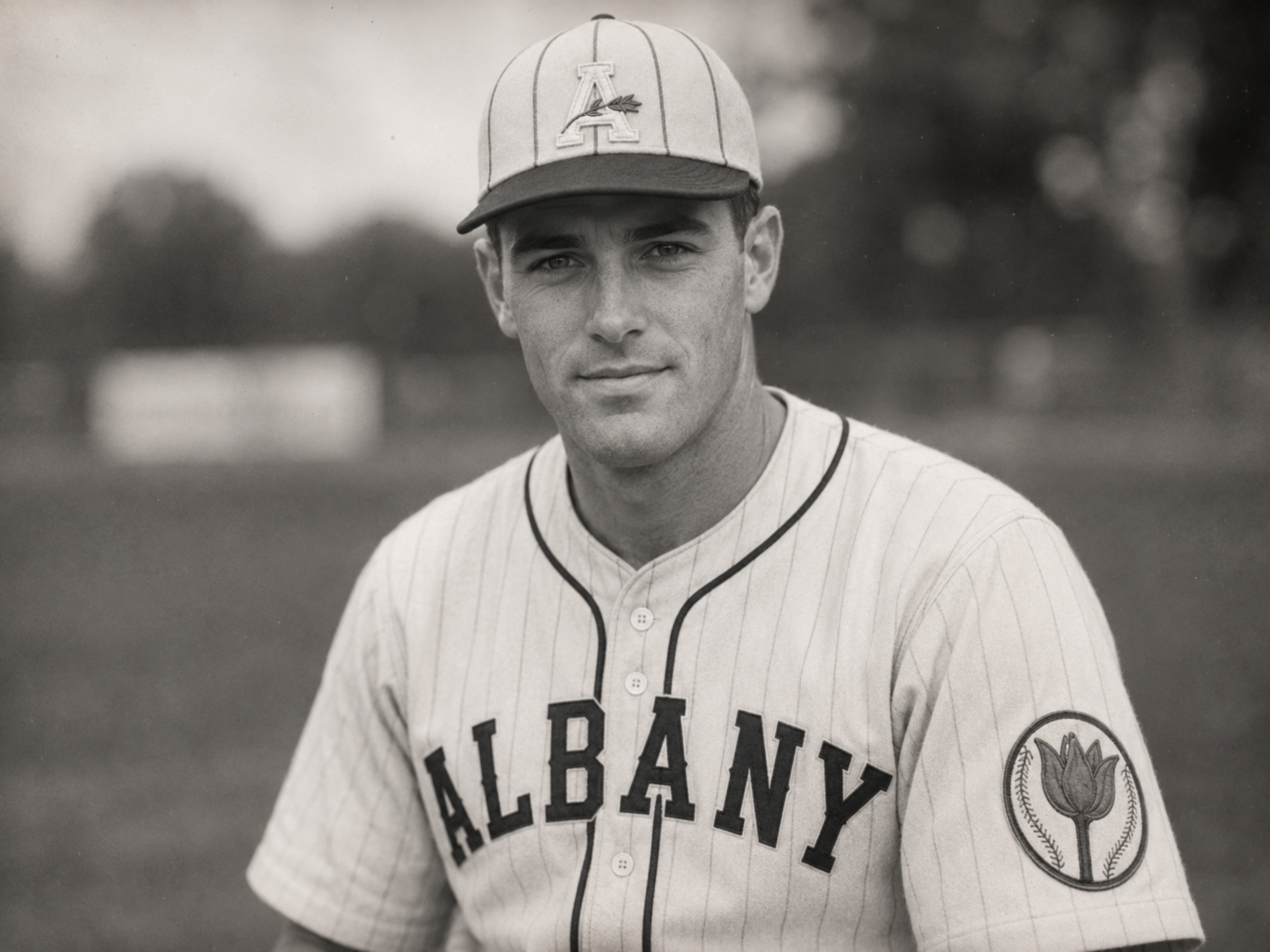
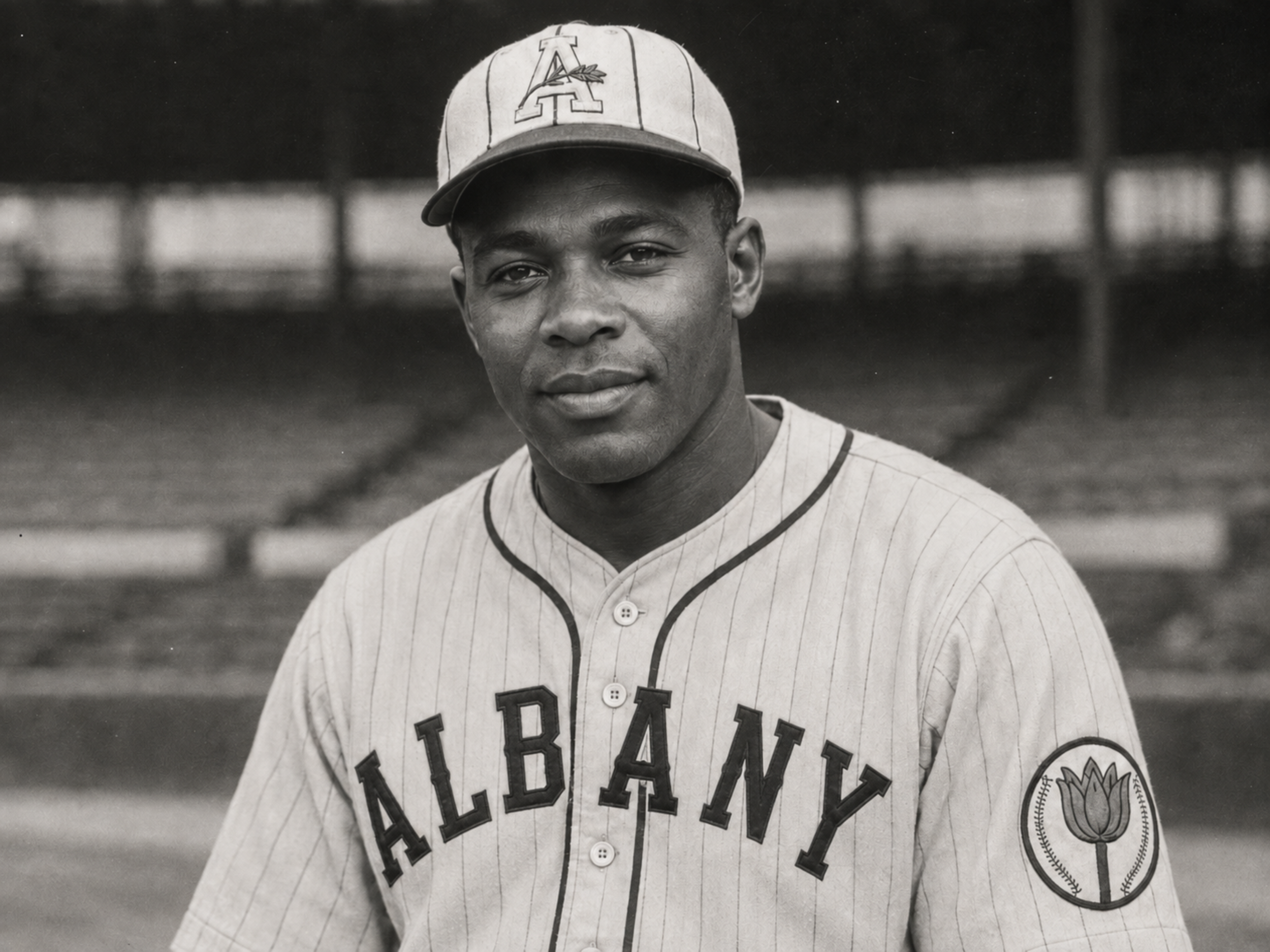
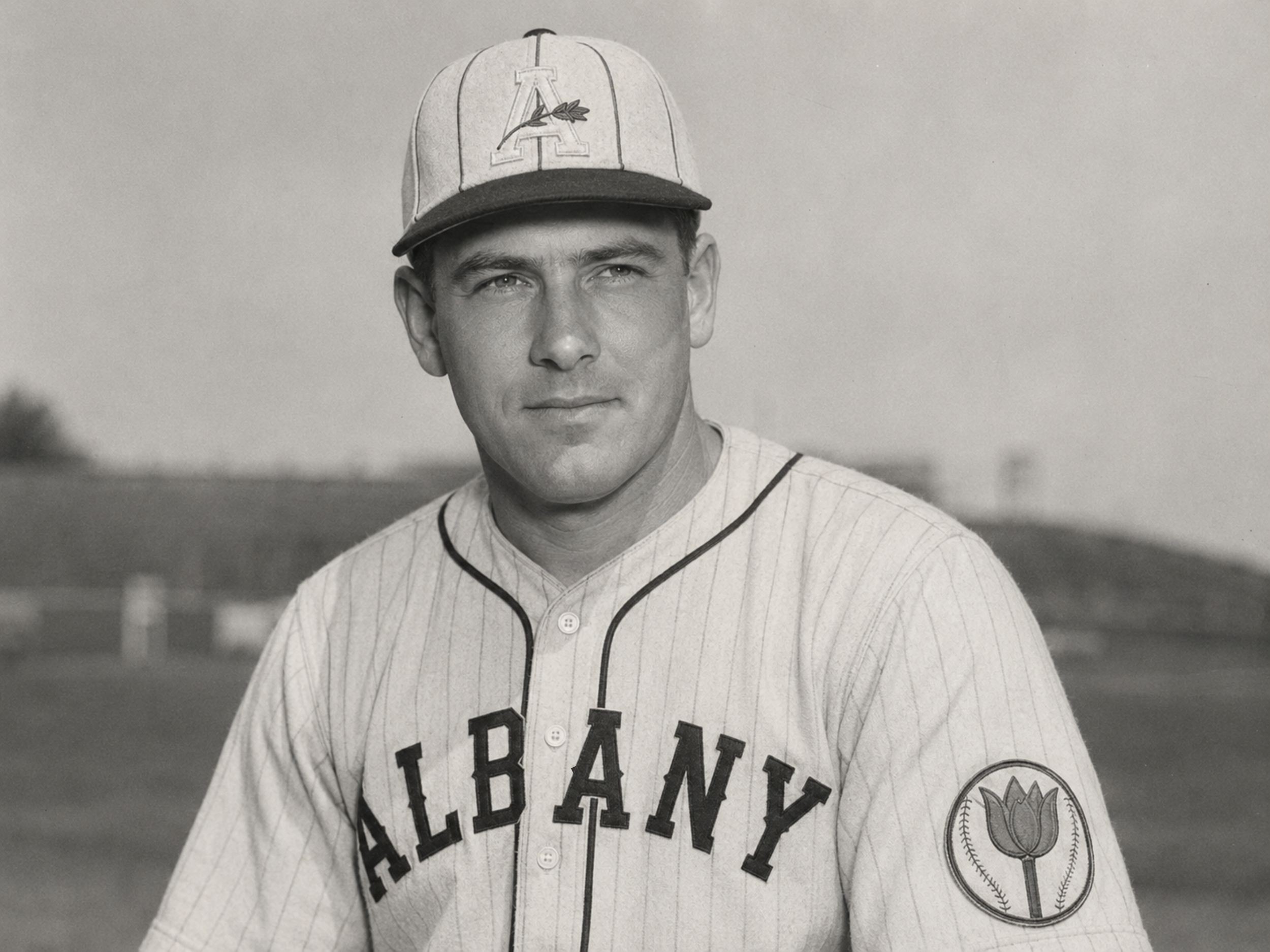
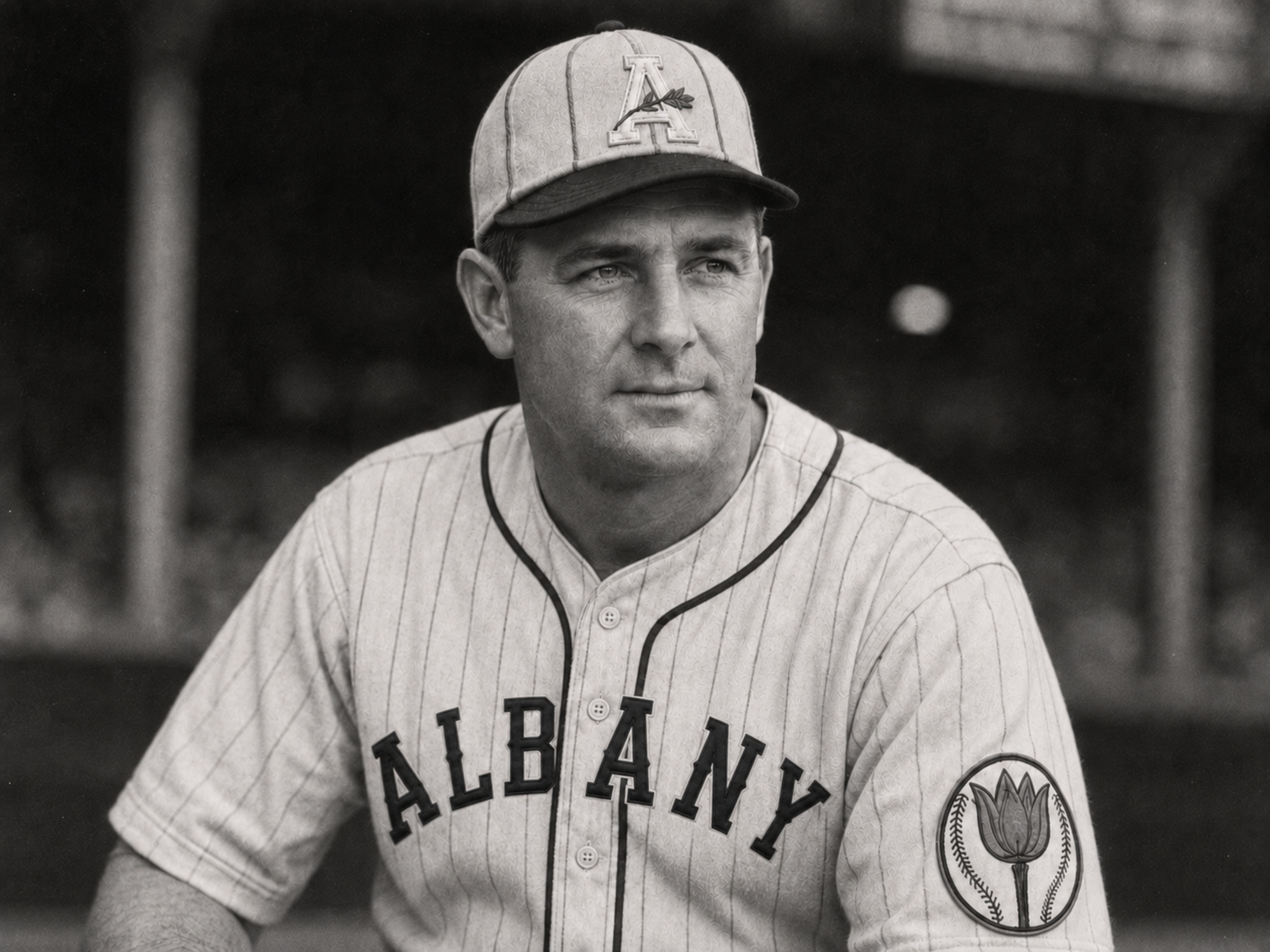
![Abe Van Alstyne wearing Orange Wonders cap and uniform.]()
Abraham “Abe” Van Alstyne
Second Baseman & Club Captain · Winning Hit in Nijmegen
Van Alstyne captained the Wonders and started every inning at second base. He led the club with four runs batted in, including the two-run single in the sixth inning of the Nijmegen finale that gave Albany the series. His cap appears in several postgame photographs with the tulip stem bent slightly upward from use.
-
![Gabe Marro in catcher’s gear beside Orange Wonders equipment trunk.]()
Gabriel “Gabe” Marro
Catcher & Tour Quartermaster · Leading Hitter
Marro caught all three games and led the Wonders with a .455 average. He also kept the equipment ledger, noting which balls, bats, masks, and gloves were used, repaired, or given away after the tour. His handwriting appears on more surviving Orange Wonders objects than any other player’s.
-
![Joseph Picard posing with baseball after Nijmegen finale.]()
Joseph Picard
Right-Handed Pitcher · Deciding-Game Winner
Picard was held for the final game and gave the Wonders the only complete-game victory entered in the tour ledger. He allowed one run against the Nassau Blues at Nijmegen, walked two, and finished the ninth without a mound conference. The game ball was marked in ink before the club left the field.
-
![Harold Ten Eyck in Albany Orange Wonders uniform.]()
Harold “Hal” Ten Eyck
Manager · 1949 Orange Wonder Veteran Series
Ten Eyck managed the Wonders as a tour club rather than a league club. His lineup changed little across the three games, and his notebook included train times, field conditions, hotel meal calls, and pitching plans on the same pages. Players remembered him for quiet instructions and for insisting that the club leave equipment behind in good order.
The Orange Wonders did not enter a league after returning to Albany. That was not a failure of ambition so much as the end of the assignment. The club had been created for a tour, and the tour had been completed. McNulty’s committee settled the travel accounts, returned borrowed funds to sponsors where it could, and placed one of the tour scorebooks in the custody of Albany’s Tulip Committee. The Orange Wonder Cup remained in Nijmegen municipal custody after the final presentation.
The players returned to ordinary lives with unusual souvenirs. Some resumed independent or industrial baseball. Others did not play again beyond benefit games and veterans’ picnics. Ten Eyck declined two invitations to assemble the Wonders for local exhibitions, noting that the club had no home ground and that its record should remain “as carried back.” That phrase later appeared on a typed label attached to the team photograph.
The Orange Wonders were often mentioned during Tulip Festival seasons, but they were not folded into the festival as entertainment. Surviving notices place former players at luncheons, street-scrubbing ceremonies, and veterans’ dinners, not at new ballgames. The distinction mattered. The Wonders had not been organized to become another Albany club. They were a civic delegation in baseball dress.
The Nassau Blues faded even more quickly. Their uniforms were returned to the sponsoring posts, and several pieces were later altered for local service-club games. The Wonders’ objects survived better because they carried the tour mark: caps with the tulip stem, bilingual scorecards, baggage tags, meal cards, marked baseballs, and the equipment trunks that carried the club’s remaining gear during the return voyage.
By the late 1950s, Albany baseball had changed around them. The Senators still supplied the city’s regular baseball memory, while the Wonders occupied a narrower place: three games, three towns, no home park, and a motto that explained more than any standings table. The phrase Baseball After Ruin appeared first in a tour program, then on a jacket collar, then on museum labels beside the objects that remained.
The club’s final significance rests there. The Orange Wonders were not preserved through a grandstand, a championship banner, or a long sequence of box scores. They survived through things carried home: a penciled scorecard from Haarlem, a tulip pressed into a program, a Rotterdam admission slip, a chipped motto board, and a cream-and-Dutch navy cap with orange seam piping and a small orange stem crossing the A.
The Later Years
Orange Wonders Collectibles
-
![Orange Wonder Cup displayed in Nijmegen City Hall with engraved Rotterdam, Haarlem, and Nijmegen plate.]()
The Orange Wonder Cup
Nijmegen Presentation Piece · Three-City Series, 1949
Presented after the final game in Nijmegen, the Orange Wonder Cup marked the winner of Albany’s three-city Dutch series. Modest in scale, with a wooden base, copper tulip, and metal plate engraved for Rotterdam, Haarlem, and Nijmegen, it reflected the tour’s purpose more than its score: a civic gift, carried through three towns and remembered as a token of friendship.
-
![Albany Orange Wonders travel trunks displayed in a dark museum exhibit.]()
Travel Trunks
Albany to Rotterdam · Netherlands Tour, 1949
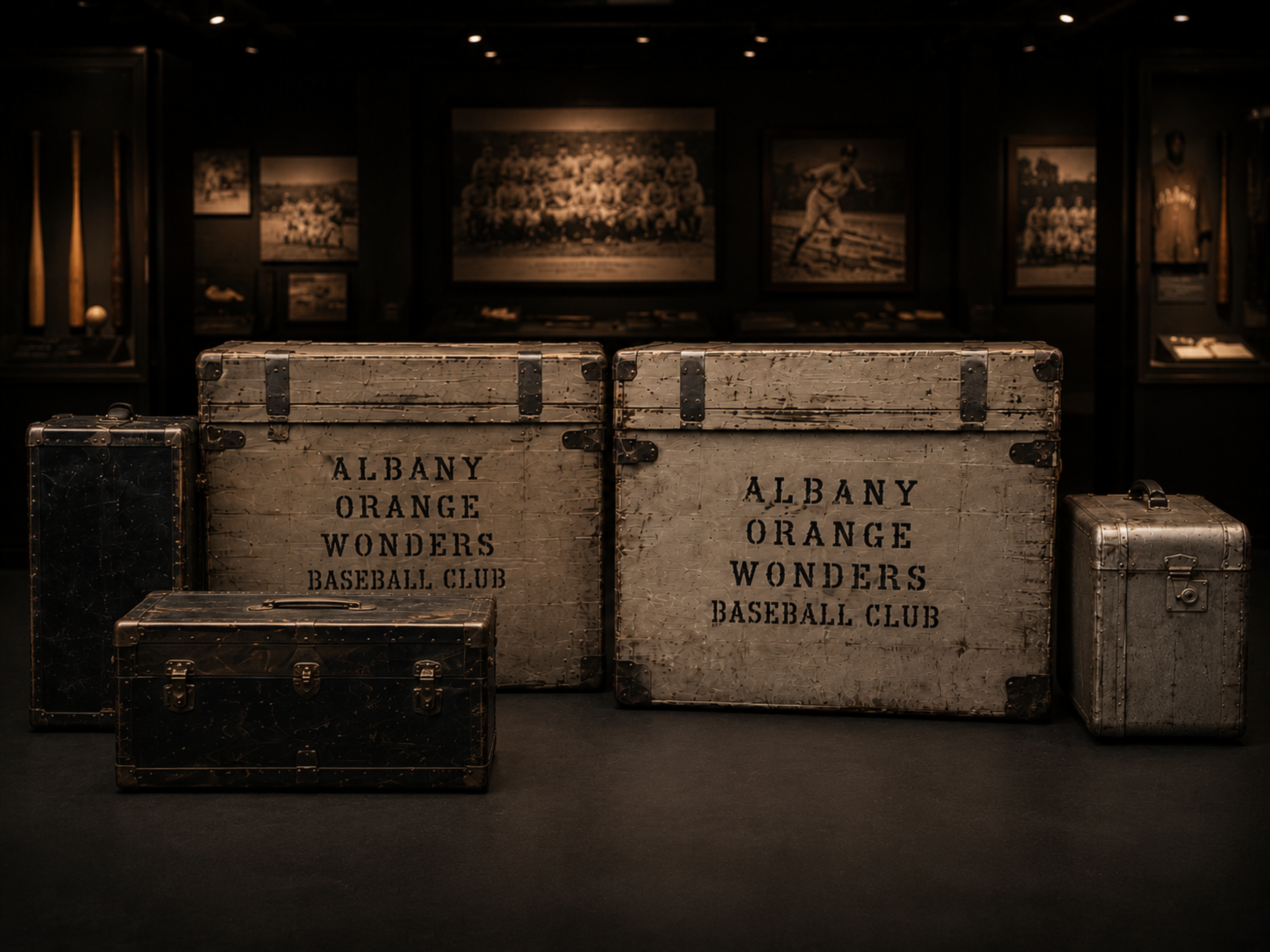
The Orange Wonders’ painted travel trunks carried the club’s uniforms, catcher’s gear, bases, chalk bags, medical supplies, and game equipment across the Atlantic. Scuffed hardware, rope handles, worn corners, and stenciled lettering show them as working objects first: civic freight that became part of the tour’s surviving archive.
-
![S.S. Waterman first-class ticket books and boarding documents for the Albany Orange Wonders Netherlands tour.]()
First-Class Passage
S.S. Waterman Ticket Books · New York to Rotterdam, June 1949
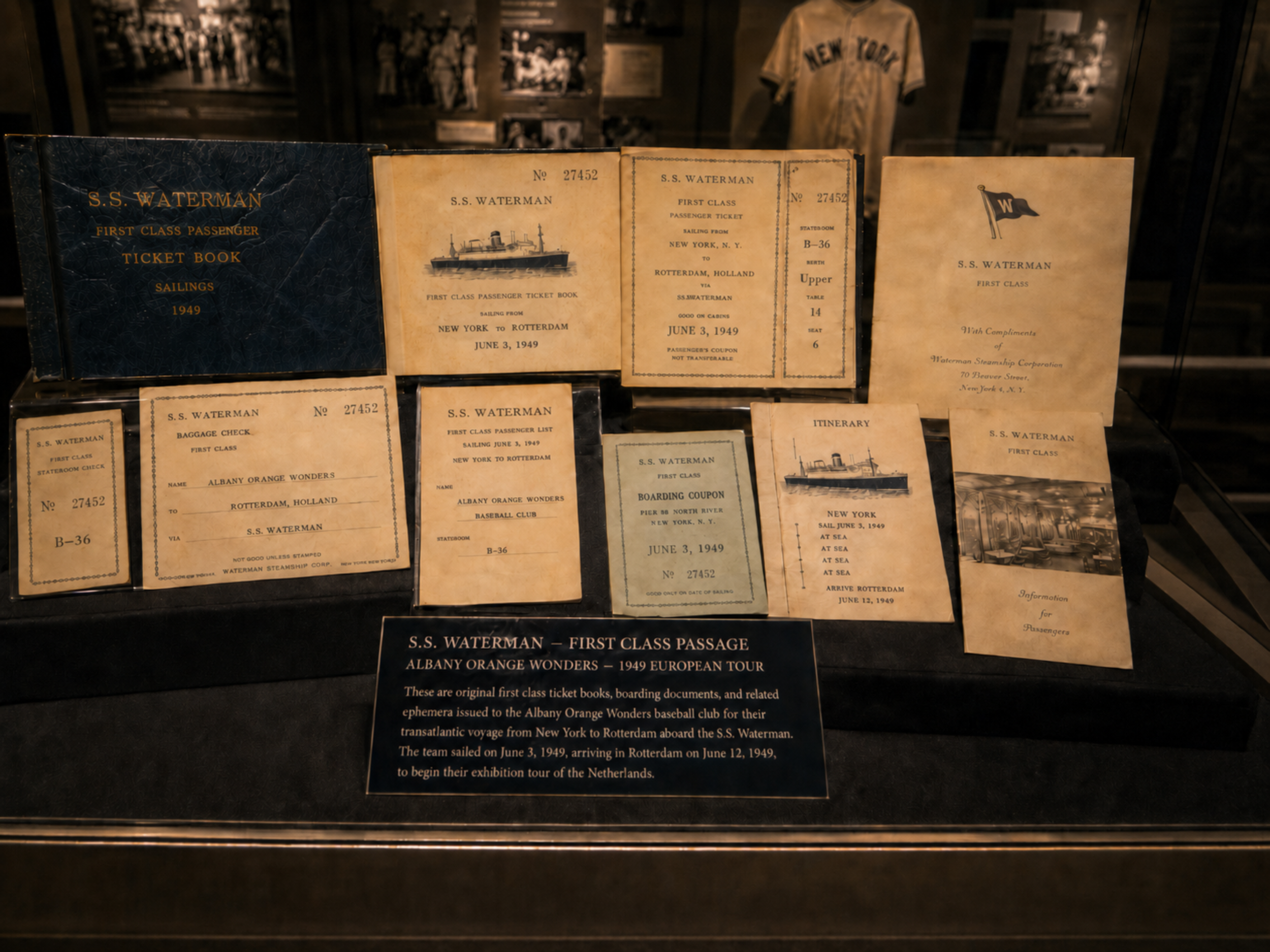
The Orange Wonders’ first-class ticket books, boarding coupons, baggage checks, and passenger documents marked the club’s Atlantic crossing aboard the S.S. Waterman. Issued for the early-June New York-to-Rotterdam sailing, the papers give the tour a precise beginning: before the trunks reached Dutch soil and before the first harbor ground was chalked, Albany’s veterans boarded as passengers with a baseball itinerary.
-
![A sack of Orange Wonder tulip bulbs, representing the bulbs presented to the team delegation before departing the Netherlands for New York.]()
Orange Wonder Bulbs for the Homeward Passage
Departure Presentation · Rotterdam Quay
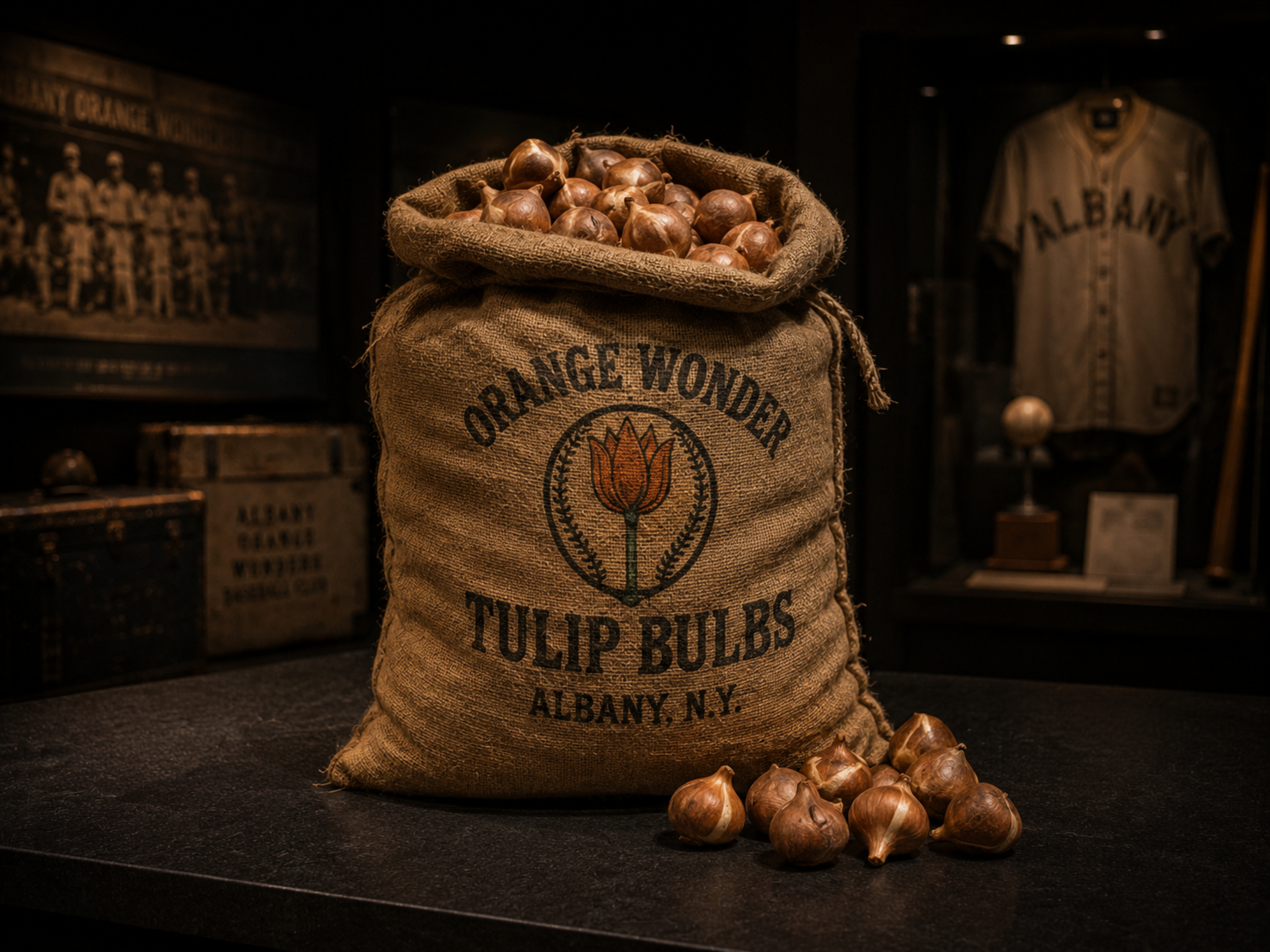
Before the Albany party left the Netherlands for New York, local hosts presented the travel delegation with sacks of Orange Wonder tulip bulbs as a parting gift. The gesture brought the story full circle: Albany had crossed the Atlantic in answer to a flower, and the flower returned with them as a reminder of the friendships made along the tour.
-
![Albany Orange Wonders pennants displayed with a black-and-white photograph of Dutch supporters.]()
Netherlands Tour Pennants
Supporter Pennants · 1949 Tour Display
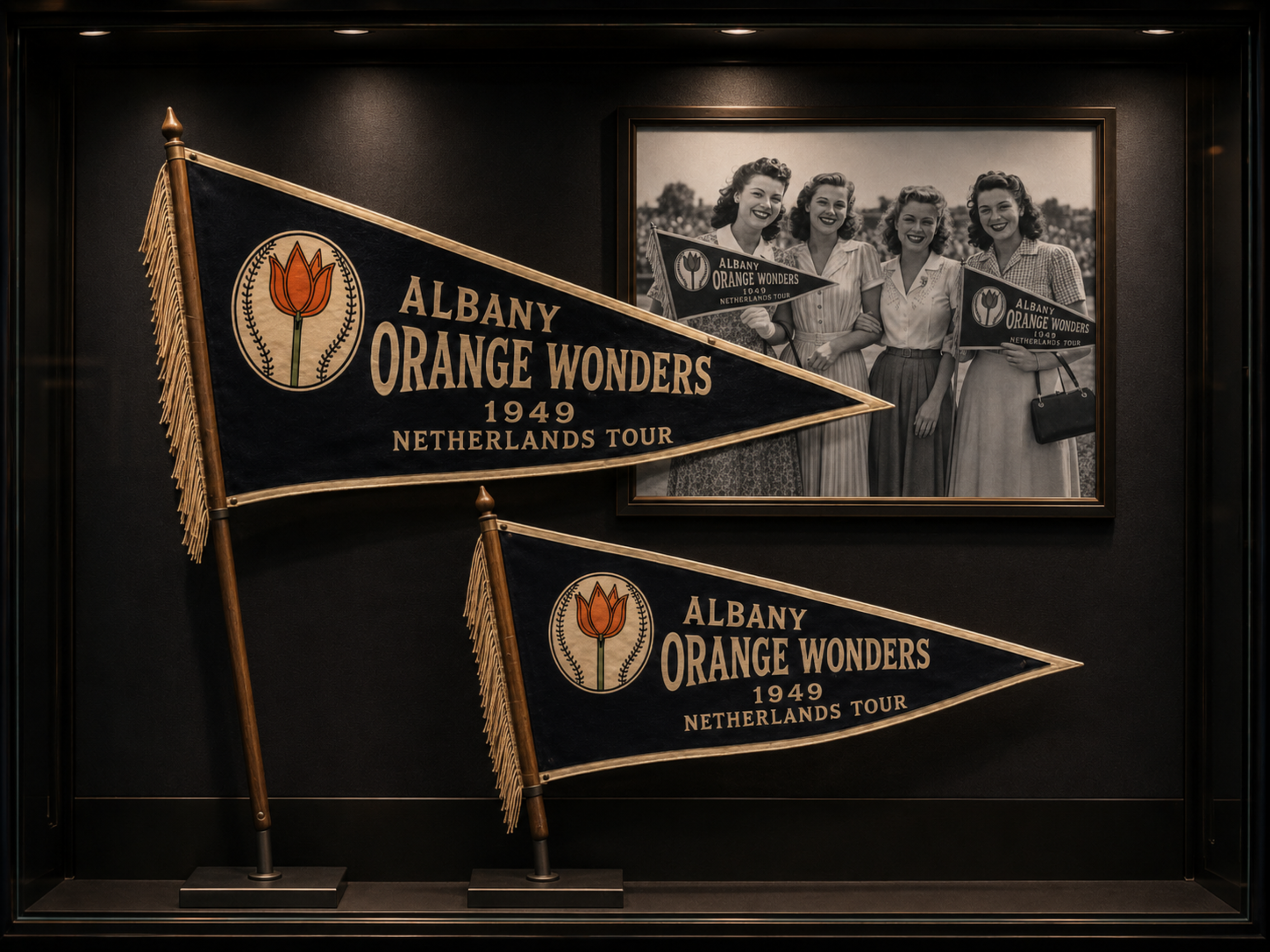
Two surviving Orange Wonders pennants are displayed with the photograph that gave them context: Dutch supporters holding the same style before one of the 1949 tour games. The flagpoles, fringe, tulip-over-baseball mark, and tour lettering show how the club’s identity traveled beyond the dugout, becoming something local spectators could carry, wave, and keep.
-
![Aged wooden Dutch-language sign advertising the Albany Orange Wonders honkbal tour in 1949.]()
The Honkbal Sign
Dutch Tour Advertisement · Rotterdam, Haarlem, Nijmegen, 1949
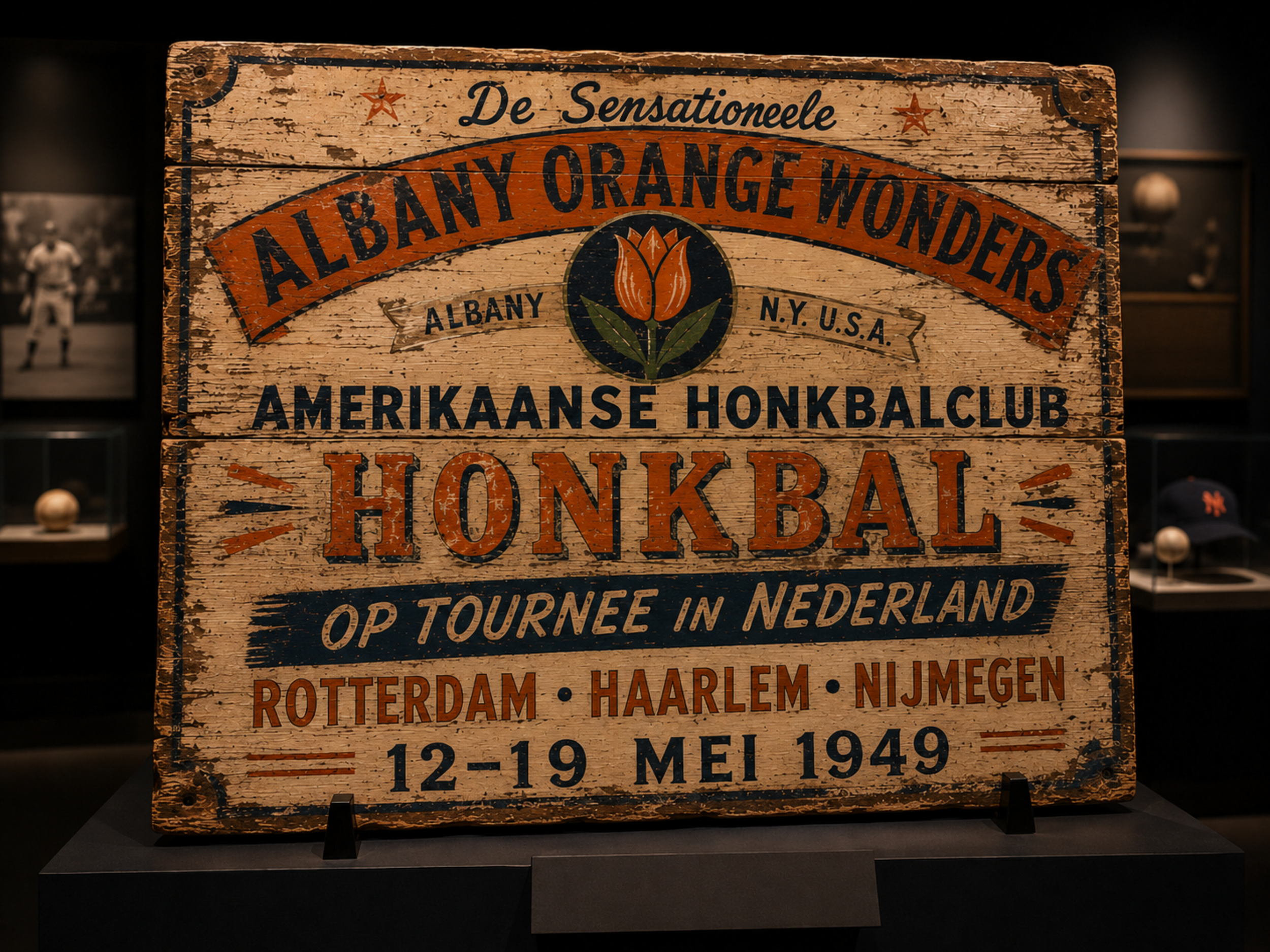
This weathered wooden sign promoted the Orange Wonders’ Netherlands tour in the language of its hosts, presenting Albany’s veterans as an American honkbal club arriving for three public games. Its chipped paint, hand-lettered dates, and Dutch phrasing show how the tour was announced locally before the first rope lines, scorecards, and ballfields were prepared.