
PERMANENT EXHIBITION · GALLERY 002
Albany Orange Wonders
Baseball After Ruin
Albany, New York · 1948–1949
Independent Veteran Touring Club
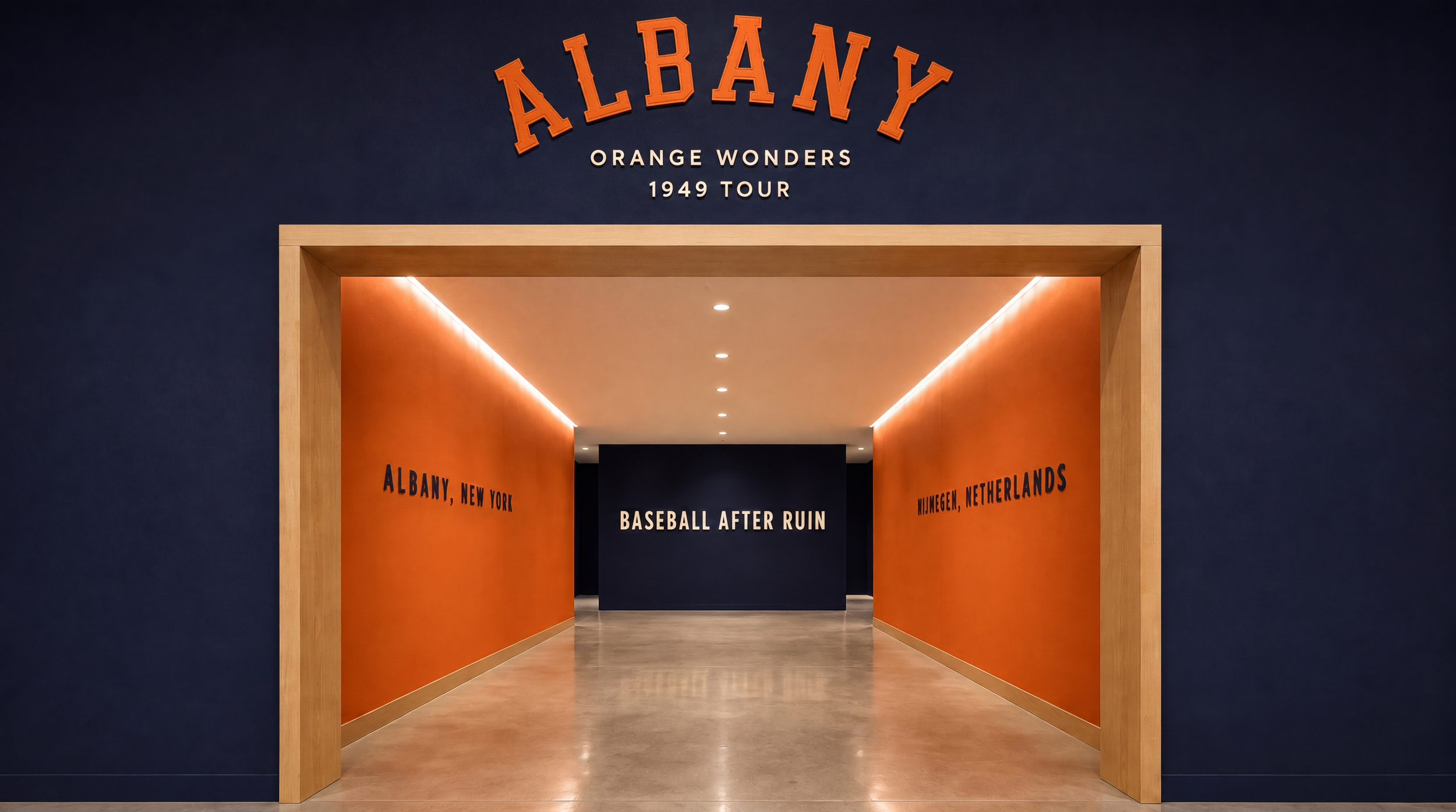
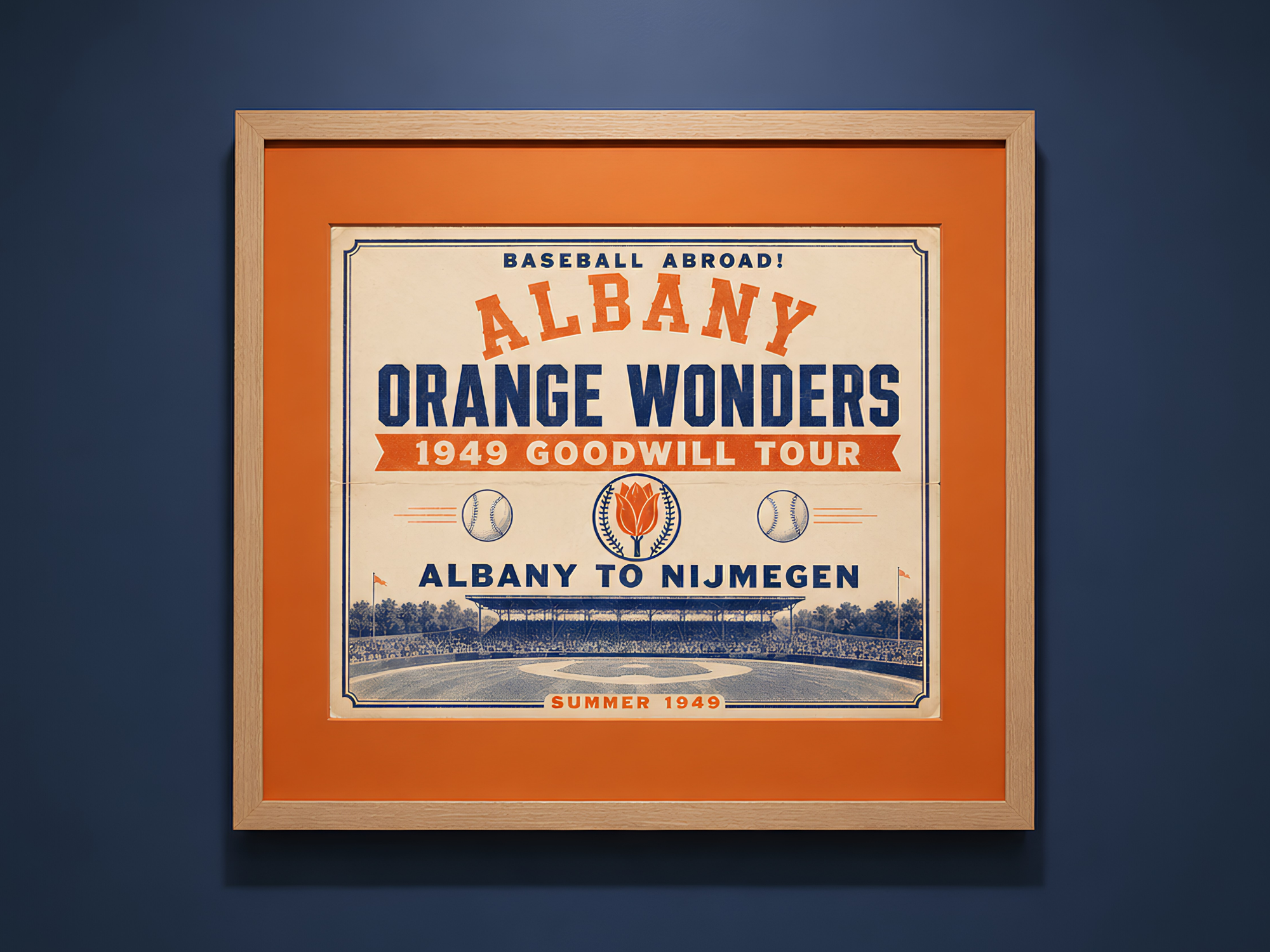
The Albany Orange Wonders played only three official games. All three were held in the Netherlands, all three were against another Albany club and every man who wore the uniform had served during the war.
The club emerged from Albany’s postwar relationship with Nijmegen. Relief shipments had crossed the Atlantic first. Tulip bulbs came back in return. In 1949, Albany answered once more by sending two baseball teams through Rotterdam, Haarlem and Nijmegen for a veteran goodwill series that filled three ballparks and drew more than 54,000 spectators.
Drawn from the tour ledger, photographs and objects carried in both directions, this exhibition preserves a ball club created for a single journey, and the civic friendship that made three games sufficient.
| Name | Albany Orange Wonders Baseball Club |
|---|---|
| Established | Winter 1948 |
| Years Active | 1949 |
| Classification | Independent veteran touring club |
| Club Type | Civic goodwill club |
| Official Games | Three |
| Opponent | Albany Nassau Blues |
| Tour Cities | Rotterdam, Haarlem and Nijmegen |
| Official Record | 2–1 |
| Tour Attendance | More than 54,000 across three games |
| Series Result | Orange Wonder Veteran Series winners |
| Club Colors | Orange Wonder orange, scarlet, Dutch navy and cream |
| Motto | Baseball After Ruin. |
I · ORIGINS
The Answer Was a Ballgame
The Albany Orange Wonders were organized in the winter of 1948, but their story began before anyone ordered uniforms, packed bats or drew up a lineup card. It began with Nijmegen.
In the first years after the war, the Dutch city was not distant to Albany. Reports of damaged streets, broken homes, shortages and returning families moved through City Hall, churches, schools, veterans’ posts, merchant associations and neighborhood clubs. Collection drives gathered clothing, blankets, household goods, school supplies and money. Shipping labels and committee minutes carried the name Nijmegen through Albany long before a baseball team did.
In 1947, Albany’s relief campaign sent roughly 300 tons of food, clothing, medical supplies, household goods and building materials to Nijmegen. The relationship was practical before it was ceremonial. The first gifts were the things a damaged city required, packed and listed by people who understood that postwar friendship could not live on speeches alone.
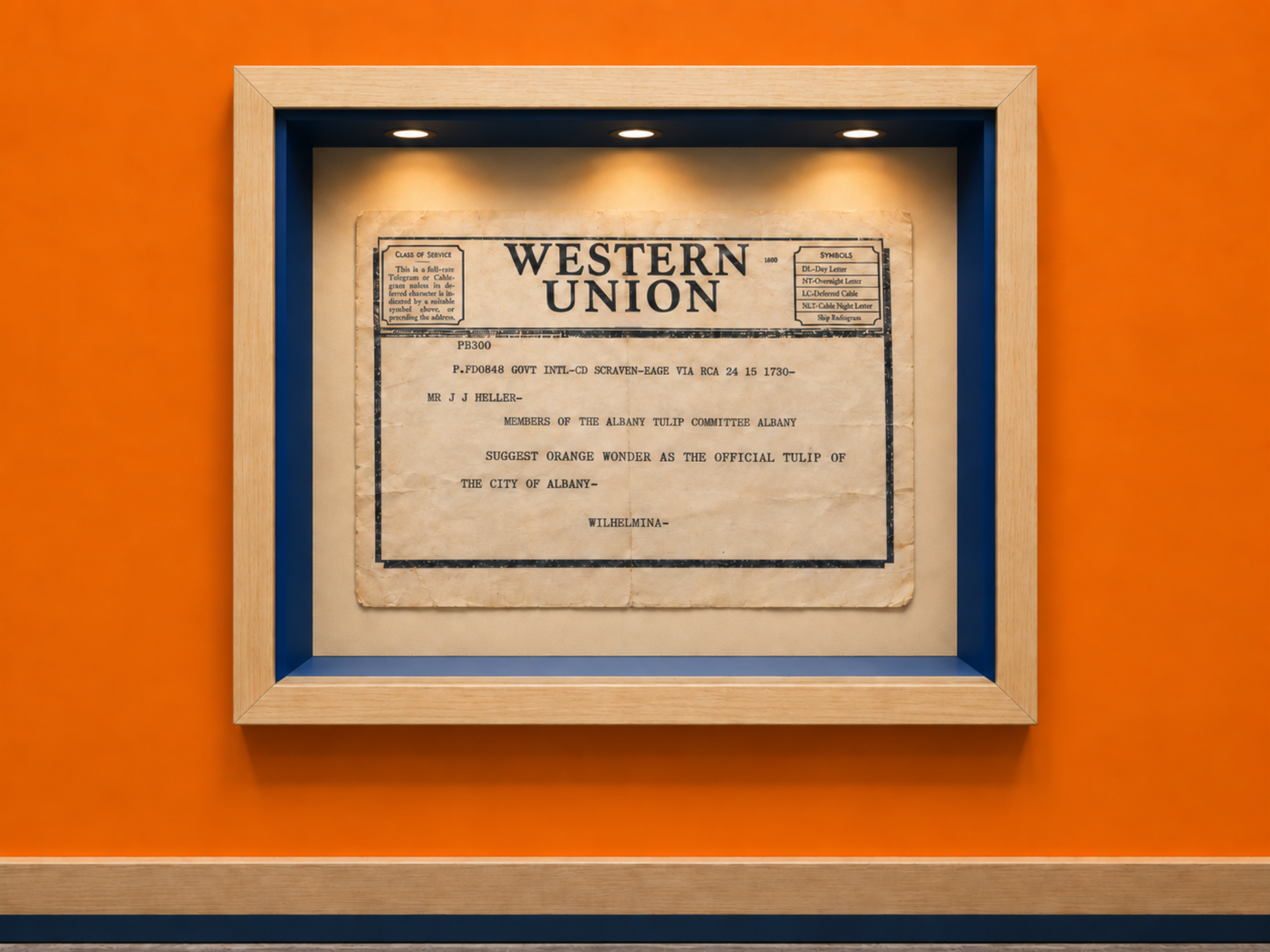
The answer from the Netherlands arrived in the form of tulip bulbs. Queen Wilhelmina selected the Orange Wonder as Albany’s tulip: bronzy orange shaded with scarlet, a living expression of the city’s Dutch inheritance and its new connection to Nijmegen. The flower gave Albany a name, a color and a spring ritual around which that friendship could gather.
The tulips did not feel like decoration. They felt like an answer.
By the following winter, local officials, veterans’ organizations, merchants and baseball men had begun discussing what Albany might send back. Another shipment would have repeated the language of relief. A monument would have remained in one place. The committee wanted something public and local, capable of bringing people together without pretending that the work of rebuilding was finished.
The answer was a ballgame.
Albany already had organized baseball. The Senators supplied the city’s professional schedule, but the proposed club was separate from that operation. It would not play at Hawkins Stadium, enter the Eastern League or serve as a reserve side. The Orange Wonders belonged to no ordinary season. They were being created for a single assignment.
Edward J. McNulty chaired the small veterans’ baseball committee responsible for the tour. A lawyer, former Navy officer and organizer of postwar benefit games, McNulty understood the proposed journey as a return visit in baseball form. Albany had already traveled to Nijmegen by crate, letter and relief ledger. Now it would travel there by roster.
By the final weeks before departure, the clubs no longer belonged only to McNulty’s committee. Orange Wonders pennants appeared in shop windows. The Palace Theatre placed the team name on its marquee. Several thousand people attended the final public workout, and the City Hall sendoff filled the steps and the street below. Albany was not sending an anonymous team overseas. It was sending a civic delegation the city had already made famous.
Albany had crossed the Atlantic in relief shipments. In 1949, it crossed again in baseball uniforms.
Club and Community
-
![Black-and-white photograph of two women holding a “We Love Albany” sign at the Albany Orange Wonders sendoff.]()
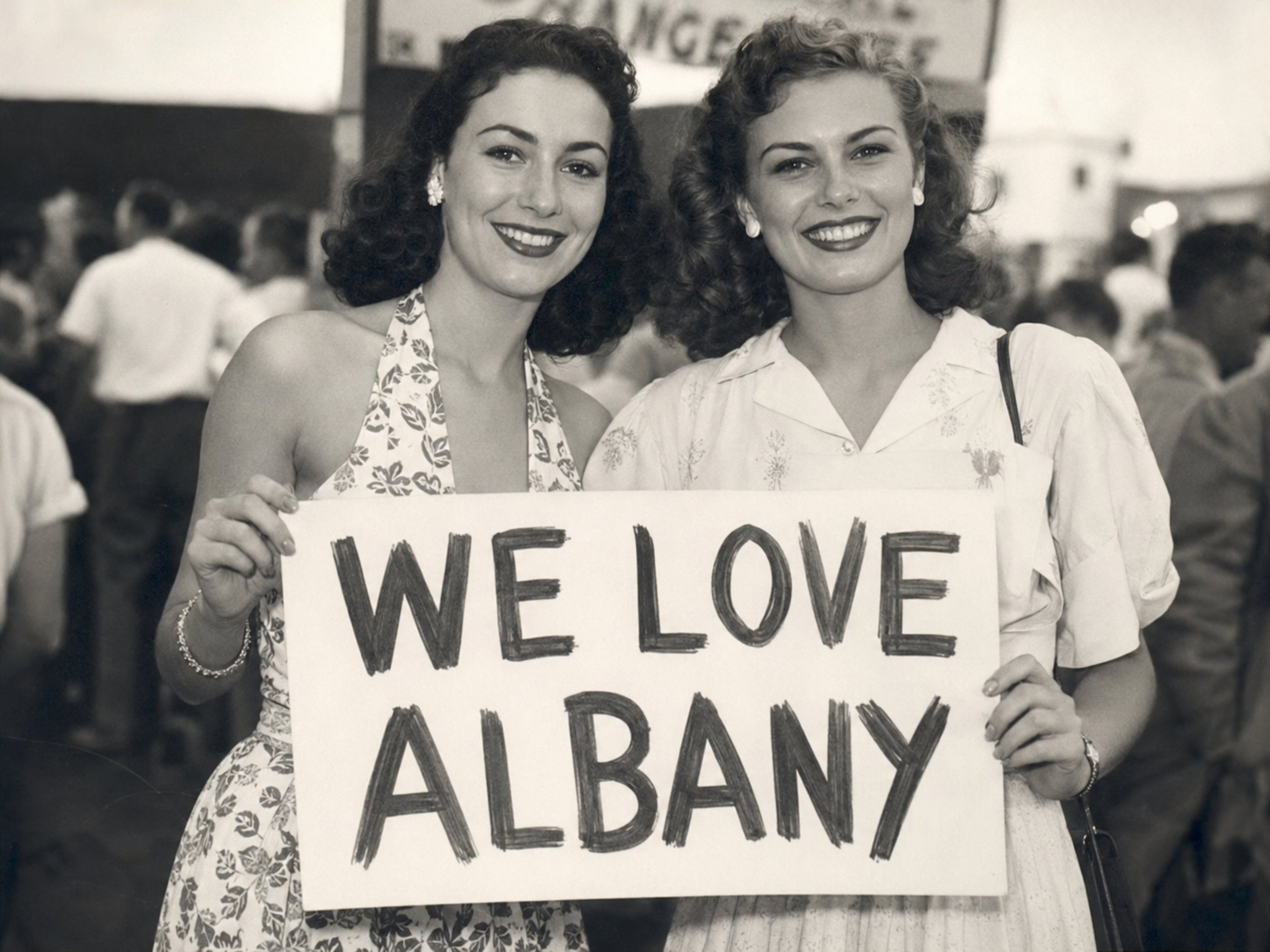
We Love Albany
Sendoff Supporters · Albany, 1949
Two young supporters display a hand-painted sign near the front of the City Hall crowd. Beyond the official banners, packed trunks and civic speeches, the photograph preserves one private gesture inside a citywide farewell.
-
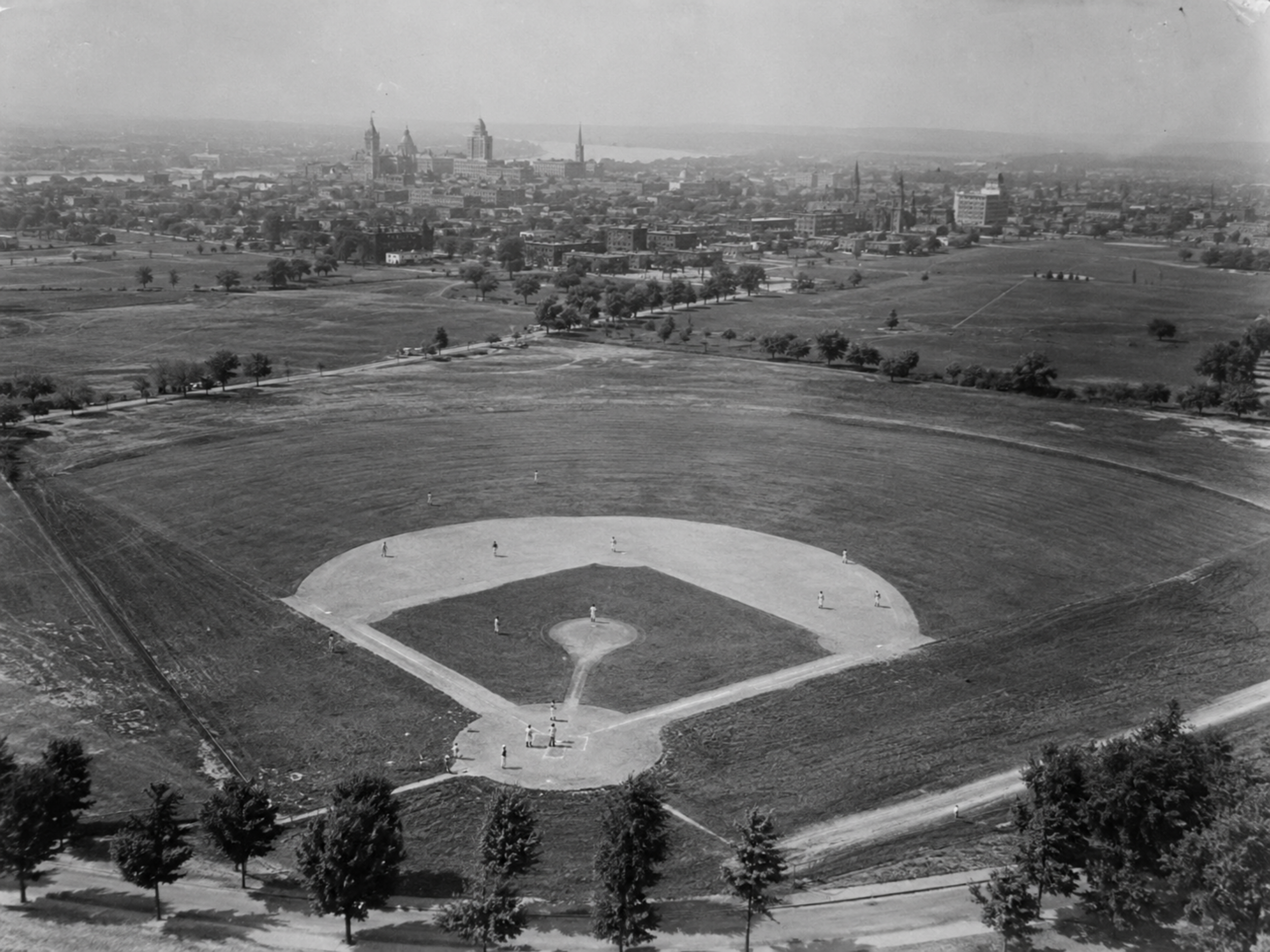
![Black-and-white aerial photograph of an open Albany municipal baseball field used by the Orange Wonders for practice.]()
The Practice Ground
Historical Photograph · Spring 1949
Several thousand Albany spectators surrounded the municipal field for the club’s final public workout before departure. Temporary bleachers, press tables and a painted lineup board transformed the practice ground for the afternoon, while the absence of an official home park remained clear: this was a sendoff, not the beginning of an Albany schedule.
-
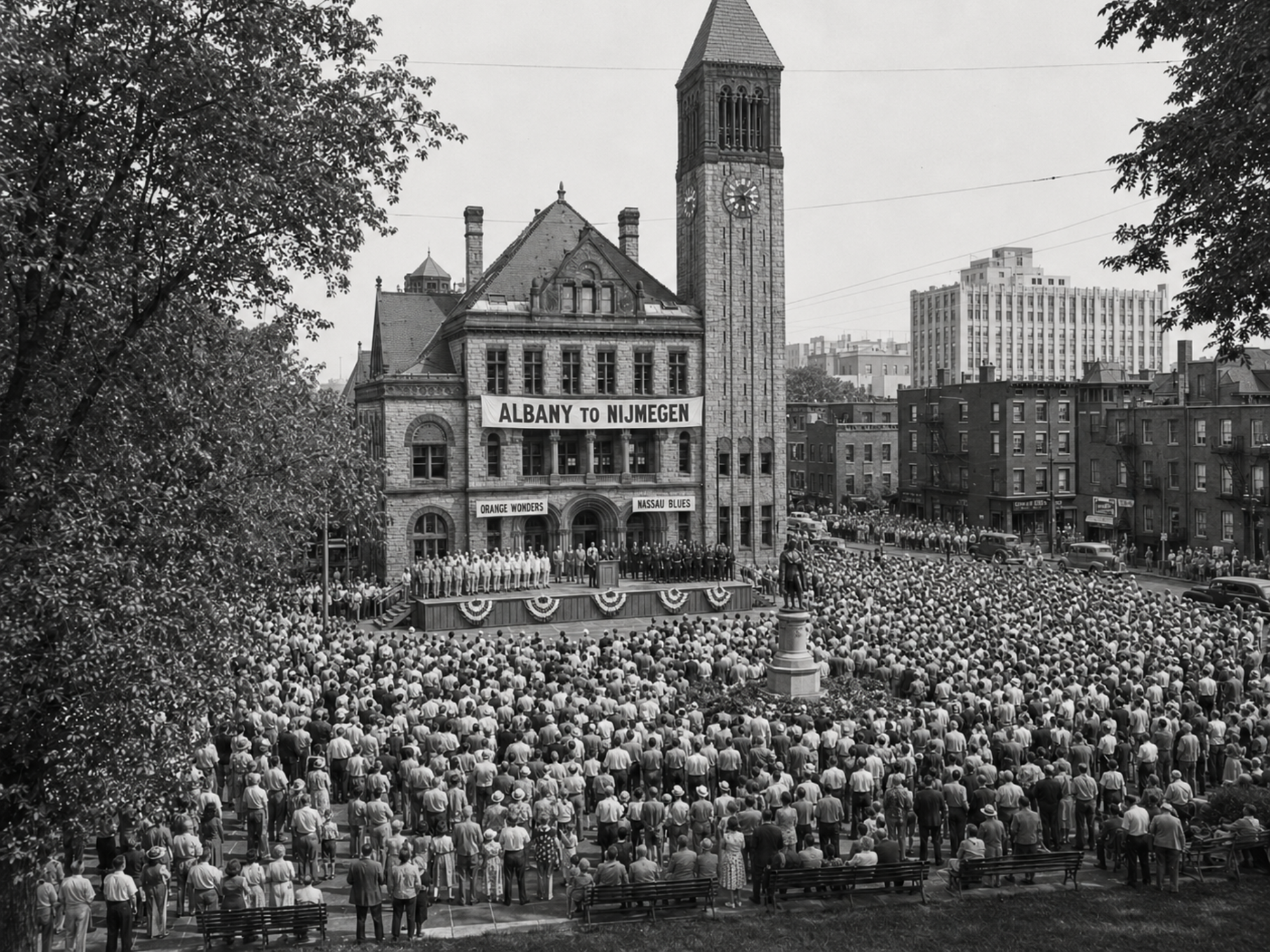
![Black-and-white 1949 sendoff crowd for the Albany Orange Wonders on the steps of Albany City Hall.]()
City Hall Sendoff
Historical Photograph · Albany, 1949
Players, veterans and civic officials fill the City Hall steps while supporters occupy the street below. Uniforms and business suits share the frame, placing the occasion somewhere between a municipal ceremony, a team portrait and a citywide farewell.
-
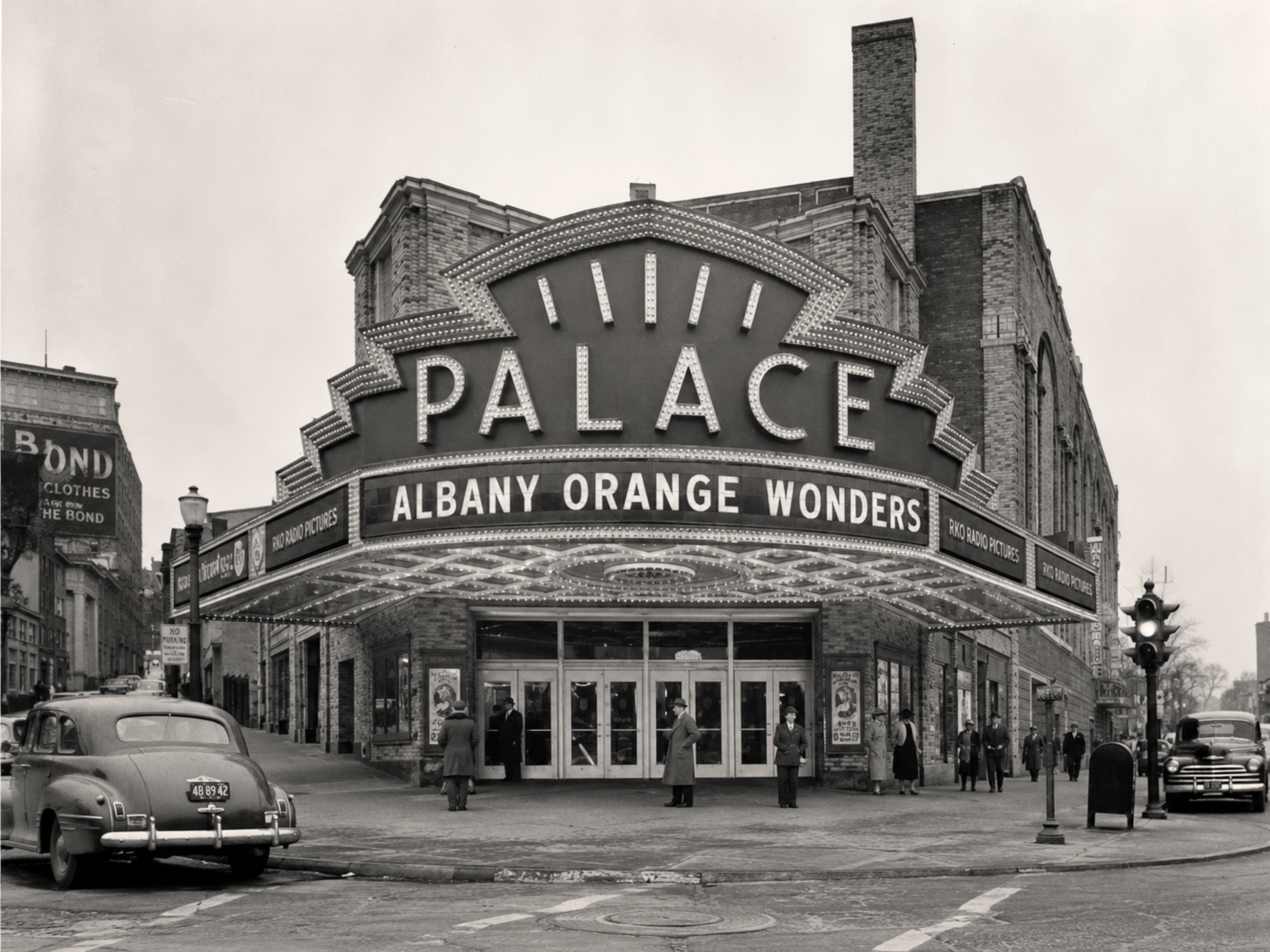
![Black-and-white photograph of the Palace Theatre marquee reading Albany Orange Wonders.]()
Palace Marquee
Historical Photograph · Albany, 1949
The Palace Theatre carried the Orange Wonders’ name above its downtown entrance in the days before departure. The notice shows how the tour passed through Albany’s public life, from committee rooms and veterans’ posts to shop windows, sidewalks and evening crowds.
II · THE CLUB
Thirty Veterans, Two Clubs
McNulty’s committee made two decisions that shaped everything that followed. The series would be played in the Netherlands rather than introduced through a home exhibition in Albany. Every uniformed player would be a veteran of the war.
There would be no college additions, sponsored ringers or promising boys included to strengthen a weak position. A man could be selected only if he could still play credible baseball, travel well, represent the city appropriately in public and understand why the games were being played overseas. If he wore an Albany uniform, he had already worn another.
That rule gave the tour its force. The players were not being sent abroad to perform innocence. They were men who knew what ruin meant, crossing the ocean to play in cities still repairing themselves. Baseball would provide the occasion. The veterans would carry the meaning.
One team would not make a series, so the committee commissioned two. Both were assembled from Albany’s service clubs, neighborhood teams, semiprofessional circles and returning players. They practiced in the same city, traveled in the same official party and shared the responsibility of representing Albany. Once the lineups were exchanged, they became opponents.
The two club names divided Albany’s Dutch inheritance between them. The Orange Wonders took their name from the tulip. The Nassau Blues paired Fort Nassau—the Dutch trading post established near present-day Albany—with Nassau blue, the heraldic color associated with the House of Orange-Nassau; their dark field uniforms carried orange trim. The rivalry had no previous seasons behind it, but it did not require them. The two clubs competed for places on the same program, attention from the same crowds and possession of a cup that would remain in the Netherlands after the final game.
Harold “Hal” Ten Eyck was appointed manager. A former infantry captain and prewar semiprofessional infielder, he preferred a settled lineup and brief instructions. Second baseman Abraham “Abe” Van Alstyne served as captain. Gabriel “Gabe” Marro caught the games and maintained the equipment ledger. Right-hander Joseph Picard was reserved for Nijmegen before the official party left Albany.
Ten Eyck treated the club as a baseball team rather than a ceremonial delegation. Positions were assigned according to ability, and the strongest available defense took the field even when civic hosts had expressed interest in seeing another player. Once the tour began, privacy became impossible. Thousands attended the public workouts, hotel entrances remained crowded into the evening and every departure required time for photographs and autographs. Ten Eyck accepted the attention without allowing it to determine the batting order.
The official record was deliberately narrow. Only the three games against the Nassau Blues were entered in the club ledger. Shared workouts, clinics, batting exhibitions and informal play with Dutch hosts were documented as tour activity, not converted into victories for the sake of enlarging a three-game season.
The distinction suited the club. The Orange Wonders had not been organized to accumulate a record. They had been organized to complete one.
The two clubs traveled as one delegation and played as rivals.
III · UNIFORMS AND IDENTITY
The Flower They Carried
The Orange Wonders’ identity began with an unusual problem. The club needed to look unmistakably like Albany without resembling a novelty team built around a flower.
The solution was restraint. Cream occupied nearly the entire field uniform, allowing the individually cut Dutch navy lettering to carry the city’s name without added trim. Orange Wonder orange appeared in the stockings and cap seam piping, while scarlet remained within the tulip. The palette gave the flower a place in the uniform without turning the uniform into a costume.
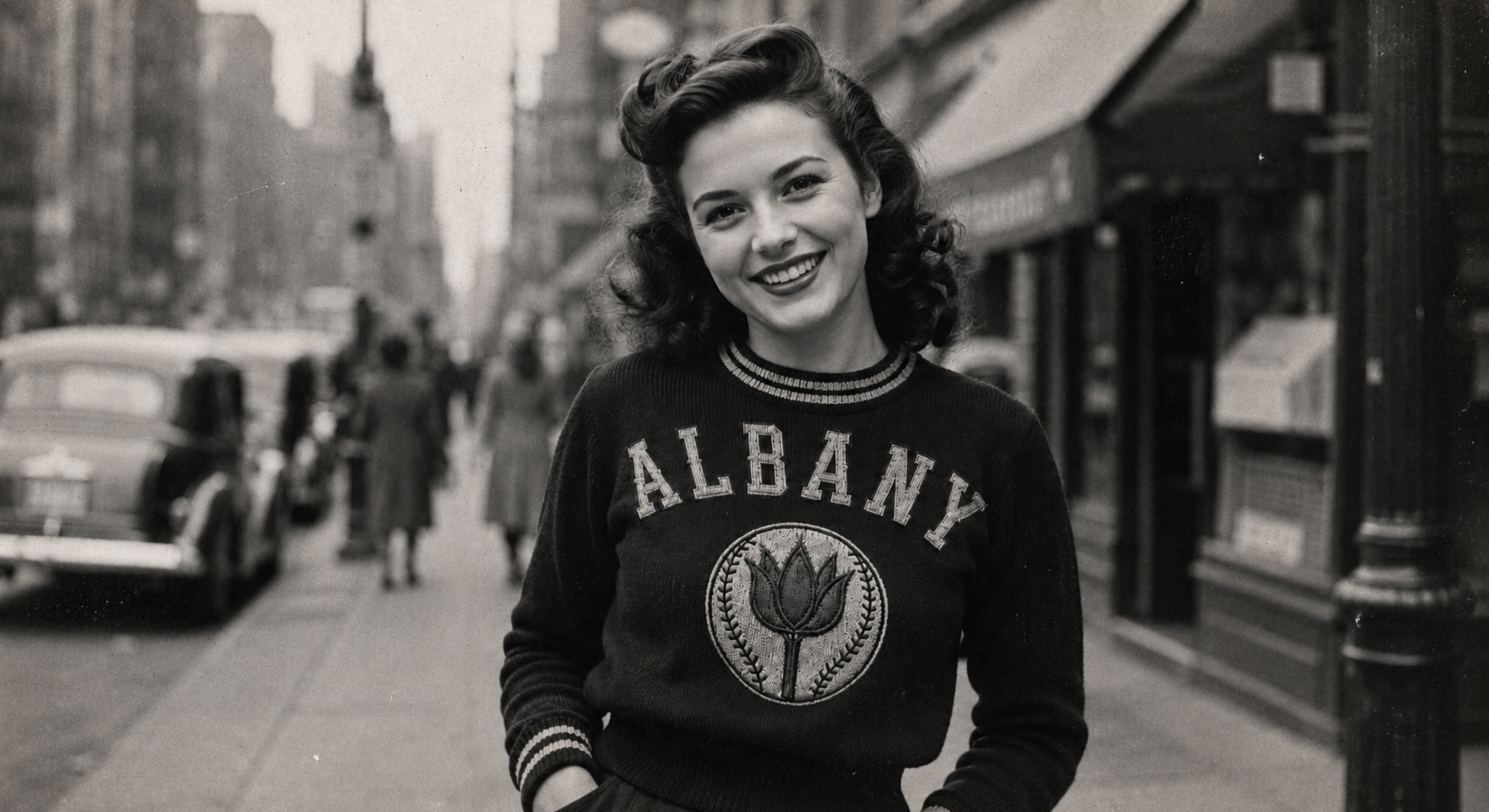
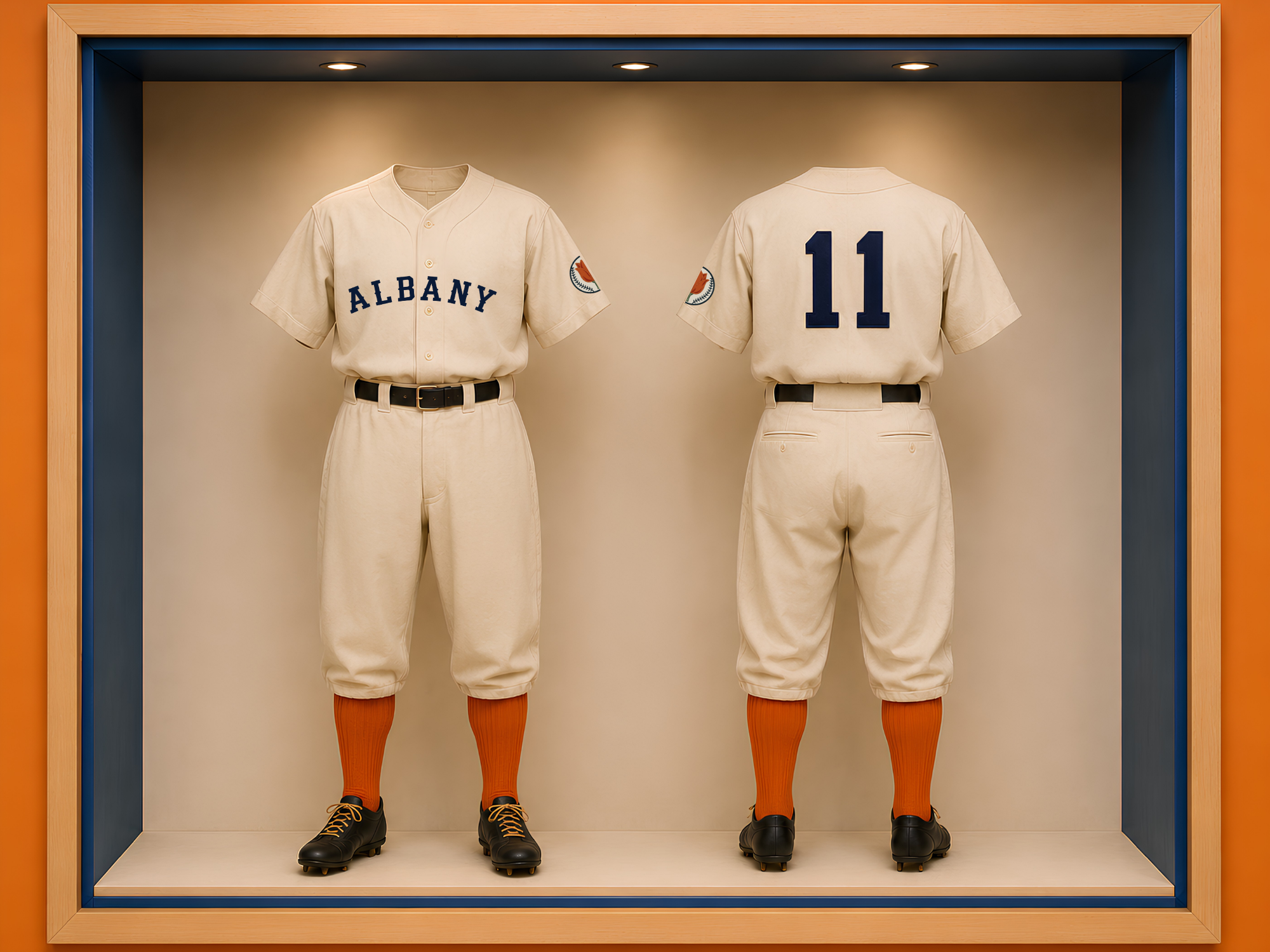
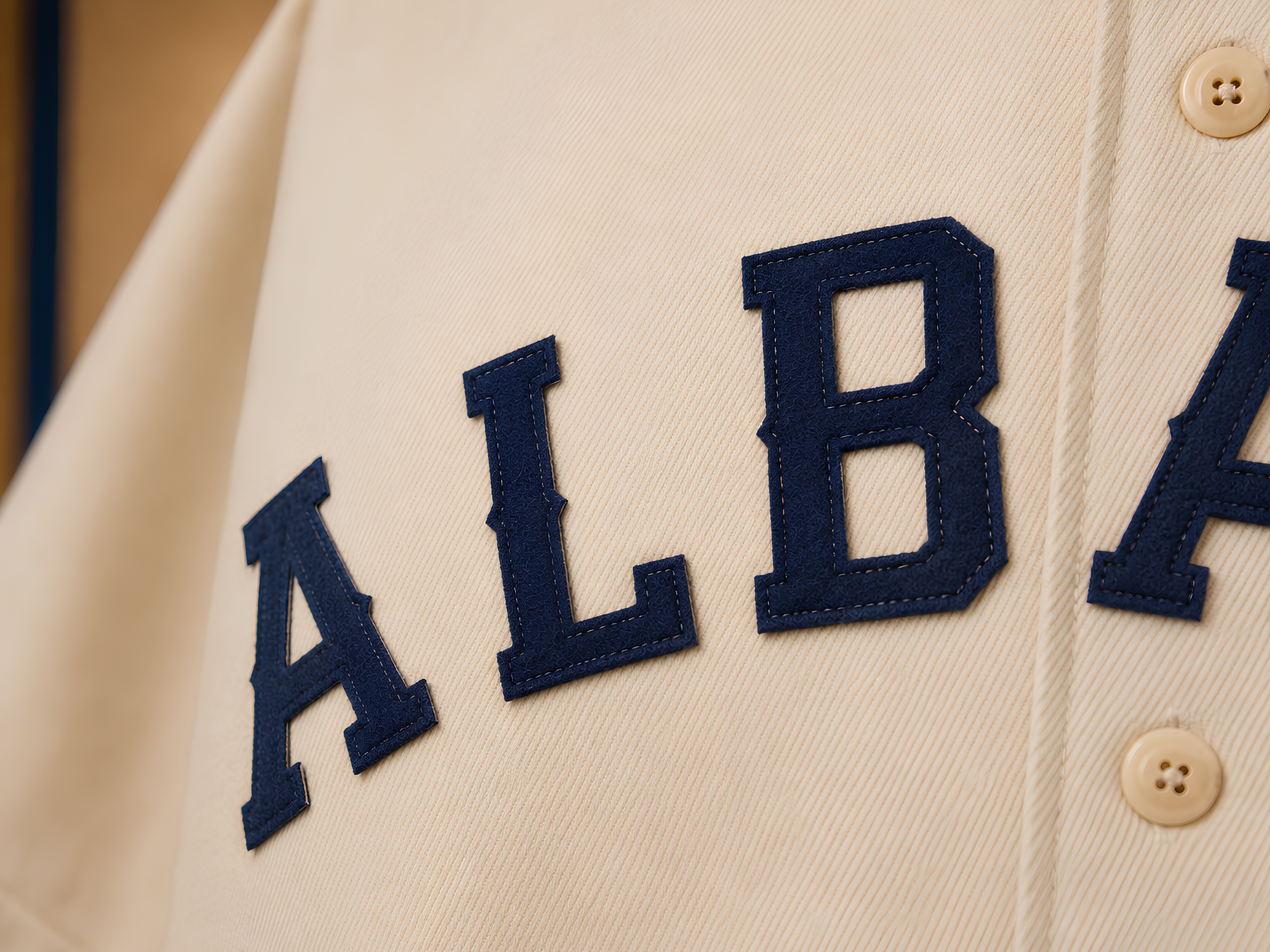
The Orange Wonders wore one field uniform throughout the tour: a plain cream wool-flannel jersey and matching trousers. Individually cut Dutch navy felt letters formed ALBANY across the chest, each built with the small notches that became the club’s most distinctive lettering detail. Dutch navy numerals appeared on the back, and orange stockings supplied the only broad field of the club’s namesake color. The uniform was restrained, practical and unmistakably Albany without turning the Orange Wonder tulip into a novelty.
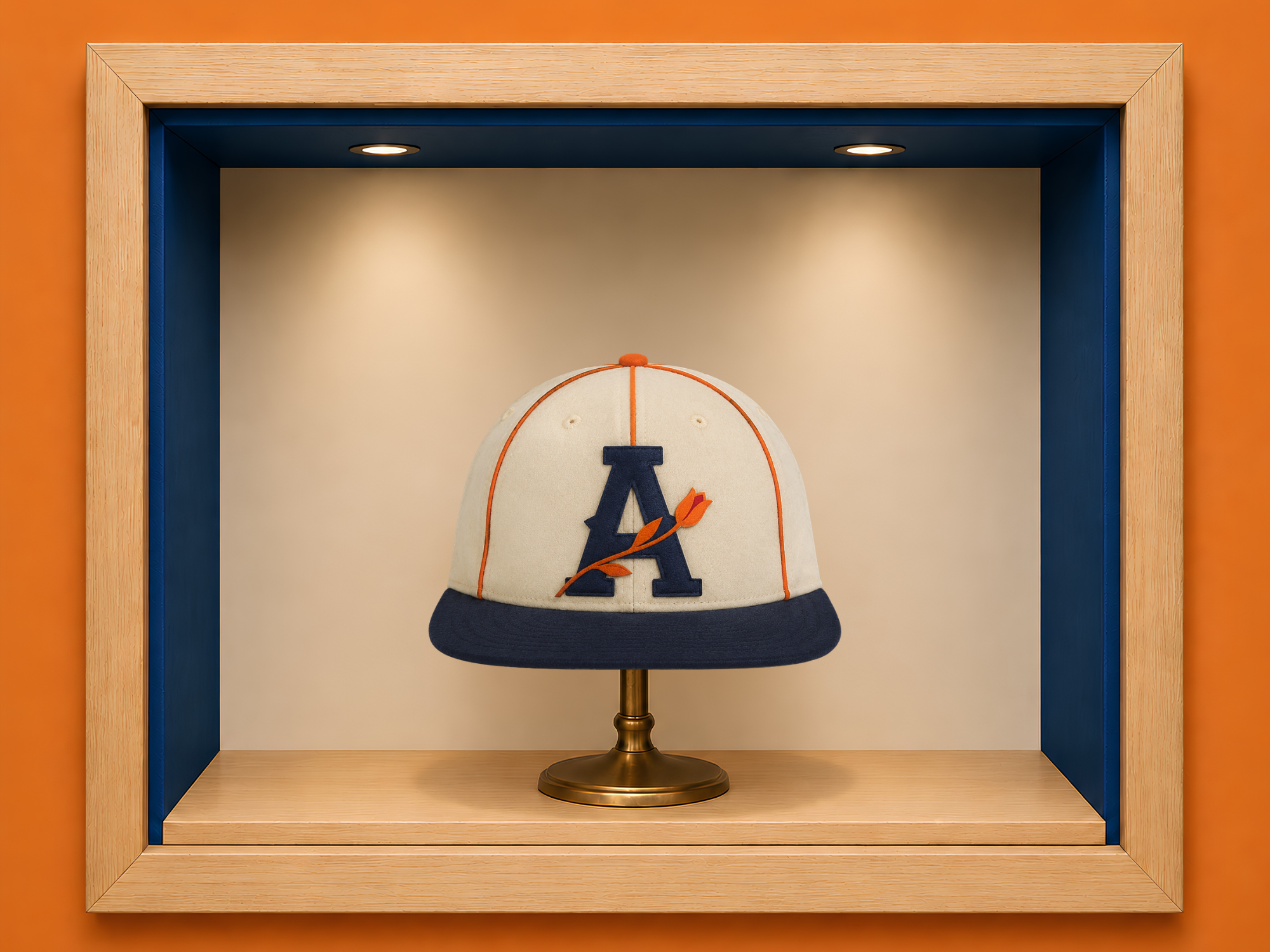
The cap was the club’s clearest field mark. A soft cream wool crown met a flat Dutch navy bill beneath orange seam piping and an orange button. A Dutch navy notched A, drawn directly from the ALBANY wordmark, stood on the front panel and was crossed by a small orange-and-scarlet tulip stem. The stems were finished by hand. On some caps the line rested low across the crossbar; on others it rose toward the left side of the crown. The variations preserved the speed and scale of a uniform order completed for one journey.
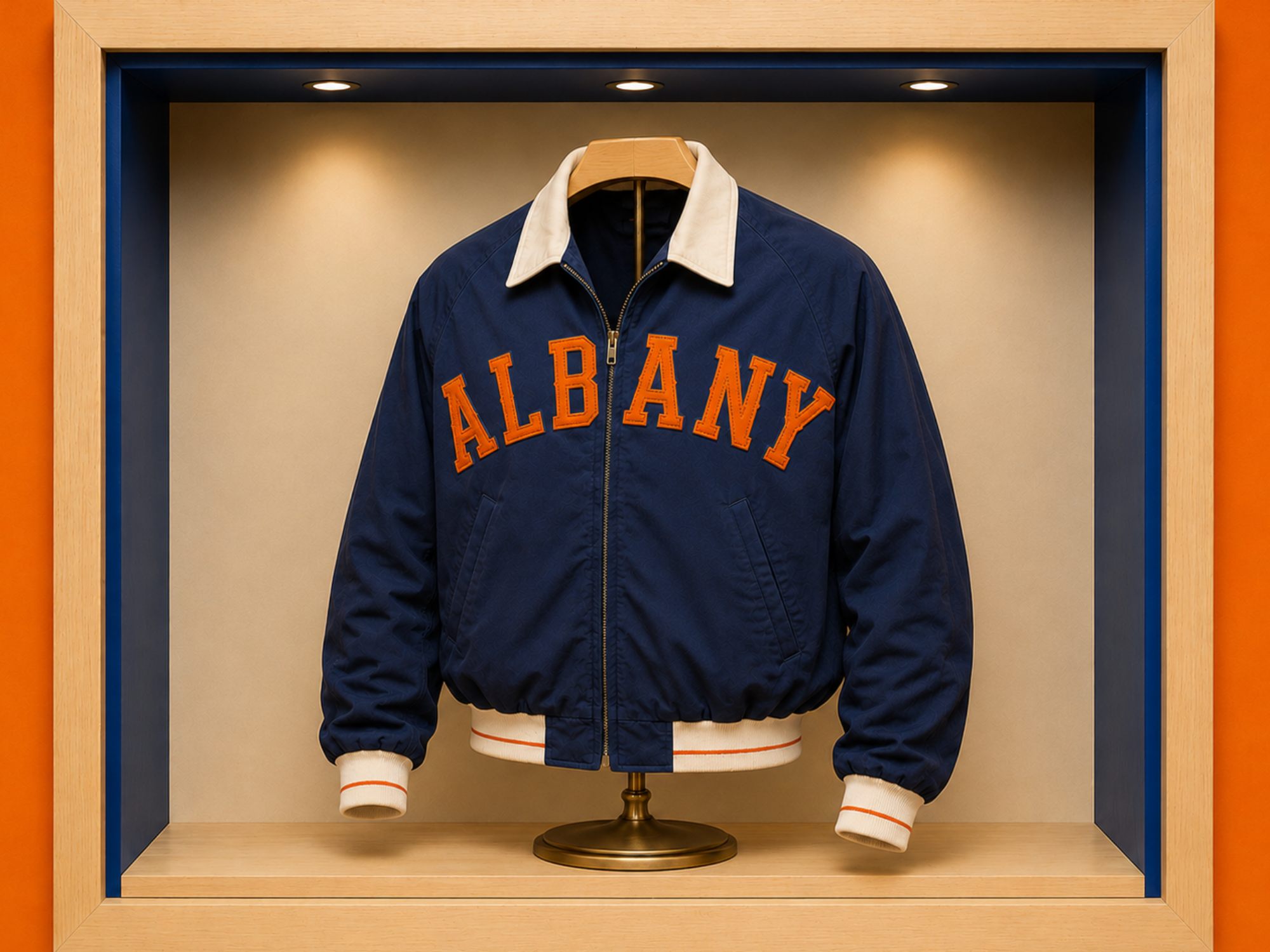
The tour dugout jacket was made for a Dutch summer rather than winter travel. A lightweight Dutch navy cotton shell closed with a brass zipper beneath a cream turn-down collar; cream knit cuffs and waistband carried narrow orange lines. Individually cut Orange Wonder orange felt letters formed ALBANY across the chest, divided by the zipper. The jacket carried no secondary patch or tour tab. Its identity rested on the same notched lettering and reduced palette used throughout the field set.
Together, the uniform, cap and dugout jacket gave the Wonders a complete identity without disguising what they were. They were Albany veterans in working baseball clothes, distinguished by uninterrupted cream flannel, orange stockings, Dutch navy lettering, the notched A and the tulip-over-baseball mark of the journey that had brought them there.
Flannel, Felt, and Thread
-
![Front and back views of the Albany Orange Wonders’ cream 1949 field uniform with navy ALBANY lettering, number 11, orange stockings and black cleats.]()
Complete Field Set
Museum Display · 1949
Shown from the front and back, the Orange Wonders’ only field uniform pairs plain cream wool flannel with Dutch navy felt lettering and the number 11. The tulip-over-baseball patch occupies the left sleeve, while orange stockings provide the set’s strongest field of color. A black leather belt and black cleats complete the uniform worn in Rotterdam, Haarlem and Nijmegen.
-
![Close view of individually sewn, notched Dutch navy ALBANY felt letters on the cream Orange Wonders jersey.]()
ALBANY Wordmark Detail
Museum Display · 1949
Individually cut Dutch navy felt letters form ALBANY across uninterrupted cream flannel. Small notches in the strokes, irregular spacing and visible stitch lines give the wordmark the hand-finished character of a short-run uniform order. The same notched A was carried onto the club’s cap, while the lettering structure was repeated in orange on the dugout jacket.
-
![Albany Orange Wonders cream wool cap with a navy flat bill, orange seam piping and a navy notched A crossed by an orange tulip.]()
Primary Field Cap
Museum Display · 1949
The soft cream wool crown and flat Dutch navy bill are joined by orange seam piping and an orange top button. The front mark uses the same notched A as the jersey wordmark, cut in Dutch navy and crossed by an orange-and-scarlet tulip stem. Its rising diagonal gives the otherwise formal cap a mark that could belong only to the Orange Wonders.
-
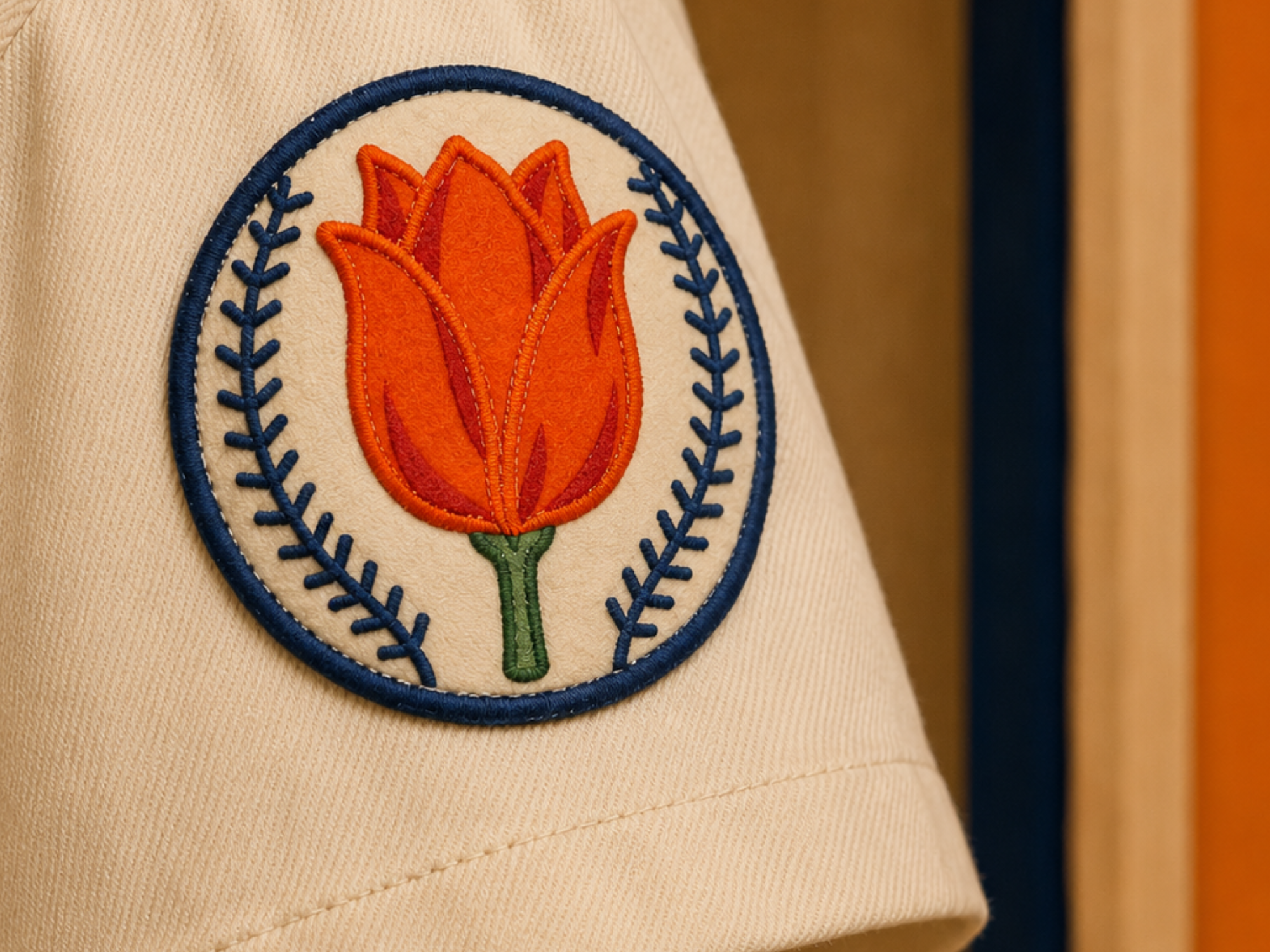
![Close view of the Orange Wonders sleeve patch, with an orange-and-scarlet tulip inside a cream baseball edged and stitched in navy.]()
Tulip-Over-Baseball Sleeve Mark
Museum Display · 1949
The left-sleeve patch places an orange-and-scarlet tulip at the center of a cream baseball edged and stitched in Dutch navy. Raised embroidery and separately defined petals allow the flower to read clearly without becoming a mascot. The mark identifies both the club’s name and the purpose of the Netherlands tour in a single piece.
-
![Lightweight navy Albany Orange Wonders dugout jacket with a cream collar and knit trim and orange ALBANY lettering across the chest.]()
Tour Dugout Jacket
Museum Display · 1949
The lightweight Dutch navy dugout jacket was suited to summer travel and pregame work rather than cold-weather wear. A cream turn-down collar and cream knit cuffs and waistband, each finished with narrow orange lines, frame the zip-front shell. Orange felt ALBANY lettering crosses the chest. With no sleeve patch or tour tab, the jacket’s identity rests entirely on color, construction and the notched wordmark.
IV · THE JOURNEY
The Home Field Was the Itinerary
The official party left Albany by rail for New York and sailed aboard the S.S. Waterman on June 6, 1949. It carried two clubs, two managers, a trainer, an official scorer, civic representatives and the equipment required to support a three-game series. By the time the ship reached Rotterdam on June 16, the players’ names and photographs had already appeared for days in Dutch newspapers.
The tour had been presented in the Netherlands as more than the arrival of two American baseball teams. These were veterans from the city that had helped Nijmegen after the war, wearing the colors of the tulip sent back in gratitude. Dutch readers followed the crossing. Radio reports announced the expected hour of arrival. Newspapers printed diagrams explaining the Orange Wonder sleeve mark and short profiles of the men who would play.
Thousands gathered along the quay when the Waterman entered Rotterdam. Municipal bands, veterans’ organizations, school groups and honkbal clubs filled the reception area, while spectators stood several rows deep along the route to the team hotel. The players had expected an official welcome. They had not expected the bus to require nearly an hour to travel the short distance from the harbor.
The crowd re-formed outside the hotel that evening. Children held programs and autograph books toward the entrance. Adults waited for photographs beneath Dutch and American flags. Whenever a player appeared in the lobby windows or crossed the pavement to the waiting bus, the gathering moved with him.
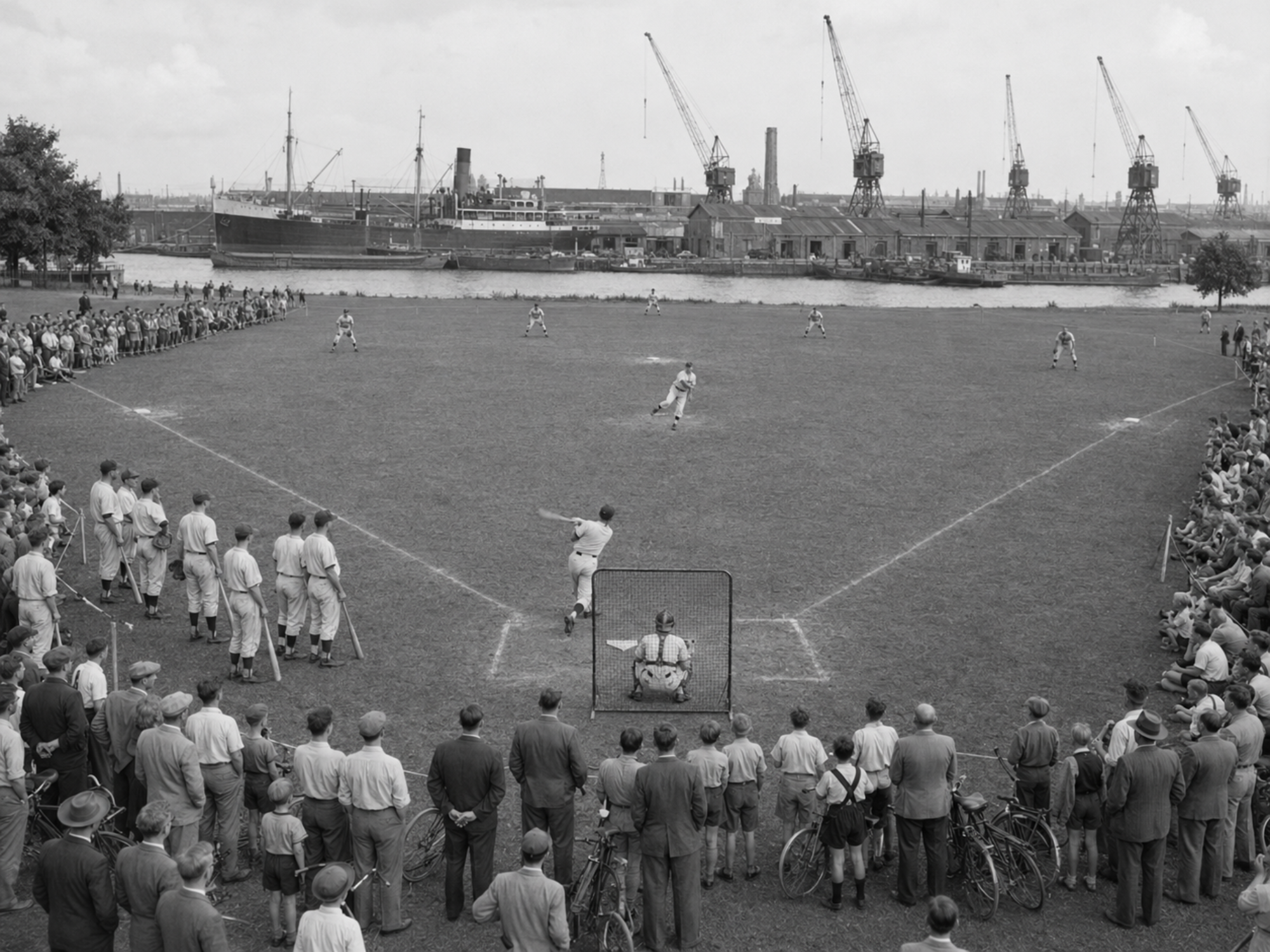
The attention followed the clubs through the Netherlands. Practices originally scheduled as ordinary workouts were opened to the public when spectators began arriving. In Rotterdam, hundreds gathered behind rope lines at an open municipal field near the harbor for the clubs’ first Dutch workout. Larger crowds attended later sessions in Haarlem and Nijmegen, where local players stood along the rail to study the visitors’ equipment and throwing routines. Railway platforms and hotel entrances became informal receiving lines.
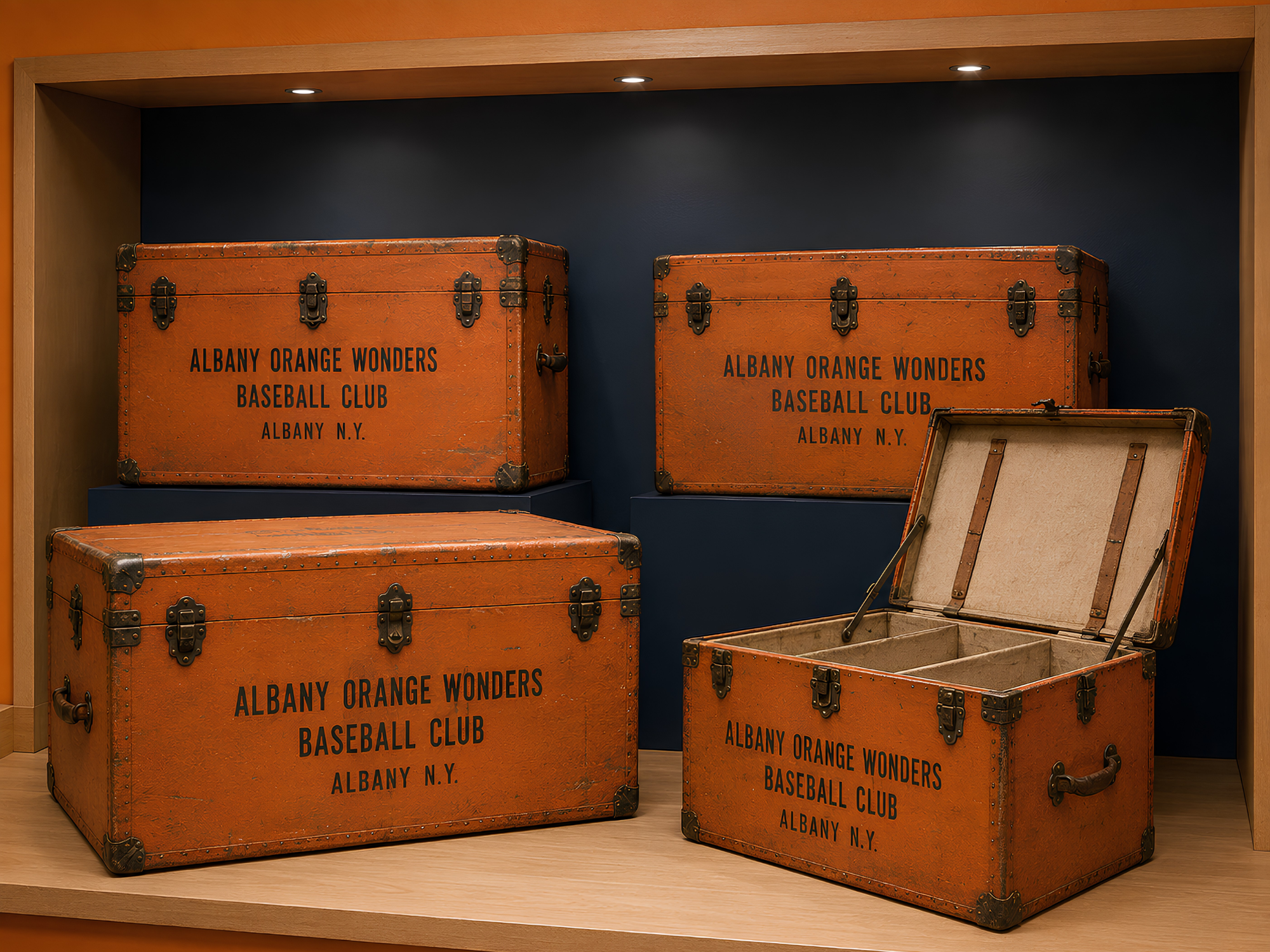
The two painted trunks still mattered. They carried bats, balls, catcher’s gear, medical supplies and the cream Orange Wonders and dark Nassau Blues uniforms. But the clubs did not arrive as an improvised team searching for a place to play. Each city had reserved one of its finest sporting grounds, expanded the seating and prepared the visit as a major public occasion.
Rotterdam came first because it was the port of arrival. Haarlem followed because its established honkbal culture offered the tour’s most knowledgeable baseball audience. Nijmegen came last because the entire journey had been moving toward the city at the center of Albany’s relief work.
Maaspark
Rotterdam’s Maaspark was a formal municipal ballpark set within a larger athletic ground south of the city center. A broad brick entrance opened into a concourse behind home plate. The principal grandstand combined a low steel roof with dark timber seating, while open terraces continued along both foul lines. A deep green wall enclosed the outfield beneath a manually operated scoreboard.
For the Albany opener, temporary galleries were added beyond first and third base, raising the available capacity to approximately 14,000. Dutch and American flags alternated above the roof. Orange Wonder tulips filled low planters near the entrances, and the tour emblem appeared on the scoreboard, ticket booths and freshly painted dugout fronts.
The field was immaculate. A local grounds crew rebuilt the mound to Ten Eyck’s specifications, reset the base paths to American measurements and cut the outfield grass in broad, even bands. The Wonders did not make their first Rotterdam appearance there. On June 17, the afternoon after the Waterman arrived, the clubs held an open workout on a municipal field near the harbor. Spectators crowded the rope lines while dock buildings and cranes remained visible beyond the outfield. Maaspark awaited the following day’s opening game.
Spaarne Honkbalpark
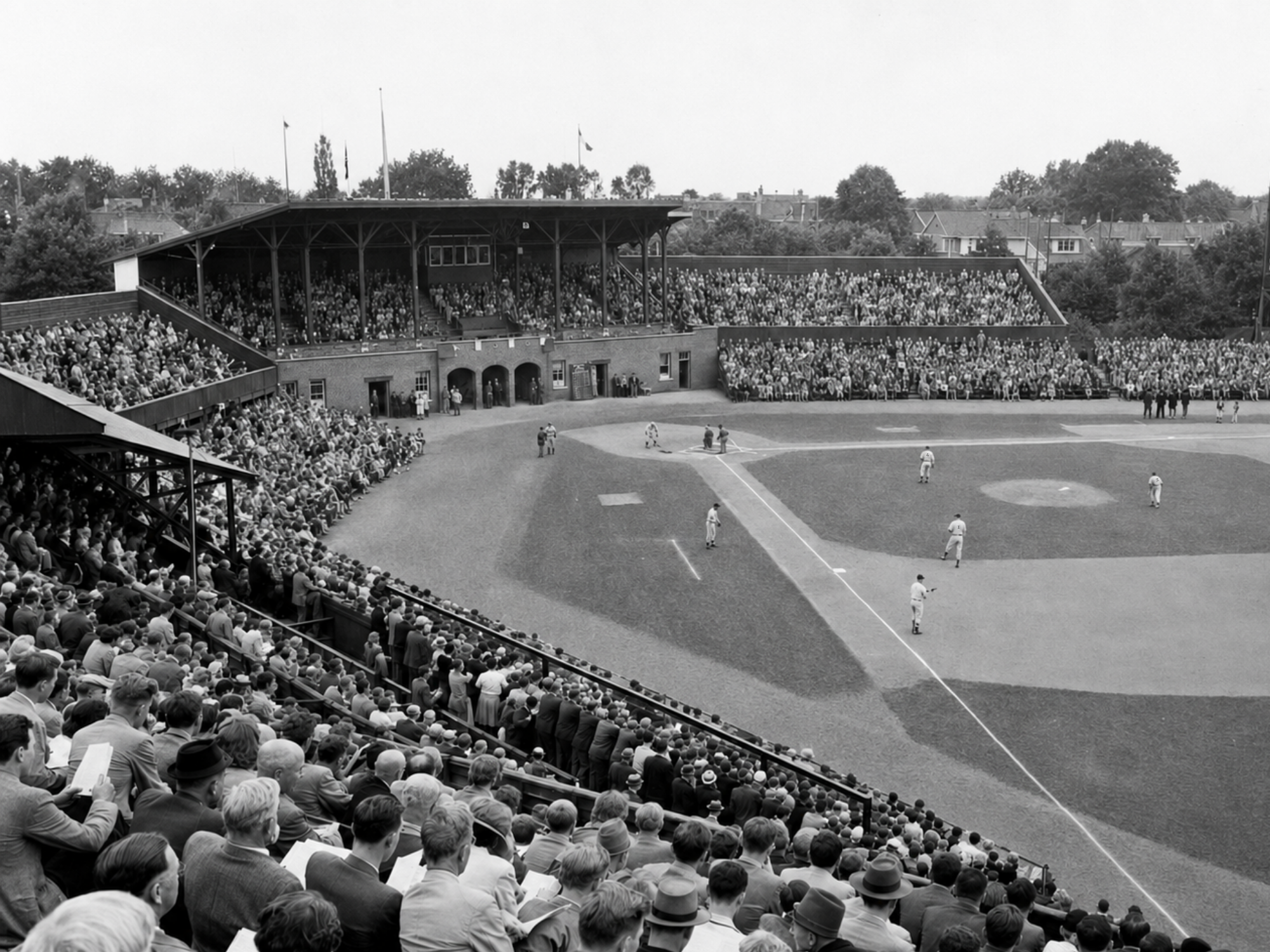
Haarlem supplied the tour’s purest baseball setting. Spaarne Honkbalpark had been developed around an established municipal diamond and carried the close, enclosed character of a neighborhood ballpark. Its dark-green timber grandstand stood directly behind home plate, with brick clubrooms below, roofed seating around the infield and a tall manual scoreboard in left-center.
Local honkbal officials treated the visit as an international baseball event rather than a civic exhibition. They prepared a Dutch-language lineup board, assigned experienced scorers and opened the park for two public workouts. Nearly every available place along the rails was occupied. Players from Haarlem clubs watched from the front rows, and children waited near the clubhouse tunnel for the Albany teams to emerge.
Additional seating carried the game-day crowd to approximately 17,000. From the field, the upper edges of the grandstand appeared lined with spectators. The park was loudest not during the introductions, but during the game itself. Haarlem understood the sport well enough to recognize a cutoff throw, a pitcher changing pace and a catcher controlling the running game.
Goffert Ballpark
Goffert Ballpark in Nijmegen was the ceremonial destination of the tour and the largest of its three venues. Built within the landscaped grounds near Goffert Park, it combined a pale-brick entrance building with a broad covered grandstand behind home plate and matching open stands along the foul lines. Mature trees rose beyond the outfield wall, and the approach passed through lawns and formal flower beds planted for the summer.
The city expanded the park for the finale. Temporary stands closed the gaps beyond the permanent grandstand, additional press positions were built above the first-base side and a flower-lined presentation platform was placed near home plate. More than 23,000 people entered for the deciding game, with additional spectators watching from the upper walks and neighboring slopes.
Both clubs received proper dressing rooms beneath the grandstand. The Orange Wonders’ room was marked with the tulip-over-baseball emblem, while the Nassau Blues occupied the third-base side beneath their shield. The painted travel trunks stood in the center of each room, no longer guarded as scarce equipment but opened among flowers, telegrams and gifts sent to the players before the game.
None of the three parks used lights for the series. The games began in the afternoon so that the full ceremonies, baseball and postgame gatherings could be completed in daylight. Each park supplied ticket offices, public restrooms, first-aid rooms, press accommodations, bicycle checks and staffed information tables. Programs were printed in Dutch and English. National radio carried reports from all three games and broadcast the Nijmegen finale in full.
The parks remained local sporting institutions after the Albany clubs departed. The Orange Wonders possessed no home ground of their own, but their official record no longer belonged to anonymous or temporary fields. It belonged to three named ballparks remembered in sequence.
The Wonders’ home field was the itinerary.
Snapshots from the Tour
-
![Albany Orange Wonders travel trunks stacked outside Albany's Union Station in 1949.]()
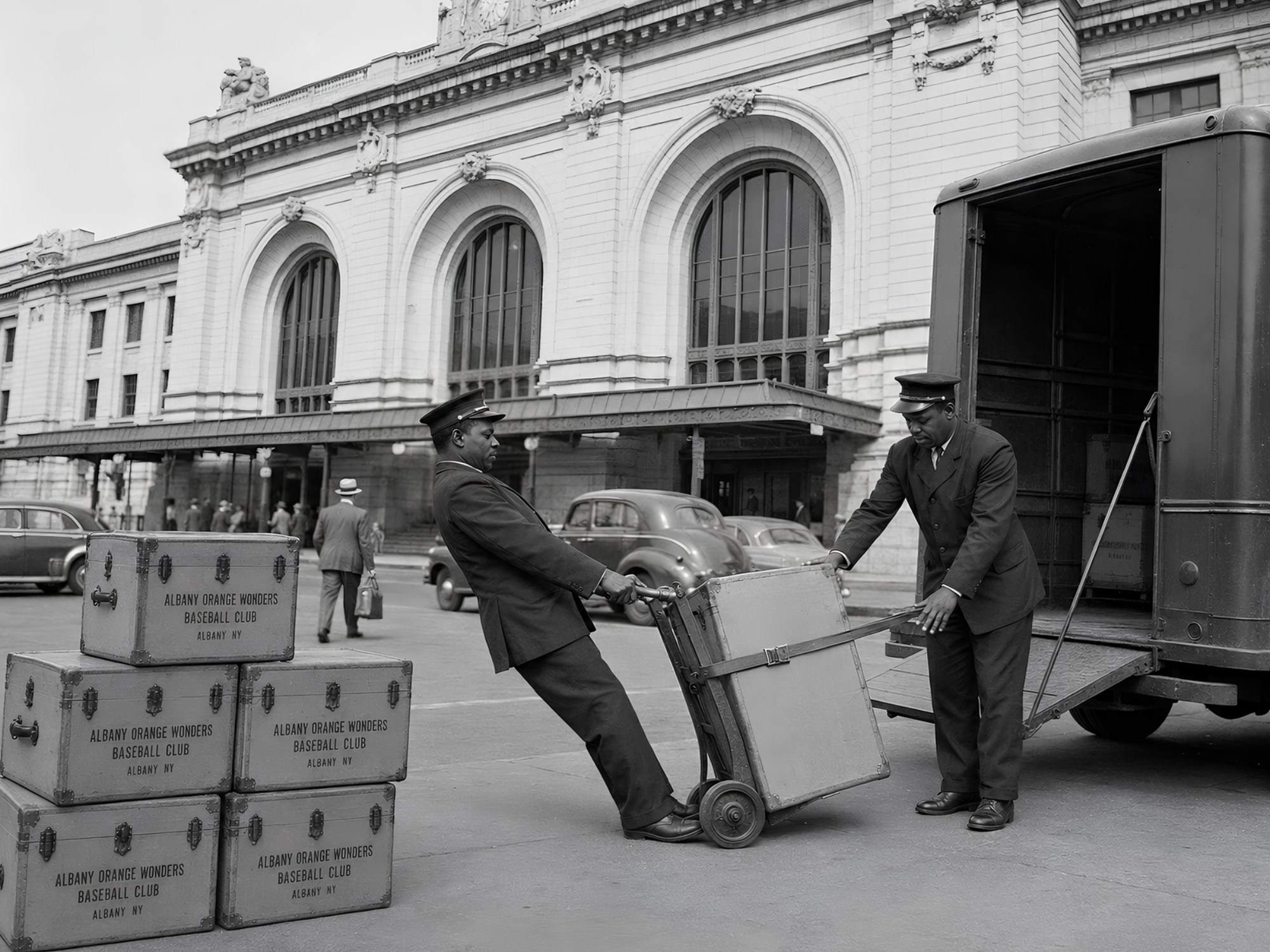
The Trunks at Union Station
Historical Photograph · Albany, 1949
Stacked outside Albany’s Union Station, the club’s orange travel trunks marked the first stage of the journey. The Orange Wonders rode south to New York City before beginning the transatlantic passage to the Netherlands.
-
![Black-and-white photograph of the S.S. Waterman docked in Rotterdam with Albany-marked trunks and dockworkers on the quay.]()
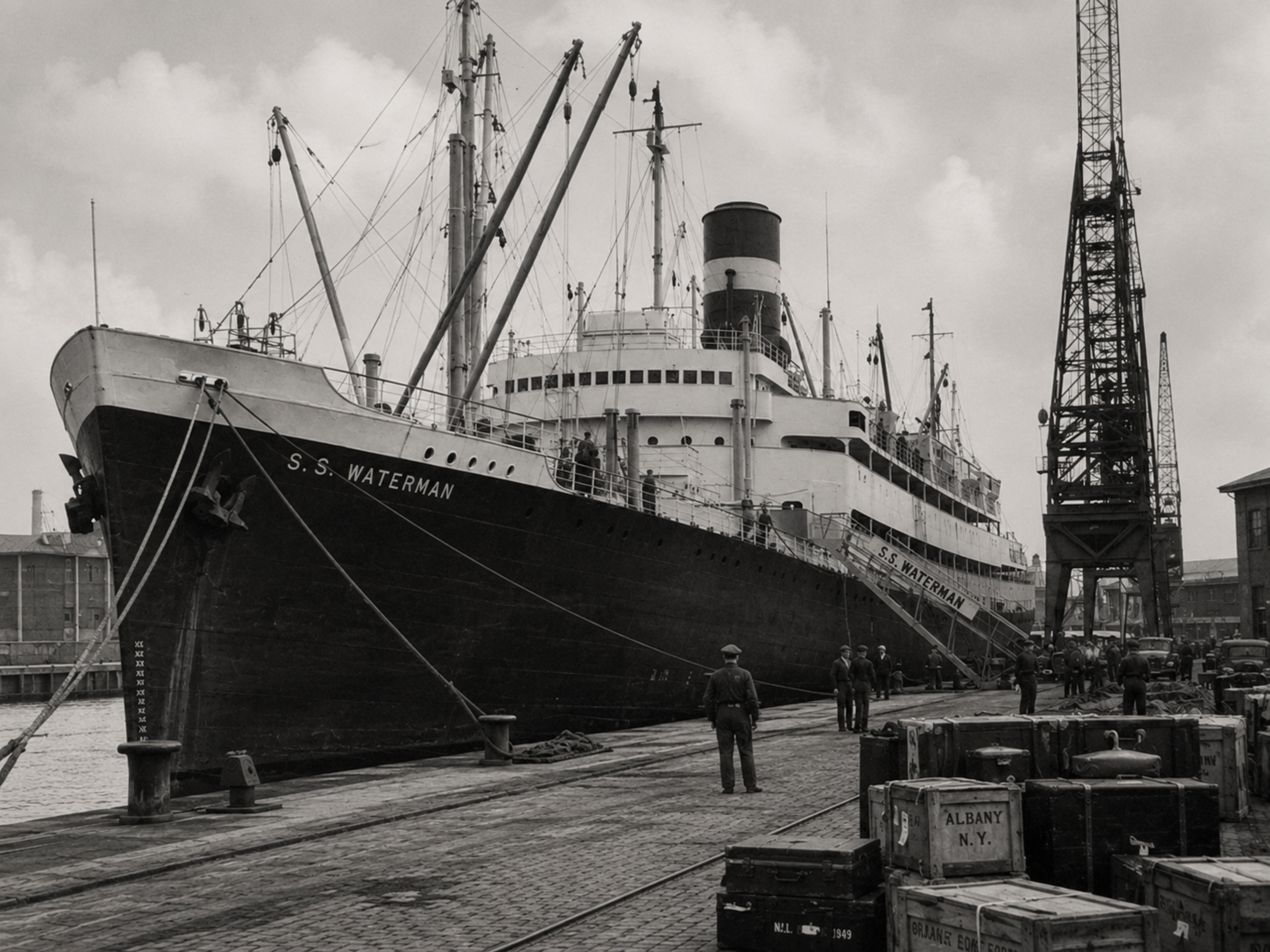
The Waterman at Rotterdam
Historical Photograph · Rotterdam, 1949
The S.S. Waterman rests at Rotterdam with Albany-marked trunks gathered on the quay. Dockworkers oversee the transfer of the clubs’ baggage and equipment before it is loaded for the hotel. Photographed after the formal reception had moved beyond the harbor, the scene preserves the quieter logistical work that followed the delegation’s arrival.
-
![Black-and-white photograph of supporters gathered outside the Albany delegation’s Rotterdam hotel, with the team bus at the curb.]()
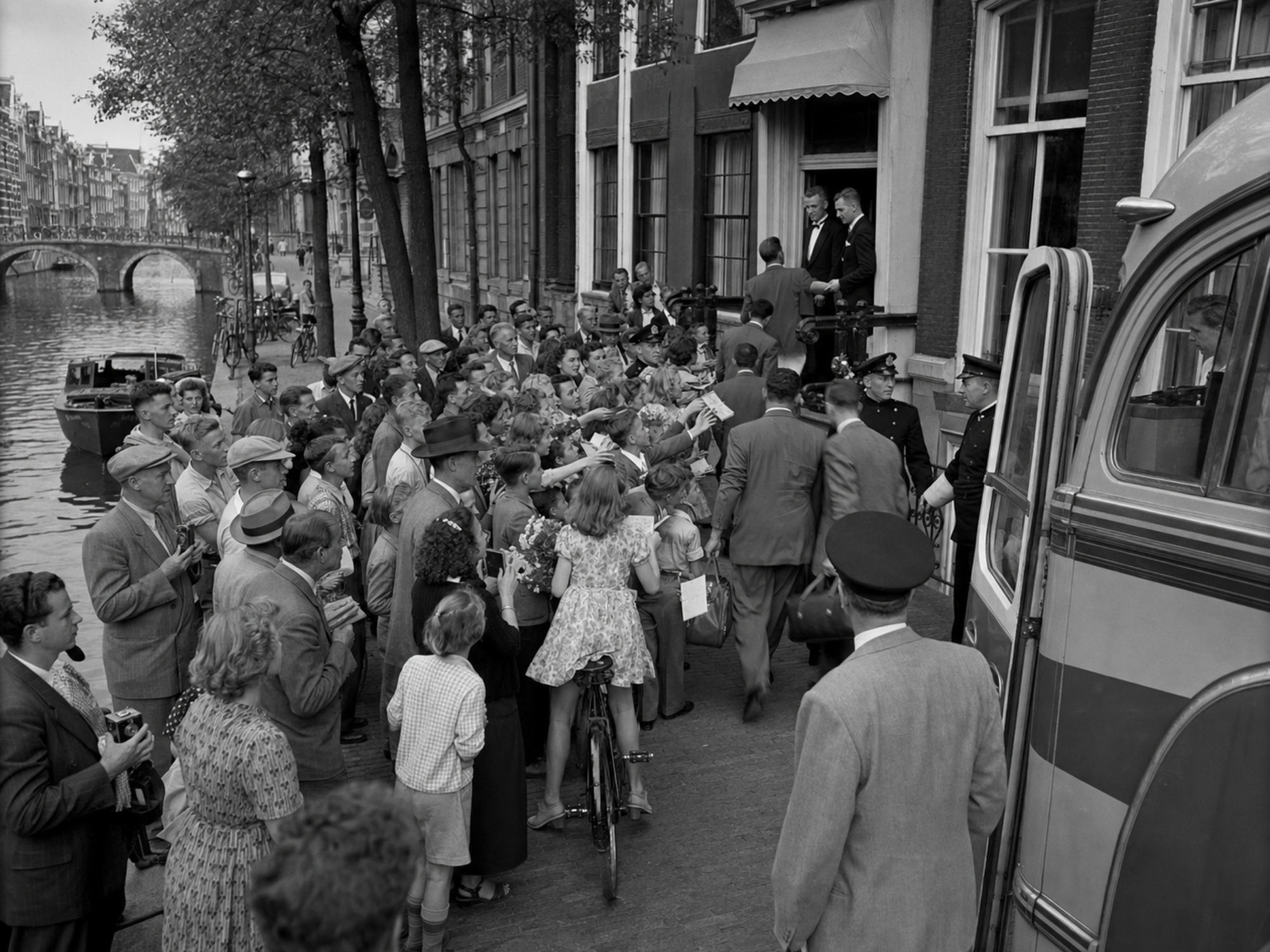
Outside the Team Hotel
Historical Photograph · Rotterdam, 1949
Supporters fill the pavement outside the Albany delegation’s Rotterdam hotel, holding programs, cameras and Orange Wonders pennants toward the entrance. The players had been in the Netherlands for less than a day. By evening, police and hotel staff had established a passage between the lobby doors and the team bus.
-
![Black-and-white photograph of the Albany Orange Wonders practicing before spectators on an open municipal field near Rotterdam harbor, June 17, 1949.]()
Open Practice
Historical Photograph · Rotterdam, 1949
Spectators gather behind temporary rope lines during the Orange Wonders’ June 17 workout on an open municipal field near Rotterdam harbor. Dock buildings, cranes and shipping remain visible beyond the outfield. Used for one afternoon, the field gave local spectators their first close view of the Albany clubs before the series opened at Maaspark the following day.
-
![Spaarne Honkbalpark in Haarlem, filled to capacity prior to the start of the Albany Orange Wonders game, 1949.]()
The Haarlem Grandstand
Historical Photograph · Haarlem, 1949
Spaarne Honkbalpark is filled before the second game, its dark-green grandstand and foul-line terraces carrying a crowd of approximately 17,000. The photograph captures the tour at its most baseball-conscious stop: scorecards open, lineups posted and local players watching from the first rows.
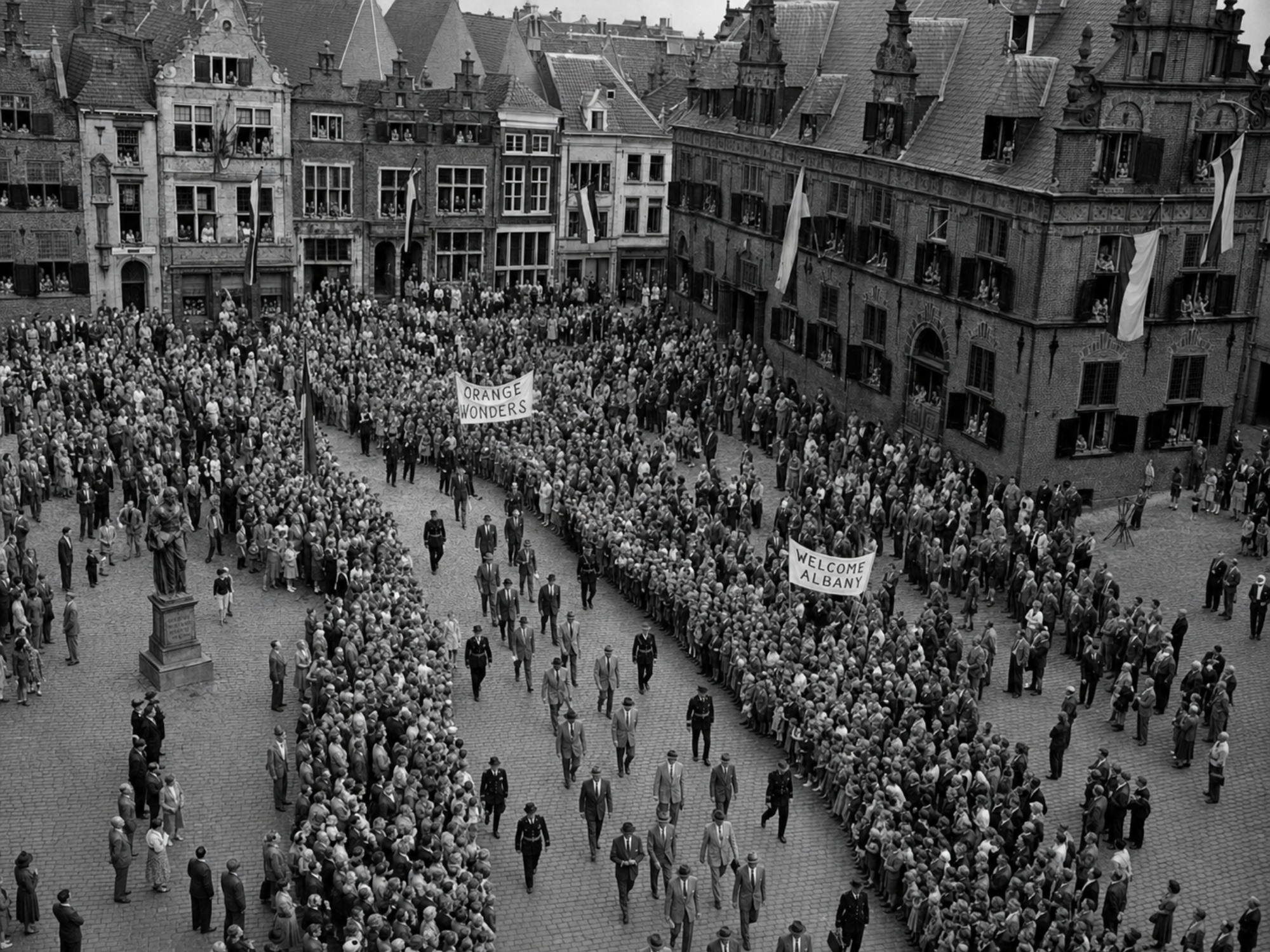
-
![Black-and-white photograph of the Albany Orange Wonders arriving in Nijmegen in June 1949.]()
Arrival in Nijmegen
Historical Photograph · Nijmegen, 1949
The Albany delegation moves through a dense crowd on its way from the welcome banquet to the team hotel. Veterans’ groups, schoolchildren and families line the route beneath flags and Orange Wonder banners, welcoming the clubs to the city toward which the tour had been traveling from the beginning.
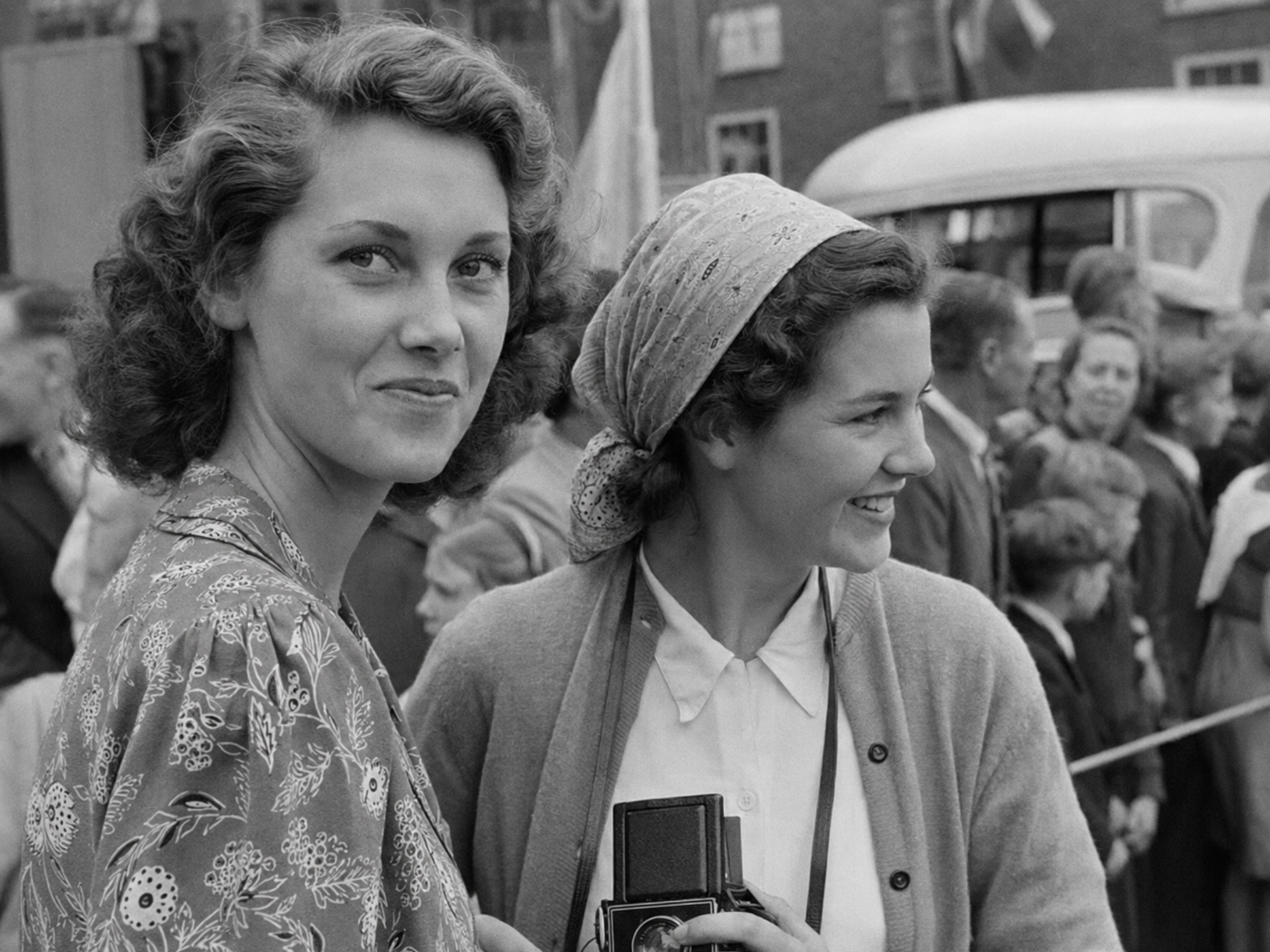
-
![Two young women in the Nijmegen welcome crowd in June 1949, one looking toward the photographer while the other smiles toward the procession and holds a box camera.]()
Among the Nijmegen Crowd
Historical Photograph · Nijmegen, 1949
Two young women stand near the procession route as the Albany delegation moves through Nijmegen. One carries a camera of her own, a reminder that the welcome was recorded not only by newspaper photographers, but by the spectators who had gathered to see the visitors arrive.
-
![Black-and-white photograph of four Nijmegen batboys holding baseball bats inside the Orange Wonders’ dugout at Goffert Ballpark.]()
Nijmegen Batboys
Historical Photograph · Nijmegen, 1949
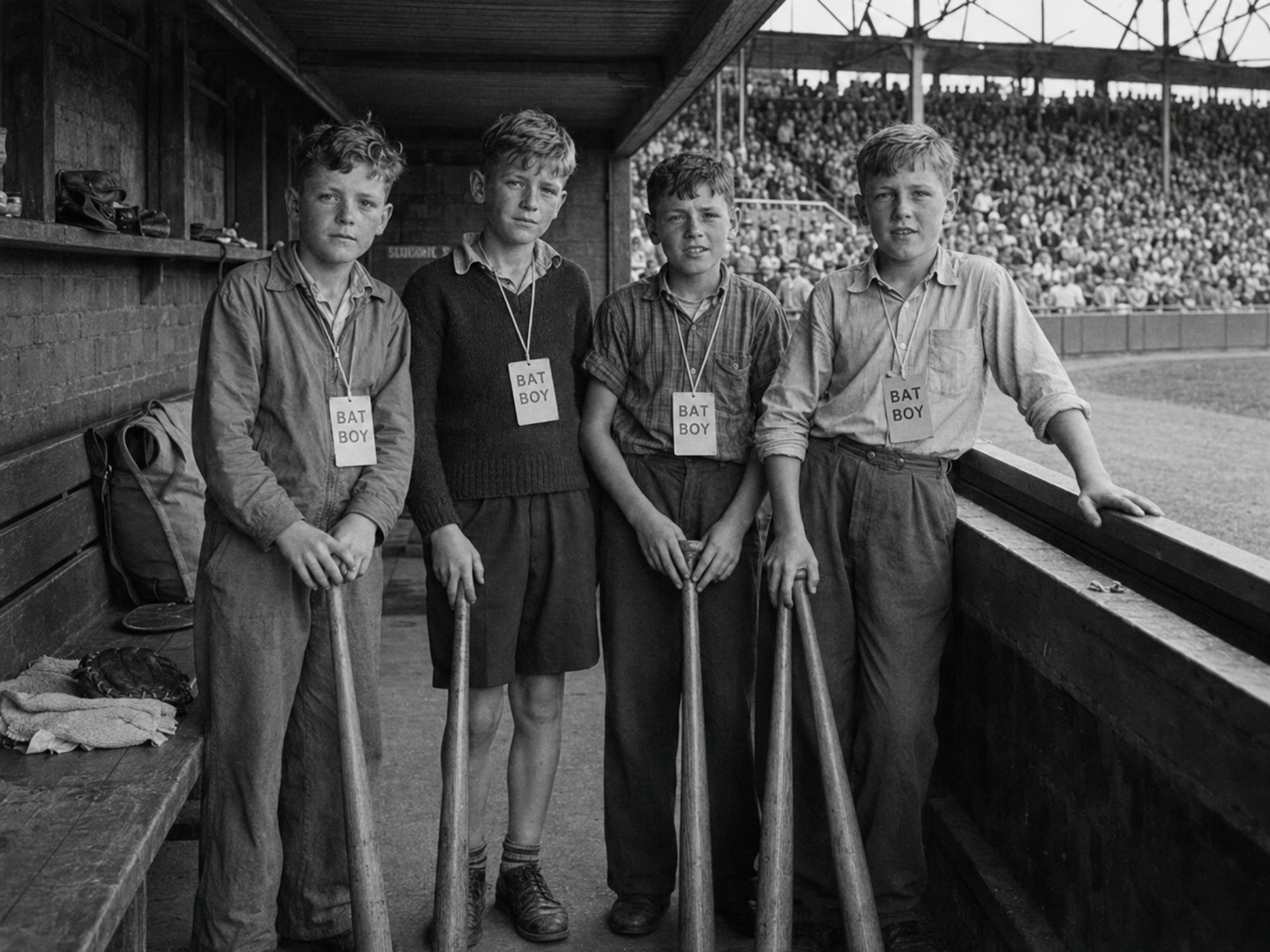
Four local boys stand inside the Orange Wonders dugout at Goffert Ballpark, wearing matching paper credentials and holding bats prepared for the finale. Beyond them, the lower grandstand is already full. Their position beside the players reflects the access granted to Nijmegen children throughout the final days of the tour.
-
![A bouquet of Orange Wonder tulips rests on home plate during the pregame ceremony at Goffert Ballpark.]()
The Bouquet at Home Plate
Historical Photograph · Nijmegen, 1949
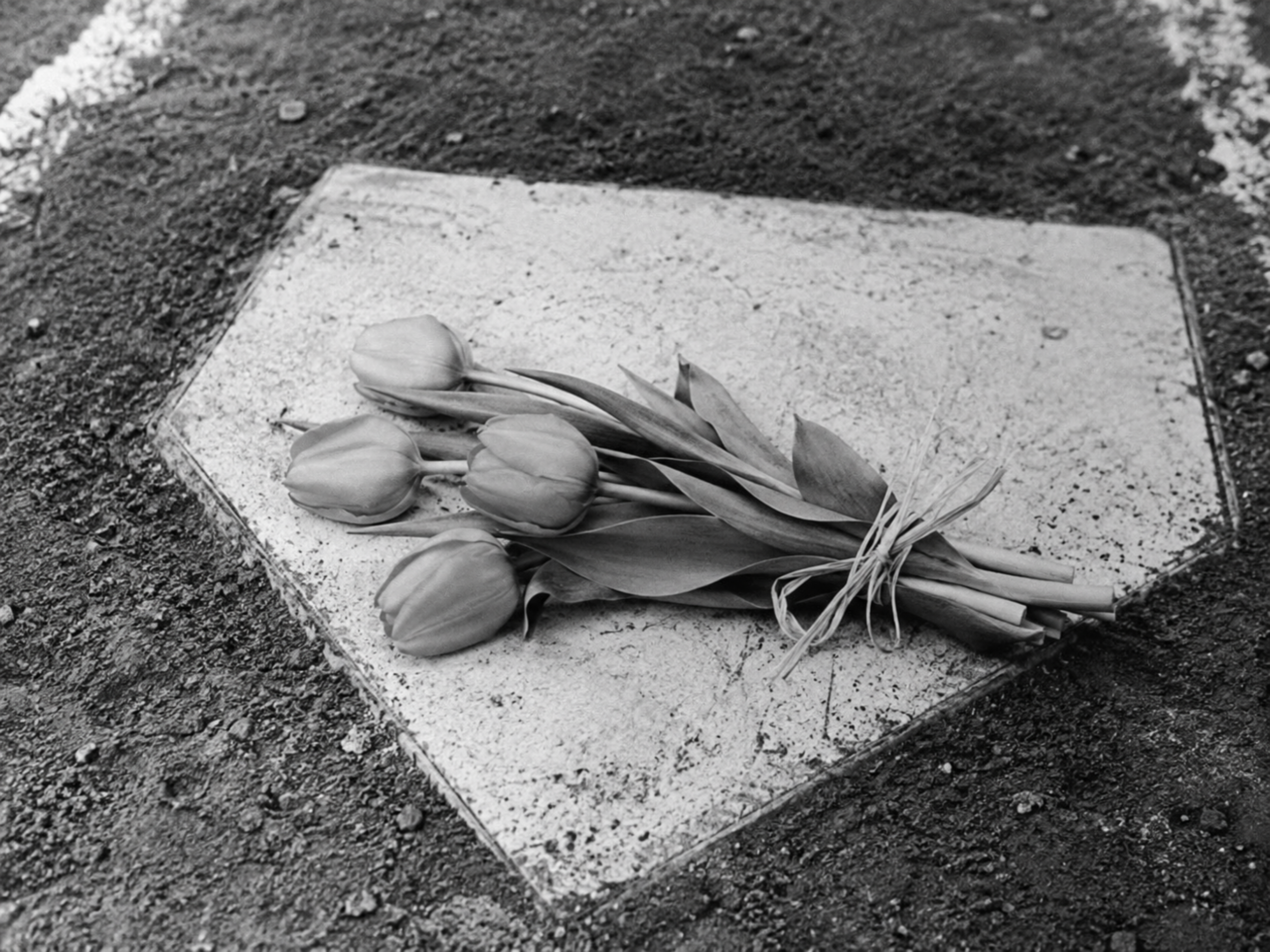
Before the deciding game, children carried an Orange Wonder bouquet to home plate before more than 23,000 spectators. Both clubs lined the base paths while the presentation was translated and the national anthems were played. The flowers were then moved to the scoring table, where they remained through the final out.
V · THE SERIES
Three Games Were Enough
The 1949 Orange Wonders did not play for a pennant in the ordinary sense. Their season consisted of three games against the same opponent, each played away from Albany and arranged through civic hosts. Yet for twelve days in June, the Orange Wonder Veteran Series became one of the largest public sporting events in the Netherlands.
The attention did not soften the baseball. Ten Eyck used a small, settled group. Marro caught every game. Van Alstyne played every inning at second base. Daniel O’Rourke received the Haarlem start. Picard was held for Nijmegen. Substitutions were made for the heat, travel and game situation, not for the benefit of the crowd.
The teams were introduced individually before each game. By the second stop, spectators recognized the principal players without waiting for the translation. Marro’s catcher’s gear, Van Alstyne’s captaincy and Picard’s planned finale assignment had been covered in the papers. Children called surnames from the rails as the clubs took the field.
Game One · Rotterdam · June 18, 1949
Approximately 14,000 spectators filled Maaspark for the opening game. The clubs entered separately from beneath the grandstand, crossed the field through parallel lines of Dutch youth players and stood along the baselines for introductions. The crowd had come to welcome Albany. Once play began, it chose sides.
The Wonders looked like a club still recovering its legs after the crossing. The Nassau Blues broke a tie with three runs in the seventh inning, helped by two Orange Wonders errors, and won the opener, 5–3. The crowd remained through the final out and surrounded both clubhouse exits afterward, asking the players to sign programs that had already been marked in Dutch and English.
Game Two · Haarlem · June 22, 1949
Spaarne Honkbalpark reached its expanded capacity well before the teams finished warming up. Approximately 17,000 spectators filled the roofed grandstand, foul-line terraces and added outfield seating. The crowd supplied the most fluent baseball response of the series, applauding a cutoff throw, questioning an official scoring decision and recognizing O’Rourke’s changing pace.
The Wonders appeared more settled. O’Rourke worked quickly, Marro controlled the running game and the defense played cleanly behind them. Van Alstyne drove in two late runs, and the Wonders won, 4–2.
Afterward, local honkbal players joined the Albany clubs on the field for an abbreviated batting exhibition. Most of the crowd stayed. What had been planned as a private exchange between players became another hour of baseball beneath a full grandstand.
Game Three · Nijmegen · June 26, 1949
Nijmegen treated the finale as the conclusion of a civic story that had begun with Albany’s relief shipments. Businesses closed early. School groups entered through reserved gates. The route from the team hotel to Goffert Ballpark was lined with spectators, and more than 23,000 people filled the grounds by first pitch.
The Nassau Blues scored first in the third inning. Marro tied the game with a fourth-inning single. In the sixth, with two runners aboard, Van Alstyne lined a two-run single through the right side. The crowd had learned the captain’s name during the week; it reached him from the grandstand before he arrived at second base.
Picard allowed nothing after the third. He completed the game, surrendered one run and walked two as the Wonders won, 3–1.
The teams shook hands at the mound before walking the perimeter of the field together. The Orange Wonder Cup was carried to the flower-lined platform near home plate, with the pregame bouquet placed before it for photographs. Players from both clubs remained on the field signing programs until the light began to leave the upper grandstand. The cup stayed in Nijmegen as the permanent series keepsake.
The victory produced no league title and began no dynasty. It completed the assignment for which the club had been made.
They arrived as a delegation. By Nijmegen, the crowds knew the players by name.
VI · PEOPLE
The People Who Carried Albany
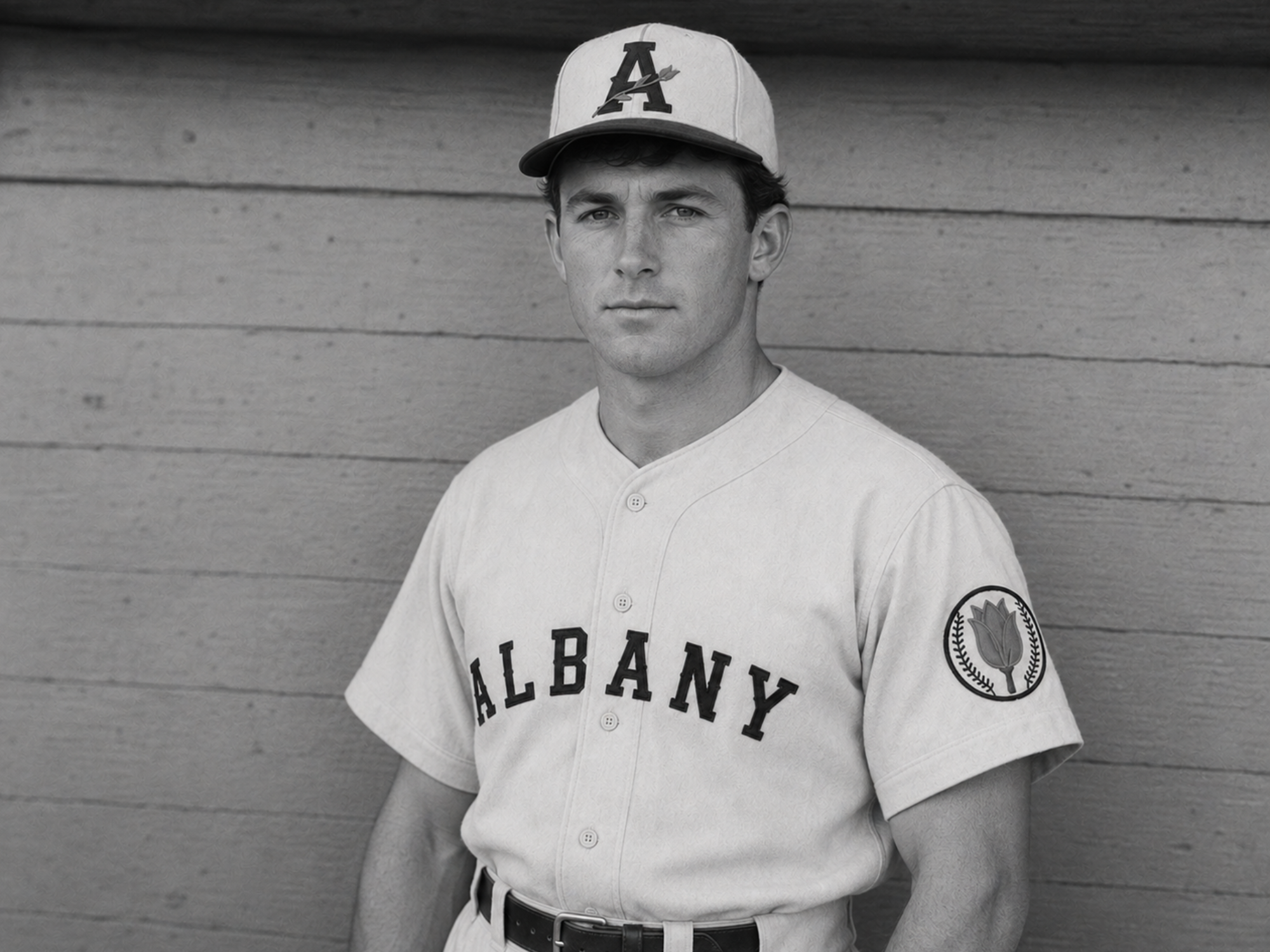
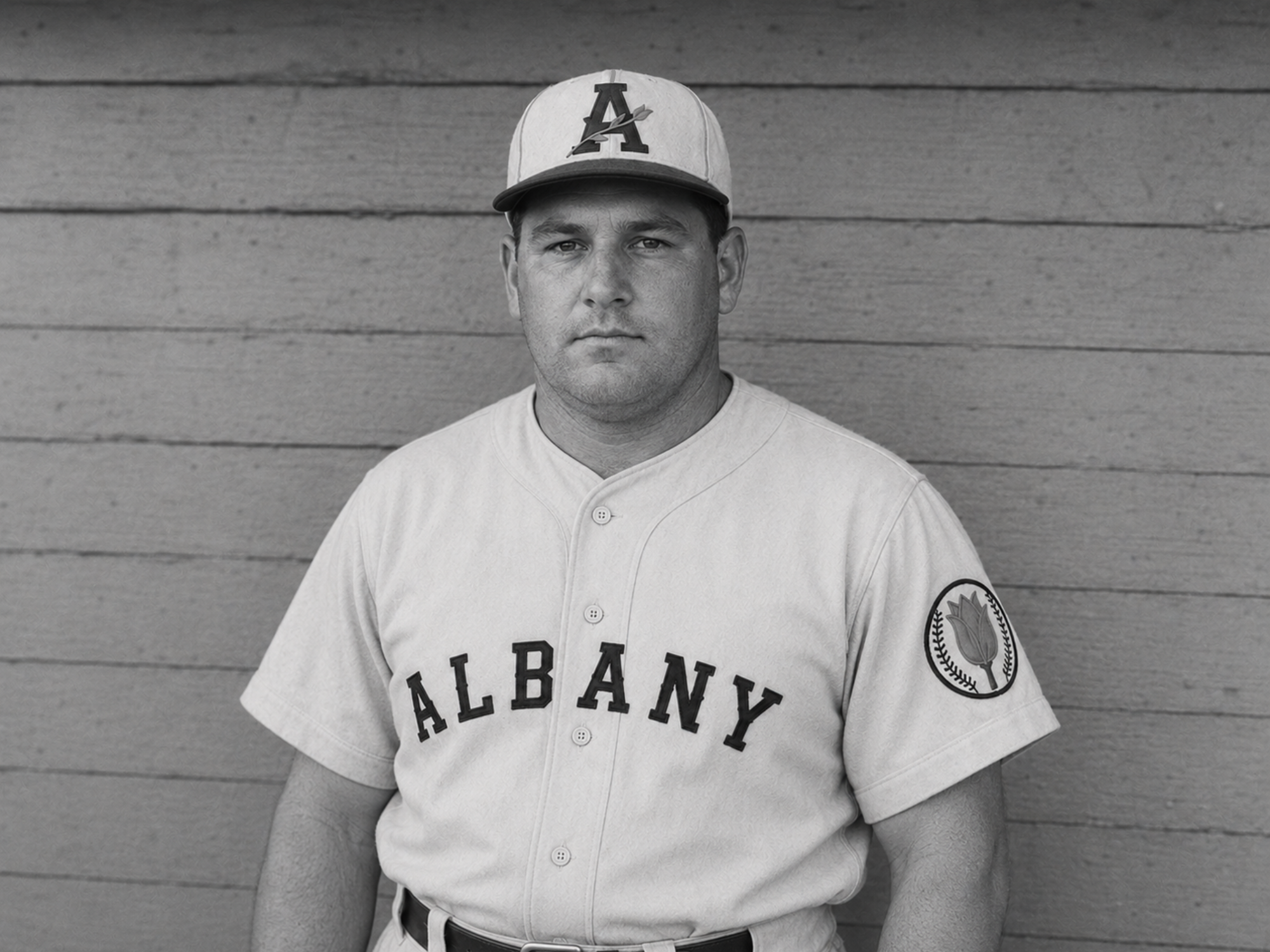
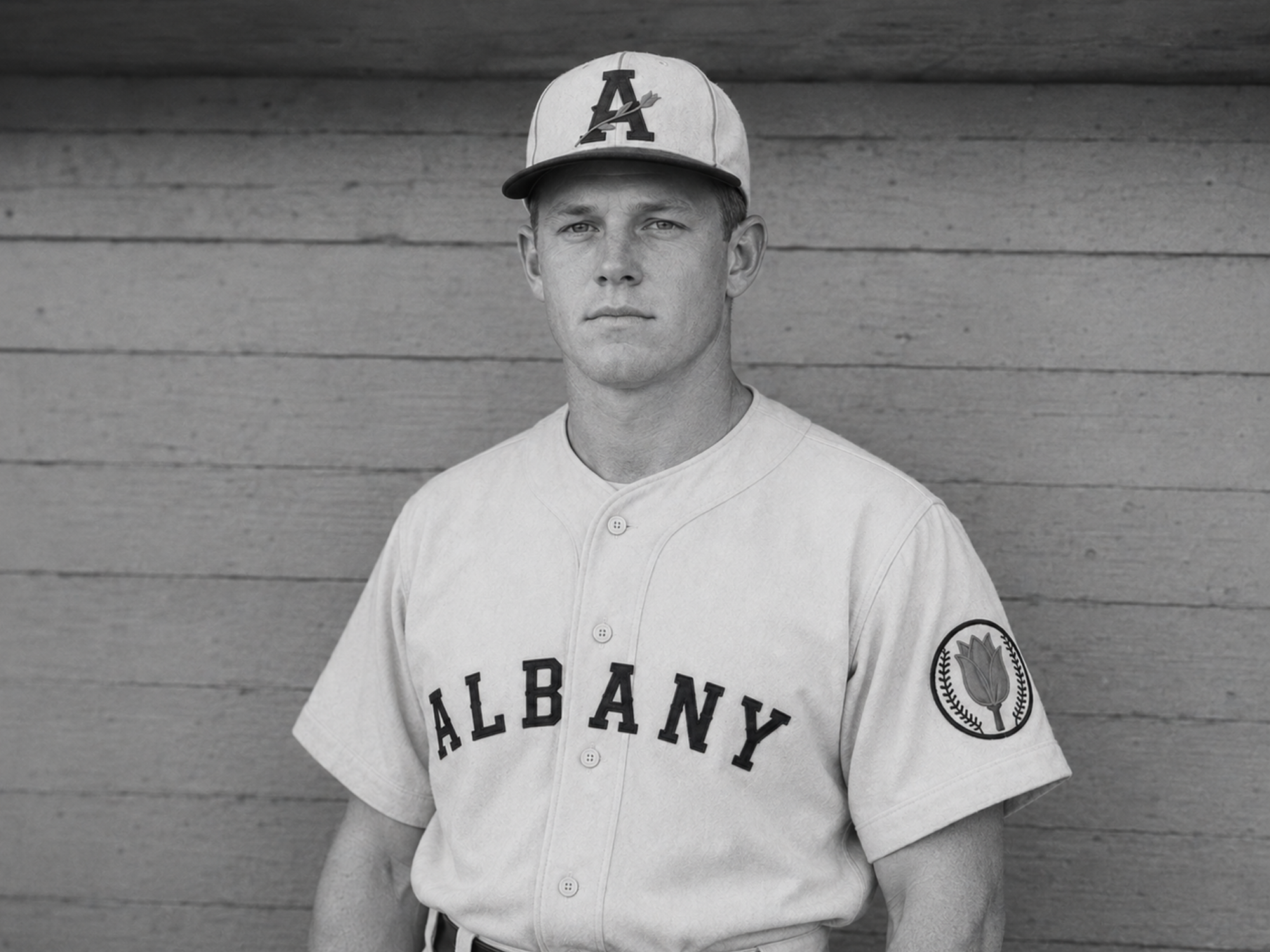
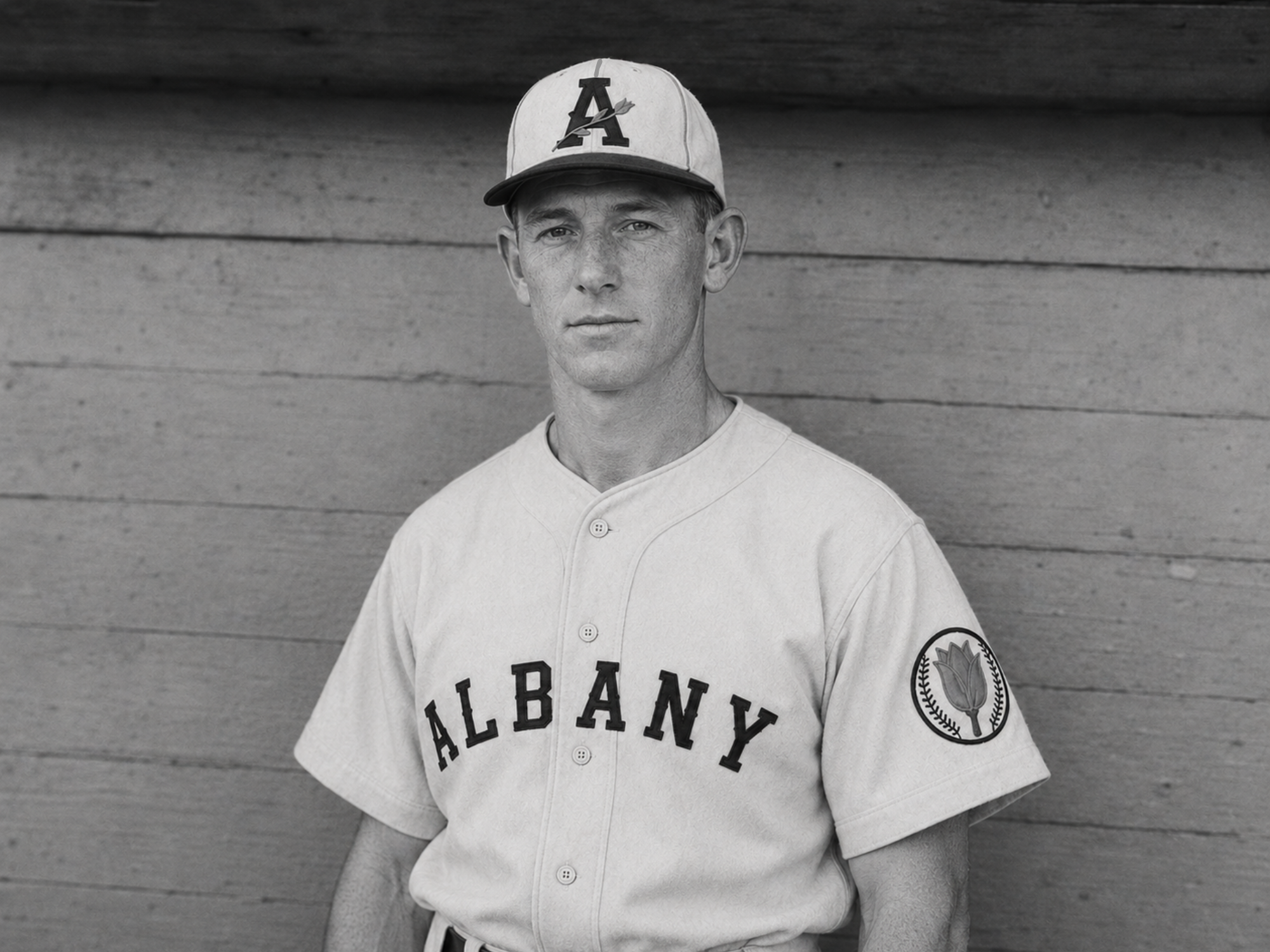
The Orange Wonders were one baseball club within a larger civic delegation. Players, organizers, scorers and equipment men traveled together, and several individuals carried more than one responsibility. Their surviving papers rarely separate the game from the journey. Lineups appear beside rail times. Pitching notes share pages with press appointments, hotel instructions and baggage counts.
The tour made public figures of men who had not expected to become them. Portraits printed before the Waterman arrived allowed Dutch spectators to recognize the principal players at the quay, outside the hotels and along the ballpark rails. By Haarlem, Van Alstyne, Marro and O’Rourke were being called by name. By Nijmegen, Picard’s scheduled start had become part of the city’s anticipation of the finale.
-
![Black-and-white portrait of Edward J. McNulty wearing an Orange Wonders cap in his Albany office.]()
Edward J. McNulty
Historical Photograph · Albany, 1949
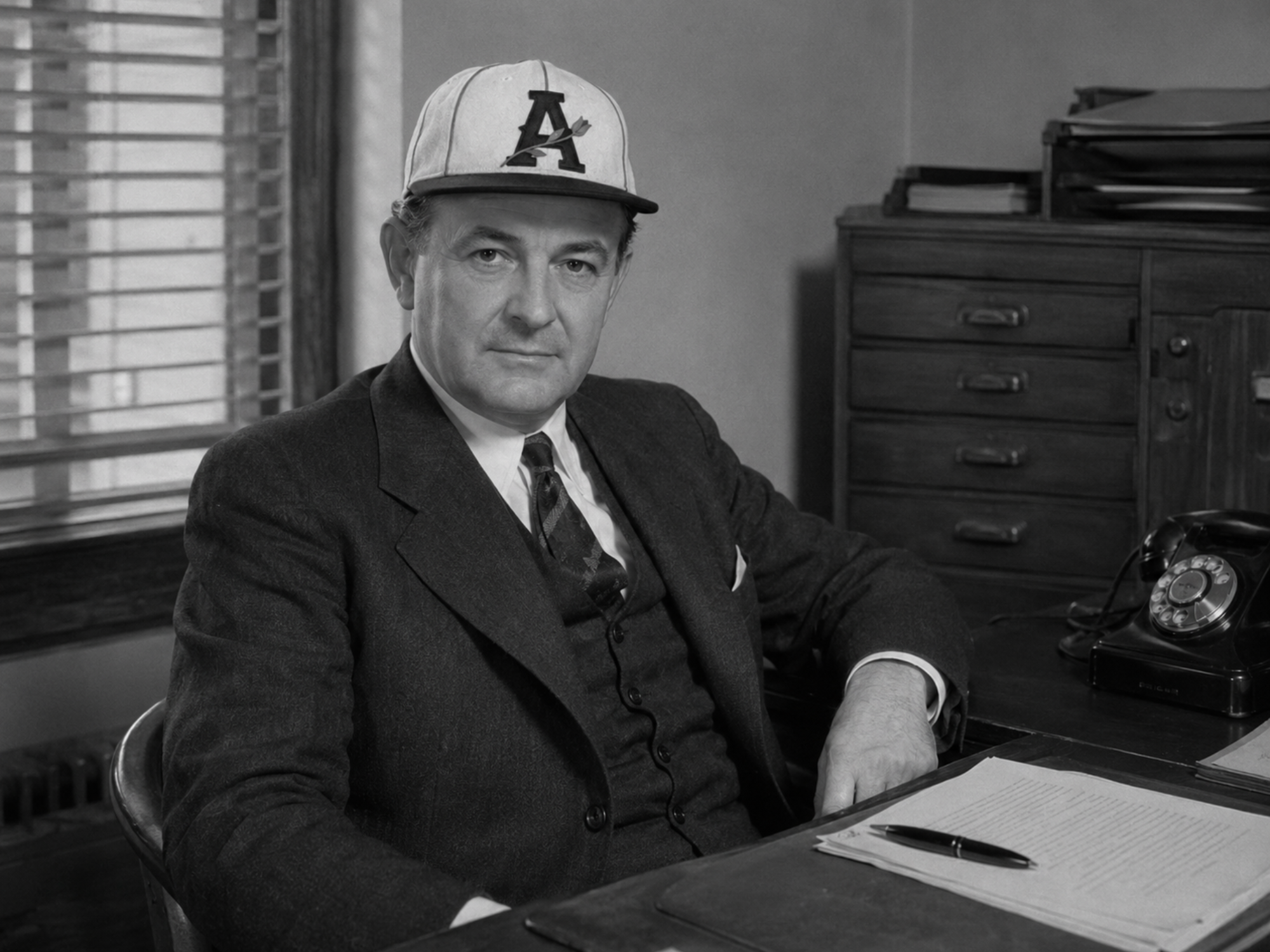
A lawyer, former Navy officer and organizer of civic benefit games, McNulty chaired the committee that turned Albany’s relationship with Nijmegen into an overseas baseball tour. He assembled the official party, secured municipal and veterans’ support and left the daily baseball operation to Hal Ten Eyck.
-
![Black-and-white portrait of Harold “Hal” Ten Eyck in an Albany Orange Wonders uniform and cap.]()
Harold “Hal” Ten Eyck
Historical Photograph · Albany, 1949
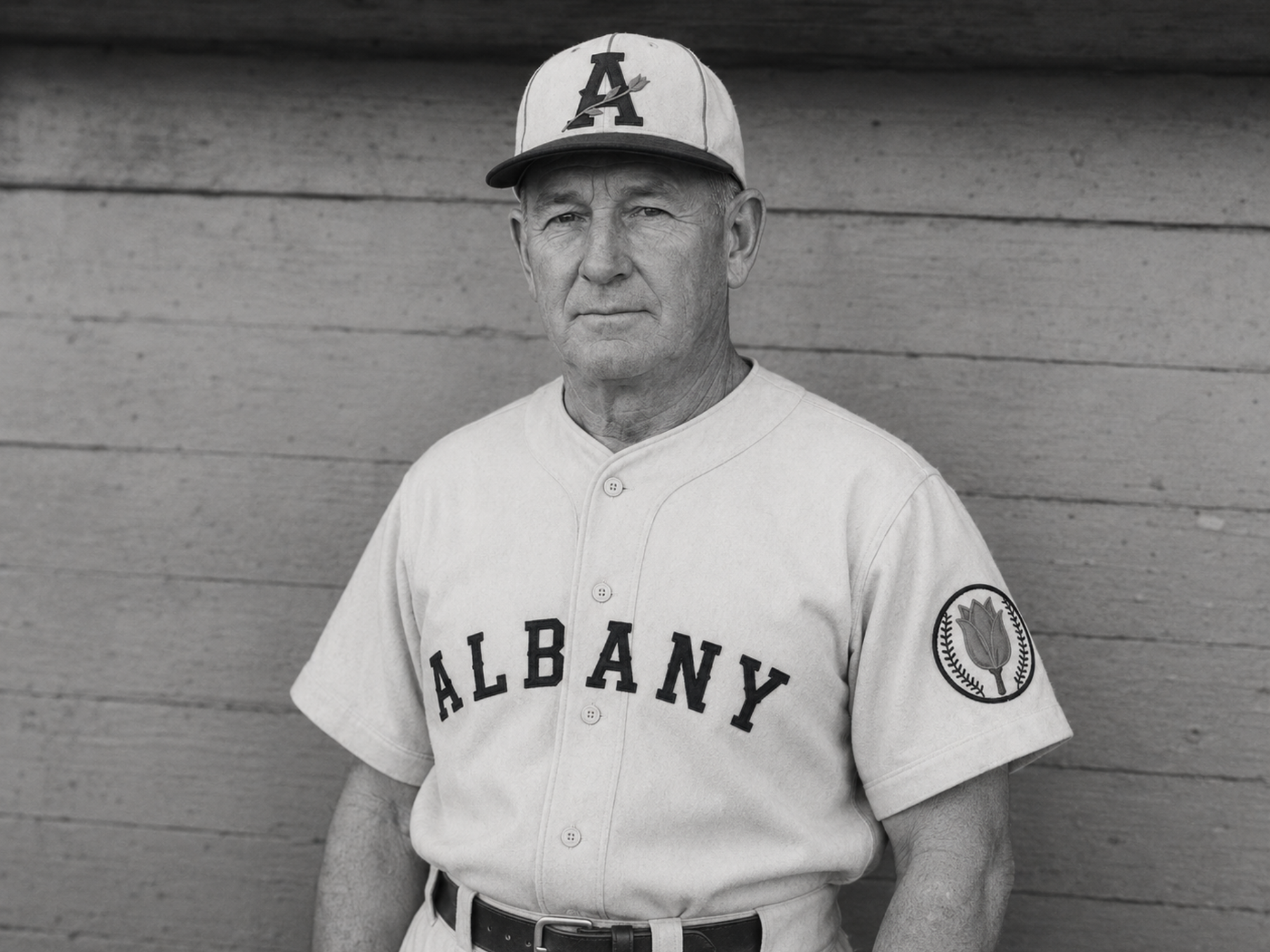
The former infantry captain and semiprofessional infielder managed the Wonders as a working club rather than a ceremonial team. His tour notebook placed lineups, field conditions, pitching plans, train times and hotel instructions on the same pages.
-
![Black-and-white portrait of Abraham “Abe” Van Alstyne in an Orange Wonders uniform and cap.]()
Abraham “Abe” Van Alstyne
Historical Photograph · Albany, 1949
Van Alstyne captained the Wonders and played every inning of the series at second base. He led the club with four runs batted in, including the two-run single in Nijmegen that gave Albany the deciding game.
-
![Black-and-white portrait of Gabe Marro in an Orange Wonders uniform and cap.]()
Gabriel “Gabe” Marro
Historical Photograph · Albany, 1949
Marro caught all three games and led the Orange Wonders with a .455 average. As tour quartermaster, he also kept the equipment ledger, recording what was used, repaired or left with Dutch hosts. His handwriting appears on more surviving club objects than that of any other player.
-
![Black-and-white portrait of Joseph Picard in an Orange Wonders uniform and cap.]()
Joseph Picard
Reserved for the finale, Picard delivered the only complete-game victory in the Orange Wonders ledger. He allowed one run and walked two against the Nassau Blues. The game ball was marked in ink before the club left Goffert Ballpark.
-
![Black-and-white portrait of Orange Wonders pitcher Daniel O’Rourke during the 1949 Netherlands tour.]()
Daniel O’Rourke
Historical Photograph · Albany, 1949
O’Rourke started the second game and gave the Wonders the steady pitching performance the series required after the Rotterdam loss. His quick work and the clean defense behind him carried Albany to a 4–2 victory at Haarlem.
VII · THE END
The Assignment Was Complete
The Orange Wonders did not enter a league after returning to Albany. That was not a failure of ambition. The club had been created for one tour, and the tour had been completed.
McNulty’s committee settled the travel accounts, returned unused sponsor funds where it could and placed one tour scorebook in the custody of Albany’s Tulip Committee. The Orange Wonder Cup remained with the municipal hosts in Nijmegen. Equipment intended for Dutch clubs had already been distributed before the official party sailed home.
The Nassau Blues disappeared even more quickly. Their uniforms returned to the sponsoring veterans’ organizations, and several garments were later altered for local service-club games. Orange Wonders material survived more readily because it carried the specific marks of the tour: the tulip-crossed A, bilingual scorecards, baggage labels, meal cards, marked baseballs and painted trunks.
Former players continued to appear during Albany’s tulip seasons, but the club was not revived as festival entertainment. Surviving notices place them at veterans’ dinners, civic luncheons and street-scrubbing ceremonies rather than in new Orange Wonders games. The distinction mattered. The team had not been created as an annual pageant.
By the late 1950s, the Senators still occupied Albany’s familiar baseball memory. The Wonders held a more singular place: three games, three Dutch cities, more than 54,000 spectators and one completed journey. Baseball After Ruin first appeared in the tour program and later on the labels placed beside the objects that remained.
Legacy
The Orange Wonders left no grandstand, long statistical record or championship banner. Their official history can be contained in three scorecards. Their larger history cannot.
The relief effort gave the club its purpose. The Orange Wonder tulip supplied its name. Albany veterans gave the tour its human weight, while Dutch hosts gave it three extraordinary public stages. None of those elements would have produced the same club alone.
What endured were objects made to travel: a penciled scorecard from Haarlem, a Rotterdam admission slip, a pressed tulip, a marked game ball, a chipped wooden sign and a cream-and-Dutch navy cap with an orange stem crossing the A.
The Orange Wonders existed briefly because permanence was never the assignment. They carried Albany to the Netherlands, filled three ballparks and left part of the club behind.
Baseball After Ruin.
Collection Study
-
![Large-scale reproduction of Queen Wilhelmina’s 1948 telegram naming the Orange Wonder as Albany’s official tulip, displayed in the Albany Orange Wonders exhibition.]()
The Queen’s Reply
Museum Display · 1948
In the spring of 1948, Albany’s Tulip Committee asked Queen Wilhelmina of the Netherlands to select a variety as the city’s official tulip. This large-scale reproduction preserves her brief reply, naming the Orange Wonder, a bronzy orange bloom shaded with scarlet. The telegram records the moment the flower entered Albany’s civic identity and, soon afterward, the identity of its ball club.
-
![Four orange Albany Orange Wonders travel trunks displayed in a blonde-wood museum case with a Dutch navy interior, including one open trunk with canvas-lined compartments.]()
The Traveling Trunks
Museum Display · c. 1949
The Orange Wonders traveled with a matched set of orange-painted equipment trunks, each marked in black stencil for the Albany club. Reinforced corners, heavy latches and worn carrying handles reflect the repeated handling of the 1949 tour. One trunk is displayed open, revealing its canvas-lined compartments and simple leather restraints.
-
![Two framed 1949 Orange Wonders felt pennants - an orange ALBANY pennant and a Dutch navy 1949 TOUR pennant bearing the tulip-over-baseball emblem - hang on an orange museum wall.]()
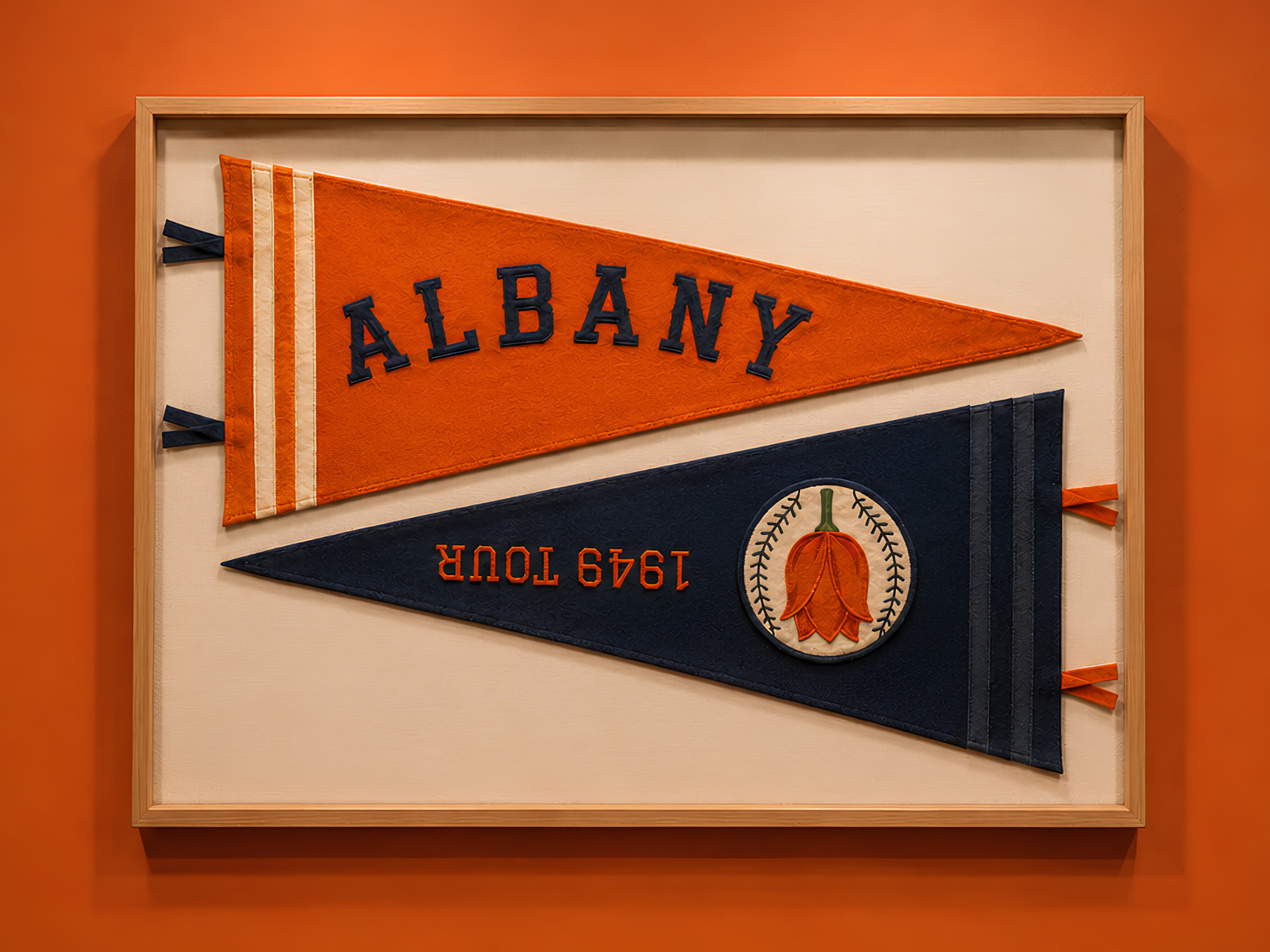
Team Pennants
Museum Display · c. 1949
Two hand-cut felt pennants produced for Albany’s 1949 goodwill tour are preserved together in a single frame. The orange ALBANY pennant is paired with a Dutch navy 1949 TOUR pennant bearing the club’s tulip-over-baseball emblem. Fine stitching, softened edges and subtle irregularities in the applied lettering retain the character of their handmade construction.
-
![Cream-and-navy 1949 Albany Orange Wonders tour bus displayed beneath museum lights in the orange-walled Albany exhibit.]()
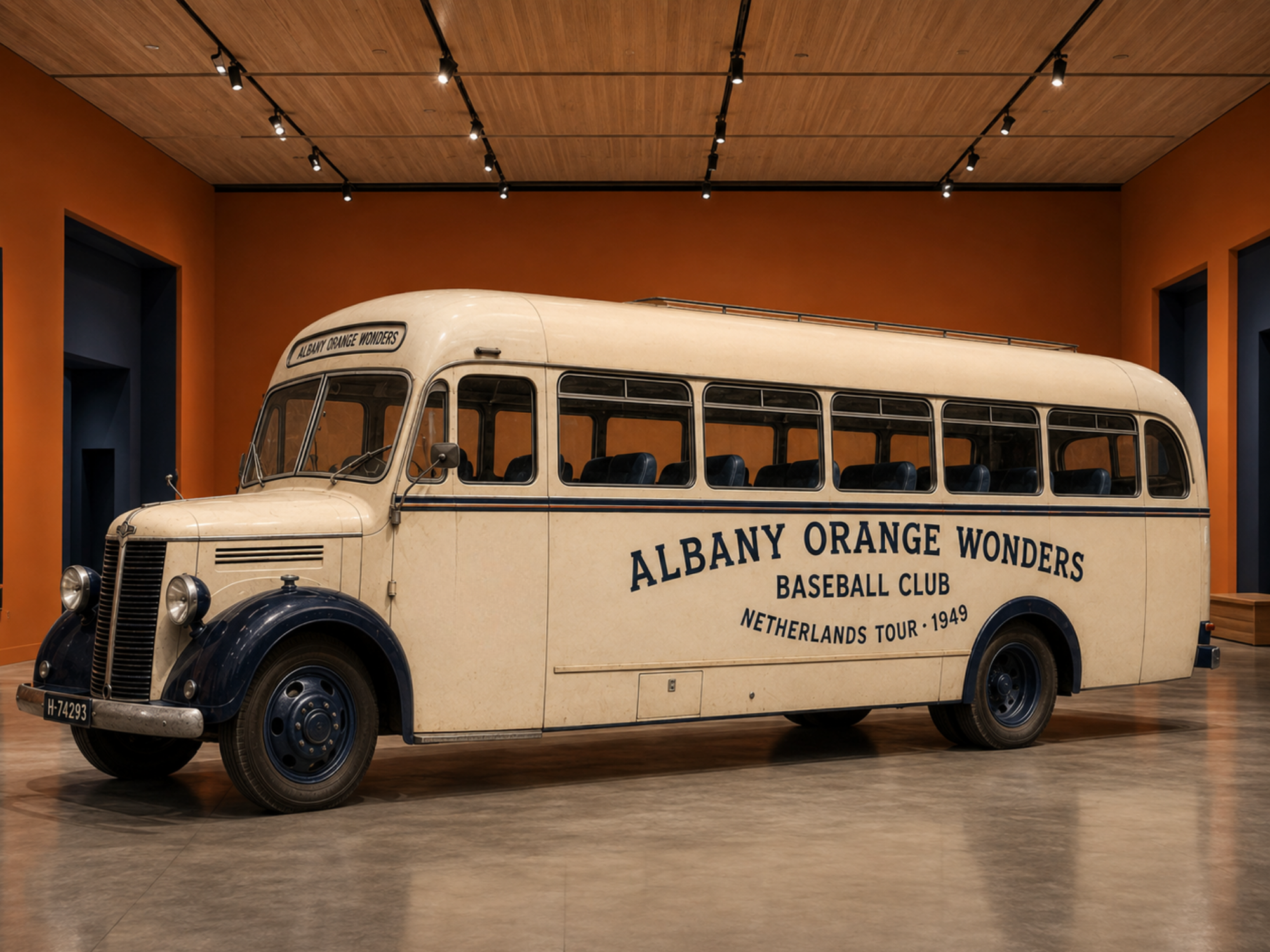
The Netherlands Tour Bus
Museum Display · c. 1949
The Orange Wonders’ touring coach carried the Albany delegation between appearances and games in Rotterdam, Haarlem and Nijmegen. Preserved in its cream, Dutch navy and orange livery, the bus retains the club lettering and tulip-over-baseball emblem that made a practical vehicle one of the 1949 tour’s most visible symbols.
-
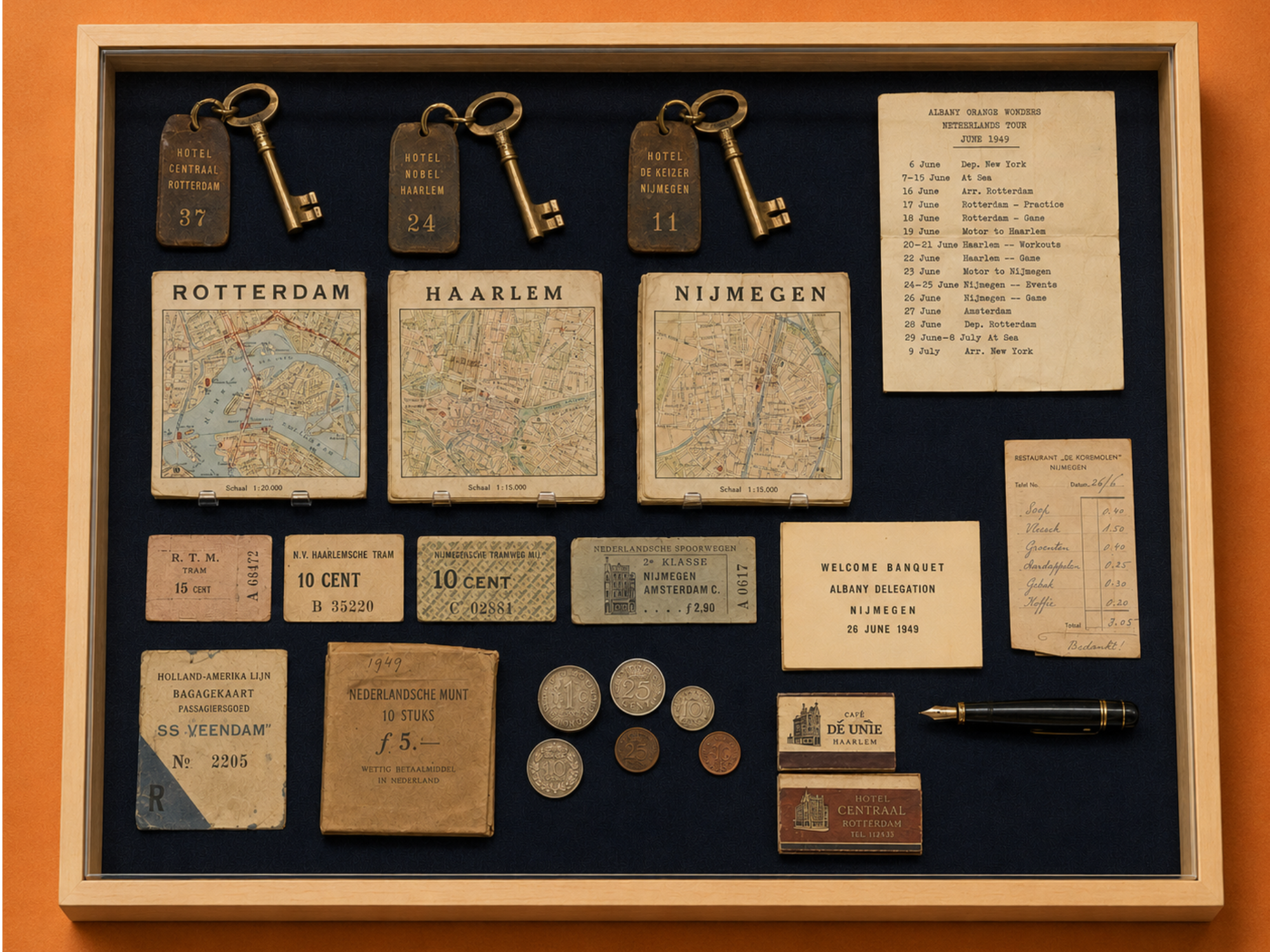
![A blonde-wood museum vitrine containing three brass hotel keys, maps of Rotterdam, Haarlem and Nijmegen, a 1949 tour itinerary, tickets, a banquet invitation, receipts, Dutch coins, matchbooks and a fountain pen on dark navy fabric.]()
The Tour in Their Pockets
Museum Display · c. 1949
Hotel keys, city maps, tram tickets, receipts and other small keepsakes trace the Orange Wonders’ passage through Rotterdam, Haarlem and Nijmegen. Preserved with the delegation’s itinerary, the objects record the tour at its most personal scale: rooms occupied, meals taken, fares paid and dates carefully kept.
-
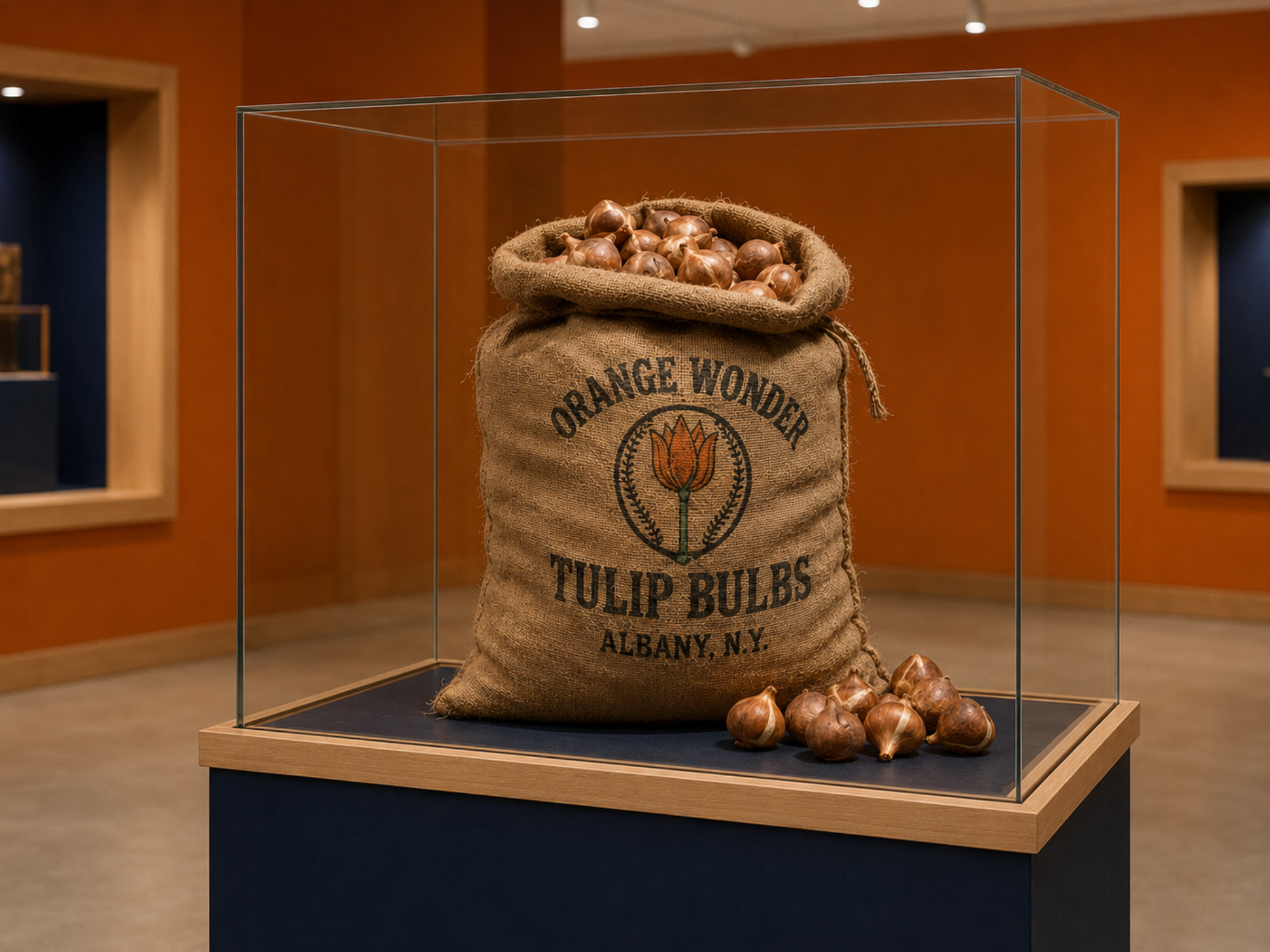
![A sack of Orange Wonder tulip bulbs, representing the bulbs presented to the team delegation before departing the Netherlands for New York.]()
Orange Wonder Bulbs for the Homeward Passage
Museum Display · c. 1949
Before the Albany delegation sailed home, Dutch hosts presented it with a sack of Orange Wonder tulip bulbs. The gift completed the exchange in miniature: Albany had crossed the Atlantic in answer to a flower, and the flower traveled home with the players.
-
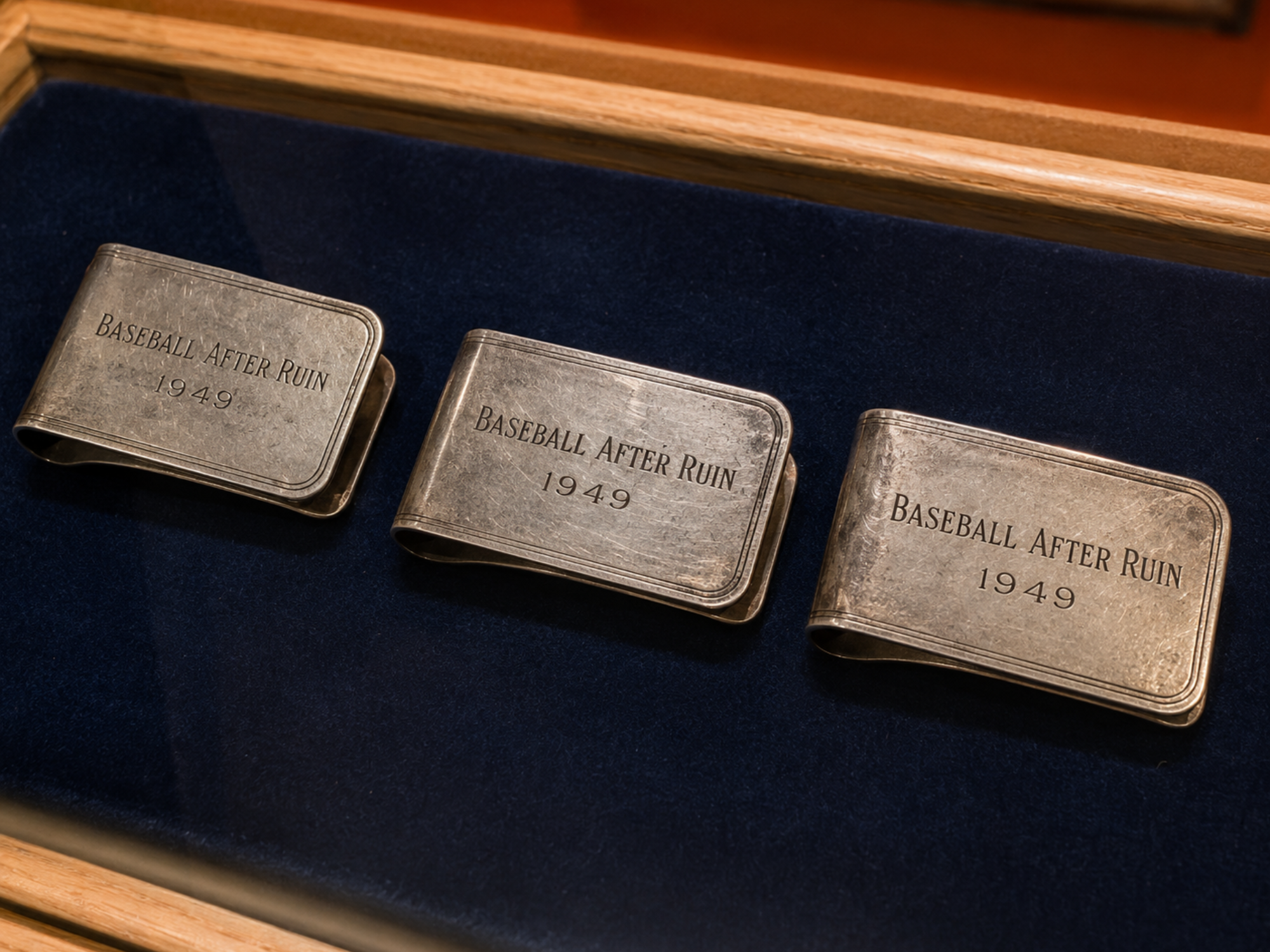
![Three worn silver money clips engraved “Baseball After Ruin” and “1949” rest on Dutch navy velvet inside a blonde-wood museum case.]()
Departure Money Clips
Museum Display · c. 1949
Each member of the Albany delegation received an engraved sterling-silver money clip before leaving Albany in June 1949. Marked BASEBALL AFTER RUIN and dated 1949, the clips were intended as formal presentation pieces but soon became personal objects. Fine scratches, rubbed edges and tarnish distinguish one recipient’s clip from another.
-
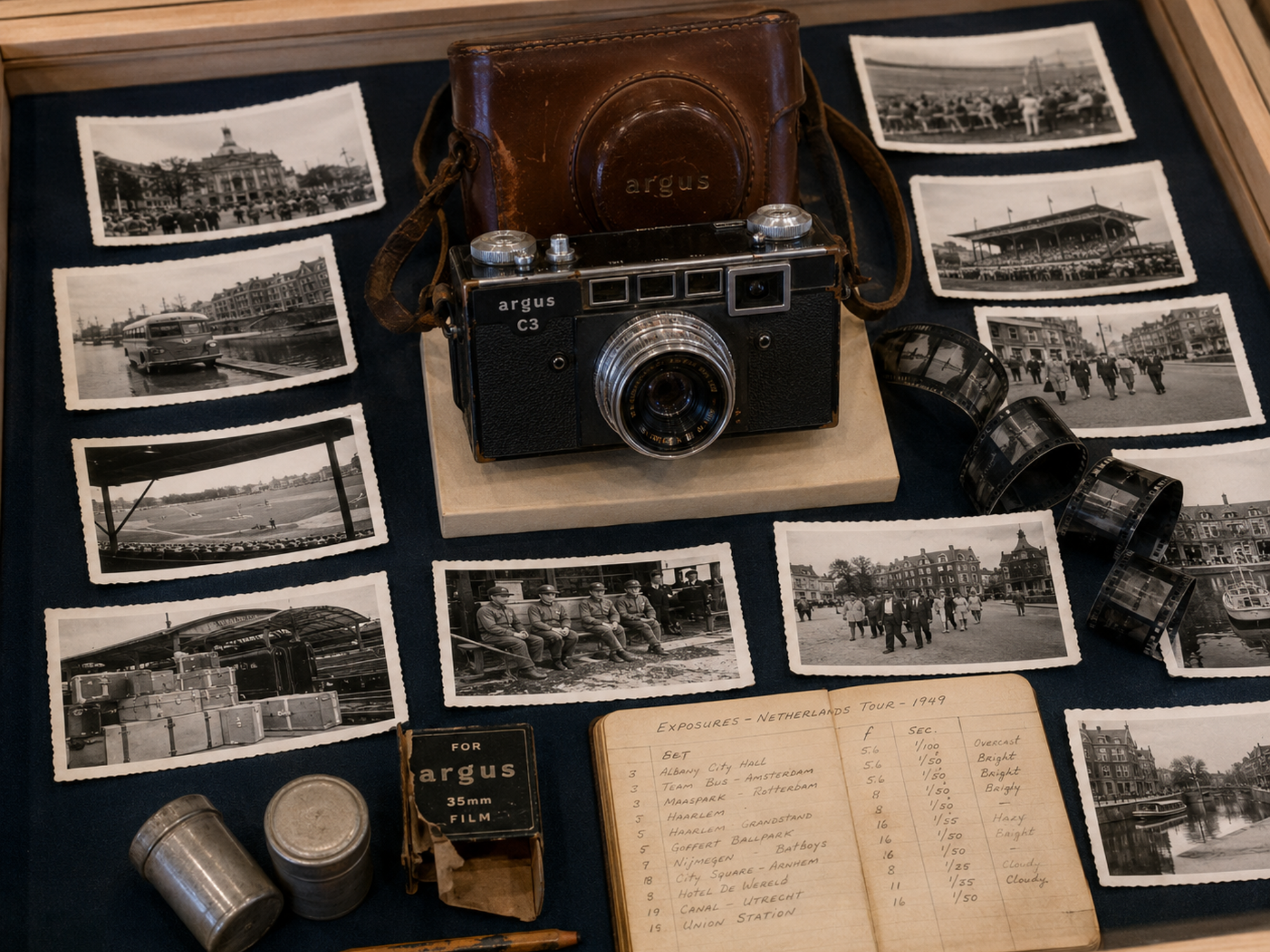
![An Argus C3 camera and its leather case displayed in a blonde-wood museum vitrine, surrounded by black-and-white travel photographs, contact strips, film canisters, a film box, an exposure notebook and a pencil.]()
A Player’s View of Holland
Museum Display · c. 1949
An Argus C3 camera is displayed among contact strips and black-and-white snapshots made during the 1949 tour. The informal photographs of crowds, ballparks, baggage and teammates between games preserve the journey as one player encountered it, beyond the official ceremonies and newspaper record.
ARCHIVAL RECORD
Albany Orange Wonders
Complete Club Register Entry
The following entry consolidates the known organizational, competitive and material record of the Albany Orange Wonders. It is preserved as supporting documentation for Gallery 002.
Club Record
| Club | Albany Orange Wonders Baseball Club |
|---|---|
| Location | Albany, New York |
| Established | Winter 1948 |
| Years Active | 1949 |
| Operations Concluded | 1949, following the Netherlands tour |
| Classification | Independent veteran touring club |
| Club Type | Civic goodwill club created for an overseas series |
| League | None |
| Official Opponent | Albany Nassau Blues |
| Official Games | Three |
| Home Games in Albany | None |
| Official Record | 2–1 |
| Series Finish | First; defeated the Nassau Blues two games to one |
| Home Park | None; official games were played at Maaspark, Spaarne Honkbalpark and Goffert Ballpark |
| Tour Attendance | More than 54,000 across three games |
| Club Colors | Orange Wonder orange, scarlet, Dutch navy and cream |
| Field Uniform | Plain cream wool-flannel jersey and trousers with notched Dutch navy ALBANY lettering, Dutch navy back numerals, orange stockings and a tulip-over-baseball sleeve patch |
| Uniform Program | One field uniform throughout the Netherlands tour; no home or travel designation |
| Cap | Cream wool crown with a Dutch navy bill and Orange Wonder orange seam piping |
| Primary Cap Mark | Dutch navy notched A crossed by a small orange-and-scarlet tulip stem |
| Uniform Mark | Orange-and-scarlet Orange Wonder tulip set over a stitched baseball |
| Dugout Jacket | Lightweight Dutch navy cotton shell with cream collar and knit trim, narrow orange cuff and waistband lines, and orange notched ALBANY lettering across the chest |
| Official Mascot | None |
| Common Shortened Name | The Wonders |
| Informal Nickname | The Veteran Nine |
| Club Motto | Baseball After Ruin. |
| Cap Mark Adopted | March 1949 |
| Uniform Patch Adopted | March 1949 |
| Motto First Used | June 1949 tour program |
| Club President and Tour Chairman | Edward J. McNulty |
| Manager | Harold “Hal” Ten Eyck |
| Club Captain | Abraham “Abe” Van Alstyne, second baseman |
| Best-Known Rival | Albany Nassau Blues |
| Pennants and League Titles | None; the club did not participate in league competition |
| Defining Result | 1949 Orange Wonder Veteran Series winners |
| Recordkeeping Note | Only the three Dutch series games were entered as official contests; clinics, shared practices, civic appearances and batting demonstrations were recorded as tour activity |
The Netherlands Tour
Complete Travel and Series Record
| Departure Port | New York |
|---|---|
| Ship | S.S. Waterman |
| Sailing Date | June 6, 1949 |
| Arrival Port | Rotterdam |
| Arrival Date | June 16, 1949 |
| Tour Cities | Rotterdam, Haarlem and Nijmegen |
| Rotterdam Game | June 18, 1949; Nassau Blues 5, Orange Wonders 3 |
| Rotterdam Attendance | Approximately 14,000 |
| Haarlem Game | June 22, 1949; Orange Wonders 4, Nassau Blues 2 |
| Haarlem Attendance | Approximately 17,000 |
| Nijmegen Game | June 26, 1949; Orange Wonders 3, Nassau Blues 1 |
| Nijmegen Attendance | More than 23,000 |
| Return Ship | S.S. Veendam |
| Return Sailing Date | June 29, 1949 |
| Return Arrival | New York, July 9, 1949 |
| Total Series Attendance | More than 54,000 |
| Series Result | Orange Wonders defeated the Nassau Blues, two games to one |
| Leading Pitcher | Joseph Picard, 1–0 with a complete-game victory in Nijmegen |
| Other Winning Pitcher | Daniel O’Rourke, Game Two victory at Haarlem |
| Leading Hitter | Gabriel “Gabe” Marro, .455 |
| Runs Batted In Leader | Abraham “Abe” Van Alstyne, 4 |
| Deciding-Game Hit | Van Alstyne’s two-run single in the sixth inning |
| Public Workouts | Public workouts were held at all three stops; attendance across the tour numbered in the thousands |
| Media Coverage | Daily newspaper coverage and radio reports from all three cities; the Nijmegen finale was broadcast nationally in full |
| Pregame Custom | An Orange Wonder tulip or small bouquet was placed near home plate before the lineups were exchanged |
| Postgame Exchange | Players signed scorecards, exchanged addresses and left selected bats, balls, gloves and catcher’s equipment with Dutch hosts |
| Presentation Piece | Orange Wonder Cup, retained in Nijmegen |
| Series Status | Albany-commissioned veteran goodwill series; no league office or professional circuit recognized the result |
The Three Dutch Grounds
Complete Field and Operations Record
| Rotterdam Ballpark | Maaspark |
|---|---|
| Rotterdam Setting | Formal municipal ballpark within a larger athletic ground south of the city center |
| Rotterdam Architecture | Broad brick entrance, roofed timber grandstand, foul-line terraces, deep green outfield wall and manual scoreboard |
| Rotterdam Expanded Capacity | Approximately 14,000 |
| Rotterdam Attendance | Approximately 14,000 |
| Haarlem Ballpark | Spaarne Honkbalpark |
| Haarlem Setting | Established municipal honkbal park with an enclosed neighborhood-ballpark character |
| Haarlem Architecture | Dark-green timber grandstand, brick clubrooms, roofed infield seating, foul-line terraces and a tall manual scoreboard |
| Haarlem Expanded Capacity | Approximately 17,000 |
| Haarlem Attendance | Approximately 17,000 |
| Nijmegen Ballpark | Goffert Ballpark |
| Nijmegen Setting | Landscaped civic ballpark near Goffert Park, approached through lawns and formal flower beds |
| Nijmegen Architecture | Pale-brick entrance building, broad covered grandstand, matching foul-line stands and a flower-lined presentation platform |
| Nijmegen Expanded Capacity | More than 23,000, including added stands and overflow areas |
| Nijmegen Attendance | More than 23,000 |
| Clubhouses | Separate permanent dressing rooms beneath the grandstands for both Albany clubs |
| Field Preparation | Mounds and base paths adjusted to American measurements; playing surfaces maintained by local grounds crews |
| Lighting | None used for the series; all three games were completed in afternoon daylight |
| Scoring | Hand-kept by Albany and Dutch scorers working together at each park |
| Press and Radio | Dedicated press seating at all three parks; radio reports throughout the series and a full national broadcast from Nijmegen |
| Equipment Storage | Painted Albany trunks housed within the clubhouses and moved directly to the dugouts before each game |
| Concessions | Coffee, lemonade, beer, sausage rolls, bread, cheese, apples, peanuts and paper-wrapped sandwiches |
| Public Amenities | Ticket offices, public restrooms, first-aid rooms, bicycle checks and staffed tram and rail information tables |
| Tour Presentation | Dutch and American flags, Orange Wonder flower displays, bilingual programs and tour emblems throughout each park |
| Later Use | All three ballparks returned to their established municipal and club schedules after the tour |
MUSEUM SHOP · GALLERY 002
Take a Piece of the Exhibition Home
Coming soon.